
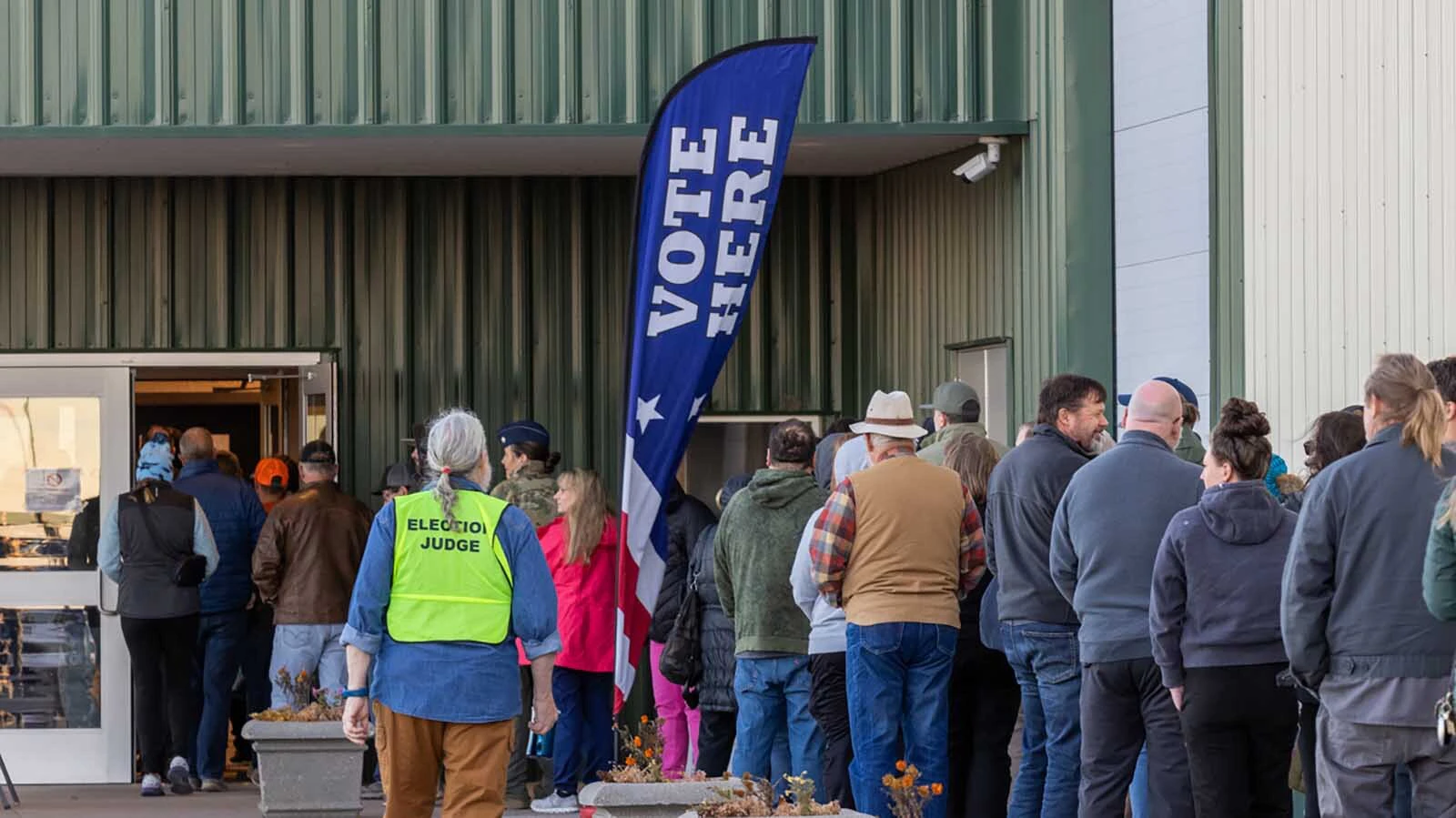
Wyoming’s political registration data isn't seeing huge changes yet, despite a push from some politicos to register Republican to participate in the generally more decisive GOP primary election.
All Wyoming parties have shrunk in registered membership from January to May.
But the GOP gained in overall percentage overall, while all other parties lost in terms of percentage of the whole.
In January, Wyoming had 31,478 registered Democrats, or 11.56% of the registered voters in the state. It had 210,214 Republicans, or 77.2%.
Plus, the state showed 549 Constitution Party registrants (0.2%), 1,792 Libertarians (0.66%), 25,948 unaffiliated registrants (9.5%) and 2,348 “other” registrants (0.86%).
All parties saw steady decreases in the four months since, as voter registration dropped by 1,404 total.
But the GOP gained in dominance in terms of percentage of the whole, up to 77.4%, while the Democratic Party lost the most percentage-wise, down to 11.4%.
Libertarians, unaffiliated and “other” voters posted negligible losses in terms of percentage of the whole.
The Wyoming Democratic Party’s spokeswoman Mandy Weaver said those numbers don’t reflect crossover voting, or people changing party affiliation to vote in another party's primary. In Wyoming, that's typically switing to Republican.
Crossover voting has been a hot topic in Wyoming since at least 2018, when some politicos theorized the more moderate Republican Gov. Mark Gordon defeated second-place challenger Foster Friess with the help of crossover Democrats in the primary election.
That GOP specter surfaced again ahead of U.S. Rep. Liz Cheney’s last electoral run in 2022, but it didn’t matter in the end. U.S. Rep. Harriet Hageman demolished Cheney by about 37 percentage points.
Weaver said the Democratic Party’s data director, Erin O'Doherty, doesn’t conclude this year’s shifts are crossover registrants, because the GOP doesn’t have the gains, numbers-wise, to account for the Democrats’ losses.
“She’s not seeing a correlating increase in Republican registration,” said Weaver. “That’s how she measures it.”
The Democratic Party lost 558 registrants since January. Weaver said 270 of those died or moved away.
Wyoming Republican Party Chair Bryan Miller, who said he was in business calls Monday afternoon, did not furnish a comment by publication.
Wyoming state law defines "major political party" as organizations able to secure at least 10% of the total votes cast in either the U.S. House of Representatives, U.S. Senate, governor or secretary of state's race in the general election.
Though its registration figures are close to that line, the vote cast is what matters, and the Wyoming Democratic Party achieved that threshold easily in 2024. For example, its U.S. Senate candidate won 23.5% of the vote.
Into The Numbers
Few Wyomingites have run as much election data as Gail Symons, president of Civics 307 and a Cowboy State Daily columnist.
She didn’t see any crossover in this year’s voter registration data either.
But since people have until May 13 to change their party affiliation before a 2023 state law bars them from changing it, Symons said no one will know whether there was a crossover wave until at least June 1.
Symons garnered controversy by urging people to vote in the primary election, in an April 5 column.
“Putting partisan loyalty aside for a moment,” she wrote, “the numbers say that unless you live in Teton or Albany County, or you hold strong Democratic convictions, registering Republican and voting in the Republican primary election gives you the greatest opportunity to influence who governs Wyoming.”
The Wyoming Democratic Party pushed back five days later to discourage the practice.
Symons clarified in a Monday interview, saying her call for GOP registration was geared more toward the unaffiliated crowd.
The unaffiliated category has lost 346 voters since January.
“Most of us are looking at being more concerned about people who lose their ability to participate because they did not select a major party when they registered to vote,” said Symons.
People who live within city limits may see nonpartisan elections on their primary election ballots, but only the major parties will see candidates from either side in partisan offices at that election.
All five Wyoming statewide elected officials are GOP right now. So too are all three of the state’s Congressional delegates and 91% of the state Legislature.
Symons said that crossover in Wyoming is rarer than people think, if they’re thinking of it as Democrats who cross over to Republican then switch back to Democrat.
It’s much likelier for people to pick a party and stay there, said Symons.
“Ironically the group that did it the most was unaffiliated to Republican, followed by Republican to Democrat,” said Symons. “This changing and then changing back was very, very low… The Democrat to Republican was the third-highest, not the highest.”
But anecdotally, Symons added, she has heard from Democrats in her county of Sheridan who are switching to Republican to vote against Rep. Ken Pendergraft, a Republican member of the Wyoming Freedom Caucus who is running this year for state Senate against Ranchester businesswoman Melissa Butcher.
‘Wyoming Needs You’
Rep. Tom Kelly, R- Sheridan, urged this week against letting Wyoming become a one-party state, but said it’s “dangerously close” to that.
In a Monday phone interview, Kelly, who’s also a candidate for State Superintendent of Public Instruction, described himself as a Venn diagram between the GOP’s populist and Libertarian-leaning wings.
In his post he wrote, “2026 has seen a large push for Democrats to raid the Republican primary in an attempt to get the least conservative candidates elected.”
“So, I’ll say this again, as a political scientist and father with children living in Wyoming, not as a candidate for office,” wrote Kelly. “All of us are better off with a functioning opposition party. Single party states are breeding grounds for corruption and waste, regardless of the platform of the party in power.”
Kelly theorized that open primary elections, rather than the partisan primaries Wyoming now has, would not help the problem, but that the state would “careen” more toward one-party dominance.
“My hat is off to those stepping up to run as Democrats this year,” he wrote. “Even though we disagree on policy choices, I recognize how much Wyoming needs you.”
‘Purists’
Rep. Karlee Provenza, D-Laramie, added to the crossover conversation in an April 30 WyoFile column, saying people should be able to vote in whichever primary election they want.
She told Cowboy State Daily in a Monday interview that some people have to switch parties because the system is broken.
A Democrat in Powell, Wyoming, for example, will have little sway over who represents her because the legislative seats are firmly red, she noted.
Provenza derided a Wyoming law passed in 2023 that bans people from switching parties between the first day of candidate registration and the primary election date.
That law forces people to make choices without data, said Provenza, since they won’t see who has officially registered for a seat until the registration period closes days later.
“There’s a law passed that suppressed voters from making informed decisions and you might have people that are party purists, who say only the people in this party, who share the same platform, should make those decisions,” she said. “But I think most people in Wyoming just want to have a say in who their representatives are.”
Worked As Intended
Kelly sees that issue differently.
“Just in general, I’m just not a fan of people looking to game the system,” he said. “And I think that’s kind of what you’re doing when you agree with the Democratic platform, and you want to raid the other party’s platform to weaken them.”
He added: “I understand that’s legal. It just doesn’t seem honest.”
One day before the crossover ban became law, Wyoming Republicans held 82% of the whole, of party registrants, and Democrats held 10.6%.
That means the GOP was even more prevalent that year and the Democratic Party was even less so.
A point-of-the-year comparison yields the same contrast from then to now, as the May 2023 figures were close to the march figures.
To Kelly, “That sounds like the law worked as intended — to get people to register as the party they’re more ideologically aligned with.
Weaver produced a different theory for why the Republican Party has shrunk, proportion-wise since then.
Perhaps “it means (the voters) don’t want people to tell them what to do and they’re tired of the little games,” said Weaver. “That’s how it feels to me.”
Clair McFarland can be reached at clair@cowboystatedaily.com.


