
People are blaming the Wyoming Freedom Caucus for the Wyoming Legislature’s nearly $4 billion per-biennium school spending package.
Whether that’s justified depends on whom you ask. So does the question of whether giving credit is more appropriate than giving blame for the court-ordered, long-overdue spending plan.
On the one hand, the Wyoming Freedom Caucus’ former chair, speaking on behalf of the caucus, took credit for the package after it became law.
On the other hand, the spending plan itself contains a mix of favored and hated provisions, and it’s often misunderstood.
“Now, to say this was a bill that was brought forward by a small caucus — it can’t be,” said state House Majority Floor Leader Scott Heiner, R-Green River, during a virtual townhall meeting Wednesday evening. “Because it was overwhelmingly supported by all the legislators, except for seven (in the House).”
Heiner co-chairs the committee that built the first draft of the spending package: the Select Committee on School Finance Recalibration.
In Wyoming, “recalibration” refers to an arduous process in which lawmakers reevaluate what public K-12 education costs, hear consultant recommendations and public comment, and rewrite the state’s mechanism for funding public schools.
“(The package) had overwhelming support not only from the Republicans, but Democrats — and everyone in the Legislature,” Heiner added.
His assessment is correct.
The Blame
Yet, when a Wyoming High School Activities Association (WHSAA) press release warned of potential cuts to school activities, many in the public criticized the Freedom Caucus.
“The Freedom Caucus was able to take a deadly shot at the heart of high school activities and athletics by cutting the budget by 8.4 percent,” wrote columnist and reporter Randy Tucker in a May 11 column for Fremont County-based outlet County10.
The “impending funding shortfall in activities and academics,” Tucker added, “will be disastrous and arrive very soon, just a few months from now.”
Under Casper-based Republican Rep. Elissa Cambpell’s Facebook re-post of the WHSAA statement, the commenters wrote things like:
• “You voted the Freedom Caucus in, and now you’ll have a hell of a time getting them out,”
• “#freedomcaucusstealingfreedom,”
• “This catastrophe is brought to you by the voters blindly following the freeDumb caucus candidates and MAGA cult.”
Tucker told Cowboy State Daily in a Thursday phone interview that he felt comfortable blaming the caucus because its members or allies chair multiple House committees.
Heiner chairs the House side of the recalibration committee. Rep. Ocean Andrew, R-Laramie, who often votes with the caucus but told Cowboy State Daily he’s not a member, chairs the House Education Committee.
“The Freedom Caucus was pretty good at getting themselves into committee chairmanships and so forth,” said Tucker.
The columnist also cast the caucus’ uncertain membership roster, group statements, and frequent bloc voting as measures that obfuscate real debate and problem-solving.
“It’s a collective thing,” he said.
The Credit
The caucus on March 5 issued a statement calling the recalibration bill “a win” for students and teachers, and proof that “conservatives can govern.”
“We did what the Insiders have failed to do for 15 years by passing a strong school finance bill,” says the statement.
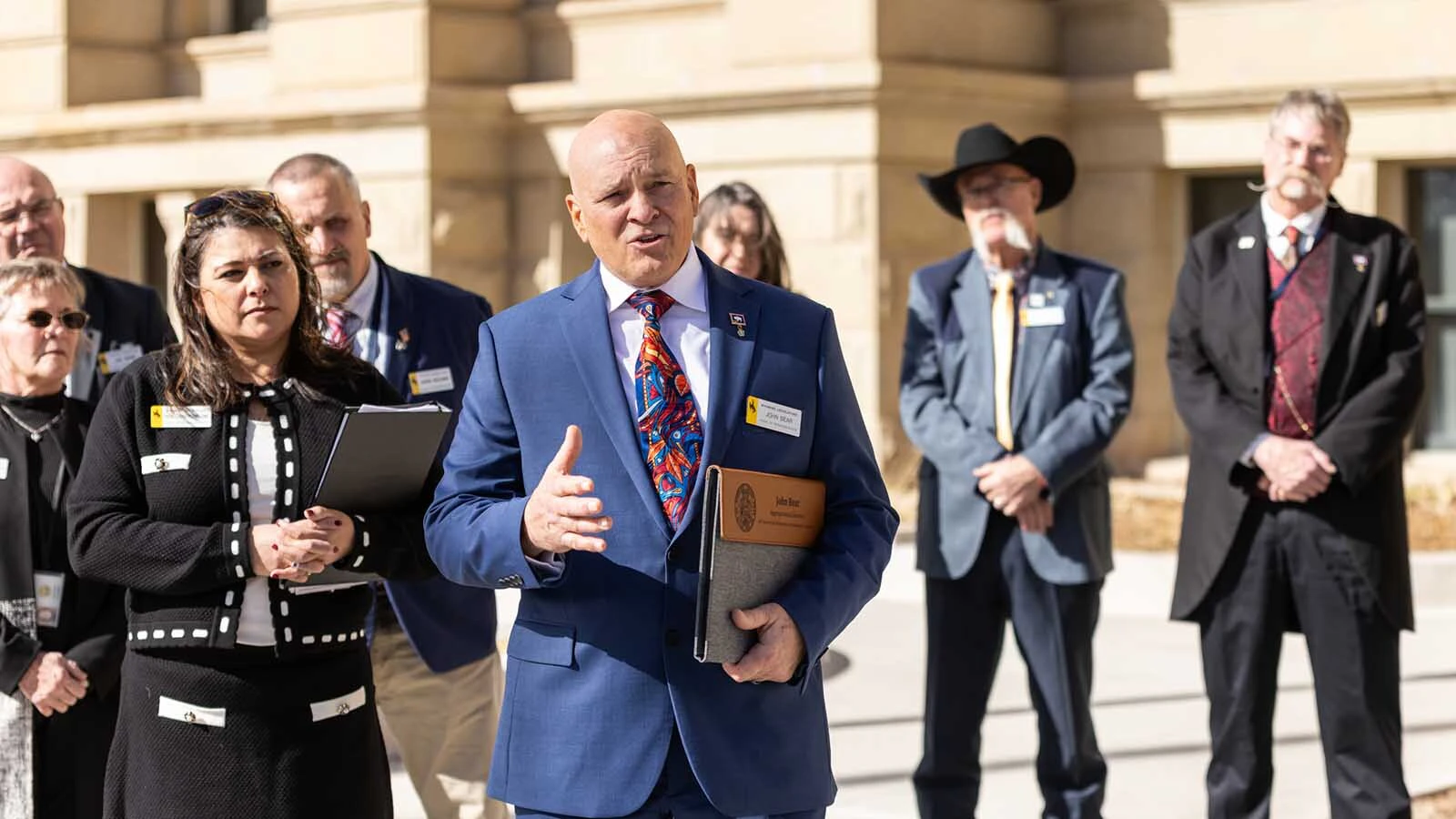
Former caucus chair, and current member Rep. John Bear, R-Gillette, took credit on the caucus’ behalf in an April 17 guest column for Cowboy State Daily.
“We passed a historic school finance bill that locks state dollars in the classroom, providing double-digit pay increases for teachers and expanding CTE and dual enrollment opportunities for Wyoming kids,” says the column. “Who wouldn’t want to ensure tax money actually funds teachers and students?”
That was about three weeks before the WHSAA statement and other public discourse sparked outrage and fear of gutted activities – stemming from what lawmakers called bugs in the package that they intend to fix.
But, popular blame notwithstanding, Bear maintained his position in a Thursday phone interview with Cowboy State Daily.
“It’s certainly something the entire Legislature did, but we led the effort,” said Bear. “The criticisms about what is going on the bill are, you know, hyperbolic, first of all. A lot of moving parts.”
Also, Bear noted, recalibrators have pledged since January to keep researching and tweaking the package in the coming months, to address additional funding requirements a court ordered in 2025.
This year’s recalibration package is the largest in Wyoming history, Heiner said during the Wednesday townhall.
Bear said the caucus has stayed mindful of its conservative principles, but still had an obligation to help build the spending plan. Law requires the Legislature recalibrate K-12 funding at least every five years. Until March, it hadn’t done it in at least 15 years.
The new funding model increases K-12 money for the coming school year by about by approximately $114.1 million, or 8.6%. That equates to about $1.95 billion per school year or nearly $4 billion per biennium - and about $22,626 per-student, per year.
The state is increasing its recommended salaries for teachers by an estimated 20.7%. It's adding about 260 teacher positions.
“It’s about leadership, when it comes to getting things accomplished,” Bear said.
The Facts
Three of the 12 members of the recalibration committee, including Heiner, are also known members of the Wyoming Freedom Caucus – a controversial and conservative group of House Republicans.
Two Democrats and 10 Republicans serve on the committee altogether.
All 12 members voted in January to advance the recalibration package.
The House killed it Feb. 9, by voting 41-21 in favor of its introduction. That’s one vote shy of the two-thirds threshold required to introduce non-budget bills in even-numbered years.
The state Senate rescued the package with a unanimous introductory vote four days later.
Sen. Chris Rothfuss, D-Laramie, a key architect of the package, added both extra dollars and extra accountability measures to the package during a Senate Education Committee the following week.
The Senate voted 30-1 to send the package to the House, which generally kept Rothfuss’ changes and passed the bill 52-7.
The seven nay-votes came from non-Freedom Caucus Republicans. The five chamber Democrats who were present (out of six total in the House) voted aye.
Rather than veto or sign the package, Gov. Mark Gordon let it become law without his signature.
Money for school sports and activities is now expected to drop from $46.3 million to $42.4 million per school year.
Dropping enrollment is a factor driving that.
So too is the educational “silo.” That’s a provision banning districts from using money for classroom educators in other areas, like equipment, administration – or activities.
It follows what some recalibrators have described as a decade of complaints, that districts can’t pay and hire teachers well enough.
House Speaker Chip Neiman, R-Hulett, told Cowboy State Daily the state has seen too many dollars meant to address those complaints go “sideways” into other areas. The silo is exposing more of those maneuvers, and has brought compliments from many teachers, he added.
The Wyoming Education Association sued the state over K-12 funding shortages, and the judge who ordered better funding said the schools had shown their educators are underfunded.
"Why you spending so much on activities?" asked Neiman in a Thursday rhetorical. "If you don’t have enough money to hire teachers; then put the money there."
The silo was response to "getting sued and losing," as well as the prevailing concerns of the past several years, he added.
Everybody Calm Down
Rep. Tom Kelly, R-Sheridan, often votes with the Freedom Caucus, but has said he’s not a member of it and has contradicted caucus members on some efforts.
He’s also a member of the recalibration committee.
Kelly took to Facebook May 15 to address the “consternation” around the drop in activities funding, and to attribute the drop to declining enrollment – since activities are funded on a per-student basis.
Heiner told Cowboy State Daily earlier this month that, while enrollment is a factor, the state also adopted its consultant’s new formula for activities funding, and intends to reevaluate that formula the coming months.
Kelly’s statement continues: “As far as a public announcement warning that school activities are about to be cut, that is a political tactic that I don’t really like.”
He said he saw similar tactics in Illinois, geared toward taking policy hiccups “out on the kids” to “start a public uproar rather than start a productive conversation.”
In the meantime, Heiner and Neiman have all urged the districts to tap into their reserves as necessary – some of which are sizable – while lawmakers address activities funding in the coming months.
Rothfuss has also pledged to address the issue in the coming months.
As for whose credit or blame the spending package tallies, Rothfuss said lawmakers should focus less on taking credit, and more on “just trying to help people.”
Wait, What?
While the activities money and the teacher silo have met with controversy, three mental health groups say some districts are responding altogether contrary to the package’s mission.
The Wyoming Behavioral Health Alliance and its members the Wyoming Counseling Association and Wyoming School Counseling Association dispatched a joint press release Tuesday, voicing “deep” concern over “reports across the state that some Wyoming school districts are using recalibration changes as justification for reducing or eliminating school counselor positions.”
The package, however, increased money for school counselors in every grade group.
“For the first time in Wyoming history, the Legislature specifically recognized the critical role of school counseling and funded positions adequately, including positions at the elementary level in addition to continued support across secondary levels,” says the statement. “The bill reflects a clear legislative acknowledgment that student mental health, prevention services, academic planning, and social-emotional support are essential components of a complete and uniform public education system.”
The groups concluded by urging districts and educational leaders to preserve those jobs, and implement the bill “as intended.”
Clair McFarland can be reached at clair@cowboystatedaily.com.


