
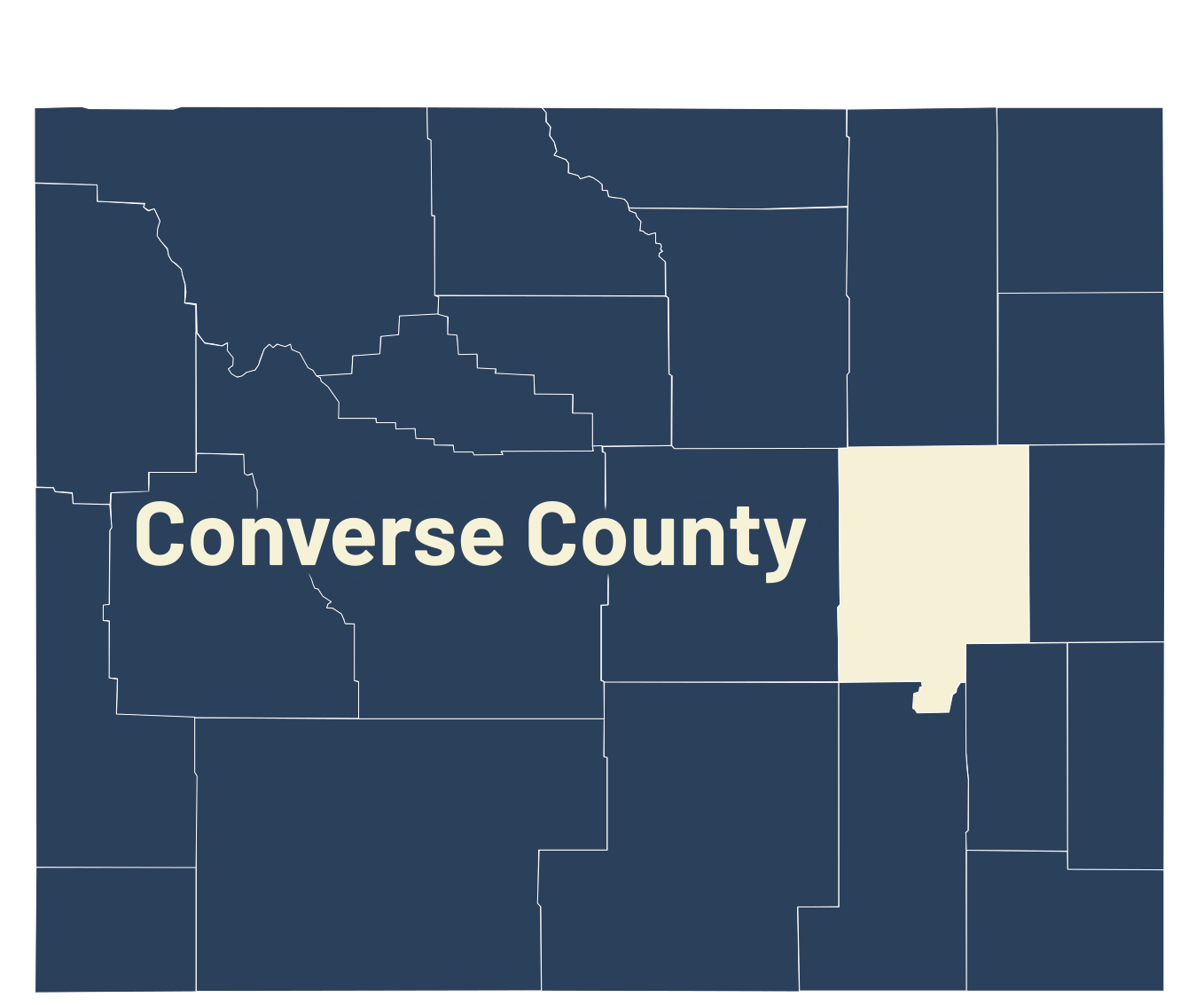
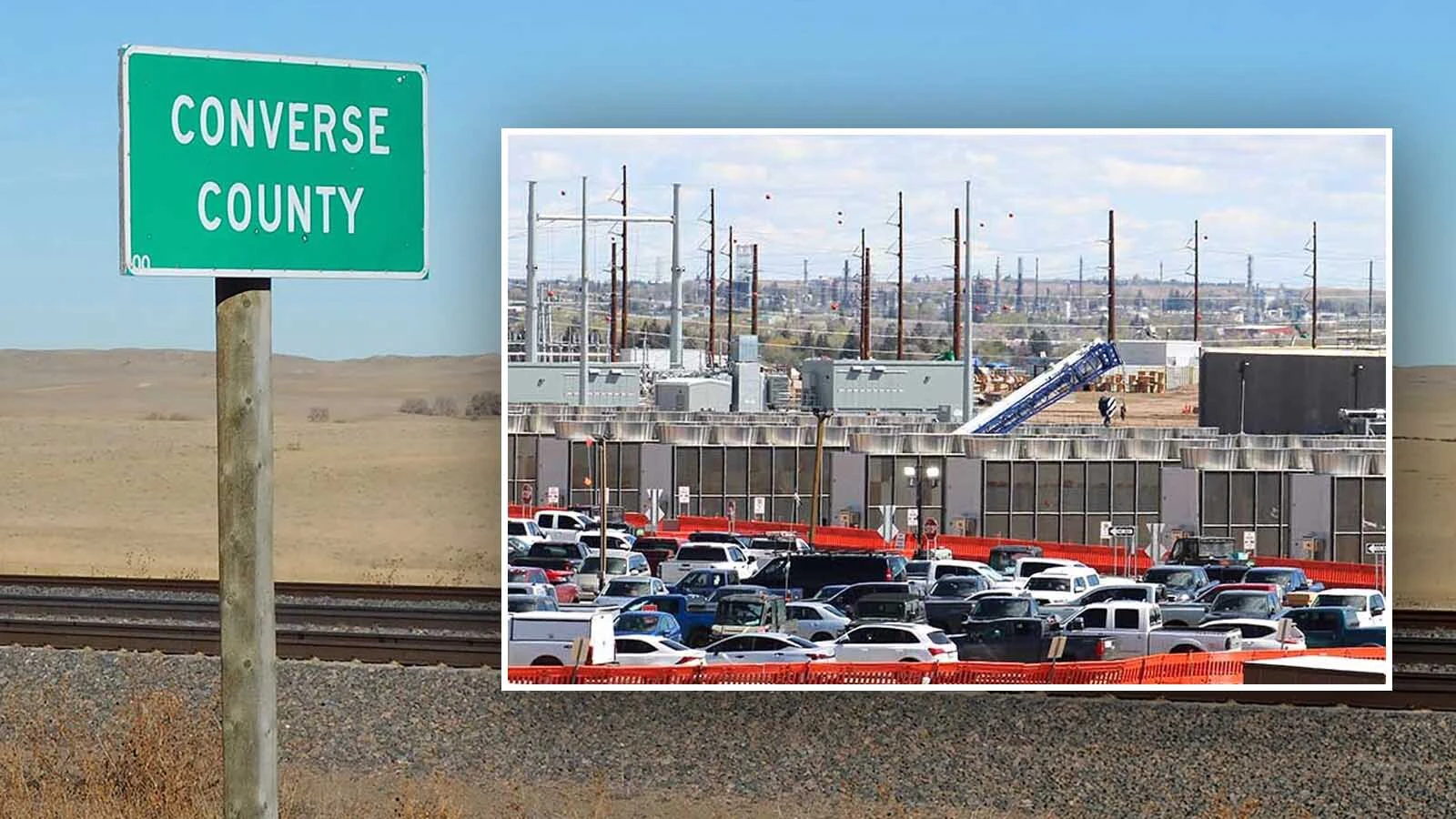
Converse County government has rescinded an earlier order that, according to commissioners, could have both fast-tracked data center development and given the county more say in the process.
The Converse County Commission on April 21 passed a resolution authorizing a more-than 140-acre industrial park near the county line.
On Tuesday, the body reversed course, rescinding the move after the Wyoming Attorney General's office reportedly said counties without zoning provisions can't use that fast-track mechanism.
Public outcry surfaced in the four weeks between the two votes.
The commission’s April 21 resolution referenced a provision in state law that says if non-mineral processing facilities are built in existing industrial parks that local government designate, those facilities are exempt from the state Industrial Siting Division’s certification procedures.
The facilities would still have to furnish some information under the industrial park exemption, however.
The prospective industrial park wasn’t meant specifically for a Prometheus Hyperscale data center, Commission Vice-Chair Rick Grant told Cowboy State Daily on Thursday, and the county hasn’t received an application for any such development.
“Have we been in contact with them? Yes. They’ve reached out to us probably on a weekly basis, trying to figure out, ‘How do we do this, where do we go?'” said Grant.
He said data center developers are eyeing both Converse and Natrona counties, but Converse qualifies as an “opportunity zone,” meaning investors can receive credits for investing in development projects there.
That incentive for parking the project in Converse County was a “decision made outside of us, that we have to try and work with — and figure out how to do the best we can with,” said Grant.
Also, one data center may be a $20 billion investment into the community, he added.
State law hampers revenues for local services somewhat by exempting data centers from sales taxes, he said, but the county can still collect property taxes.
Grant said all five commissioners voted in favor of authorizing the industrial park.
Nope
But the Wyoming Attorney General’s Office advised against the move, says a Tuesday letter from Converse County Attorney Quentin Richardson to the commission.
Converse County doesn’t have land zoning mechanisms, meaning the county doesn’t dictate categorized land designations.
Grant said that interfered with the commission’s ability to make an industrial park to locate the data center.
Both Grant and Commission Chair Jim Willox told Cowboy State Daily that county residents have voiced clear resistance over the years to adopting a full zoning system.
“The Wyoming Attorney General believes that the County lacks specific authority to promulgate this resolution” under the Industrial Siting laws, Richardson’s letter says. “I concur.”
Instead, the AG advised that the county could craft industrial zones under the state laws authorizing subdivisions, the letter says.
“These statutes provide for extensive public notice and public input both from the Planning and Zoning Committee and the Board of County Commissioners,” it concludes.
The In-Between
Between the April 21 resolution authorizing the industrial park and the Tuesday resolution reversing it, “panic” erupted in the county, according to state Rep. Kevin Campbell, R-Glenrock.
Campbell’s phone rang constantly starting earlier this month, he said.
“You know how panic is,” Campbell said in a Thursday phone interview. “Everybody over on the county line and all those little communities throughout the Platte Valley, they heard ‘fast track’ and (the county was) going to bypass the Industrial Siting Act. Immediately people lost their minds.”
Campbell said he understands the idea of large developments entering the community through a regulatory fast-track has “got to be terrifying.”
Campbell issued a public letter about the controversy via Facebook on Monday.
“Because residents feel completely ignored and left in the dark, much of the public frustration has landed squarely on my lap,” said Campbell in the letter.
He clarified that state lawmakers don’t have control over county land zoning decisions.
“The community’s frustration is entirely justified, but the shifting maps and the total lack of public participation were directly caused by the Converse County Commissioners’ vote on April 21,” wrote Campbell.
Campbell called the rigorous Industrial Siting Council process for review a “safety net, forcing multibillion-dollar projects to show they won’t ravage communities, properties and local services.
With the resolution to bypass that process, Campbell said commissioners “deliberately exploited a statutory loophole … to turn that safety net off.”
He accused the county of waving through massive permits based on promises, not agreements.
Campbell said the Industrial Siting Act — the laws that govern the state’s environmental review of large industrial projects — is broken.
He told Cowboy State Daily he’s running for reelection with the hope of fixing it.
‘Spouting’
Grant said around half the points in Campbell’s letter are not factual.
“We have a representative who is spouting off the issues and has never come to talk to the commission about what we’re doing,” Grant said.
Grant gave an example.
Campbell’s letter said, “the headlong rush into mega-infrastructure projects without public involvement has plunged Converse County into embarrassing standoffs before,” then pointed to the “recent handling of the Pronghorn H2 clean energy project.”
That’s a 57,500-acre wind farm slated for state and private land in Converse County. The Wyoming Supreme Court is now considering whether the state was correct to authorize its lease for the project.
Grant called Campbell’s reference to the wind farm, which is a state project, a conflation.
“He’s trying to bring in other issues that aren’t ours,” said Grant. “It’s not our project.”
Campbell responded in his own interview Thursday, saying two counties sit within his district. He tries to keep up with both governments’ work, but the industrial park issue erupted quickly and he sought to address people’s fears just as quickly.
“Is it my job to keep track of every single thing the county commissioners do?” asked Campbell. “Perhaps they should send me an email saying, ‘Hey, we’re going to make a resolution to create an industrial sovereign zone, bypass state statute; is that cool?’”
Fast-Track
Grant said it’s not a bypass, but an exemption the Legislature passed creating a fast-track process — shorter than the potentially 18-month-long state process.
“But they (developers) would still have to answer certain questions and do certain studies in order to build,” Grant said, listing traffic, workforce, and economic studies as examples.
That’s still more minimal than the “in-depth type of study and report” the full Industrial Siting process requires, he added.
Grant also disputes Campbell’s transparency concerns. He said that the county does its business in public and dispatches public agendas before its meetings.
The public agenda for the April 21 meeting says the commission was to contemplate a resolution “Establishing a Process and Criteria for Designation of Industrial Parks for Purposes of an Industrial Siting Exemption Request Within Converse County.”
Neither the agenda nor the resolution hyperlinked within it use the words “data center.”
These Fears
The public conversation around data centers vacillates between people embracing them as revenue boons and people who fear they’ll ravage the environment, consume water, emit noise and sponge all the electricity.
“There’s a loud group in Glenrock that don’t like any new development to happen,” said Grant. “They think everything should be run off of coal, oil and gas, and that all this new development should go away.”
But development can still happen on private land, said Grant, adding, “And without zoning, we can’t control it.”
He said the county would be closely involved with questions around noise, dust, construction, road wear and other controversies as long as it’s using a mechanism that allows that kind of supervision.
New data centers are proposing to use a “closed loop” system which consumes less water, he continued.
And, said Grant, Wyoming is a sizable producer of natural gas and could feed the increased energy demand with its own resources.
Grant said using the state’s subdivision laws to authorize data centers, as Richardson’s letter suggests, limits the county and its ability to check large projects for the locals.
But, Grant acknowledged, he doesn’t know how big Prometheus’ proposed data center will be.
He said he’s heard multiple pitches as to size, and thinks the company is eyeing 250 acres, and an undetermined number of buildings.
“We just don’t know,” said Grant. “They’re not far enough along in their design yet.”
Willox, in his own interview, said that, “What the next steps look like are unclear at the moment.”
Prometheus Hyperscale did not respond to a request for comment by publication.
The Wyoming Attorney General did not respond by publication to a voicemail request for comment.
Clair McFarland can be reached at clair@cowboystatedaily.com.


