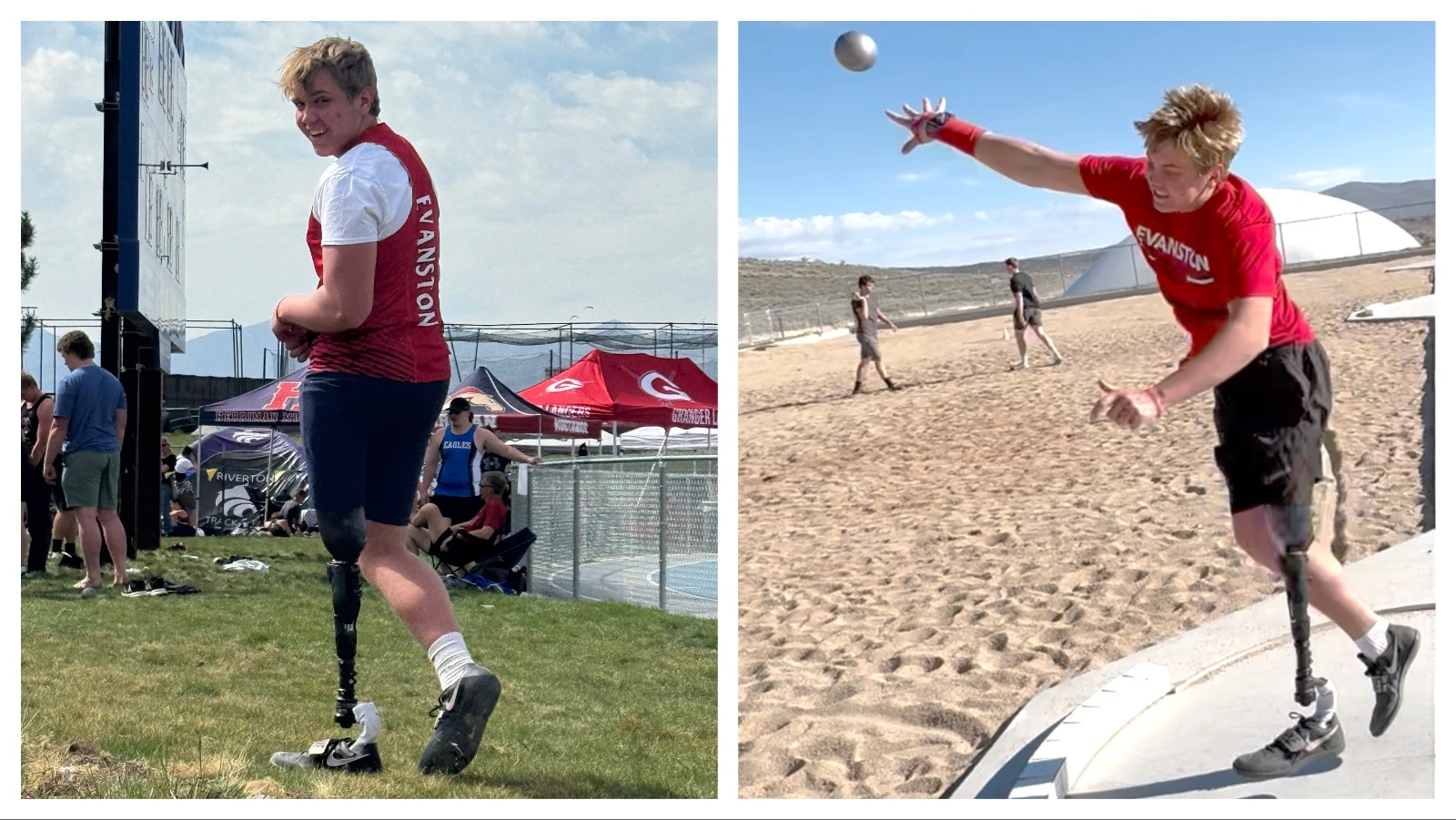
An Evanston High School junior who lost a leg to cancer at age 9 is racing toward a goal to become an elite athlete and one day represent the United States in the Paralympic Games.
Kutler Hill, now 18, heads for a track and field competition in Arizona for the Desert Challenge Games this week to throw the shot put and compete in the long jump.
He also plans to be part of the Angel City Games in Los Angeles in June, and possibly the nationals in New York in July.
Up to this point as a para-athlete, Hill hasn’t yet competed against another track athlete with a prosthetic leg.
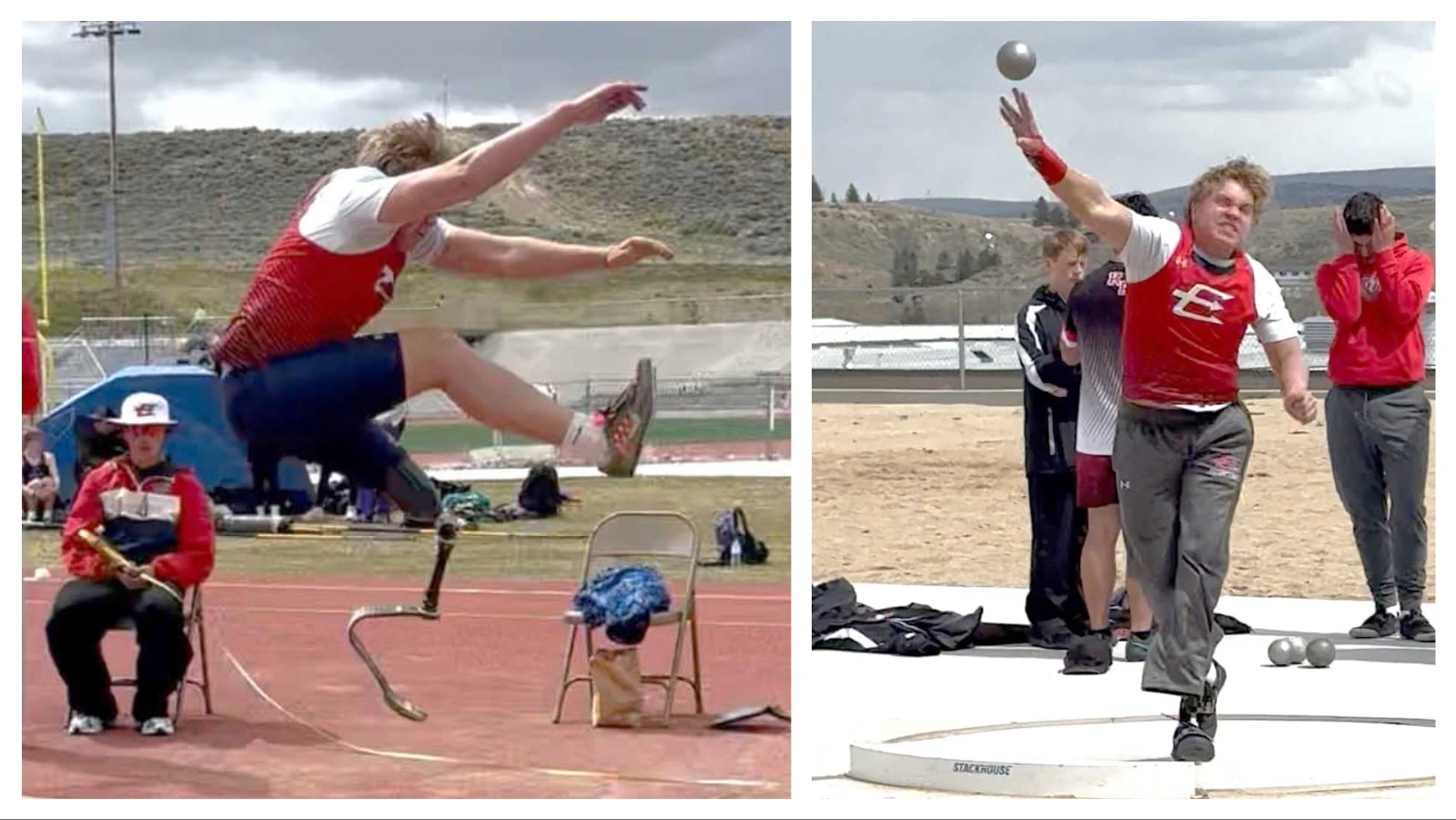
He has thrown the shot and leaped across the long-jump pit with with his prosthetic left leg as part of the Evansville High track and field team
“I’m obviously trying to do my best. I don’t personally know anybody else that has one leg and does any track events,” he said. “So, I’m just trying to see and look for some coaching in Arizona.
"I am always going to strive to go higher and see how far and I can go.”
Kutler said he finds athletics freeing and enjoys the challenges, activity and camaraderie he finds on the track team as well as his high school’s football squad.
While running events are more difficult for him to be competitive, he discovered that throwing the shot put allows him to challenge other athletes.
“It feels a lot better than doing any other track event,” he said. “It’s a lot more smooth and I just fell in love with it.”
Kulter’s mom Kapri Hill said as a youngster, her oldest child was active and showed athleticism playing soccer and other sports.
Kapri Hill said both she and her husband were athletes for a time in college, and the now seven-member family has always enjoyed working out and keeping an active lifestyle.
When Kutler was 8, the family was living in California.
During a visit with relatives in Wyoming, Kutler was hit in the leg with a sled.
Kapri Hill said his leg swelled up with a large bump and the bump did not shrink days later. It affected his ability to run.
Cancer Diagnosis
A visit to doctors in San Francisco resulted in a diagnosis of osteosarcoma — cancer of the bone.
Chemotherapy followed, but the parents were told their son needed to either have an amputation or a removal of the cancerous bone at the top of his shin on his left leg.
When they talked with Kutler, the bottom line was that he wanted to be able to keep running.
His dad, Jeff Hill, who’s also a doctor, did research, called specialists and learned that with a bone salvage surgery — which involved a metal rod and future surgeries as he grew — running likely would not be an option.
“I’ve just been surrounded by people who are athletic,” Kutler said. “I just decided to amputate my leg so I could run again.”
Kapri said because Kutler was determined to run again, they understood that “amputation was the best way to go.”
After his surgery in 2017 at a Stanford University hospital, Kutler still had to do chemo and his leg took time to heal.
Initially, Kutler was fit with a prosthetic leg that did not allow him to run.
It wasn’t until about a year later the family was able to get help from the Hanger Clinic, the Ossur prosthetics company, and the Challenge Athletes Foundation to get a running foot and leg.
The leg has different components than a standard walking prosthetic.
“All the pieces are different,” Kapri said. “It’s just a blade. … He learned how to run on it and we have this incredible video footage of him just beaming once he finally got the hang of it.”
Once he had his running leg, he did not want to put on a “clunky” walking leg until probably his sophomore year in high school, she said.
Kutler charaterizes the running leg as something that “showed me how high I could go.”
Other Opportunities
He has since been to the National Ability Center in Park City, Utah, where he learned to snowboard and more about the various prosthetic leg parts required for the different sports and activities.
While in California, Kutler played on the freshman football team at his high school.
After the family moved to Wyoming in 2024, he has continued to play for Evansville High School on the defensive and offensive lines.
Kutler said it is harder for him to compete on the football field but he loves the sport and has definitely improved.
“It builds discipline, it helps you get mentally tough, I love the sport of football,” he said. “You just get to have really close friends and you gotta be able to build your strength while doing something fun.”
Kutler plans to return to high school sports for his senior year, but this summer is focused on improving his shot-put skills.
Now that track season is over he continues throw the shot and go to the weight room to work on the muscles required to take him to the next level.
In high school, he throws a 12-pound shot and recently received a 13-pound one used in the Arizona and Los Angeles competitions.
His performance at the Arizona games will determine whether he can go to New York. His longest shot-put throw in high school is 35 feet, 9 inches.
Kapri started a GoFundMe to help with the travel expenses and also with potentially getting different prosthetic leg parts that will enhance his ability to perform.
She said at his current weight of 200 pounds, the foot Kutler uses for the long jump needs to be upgraded.
Grateful For Help
She appreciates the support already shown Kutler and their family, which includes four other children ages 16, 14, 6, and 3.
“We’re really grateful,” she said. “It would have been impossible for us to have pursued it at all without the help.”
Kutler’s mom characterizes him as someone who is “quiet” but “persistent” in pursuing his goals.
She said her son has been “gracious” and “positive” despite the setbacks he has faced in life.
“As his mom, I think he’s a pretty impressive kid,” she said. “Sometimes I’m embarrassed if I’m having a bad day and don’t want to get out of bed, and I have to think about Kutler, he has to get out of bed and put a leg on every day.”
Kutler said his parents have helped him believe in what is possible and he is grateful to be in a position to compete in Arizona and beyond.
His advice for any others young or old facing what appears to be a life-limiting diagnosis is to “keep everything open and never shut yourself down.”
“That’s probably the easiest part when you get some diagnosis like that is just to ruin yourself by saying, ‘I’m never going to be able to do this again,’” he said. “My parents used to say that I would say, ‘I can’t do something.’ But then they’d say, ‘You can’t do something — yet.’
"You just have to say ‘yet.’”
Dale Killingbeck can be reached at dale@cowboystatedaily.com.