
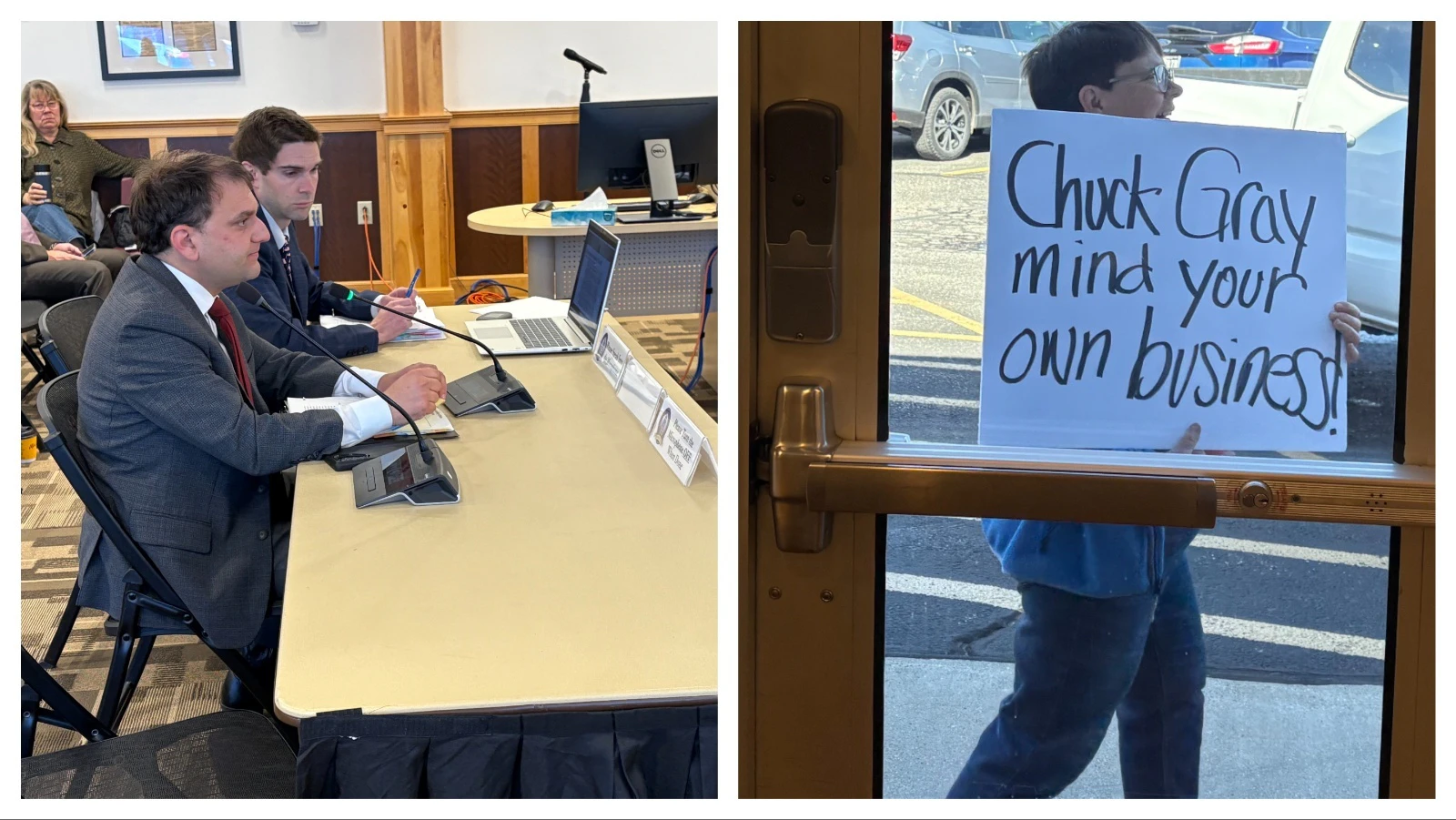
Protestors pressed signs against the windows of a meeting room in Lander Friday, which read “Chuck Gray mind your own business,” “Hands Off HD33,” and “Wyoming Needs Native Wisdom Not Trumpian Toadies.”
That was ahead of the Wyoming Legislature’s Joint Corporations Committee discussion on whether House District 33, which centers on the Wind River Indian Reservation, is a product of unconstitutional racial gerrymandering.
The U.S. Supreme Court's April 29 decision, Louisiana v. Callais, makes race-based voting districts harder to justify.
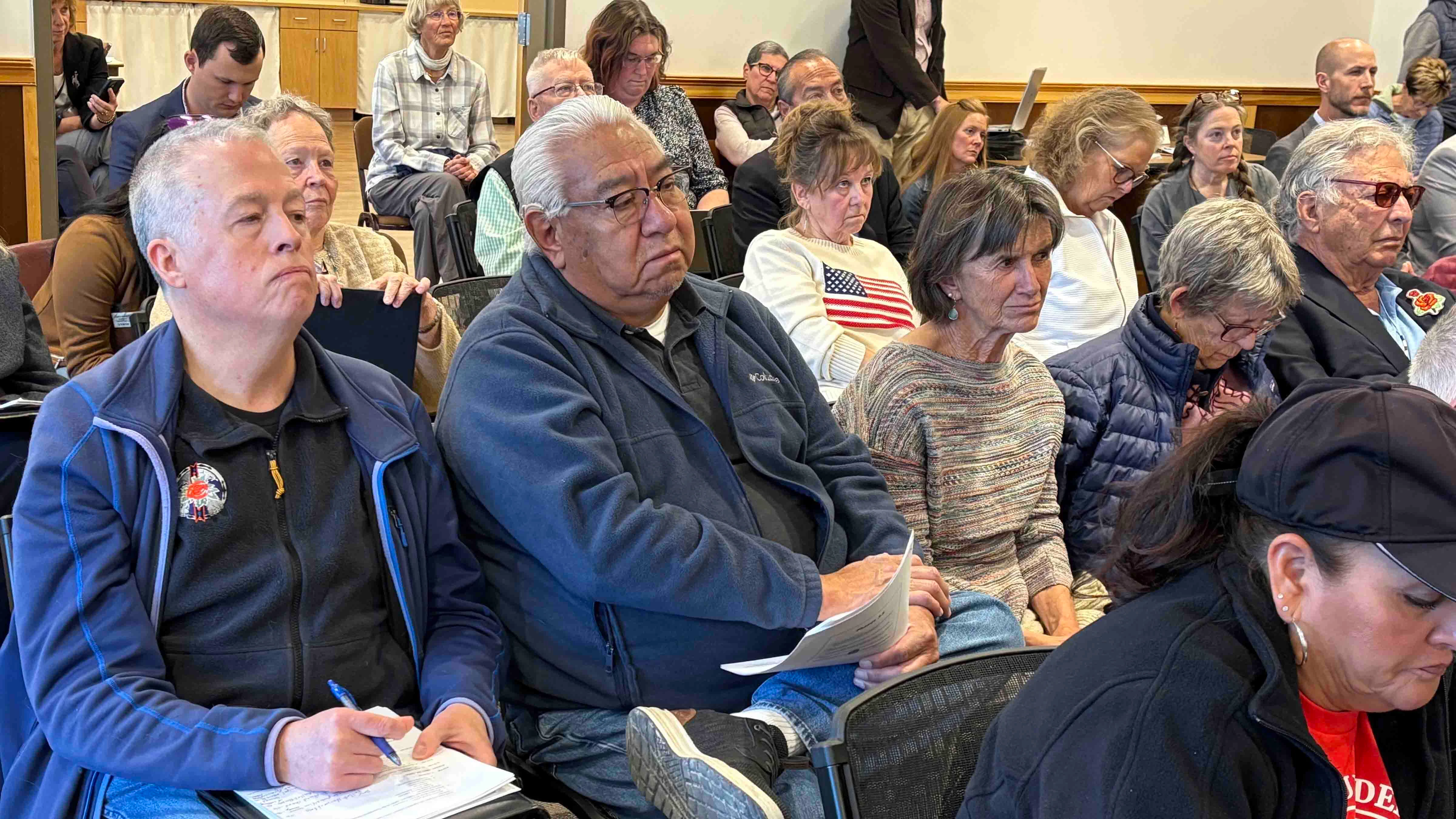
Numerous Fremont County residents testified on both sides of the issue.
Ultimately the committee punted it. Senate Corporations Committee Chair Cale Case, R-Lander, noted what an immense undertaking redistricting the state is, and said reworking HD 33 would require reworking the rest of the legislative seats.
He advised waiting until the state is due to undertake the task once again.
Rep. Mike Yin, D-Jackson, agreed.
In a rare alignment with his Democratic colleague, so too did Rep. Steve Johnson, R-Cheyenne.
“I tend to agree with my colleague from the other side of the aisle,” said Johnson. “We need to just let this go.”
Johnson pointed to other districting disputes that people could litigate between map-drawing years.
“We’d be better off to not poke the dog, that sleeping dog, and just let it go,” said Johnson. “Just leave us alone. We’re Wyoming.”
But Rep. Nina Webber, R-Cody, said the committee should keep the topic open for its next meeting, which is set for Sept. 10.
Case said that’s a fair request since other events can intervene and merit more attention on the topic. He agreed to keep it open.
He had warned spectators all along, however, that Friday's meeting was conceptual and no one would see final action on any legislation that day.
Why This Outcry
This controversy stems not only from the Callais ruling, but also from May 12 and May 13 letters Secretary of State Chuck Gray sent to the Fremont County Commission and to Gov. Mark Gordon, respectively.
Gray had called Fremont County’s system of regional districting unconstitutional and urged the commission to take immediate steps to address it.
The county’s districted map is unique, since all other Wyoming counties run at-large elections.
U.S. District Court Judge Alan B. Johnson ordered the county to draw the districted map in 2010 after five years of litigation, in which five tribal members had claimed the at-large system diluted the Native vote unconstitutionally.
Gray had also called HD33 unconstitutional in his letter to Gordon, and urged the governor to make a “path” toward addressing that.
Gray on Friday told lawmakers his letters call for an “examination” of both districts in light of Callais.
“I don’t think we should wait for a lawsuit to engage in that examination,” said Gray, adding that if the Wyoming attorney general believes the districts are unconstitutional, “I’m happy to be the plaintiff on that (lawsuit).”
He also said the Legislature could “help” Fremont County with its districts issue.
Gail Symons, who runs the nonprofit group Civics 307, read a letter on behalf of the League of Women Voters, calling Gray’s maneuver “overreach” toward the local county government.
Symons also writes a column for Cowboy State Daily but was not speaking on behalf of the outlet.
Rep. Ivan Posey, D-Fort Washakie, represents HD33 currently. It is a swing district and has alternated in recent years between Democratic and Republican representation, and between tribal and non-tribal representatives.
Posey declined to comment on the controversy Thursday, deferring instead to the tribal governments.
But First…
Fremont County people testified heartily.
Former state Sen. Mark Harris, a Democrat who’d represented multiple southwest Wyoming counties and now lives on the Wind River Indian Reservation, recalled participating in drawing House District 33 in 2001 and 2002. He said it’s incorrect to say the district is based on race, and that meeting minutes from that era emphasized contiguous, compact districts focused around a community of interest.
“House District 33 represents a community of interest,” he said, where reservation-linked concerns influence issues more than race.
The Wind River Indian Reservation is home to both the Northern Arapaho and Eastern Shoshone Tribes.
Clinton Glick, member of one of the groups currently vying for control of the Eastern Shoshone Tribe, told the committee he’d like it to leave House District 33 alone, but he’d like to see more Native American representation on the county government.
Jesse Crispin speaking for the Northern Arapaho Business Council, which is the Northern Arapaho Tribe’s executive branch, said some people feel that, “as we’re finally getting our foothold, we’re going to lose it.”
He said tribal leaders want to improve the economy for their people, and “redistricting is a terrible idea at this time.”
Both the NABC and its Shoshone counterpart – which is in litigation as to whether it still controls the tribe – have formally opposed Gray’s letters in recent statements.
The Chair Who Was Sued
Former Fremont County Chair Doug Thompson was among the people sued in his official capacity over the county’s former at-large system.
The county’s district and the judge’s order are both based on race, he said, noting that he spent hours in court testimony and proceedings.
“There was plenty of window dressing put in there, but it was race-based. And if you read the transcripts you can see that,” said Thompson.
He also noted that while that case was ongoing a tribal member, Keja Whiteman, was elected to the commission. She campaigned across the county and studied the issues, he said, while other tribal members who’d complained of racial dilution had campaigned poorly.
“She served the commission excellently under both (systems), at-large and districts,” said Thompson.
Our Receipts
Cowboy State Daily has reported that race was a driving factor in House District 33’s 2021 formation because it was.
A Cowboy State Daily reporter worked for Fremont County-based newspaper The Ranger in 2021, and attended local townhalls, Fremont County legislator brainstorming sessions, county commission meetings, and legislative committee meetings regarding redistricting at that time.
Case was a member of the Joint Corporations Committee and instrumental in the redistricting effort.
“It’s the only way to prevent us from having a lawsuit,” he said in a Nov. 18, 2021, interview with the reporter. “It’s important we try to maximize the ability of the native people to elect a representative. It’s not just 51% - you’ve got to do a little better than that, especially when you have two tribes involved.”
“So,” he added, “we’re starting with House District 33.”
Case said the zone “that maximizes the Native presence, it works out to be about one House district exactly. So that sort of drives the rest of the Fremont County plan whether we interact with the Basin or not.”
County officials had at that time grappled with Big Horn Basin-area legislators’ desire to add more constituents in Fremont County to equalize their districts’ sizes with other districts.
That October in a meeting with other Fremont County legislators, Case had said, “There’s a lot of shifting, but we have to pay attention to the reservation. We have to make sure we don’t exclude people from being in the majority-minority district.”
After a December 2021 redistricting meeting of the Joint Corporations Committee, the Wyoming Tribune Eagle reported that Case had countered a proposition by Sen. Ogden Driskill, R-Devils Tower, because Case couldn’t tell if it would impact the majority-minority district.
The Tribune Eagle then called House District 33 a majority-minority district, where “a concentrated body of ethnic minority voters must be maintained in their own House district.”
In a Nov. 18, 2021 letter to the Fremont County Association of Governments – which is a collective of Fremont County’s local governments – Case wrote, “Fremont County does have a very unique and wonderful situation with respect to the rest of Wyoming in that our citizenry includes a large enough group of minority citizens, the members of the Eastern Shoshone and Northern Arapaho Tribes, in a geographic region that has enough population to elect a representative.”
He emphasized the court precedent at the time, “that this fact requires special consideration and nourishment in our redistricting efforts.”
“This is well known by the Corporations Committee and will be fully respected in upcoming deliberations,” wrote Case. “Protection of the reservation district has implications for the rest of Fremont County district boundaries as well.”
During an early December 2021 meeting of the Joint Corporations Committee, Case presented the Fremont County legislators’ plan, which they built with the Fremont County Clerk’s office.
The meeting minutes from that presentation say Fremont County holds the only majority-minority legislative district in Wyoming.
“It is also the only county with commissioner districts and eight school districts,” say the minutes. “The plan started with the boundaries of the Wind River reservation and they wanted to maintain and enhance HD33 to uphold Native American voter power.”
The Legislative Service Office published a May 6, 2021, memo on redistricting informing legislators that The Wyoming Legislature has recognized the Native American population on the reservation “constitutes a geographically distinct minority group with a sufficient population to warrant the creation of a Native American majority house district.”
For both its 2002 and 2012 redistricting plans, the Joint Corporations Committee sought both tribes’ input to ensure that Native Americans were fairly represented in the redistricting plan, the memo says.
Case acknowledged in an April interview with Cowboy State Daily that race was a significant consideration in the process.
“That district was drawn to have the maximum number of Native American people, and as a result it includes parts of Riverton,” he said a time. “We worked very hard (to honor the case law of the time).”
He has also since told Cowboy State Daily that, though race was a driving factor, other factors like common culture and political interest could also justify the district’s shape.
This Curveball
Andy Baldwin, the attorney who represented tribal members in the Fremont County litigation starting in 2005, sent a letter earlier this month to the county commission.
Baldwin said in the letter that he's retired and he wrote it as an individual, not anyone's counsel.
"Chuck Gray recently called for Fremont County to return to a system that diluted the voice of Indian voters in favor of voters in the rest of the County," wrote Baldwin. "Why does Mr. Gray want to return to a system that dilutes Indian voting? Why would the county want to do that?"
One out of five seats makes 20%, which is about the population of tribal members in Fremont County, Baldwin noted.
"Nothing in the Supreme Court ruling requires the County to abandon its district-based election of Commissioners," he wrote, adding that the high court allows districting based on factors other than race, and state law allows for districted commissions.
And The Argument
Multiple U.S. Supreme Court cases have treated American Indian tribal members as parts of a political, rather than strictly racial class.
Whether the high court would do the same in the context of voter districts is an interesting, but unsettled argument, one attorney with extensive experience with Indian law told Cowboy State Daily earlier this month.
Cheyenne-based attorney Mike Turner called the political class point a “relatively new” question.
Since districting efforts are often separated by a decade, these legal questions don’t revolve as quickly as in other areas of law, he said.
“I’d have to think that someone is going to seriously debate that angle,” said Turner.
Each side of any prospective legal challenge is going to be “results-driven,” he added. “So every theory you have, you’re going to throw that (in) as long as you’ve got good faith to support that.”
Turner said the issue “could get pushed in a lot of interesting directions where there could be some unintended consequences."
“You’ve found a pretty fascinating thing to get a front-row seat to,” he added.
‘Absolutely Not’
William Perry Pendley, former president of the Mountain States Legal Foundation, told Cowboy State Daily earlier Wednesday that the tribes’ governmental traits shouldn’t factor into voting districts.
“Absolutely not,” said Pendley. “The bottom line is, who’s voting? The tribe’s not voting. Individual American Indians are voting.”
And, he added they’re voting to “ascribe to individual Americans” and are not bound by race or tribe.
Pendley had helped to defend Fremont County when its former at-large district was challenged as racial discrimination starting in 2005. The county lost that federal court case, which is why it now has districts.
He told Cowboy State Daily after the Callais decision last month that, “It’s nice to be vindicated.”
Clair McFarland can be reached at clair@cowboystatedaily.com.


