
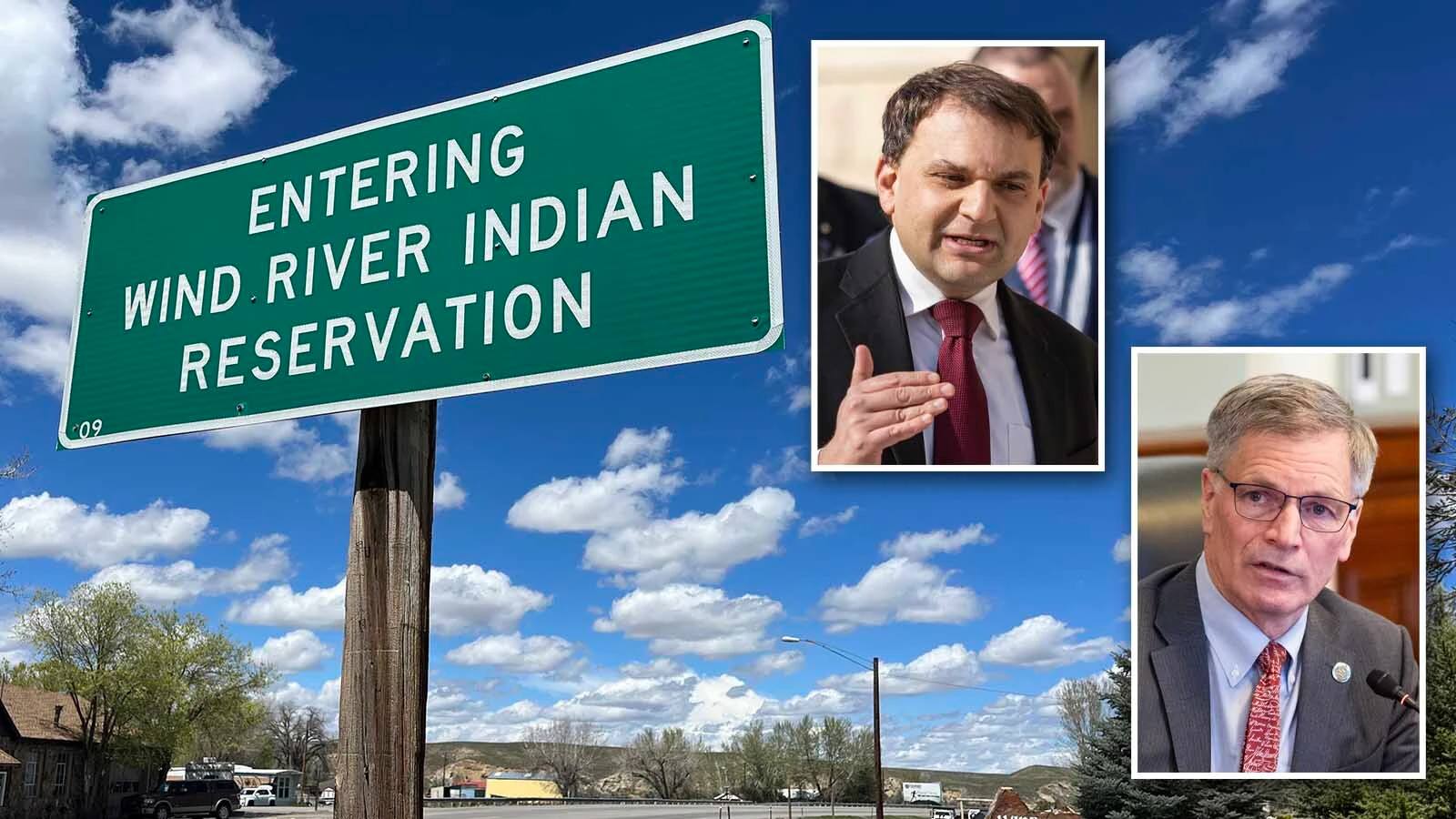
One day after Secretary of State Chuck Gray sent a letter to the Fremont County Commission asking it to take “immediate” steps to eliminate a race-based county voting district, he sent a similar letter to Gov. Mark Gordon about Wyoming’s lone race-based state House district.
That’s because racial factors went into drawing the state Legislature’s House District 33 in 2021. At that time, the relevant case law indicated a need to create a mostly Native American House district in the area of the Wind River Indian Reservation.
The U.S. Supreme Court released a ruling in Louisiana v. Callais on April 29 that didn’t outright ban that kind of districting, but made race-based districts harder to justify.
Gray makes a bolder assertion.
“With the Supreme Court’s ruling, it is clear that drawing districts based on race is a blatant violation of the United States Constitution,” wrote Gray in a Wednesday letter to Gordon.
That follows a similar letter Gray sent Tuesday to the Fremont County Commission, telling it to take “immediate” steps to eliminate its race-based commission district. That district, like HD 33, sits on the Wind River Indian Reservation.
Wyoming’s other county commissions are made up of at-large representatives instead, which Gray said would satisfy the U.S. Constitution.
To Gordon, Gray wrote to “bring to your attention” the bill Wyoming passed drawing House District 33 after the 2021 redistricting talks.
“I believe House District 33’s boundaries need to be examined to ensure compliance with Callais,” Gray wrote, adding that the legislative Joint Corporations Committee is meeting next week, “and I expect this to be discussed.”
Wants Gordon To Act
But, added Gray, “I believe you, as Governors in other states have done, need to provide a path of action to examine legislative districts to ensure our compliance with the United States Constitution in light of Callais.”
Georgia Gov. Brian Kemp called a special legislative session for redistricting this week. Alabama and Tennessee both called special sessions after the court's ruling. Louisiana's governor signed an executive order encouraging redistricting.
Gordon’s spokeswoman Amy Edmonds told Cowboy State Daily on Wednesday afternoon that Gordon had just received Gray’s letter, is reviewing it, and will be speaking to legal counsel and the Wyoming attorney general.
Sen. Cale Case, R-Lander, acknowledged in a Cowboy State Daily interview last month that those planning HD 33 in 2021 emphasized race to stay in keeping with the case law then reigning.
But the district is defensible on other, nonracial grounds, he said Wednesday.
“I think it would survive a lawsuit. I think the AG could defend this, and we could have time to be thoughtful about it,” said Case.
But it’s impossible to redraw Wyoming’s districts immediately, said Case.
The two-week candidate filing period opens Thursday, many election processes are underway, and districting is a huge effort, he added.
“I’m not saying don’t address it, I’m just saying it’s impossible to address it without a chaotic effort that would involve the county clerks, rushed stuff, and no census information,” said Case.
The Wyoming Constitution says the Legislature shall reapportion its districts after the federal census is released. That’s every 10 years.
Wyoming isn’t due to start its next redistricting planning until 2031.
“I think it’s a bad idea to rush into it, and I’m advising people, and I’ll discuss with my committee and support some kind of thoughtful measure to approach it, get more information, move forward,” said Case, who also chairs the Senate Corporations Committee. “Maybe do some legal work — but don’t rush into it.”
Meanwhile, A Fascinated Lawyer
Cheyenne-based attorney Mike Turner voiced fascination with the topic and what he called a noteworthy but “novel” legal angle in the voting rights context.
The U.S. Supreme Court in Callais overturned a zigzag-shaped congressional district in Louisiana as racial gerrymandering. The district had sought to “scoop up pockets of predominantly Black populations” across a wide regional swath, says the high court’s majority opinion.
The court made it harder for governments to justify race-based districting.
“The State never hid the ball,” wrote the majority opinion’s author Justice Samuel Alito, speaking of Louisiana. “It configured District 6 to achieve a black voting-age population over 50%” because another court had overturned its earlier map that lacked the minority-concentrated district.
Native Americans are different, noted Turner in a Wednesday interview.
Though working in Cheyenne now, Turner was elected to the Oklahoma House of Representatives in 2013, then became an assistant district attorney for Southwestern Oklahoma years later.
In the state House he served before the landmark 2020 Supreme Court decision of McGirt v. Oklahoma. And he became a prosecutor after it.
That decision says that the Creek Reservation remains Indian Country, not state jurisdiction, for the purposes of criminal prosecutions.
Turner had to learn a lot about Indian law to prosecute crimes and handle other legal questions, he said.
He became versed in cases like the 1974 case of Morton v. Mancari, where the high court treated Native Americans according to their political, not their racial designation.
Tribes have their own governments, and treaties with the federal government.
It’s a “relatively new” question whether tribal members’ political classification is a counterpoint that could rebut a racial gerrymandering claim, Turner said.
Since districting efforts are often separated by a decade, these legal questions don’t revolve as quickly as in other areas of law, he said.
“I’d have to think that someone is going to seriously debate that angle,” said Turner.
Each side of any prospective legal challenge is going to be “results-driven,” he added. “So every theory you have, you’re going to throw that (in) as long as you’ve got good faith to support that.”
Turner said the issue “could get pushed in a lot of interesting directions where there could be some unintended consequences."
“You’ve found a pretty fascinating thing to get a front-row seat to,” he added.
‘Absolutely Not’
William Perry Pendley, former president of the Mountain States Legal Foundation, told Cowboy State Daily earlier Wednesday that the tribes’ governmental traits shouldn’t factor into voting districts.
“Absolutely not,” said Pendley. “The bottom line is, who’s voting? The tribe’s not voting. Individual American Indians are voting.”
And, he added they’re voting to “ascribe to individual Americans” and are not bound by race or tribe.
Pendley had helped to defend Fremont County when its former at-large district was challenged as racial discrimination starting in 2005. The county lost that federal court case, which is why it now has districts.
He told Cowboy State Daily after the Callais decision last month that, “It’s nice to be vindicated.”
A Word From Gray
Gray reiterated part of his letter in a Wednesday statement to Cowboy State Daily, adding a claim that, "Insiders and the radical leftwing media are wrong in trying to repeat over and over again in a coordinated fashion their false statements in which they are trying to keep the status quo, rather than addressing the underlying issue in light of the very important ruling in Callais."
It is unclear which media or "insiders" Gray is referencing. He did not return a follow-up question on the matter. The statement is nearly a copy of one he sent earlier Wednesday regarding the Fremont County Commission.
"Callais applies to Wyoming, and Governor Gordon and the state legislature must abide by the Constitution,” he concluded in his statement regarding his letter to Gordon.
Meanwhile, Harmeet Dhillon
U.S. Sen. Eric Schmitt, R-Missouri, urged the U.S. Attorney’s Office on April 30 to enforce the Callais decision nationwide.
Harmeet Dhillon, assistant U.S. attorney at the Civil Rights Division, posted a response that same day to X: “Senator — we are ON IT!”
The U.S. Department of justice “continues to prioritize equal protection of the laws for ALL Americans, be it employment, housing, education — and VOTING!” adds Dhillon’s post.
Pendley called the exchange between Dhillon and Schmidt “interesting" in a Wednesday phone interview.
“I think there are a lot of people around the country notifying the Department of Justice, ‘Hey we’ve got a problem here locally, you want to get involved,’” said Pendley. “It would not surprise me if the DOJ got involved (in Fremont County), because this is their bailiwick.”
Yeah That Change Relied On Race
For both Fremont County and HD 33, history supports the statement that their districting was based on race.
Five tribal members from both the Eastern Shoshone and Northern Arapaho tribes challenged the county’s earlier at-large system in federal court starting in 2005.
The Mountain States Legal Foundation entered the case to defend the county, while the American Civil Liberties Union represented the tribal members.
U.S. District Court Judge Alan B. Johnson ruled for the tribal members on April 29, 2010.
He gave a breakdown of county racial demographics from that timeframe, noting that county’s Native American population was at about 21%.
“The evidence presented to this Court reveals that discrimination is ongoing, and that the effects of historical discrimination remain palpable,” wrote Johnson. “The Court rejects any attempt to characterize this discrimination as being politically, rather than racially, motivated.”
Johnson based his ruling on Section 2 of the Voting Rights Act.
That’s the same law that, 16 years later, the Supreme Court reevaluated in Callais, changing its racial gerrymandering review standards and making the practice harder to justify.
Johnson evaluated the Native American litigants’ claims under the framework the in place as of 2010, which tested things like how large the group of racial minority voters is, how cohesive it is, and whether the “white majority votes sufficiently as a bloc to enable it” to defeat the racial minority’s preferred candidate.
The Native American litigants passed those tests.
“The Court finds and concludes that the plaintiffs have shown that at-large elections for Fremont County Commission dilute the Indian voting strength in violation of Section 2 of the Voting Rights Act,” wrote Johnson.
He permanently blocked the at-large selection system and ordered the county to propose a remedy requiring district-based elections within two months of his order. Then he rejected the county's proposed solution — which had tried to keep the four non-reservation districts at-large — and fashioned his own five-district remedial plan.
The 10th Circuit Court of Appeals in 2012 upheld his decision.
The Ruling Says …
The U.S. Supreme Court in its April 29 decision of this year didn’t overturn the Voting Rights Act’s Section 2 or the framework earlier decisions have given to it, but the majority “updated” that framework in a way that makes it harder for a government to justify racial discrimination when drawing legislative districts.
On the other hand, governments face liability under Section 2 of the Voting Rights Act “only when the evidence supports a strong inference that the state intentionally drew its districts to afford minority voters less opportunity because of their race,” the case syllabus says.
The ruling doesn’t outright foreclose Fremont County’s system as “squarely unconstitutional” as Gray asserted in his separate letter to the county, but it may make it more difficult to defend.
Rep. Ken Chestek, D-Laramie, who is a retired law professor and served prior on the legislative Tribal Relations Committee, told Cowboy State Daily that yes, the high court's ruling imposes a more rigorous test for defending race-based maps.
However, he's not sure if it's enough for a new challenger to overturn Fremont County's districted commission system.
The test is rooted in the 1986 case of Thornburg v. Gingles.
The high court’s “update” doesn't automatically invalidate Johnson's 2010 opinion, said Chestek, adding that nothing will change unless someone files a new challenge.
"Even then it's not clear ... and it's very possible to me the (tribal members) would win again," he said. "But I don’t think there’s a definitive answer we can come up with right now."
Clair McFarland can be reached at clair@cowboystatedaily.com.


