
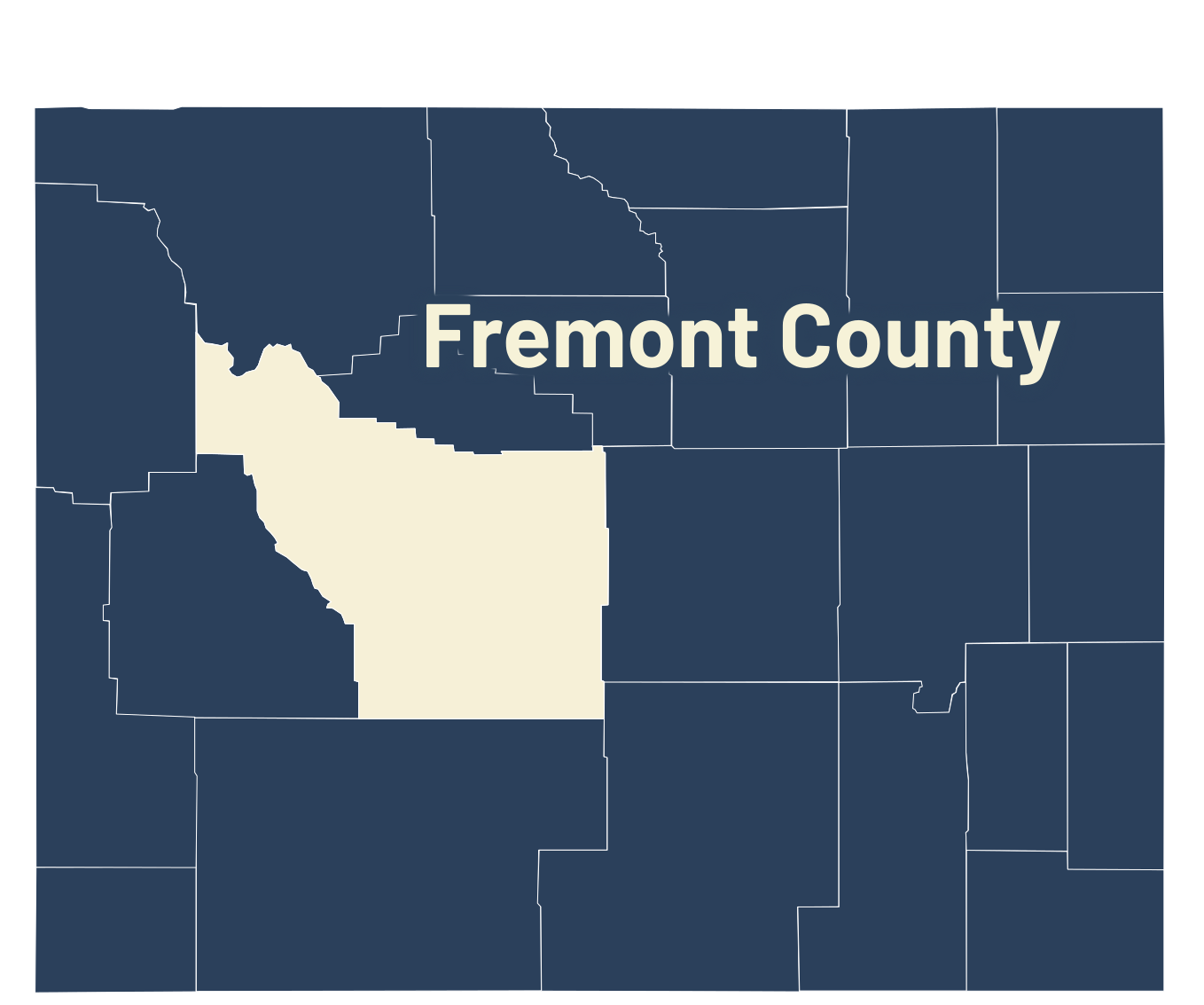
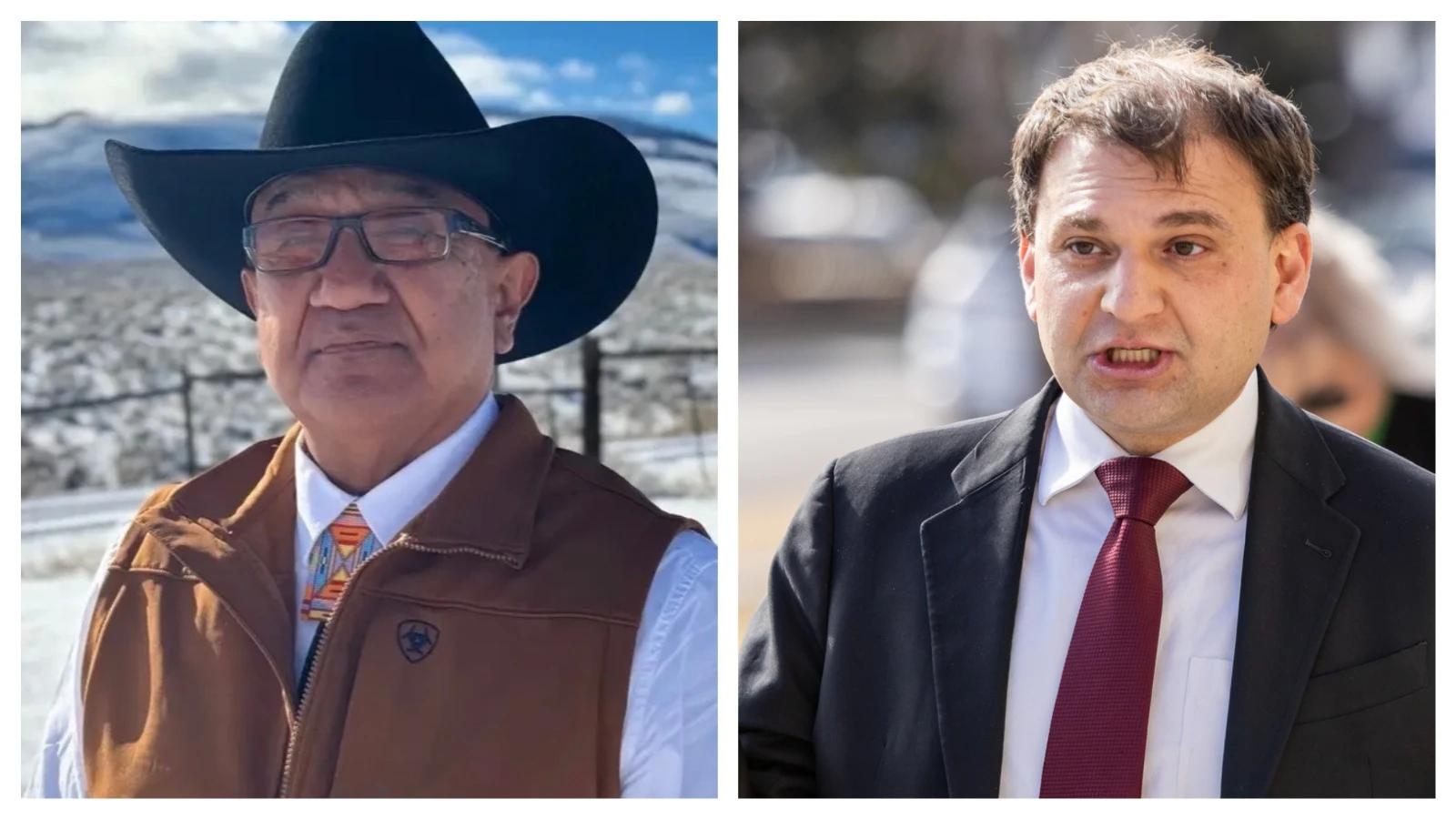
Secretary of State Chuck Gray told the Fremont County Commission on Tuesday to “take immediate action” to change its race-based system of commission districts back to the at-large system the rest of the state’s counties have.
A federal court first ordered the county to draw its commission districts to prevent dilution of the Native American vote starting in 2010. Other Wyoming counties run their commission elections at-large, meaning everybody in the county votes on all the candidates, with the top vote-getters being elected.
Gray's letter came after the U.S. Supreme Court in Louisiana v. Callais tightened its review of potential racial gerrymandering and overturned a race-based district in Louisiana, and after Cowboy State Daily reported that Wyoming has two voter districts — one in Fremont County and one in the state House of Representatives — based on racial factors.
“With the Supreme Court’s ruling, it is clear that drawing districts based on race is squarely unconstitutional, and a blatant violation of the Fourteenth Amendment,” wrote Gray in a Tuesday letter to the Fremont County Commission.
Fremont County contains the Wind River Indian Reservation, where both the Northern Arapaho Tribe and Eastern Shoshone Tribe are headquartered.
“Given the Fremont County Commission is the only county commission which is drawn into districts with the consideration of race, I believe the Commission’s existing electoral boundaries are in violation of the Callais decision, and the United States Constitution.”
Gray’s letter says that Fremont County’s previous at-large system, which it had prior to 2010, was in line with the U.S. Constitution.
Call In The Lawyers
Among themselves, Fremont County Commissioners are reacting differently to the letter.
The commission sent the question to the Wyoming Attorney General’s Office for further guidance, Chairman Larry Allen told Cowboy State Daily on Wednesday.
Allen said he thinks people prefer the districts because they know they’re being represented by someone from their area that way. Allen represents Dubois and other rural swaths of the county.
Commissioner Jennifer Wilson, who represents other rural areas encircling Lander, said that she thinks the at-large system was better. But if she had her way, she’d put it to a ballot vote of the people to decide which system they prefer.
“No matter what we do there’s going to be a lawsuit,” said Wilson, adding that the timing is flustering with the campaign filing window opening Thursday and the election process underway.
“I really kind of want to sit and wait to see what we get back from legal,” said Wilson, “Chuck Gray can say well, ‘Do this’ and ‘Do that,’ but that’s ridiculous — because who’s paying for the lawsuit, Chuck? You?”
It was possible under the old system for tribal members to win seats on the commission.
Wilson noted that while the districting challenge was ongoing, a tribal member, Keja Whiteman, won election to the commission at-large.
Commissioner Clarence Thomas, who represents the reservation area, voiced outright displeasure with the letter and the notion of going to at-large selection.
He said it’s not about race, but about unique cultural divisions in Fremont County.
Thomas pointed to how different Riverton is from Lander, as well as how different the reservation is from other districts.
“We are Wyoming. And we are different. And we adapt to the issue of listening to constituents rather than listening to, I guess, outside sources of political movement,” said Thomas. “So I disagree with his letter, and I’ll continue to disagree with his letter.”
Commissioner Ron Fabrizius, of Riverton, told Cowboy State Daily the county is strung between past and current court rulings and is in a “darned if you do, darned if you don’t situation.”
He indicated he doesn’t feel strongly about the district issue, but noted it will be more expensive and time-consuming for candidates to campaign county-wide.
“I think it’s more of a legal issue,” said Fabrizius, “and let the powers that be, above us, tell us what we need to do.”
Commissioner Mike Jones, of Lander, did not return a voicemail request for comment by publication.
Gray reiterated part of his letter in a Wednesday email statement to Cowboy State Daily, adding a claim that, "Insiders and the radical leftwing media are wrong in trying to repeat over and over again in a coordinated fashion their false statements in which they are trying to keep the status quo, rather than addressing the underlying issue in light of the very important ruling in Callais."
It is unclear which media or "insiders" Gray is referencing. He did not return a follow-up question on the matter.
"Callais applies to Wyoming, and the Fremont County Commission must abide by the Constitution," he wrote in his original statement.
Meanwhile, Harmeet Dhillon
U.S. Sen. Eric Schmitt, R-Missouri, urged the U.S. Attorney’s Office on April 30 to enforce the Callais decision nationwide.
Harmeet Dhillon, assistant U.S. attorney at the Civil Rights Division, posted a response that same day to X: “Senator — we are ON IT!”
The U.S. Department of justice “continues to prioritize equal protection of the laws for ALL Americans, be it employment, housing, education — and VOTING!” adds Dhillon’s post.
William Perry Pendley, the former Mountain States Legal Foundation president who helped to defend Fremont County in its districting case, called the exchange between Dhillon and Schmidt “interesting" in a Wednesday phone interview.
“I think there are a lot of people around the country notifying the Department of Justice, ‘Hey we’ve got a problem here locally, you want to get involved,’” said Pendley. “It would not surprise me if the DOJ got involved (in Fremont County), because this is their bailiwick.”
Yeah That Change Relied On Race
History supports the statement that Fremont County has commission districts because of race.
Five tribal members from both the Eastern Shoshone and Northern Arapaho tribes challenged the county’s earlier at-large system in federal court starting in 2005.
The Mountain States Legal Foundation entered the case to defend the county, while the American Civil Liberties Union represented the tribal members.
U.S. District Court Judge Alan B. Johnson ruled for the tribal members on April 29, 2010.
He gave a breakdown of county racial demographics from that timeframe, noting that county’s Native American population was at about 21%.
“The evidence presented to this Court reveals that discrimination is ongoing, and that the effects of historical discrimination remain palpable,” wrote Johnson. “The Court rejects any attempt to characterize this discrimination as being politically, rather than racially, motivated.”
Johnson based his ruling on Section 2 of the Voting Rights Act.
That’s the same law that, 16 years later, the Supreme Court reevaluated in Callais, changing its racial gerrymandering review standards and making the practice harder to justify.
Johnson evaluated the Native American litigants’ claims under the framework the Supreme Court had ascribed to the Voting Rights Act as of 2010, which test things like how large the group of racial minority voters is, how cohesive it is, and whether the “white majority votes sufficiently as a bloc to enable it” to defeat the racial minority’s preferred candidate.
The Native American litigants passed those tests.
“The Court finds and concludes that the plaintiffs have shown that at-large elections for Fremont County Commission dilute the Indian voting strength in violation of Section 2 of the Voting Rights Act,” wrote Johnson.
He permanently blocked the at-large selection system and ordered the county to propose a remedy requiring district-based elections within two months of his order. Then he rejected the county's attempt - which had tried to keep the four non-reservation districts at-large - and fashioned his own five-district remedial plan.
The 10th Circuit Court of Appeals in 2012 upheld his decision.
The Ruling Says …
The U.S. Supreme Court in its April 29 decision in Louisiana v. Callais ruled that a narrow horizontal zigzag-shaped congressional district comprising a majority concentration of black voters was a product of unconstitutional racial discrimination.
Ruling 6-3, the high court didn’t overturn the Voting Rights Act’s Section 2 or the framework earlier decisions have given to it, but the majority “updated” that framework in a way that makes it harder for a government to justify racial discrimination when drawing legislative districts.
On the other hand, governments face liability under Section 2 of the Voting Rights Act “only when the evidence supports a strong inference that the state intentionally drew its districts to afford minority voters less opportunity because of their race,” the case syllabus says.
The ruling doesn’t outright foreclose Fremont County’s system as “squarely unconstitutional” as Gray asserts, but it may make it more difficult to defend.
Rep. Ken Chestek, D-Laramie, who is a retired law professor and served prior on the legislative Tribal Relations Committee, told Cowboy State Daily that yes, the high court's ruling imposes a more rigorous test for defending race-based maps.
But, he's not sure if it's enough for a new challenger to overturn Fremont County's districted commission system.
The test is rooted in the 1986 case of Thornburg v. Gingles.
The majority's April decision added a requirement to that test and made it harder to survive.
That doesn't automatically invalidate Johnson's 2010 opinion, said Chestek, adding that nothing will change unless someone files a new challenge.
"Even then it's not clear ... and it's very possible to me the (tribal members) would win again," he said. "But I don’t think there’s a definitive answer we can come up with right now."
A Quirk Here
A quirk of American Indian jurisprudence is that the U.S. Supreme Court has in multiple cases treated tribal members as part of a political, rather than racial, class. Tribes have treaties and governments of their own.
However, two of the dominant cases in this area — Morton v. Mancari (1974) and Haaland v. Brackeen (2023) — address the federal government’s relationship with tribes as political entities, not the state’s.
Pendley told Cowboy State Daily he doesn’t think the political class argument protects the race-based district here.
“Absolutely not,” said Pendley in a Wednesday phone interview. “The bottom line is, who’s voting? The tribe’s not voting. Individual American Indians are voting.”
And, added Pendley, they’re voting to “ascribe to individual Americans” and are not bound by race or tribe.
Andy Baldwin, of Lander-based firm Baldwin, Crocker & Rudd, did not comment by publication. Baldwin had successfully represented tribal members in the districting case.
Oh, And In The House
History also supports the assertion that Wyoming’s reservation-area House of Representatives district, House District 33, was drawn based on racial factors.
Sen. Cale Case, R-Lander, was overt about those efforts during the Legislature’s redistricting efforts in 2021.
He confirmed that to Cowboy State Daily on April 30 as well, acknowledging that the district architects within the Legislature were at that time trying to honor the jurisprudence of that time.
“That district was drawn to have the maximum number of Native American people, and as a result it includes parts of Riverton,” said Case. “We worked very hard (to honor the case law).”
That could invite legal action now, after the high court’s April 29 ruling, said Case, whose Senate district also spans HD 33.
On the other hand, Wyoming’s tribal population shares other commonalities besides race.
Each tribe has its own government. The reservation is a distinct geographical region and bears some cultural distinctions, while federal law governs the tribes with numerous, specific laws.
Case said it might be futile, with the next Wyoming legislative redistricting only five years away, for someone to challenge the structure.
“But it might mean for different considerations next time we draw the districts,” he said.
State Rep. Ivan Posey, D-Ethete, who represents House District 33, did not comment by publication following a text message request for an interview.
Clair McFarland can be reached at clair@cowboystatedaily.com.


