How long grizzly cubs get to stay with their momma bear before they’re kicked out on their own, so to speak, can be an open-ended question.
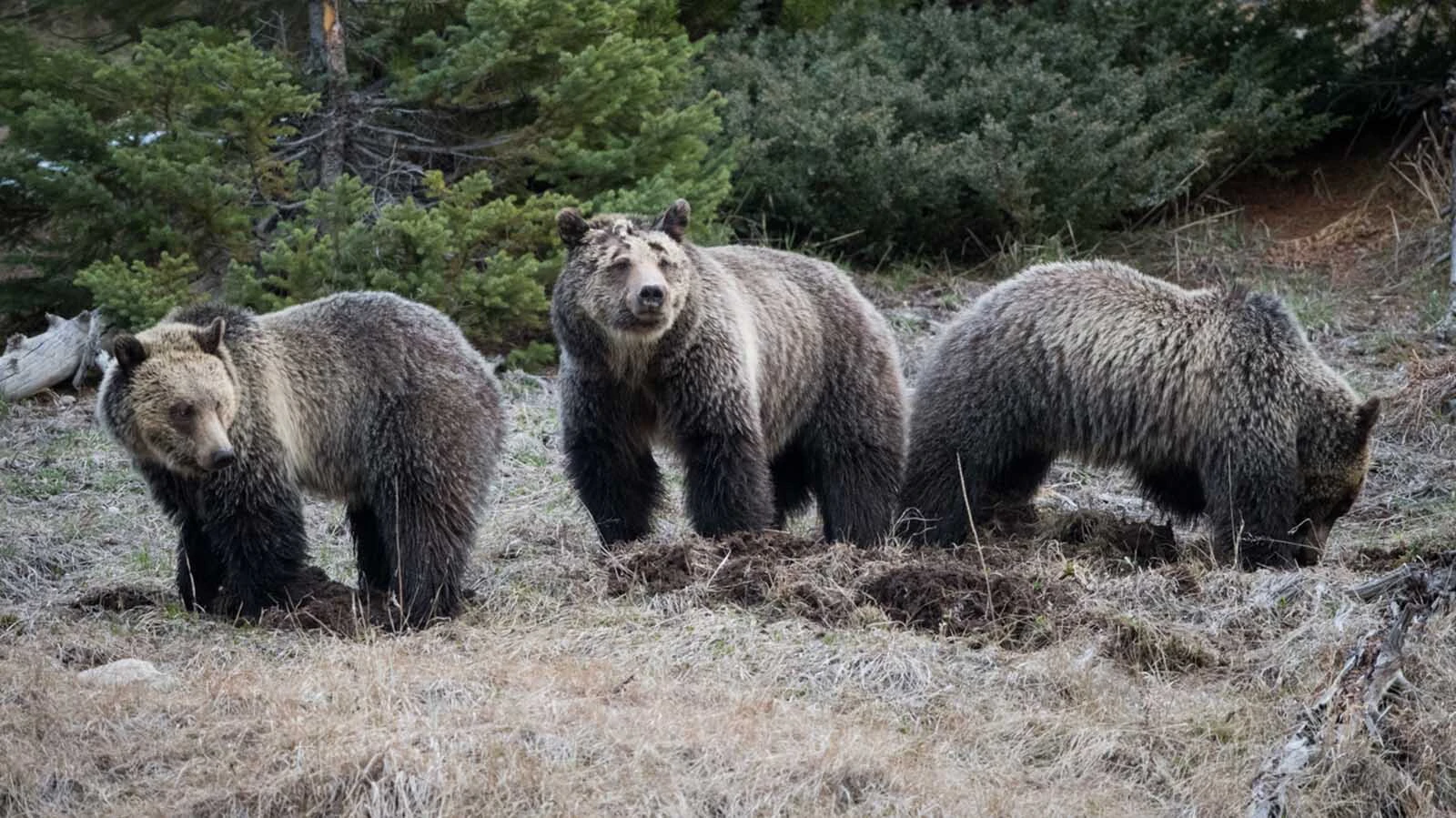
A popular female grizzly called Beryl in Yellowstone National Park still has two cubs with her that are roughly 3.5 years old, and nearly as big as her.
That’s raising some eyebrows, because it’s generally accepted that grizzlies in the Greater Yellowstone Ecosystem (GYE) usually split from their mothers at about age 2.
Among the species as a whole, a range of about 2 to 4 years is the average age that grizzlies separate from their mothers, Nicholas Scapillati, executive director of the Grizzly Bear Foundation in British Columbia, Canada, told Cowboy State Daily.
“Don’t make too much of it,” he said about Beryl’s cubs still being with her at 3.5 years old.
Scapillati and others said a variety of factors can play into when cubs strike out on their own, including available resources, if and when the mother goes back into estrus (heat), and even the individual temperaments of the bears involved.
‘They Seem Pretty Playful’
This spring, Beryl and her cubs appear to still be living their best grizzly lives together, wildlife tour guide Tristen Moffett of Jackson told Cowboy State Daily.
The cubs "seem pretty playful,” said Moffett, who runs Roam Wild Photo Tours in Teton and Yellowstone national parks.
Grizzly cubs in the GYE are usually born in their mothers’ winter dens in January, according to research.
Mothers with cubs-of-the-year (COY) are the last to emerge from dens in the spring, with the first sightings usually in May.
Grizzly cubs have it rough, with an estimated mortality rate of about 50%.
Moffet said that to her knowledge, Beryl’s current cubs beat the odds.
“We’ve watched her raising them together since they were COYs,” she said.
She added that by her estimation, the cubs will most likely separate from Beryl sometime this summer.
An Unusual Occurrence
Bear biologist Cecily Costello told Cowboy State Daily that to her knowledge there’s no trend to grizzly cubs staying with their mothers longer than usual in the GYE.
“It’s an unusual occurrence and always has been,” said Costello, the statewide grizzly research biologist with Montana Fish, Wildlife and Parks (FWP).
In light of that, “it’s nearly impossible to explain why” any particular bear’s cubs might stay with her longer than usual, she added.
Grizzly conservationist Louisa Willcox of Montana told Cowboy State Daily that when a female grizzly has older cubs, whether she goes into heat could play a part in when she pushes the cubs away.
The mother might be more apt to separate from the cubs, “if she has an aggressive male pursuing her,” she said.
And “she has to decide if she’s interested” in mating with that male, Willcox added.
Siblings Stay Together
Scapillati said that mother grizzlies going into heat can play a part in when they might separate from older cubs.
However, he’s seen instances of older offspring still hanging around their mothers, even after a new cub is born.
“The momma bear won’t let the older cub get too close because she’s protective of the new cub,” he said, but the bears might keep a distance of 100 yards of so.
Bears learn everything they need to know in order to survive from their mothers, Scapillati said.
“Up here in the coastal areas, we see bears that know how to dig up clams, and other bears that don’t know how to dig up clams, because they never learned that from their mommas,” he said.
Sometimes sibling cubs will stay together as long as 2 or 3 years “after the age of dispersal” from their mothers, he added.
And like people, bears have different temperaments and degrees of attachment to each other, he said.
“There could be an emotional attachment” that keeps older cubs hanging around their mothers, or siblings staying together, Scapillati said.
Re-Wilding Cubs
On the other end of the scale, younger bears can also survive without their mothers, if conditions are right, Scapillati, said.
Toward that end, his organization has been conducting long-term research into “re-wilding” young orphaned grizzlies.
Orphaned COY grizzlies are brought in, “fed all winter, so they don’t hibernate and then released in the spring as yearlings,” Scapillati said.
“But they look more like three-year-olds, because they’re so fat,” he said.
For instance, a pair of orphaned siblings – a male and a female – went through re-wilding and are thriving, Scapillati said.
The program could be presented as an alternative to orphaned COY grizzlies being euthanized on the assumption that they can’t survive without their mothers, he said.
Mark Heinz can be reached at mark@cowboystatedaily.com.