
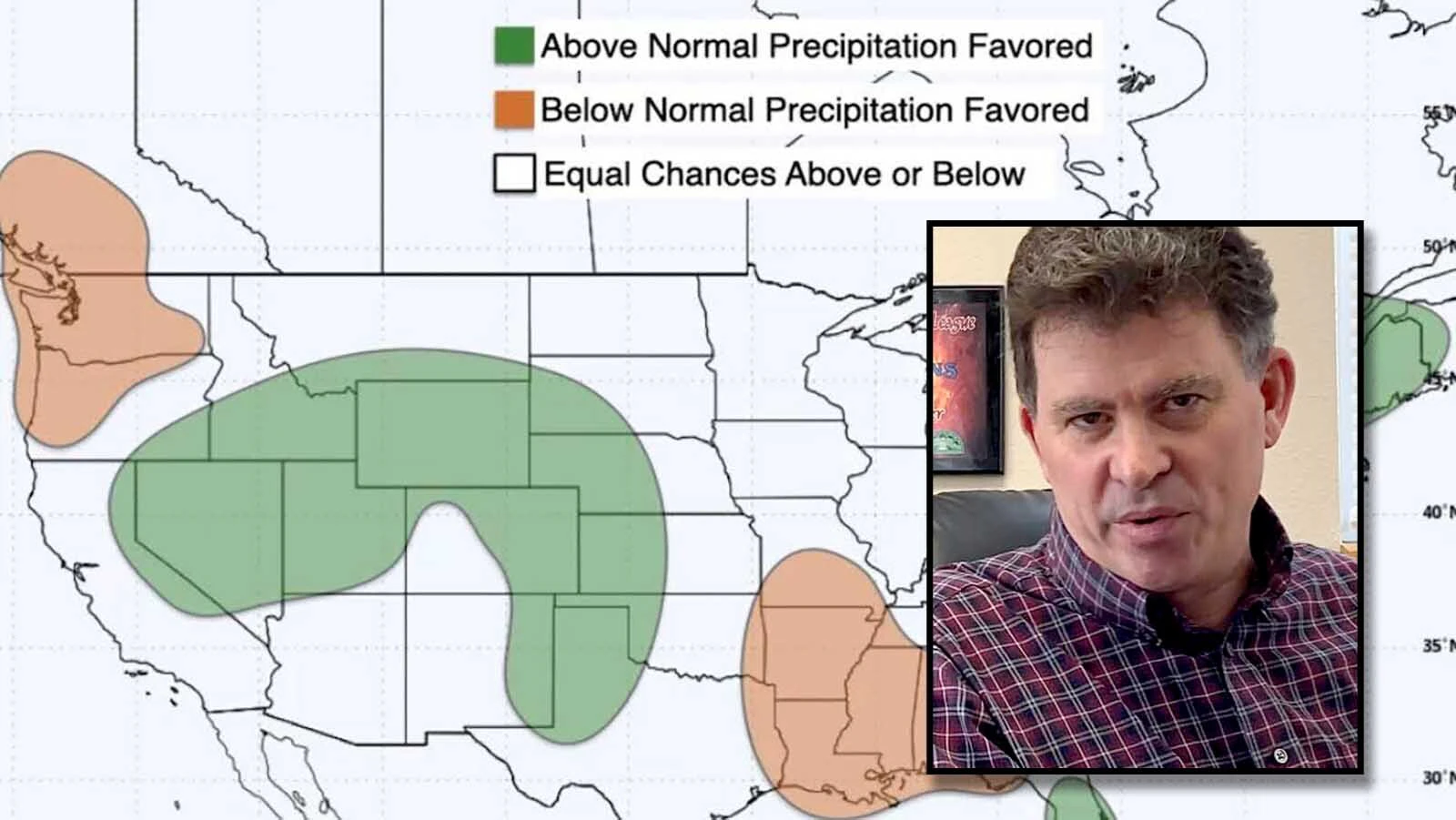
After one of the worst winters on record in Wyoming, a popular weather forecasting website is predicting a wetter-than-usual summer, but meteorologist Don Day is skeptical and warns against counting on the prediction to come through.
A 2026 summer forecast put out by OpenSnow includes a map showing a promising prognosis of above-normal rainfall across the entire state of Wyoming, and most of Idaho, Nevada, Utah, and Colorado.
The area projected to get “above normal precipitation” is outlined on the map with a giant green blob that resembles a cashew.
Cowboy State Daily meteorologist Don Day saw OpenSnow’s assessment and map, and a quote immediately flooded into his mind.
“A meteorologist friend came up with the expression, ‘Beware of the green blob,’” he said. “You have to be very careful when it comes to green blobs.”
The Source
Meteorologist Alan Smith with OpenSnow published his Summer 2026 outlook last week.
It incorporates data from the National Oceanic and Atmospheric Administration (NOAA) with a strong emphasis on the developing El Niño in the Pacific Ocean, as of April 2026.
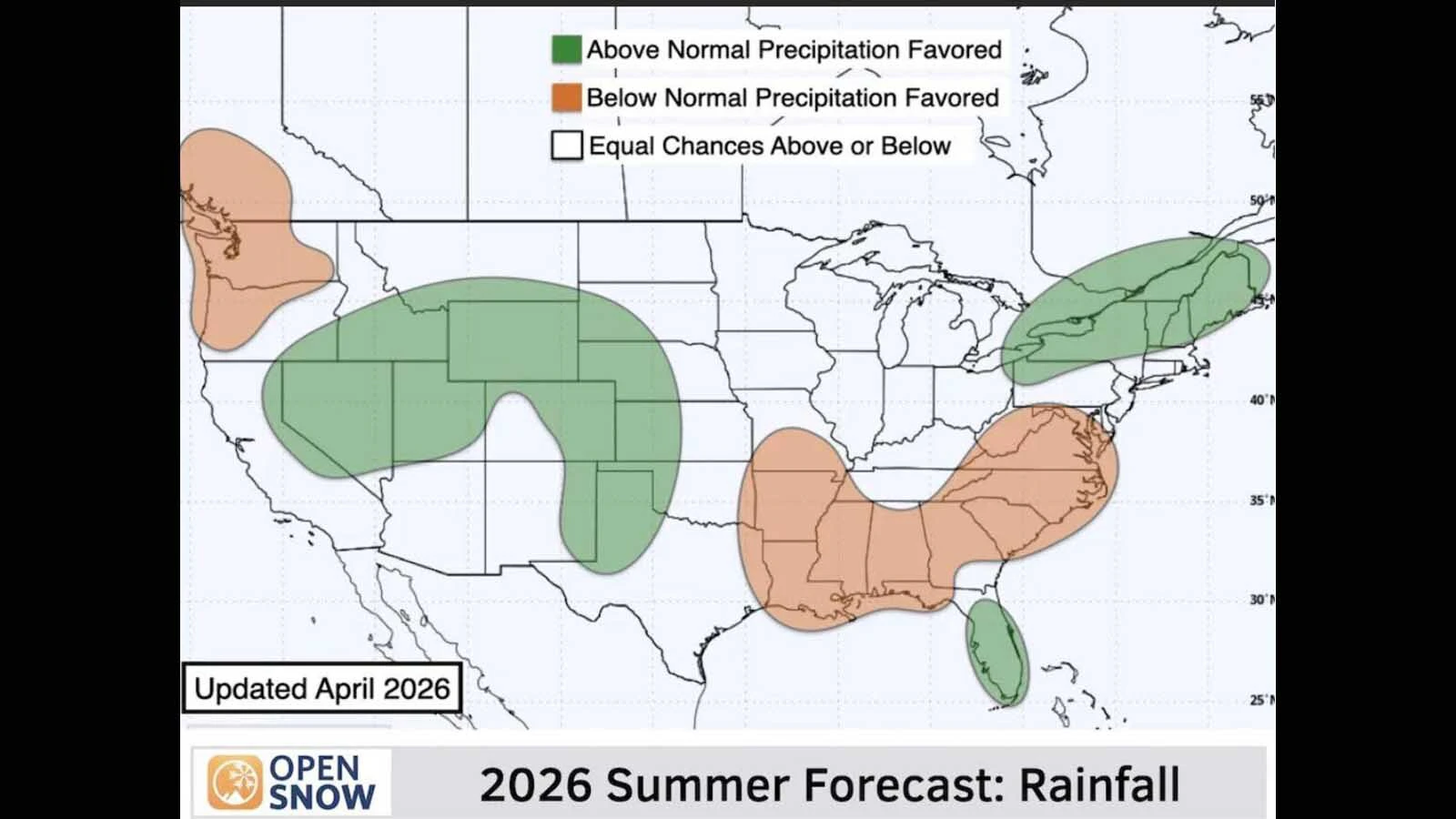
Smith published a map of the United States with green and brown blobs indicating areas of above- or below-average precipitation for the months of June, July, and August.
“Emerging strong and east-based El Niño summers have a clear signal toward above-average rainfall in these green-shaded areas across the West,” Smith wrote. “The connection is less clear across the core monsoon region of the Southwest and across the Northern Rockies.”
The green-shaded area Smith mentioned is a blob of above-normal precipitation stretching from eastern California to central Nebraska and Kansas, and from southern Montana to the eastern edge of Arizona. It also covers all of Wyoming.
“Based on the above factors and analog years evaluated, in the West, we are expecting above-average late spring and summer rainfall across the Sierra, Great Basin, Central Rockies, Front Range, and High Plains, with equal chances of above or below normal rainfall across Arizona, New Mexico, and Southwest Colorado,” Smith wrote.
But is that a precipitation promise or just another flaccid forecast?
Openly And Overly Optimistic
When Day reviewed OpenSnow’s forecast, he had some immediate critiques. For one, it’s OpenSnow.
“OpenSnow takes great liberties with long-range computer modeling,” he said. “Those are the guys who were putting snow all the way to Florida one winter.”
Nevertheless, Day acknowledged there’s some solid data backing up OpenSnow’s forecast, particularly when it comes to El Niño’s impact on the Western United States.
“The historical precedent is that usually when the El Niño comes in late spring into early summer, it does tend to make June and July wetter,” he said. “I think a lot of people are seeing some of the long-range models in the month of June being somewhat hopeful for that.”
OpenSnow also cited three analog years as “the strongest match” for what they’ve forecasting for the summer: 1997, 2015, and 2023.
Day said that modern weather modeling and historical precedent are “giving everybody hope" for a strong El Niño, and there are reasons to be hopeful. However, he’s not fully indulging in that hope.
“I can tell you, based on our experience this winter, that you can have another blocking pattern set up that wasn't anticipated and completely blows up every long-range forecast,” he said. “Nobody anticipated what happened this winter, including the models.”
Beware The Green Blob
Green blobs are a regular and reliable source of hopefulness on weather maps. NOAA and the National Weather Service use them to show a generalized area of above-average precipitation.
Thanks to Day’s friend, he knows to “beware the green glob.” They might not be inaccurate, but tend to be overly simplistic.
Wyoming is a perfect case study, Day said. The Cowboy State rarely has a “one-size-fits-all” forecast because it’s a large state with significant topographic changes in all directions.
The green blob on OpenSnow’s map covers all of Wyoming and at least a portion of 12 other states.
That’s a massive area to cover with a generalized forecast, especially when it’s rare for both sides of the same Wyoming mountain range to have the same weather over an extended period.
“You have to be careful when you’ve got a green blob covering that much of the Western U.S.,” Day said. “That blob wouldn’t be equally across the state, let alone 13 states."
Also, it’s worth noting that OpenSnow’s map was based on April information. Trends have stayed consistent since then, but that doesn’t mean the models are making the exact same calls.
But What About Super El Niño?
OpenSnow, like many weather outlets, partially framed its Summer 2026 forecast through the lens of a possible Super El Niño.
“Heading into the summer of 2026, confidence is high that El Niño conditions will develop, with a strong El Niño phase expected,” Smith wrote.
Day isn’t as bullish about a Super El Niño, even though a normal El Niño is all but guaranteed by the end of 2026. How that all-important weather system manifests will have wide-reaching implications that are notoriously hard to anticipate.
“We are undoubtedly going to have an El Niño, and it’s going to be a strong one, but I’m telling people to proceed with caution,” he said. “Making leaps into projections of what’ll happen six months down the road is not smart.”
Every seasonal forecast should be taken with “a grain of salt,” said Day, including his own. While it’s important to factor El Niño into extended forecasts, its impact is hard to determine until it arrives.
“There's a lot of hope that we can see that increased precipitation for June and into July because we're seeing the El Niño come on,” he said. “We've seen that uptick in June and July in years past.
“Some models are suggestive of that increase in precipitation this year, and some of them are not as suggestive.”
El Niño tends to favor above-average precipitation in Wyoming and the Western U.S., and the amount of moisture we received in May is an encouraging sign of strong shifts.
However, Day isn’t comfortable making a confident, blobby prediction for an entire season.
“When they draw these large blobs of green or brown, they can be misleading,” he said. “It’s just better to take it one week at a time, let alone three months out.”
Somewhere That’s Green
Overall, Day didn’t refute OpenSnow’s 2026 rainfall forecast for the U.S., as it could very well come to pass.
His critique was more about generalizing a confident outlook across a large area, given many complex meteorological and geographical considerations.
“Seasonal forecasts tend to be generous with green and brown blobs, but they’re very generalized,” he said. “You can have a lot of different results inside those blobs.”
The rest of OpenSnow’s assessment calls for above-normal precipitation in New England and Florida and below-average precipitation in the Pacific Northwest and a swath of southern states from Arkansas to Virginia.
Day usually sticks to Wyoming’s weather, except when he’s hot air ballooning, but those outlooks also strained credibility for him.
“I could look at other parts of the country and already say this forecast is not going to work out,” he said. “The southeastern United States is droughty, but they're getting a lot of rain right now, and they're going to get more.”
As for the three analog years, Day said that’s an “alright,” but far from a foolproof, way to anticipate what lies ahead.
“All three of those years were El Niño years, but they had different results in different locations,” he said. “Averaging those years together might not be the best practice.”
One outlier Day noticed is 2023, when Wyoming had a historically wet, chilly summer.
“That year was so big with precipitation, it could skew the average they’re anticipating,” he said.
Even if OpenSnow is right, that doesn’t mean the entire state of Wyoming is going to equitably benefit from the giant green blob. It’s too big and complex for that.
Day’s message to Wyomingites encouraged by OpenSnow’s outlook is to proceed with cautious optimism.
“We have to take this one step at a time,” he said. “A lot of people are comparing this El Niño to the really strong ones we’ve had in the past, but it's not apples to apples. You usually don't have an area that expansive where everybody gets above-average precipitation.
"That green blob could be accurate, but it’s very generalized."
Andrew Rossi can be reached at arossi@cowboystatedaily.com.


