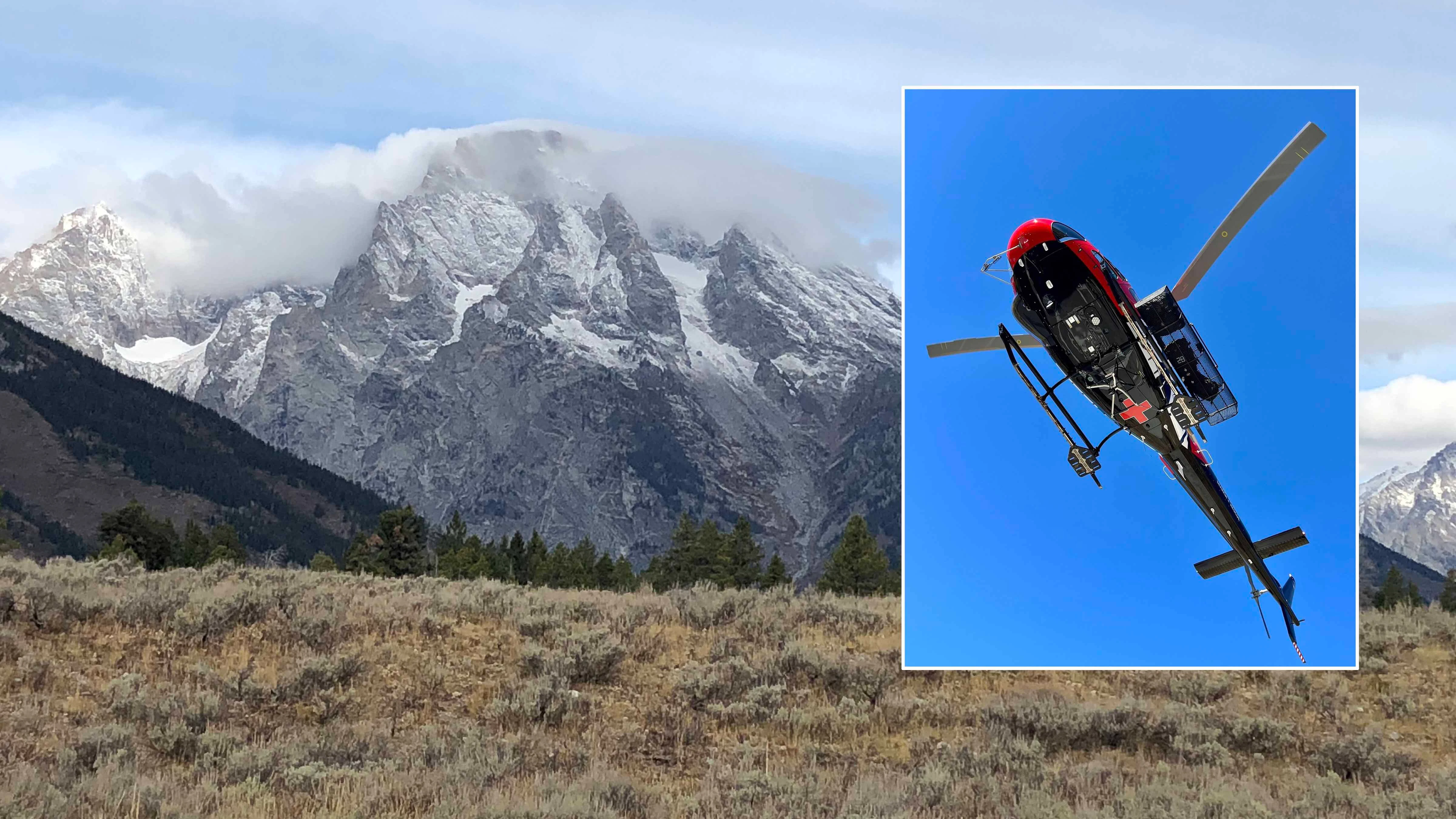
Two hikers on a multi-day excursion in Teton County were helicoptered out of the mountain range by Teton County Search and Rescue after becoming dangerously dehydrated in the snow-covered mountains.
Around 1 p.m. Monday, Teton County Search & Rescue (TCSAR) received an emergency alert for two backpackers in distress on the Death Canyon Shelf, a plateau on the Teton Crest Trail in Grand Teton National Park. Two men, ages 20 and 22, were suffering from intense gastrointestinal issues.
“Both had excessive vomiting and didn't feel like they were going to be able to get out,” Anthony Stevens, TCSAR’s chief advisor, told Cowboy State Daily. “They were unable to maintain hydration or food.”
The group of four hikers from Iowa told TCSAR volunteers via cellphone that they’d try to hike out of the mountains. After an hour, the two afflicted men were unable to continue.
TCSAR sent a helicopter to pick up the two men at Hurricane Pass, a mountain pass in the Alaska Basin within the Teton Range. They were flown to the TCSAR headquarters in Jackson but didn’t needed to be hospitalized.
“We gave them some Zofran to help control the vomiting,” Stevens said. “After they got to sit tight and recuperate a bit, we gave them some food and water, and they were able to get a ride back to their vehicle.”
The other two hikers in the group were able to hike out of the mountains and reunite with their peers.
“Last I heard from them, everybody was doing better, they’d gotten a meal in them, and they were starting to hydrate,” Stevens said.
Not A Drop To Drink
Death Canyon Shelf is a section of the 40-mile Teton Crest Trail. Stevens said the four-person group was on the second day of a multi-day excursion.
TCSAR routinely rescues people who’ve been seriously injured in Teton County’s backcountry. This incident was a little different.
“My guess is that they were dehydrated to the point that they couldn't hold down any fluids or food,” Stevens said. “It sounded like they weren't prepared to hit as much snow as they did in the high country when they were coming into Alaska Basin.”
According to Stevens, the group had expected to collect water on the trail. When they got up there, there was more snow than they anticipated, and the effort to get through exacerbated their dehydration.
The hikers seemed aware of their circumstances. Stevens said that at one point, they resorted to boiling snow to get drinking water.
“It sounded like they didn't have enough water between the four of them to maintain hydration,” he said. “They boiled what they could, but it wasn’t enough to maintain them for the amount of time they were traveling that day.”
If that seems unlikely, the National Weather Service says 1 inch of liquid water is equal to 12 inches of snow. You'd need a lot of boiled snow to sufficiently hydrated one person, let alone four hikers on a high-elevation hike.
That’s why the two rescued hikers didn’t need to be hospitalized once they reached Jackson. Once they stopped vomiting and started to rehydrate, they recovered.
Stevens asked whether their condition was related to high altitude, since Alaska Basin is above 10,000 feet. The hikers told him it wasn’t.
“They’re from Iowa, but they said they had all been at altitude before,” he said. “They just hit a lot of snow and did a lot of post-holing, and that’s exhausting. They definitely struggled up there.”
Simple Swoop And Scoop
Stevens said this incident wasn’t due to lack of experience or preparedness on the hikers’ behalf. They were prepared for an intense, high-altitude backcountry hike.
“I don’t know what they did for trip-planning or prep, but they definitely had had the gear to be out there for a couple of nights,” he said.
Despite the overall below-average snowpack across Wyoming, areas above 9,500 feet still have significant snow accumulation. Even in late May, TCSAR encourages hikers in the Tetons to bring ice axes and crampons in case they encounter impassable snowbanks.
In this case, the moral of the story is to bring enough water for a multi-day, high-energy excursion. Finding drinkable water in the mountains is a reliable workaround, but not always an option.
For TCSAR, the entire mission took four hours. It was what Stevens called a simple “swoop and scoop.”
“It was just a couple of kids unable to maintain hydration who didn’t think they were going to get out,” he said. “They didn’t expect to encounter as much snow as they did.”
Andrew Rossi can be reached at arossi@cowboystatedaily.com.