
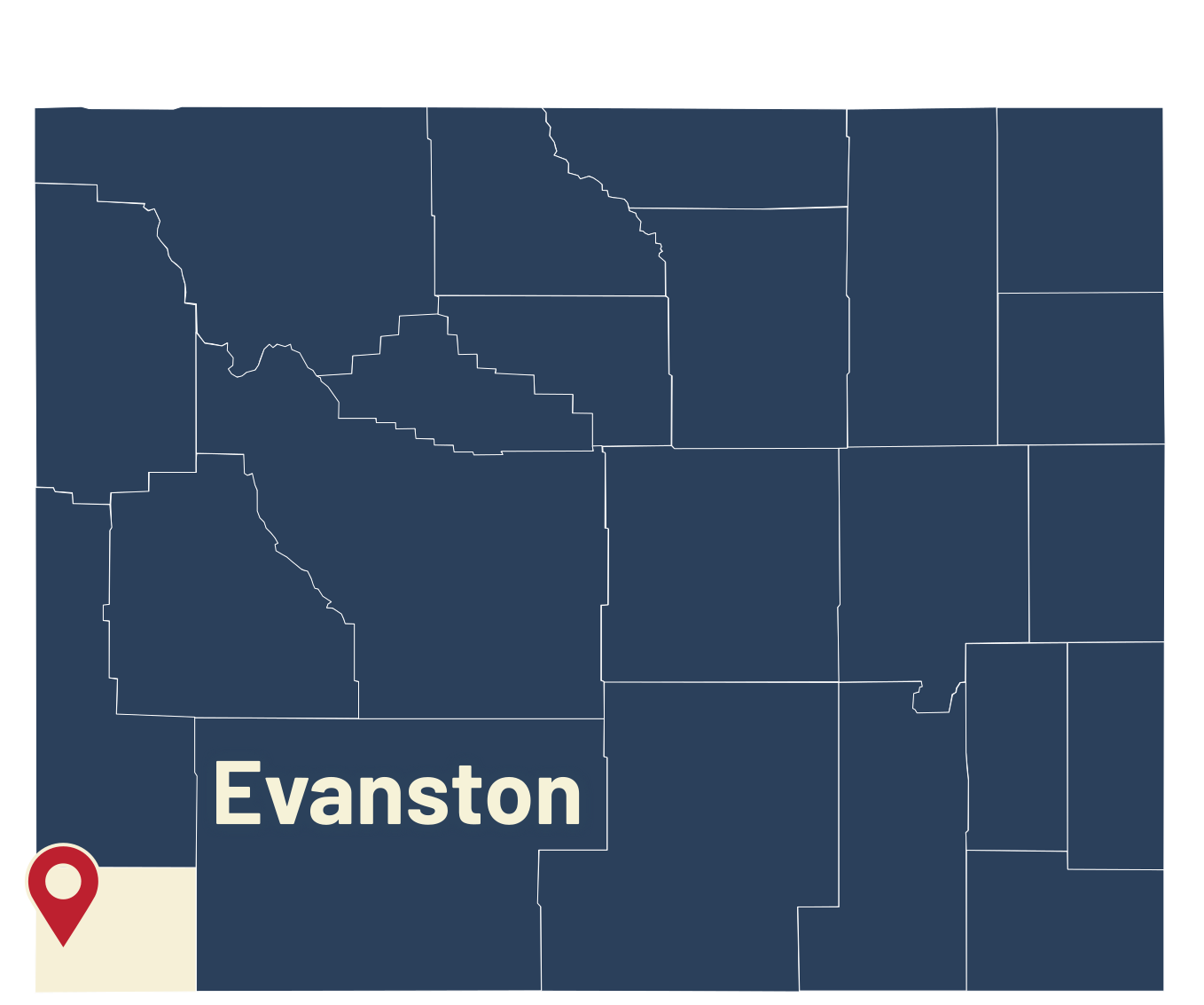

EVANSTON — Prometheus Hyperscale laid out a vision for its massive 1.2 gigawatt data center campus on a ranch east of town owned by native Trenton Thornock. It’s a place where cattle still graze and the residents prize open country and sky.
That includes Thornock, the fifth-generation ranching family member told a packed room of Uinta County residents, many of whom are wary of becoming the next front in Wyoming’s data center boom.
“Our family ranches here, and my great-great-grandmother homesteaded here down Bear River back in 1869,” Thornock said. “I started the company because I saw two things that were wrong with the data center industry.
"They’re using way too much power for the amount of compute that they’re getting out and they’re using way too much water for cooling.”
Thornock said he started his company in 2020 with the idea of first innovating water cooling systems and doing things in a more sustainable way and second improving the economy of his home state.
Wyoming has struggled with outmigration of its youth, losing most of them by age 30 to other states.
It’s a dynamic Thornock, as a Uinta County native, said he's all too familiar with. He knows plenty of his Wyoming friends who wanted to stay in Wyoming, but couldn’t find high enough paying jobs to support a family.
His thought was that data centers could be part of a new story that changes that dynamic.
That’s one of the reasons he settled on a “bring-your-own-power” approach. Because of severance taxes paid on every molecule of natural gas used, that would be the best way, he figured, to support the state.
“Instead of exporting all of this economic value from the gas that’s produced here in Wyoming like we’ve always done, the point is to consume that here, do the compute here, have the property taxes from these facilities here to support our tax base, to support our schools, and all the other county services,” he said. “That’s my reason for doing this project.”
Thornock’s data center would be built on family-owned ranch land near the Silver Eagle refinery.
This, he added, is not a case where some billionaire from far away is coming to buy up Wyoming land. This is a born-and-raised Wyomingite, wanting to make a difference for his home town.

More Than Just Water, Power Questions
Prometheus Hyperscale has faced a rising tide of opposition against data centers amid broader concerns gripping the state, following a surge of as many as 70 data centers headed for Cheyenne.
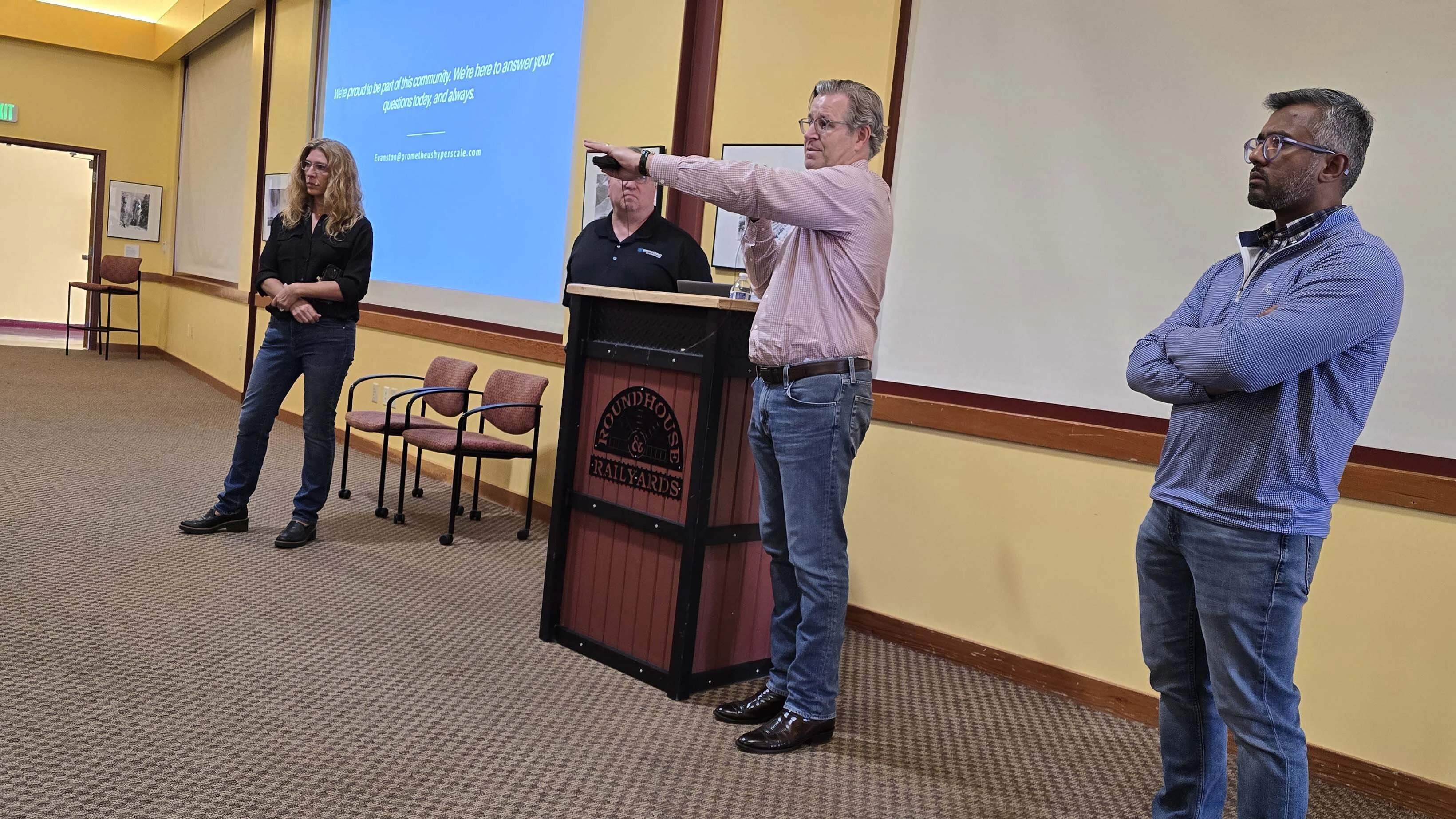
The meeting Tuesday was informational to answer questions from Uinta County residents about the company’s plans — and they had plenty.
It wasn’t just the usual gamut of water and power use issues.
People wanted to know who the tenants were, who would be minding the man camps and policing any crimes, whether public officials have signed any non-disclosure agreements, and whether there are any federal, state, or local subsidies, tax abatements, or special utility deals.
As far as tenants, Thornock said he’s not able to reveal the tenants just yet because they’re not yet ready to go public.
However, he would say that he’s signed a binding agreement with a tenant that restricts future owners of the facility.
“It will not be sold to certain types of entities,” Thornock said. “And there are at least five Chinese names on that list.”
Thornock revealed that he’d gone through a full-blown process early on to bring in a tenant, and ultimately had to reject the contract when he learned that the tenant would have been Chinese-owned ByteDance.
“So we’ve waited two more years to get to someone we think is the right person to have in this county,” he said.
There were questions as well about Prometheus CEO Bernard Looney’s ties to the World Economic Forum, as well as his ties to Blackrock, his involvement in environmental, social, governance (ESG) measures during his tenure as CEO of BP.
Thornock had to say, more than once, that he hasn’t requested any abatements, nor is he accepting any government funding. Looney, he explained, made a better CEO than himself for the sake of name recognition.
“No one knows who Trenton Thornock is on Wall Street,” he said. “They don’t care who I am. The CEO of the company, Bernard Looney, everyone knows him. Jamie Dimon knows him. The head of Blackrock knows him. He’s the reason we had a CEO change, to go raise the money for private markets.”
All of the equity, all of the debt, will be raised from private investors using a bond offering that will be managed by Morgan Stanley.
Not Remote Jobs
Uinta County Commissioner Mark Anderson told Thornock and his team that he’d been engaging with local residents for the past two weeks, and that he had a long list of questions from them.
Chief among them was whether the 200 long-term jobs the data center projects it will have once operational will be actual jobs for people residing in Uinta County.
“Or will these be jobs created for somebody to sit and operate remotely?” Anderson asked.
The jobs will not be remote, Anderson was told, and the company is taking extra steps to try and hire as many people locally as possible.
“The way we’re going to do it here is that we’re first going to post all these jobs locally so that we can pull all the talent that’s here or people who are interested in getting a job there,” Thornock said. “And I can tell you what the wages are, because they’re kind of the same across the industry.
"These 200 jobs range from $75,000 a year on the low end to about 150 on the high end. They’re good jobs … and these jobs will come with all the benefits. You’ll have bonus, you’ll have overtime, vacation, full healthcare, 401K — all the things that you want that I don’t have working for a startup.”
The data center will bring “a lot of advancement in the learning and the workforce,” Prometheus Head of Construction Ahmed Anwar said.
“When you talk about direct construction, we’ll need electricians, we’ll need pipefitters, we’ll need ironworkers,” he said. “Pretty much any trade that supports an oil and gas field, any type of power plant project, those are the same types of trades that we’re looking for as we build data centers.”
Minimizing Water Use
In a state where ranching and water rights are existential issues, residents pressed hard on water use and power use.
Thornock spent the most time addressing questions about those issues, explaining that his data center will use a closed-loop, liquid cooling system similar to the radiator of a car.
Unlike the radiator of car, the cooling loop for the data center will be filled with a propylene glycol water mixture referred to as PG25.
Propylene glycol is an additive that’s been generally recognized as safe by the Food and Drug Administration for food, cosmetics, and pharmaceuticals.
It has a variety of uses including as an anti-caking agent, as well as an emulsifier or stabilizer. It’s also useful as a humectant — absorbing and retaining moisture — which helps keep baked goods fresh and soft.
PG25 is good for around six years, after which it requires recharging. That will be done off-site by a chemical supplier, which will manage trucking the fluids in and out of Wyoming.
The spent fluid will not be released into local well water. It will be drained and sealed into 1,000-gallon drums or containers and shipped off either for recycling or disposal in a Class VI well.
The only well water the site will use is for domestic uses such as employees washing their hands when they use the restroom.
The company also promised it would report daily water extraction from its wells on a portal, so that residents can track usage.
Staying Off Grid
As far as energy, Prometheus is proposing a fully off-grid power strategy that will be built around on-site natural gas generation through the Kern River pipeline, which already loops through that area.
“Because we’re not connecting to the grid, there’s zero impact on your rates, because we are not connecting to Rocky Mountain Power,” he said. “The rules in Wyoming are such that we can consume our own electricity on site, and we’ll have to abide by all regulations.”
The type of power generation will be natural gas reciprocating engines, which Thornock said will use very little water.
“We’re talking about, on a per engine basis, a couple of Yeti cups per day,” he said. “So it’s not significant. And when we get to the larger turbine generation, those will be cooled with dry coolers, similar to the data center, so there’s no water consumption there either.”
Thornock further committed to paying for municipal fire protection, road maintenance, and emergency service responses required by the facility, and said the company will be working with Target Hospitality to provide workforce housing to avoid affecting the local housing market.
Wyoming’s abundant gas resources and existing gathering systems, meanwhile, mean that production can increase with demand without dramatically spiking prices for that resource, while simultaneously supporting the state through severance taxes.
Why Data Centers Matter
Swipe a credit card, and you’re interacting with a data center somewhere. Go to a gas station and use a preferred shopping card, and you’re interacting with a data center somewhere else.
“Our health care rules have been focused around the fact that all the records are in data centers,” Prometheus Hyperscale Head of Global Infrastructure James Faccone told the standing-room only crowd at Evanston’s Roundhouse on Tuesday.
“So, as much as we think we might be trying to avoid data centers, they’re here to stay,” he said. "They are very much part of our life, and they bring us a lot of value.”
That frames the Evanston project as part of a broader shift in “critical infrastructure,” akin to things like hospitals, military installations, and other complex facilities that require operations, maintenance, and security personnel to run safely and reliably.
Inside these data centers, there are hundreds of computers sitting in rows on server racks, supported by intricate systems that require skilled jobs and long-term technical capabilities who both work and live in their host communities.

Overall Economic Impact
An economic analysis commissioned from the University of Wyoming projects a $3.1 billion economic impact in Uinta County through 2032, with hundreds of permanent jobs and hundreds more indirect positions once the campus is fully built out.
Statewide, the economic impact for Wyoming is $184 million through 2029, Thornock said, with a $40 million impact to Uinta County over the same period.
Once operational, it will be good for $53 million annually to the state, largely from severance taxes on natural gas consumed on site, and roughly $13 million per year in county and sub-county impact, which includes property taxes.
These revenue streams would help stabilize a county whose tax collections have been buffeted by swings in oil, gas and coal, Thornock said.
The biggest beneficiary will be school districts, he added, followed by fire districts, roads, infrastructure, public safety and county government.
Continued Engagement
With opposition to data centers rising across the Cowboy State, residents have voiced concern that Prometheus’ data center campuses are large enough to still put pressure on local water supplies and the regional power grid even with these efficiency measures in place.
Along with the Uinta County project, the company also is moving forward with a data center in Natrona County.
They’ve had a long list of growing questions from residents, ranging from what the campus will look like on the ground to how it might affect everything from housing and traffic to emergency services.
Prometheus has promised to engage with those concerns directly through community benefit agreements and local-hiring priorities through a broader “Build Wyoming” message that pitches data centers as a tool to fight the state’s brain drain and keep more young people working at home.
Company officials have said construction is expected to begin on the Evanston data center within six to nine months, with an eye to starting operation sometime in 2027.
Tuesday’s informational meeting was the latest opportunity for residents to weigh those assurances, ask detailed questions about water and power use, and help shape how this ambitious AI campus, if built, fits into Uinta County’s future.
Renée Jean can be reached at renee@cowboystatedaily.com.


