
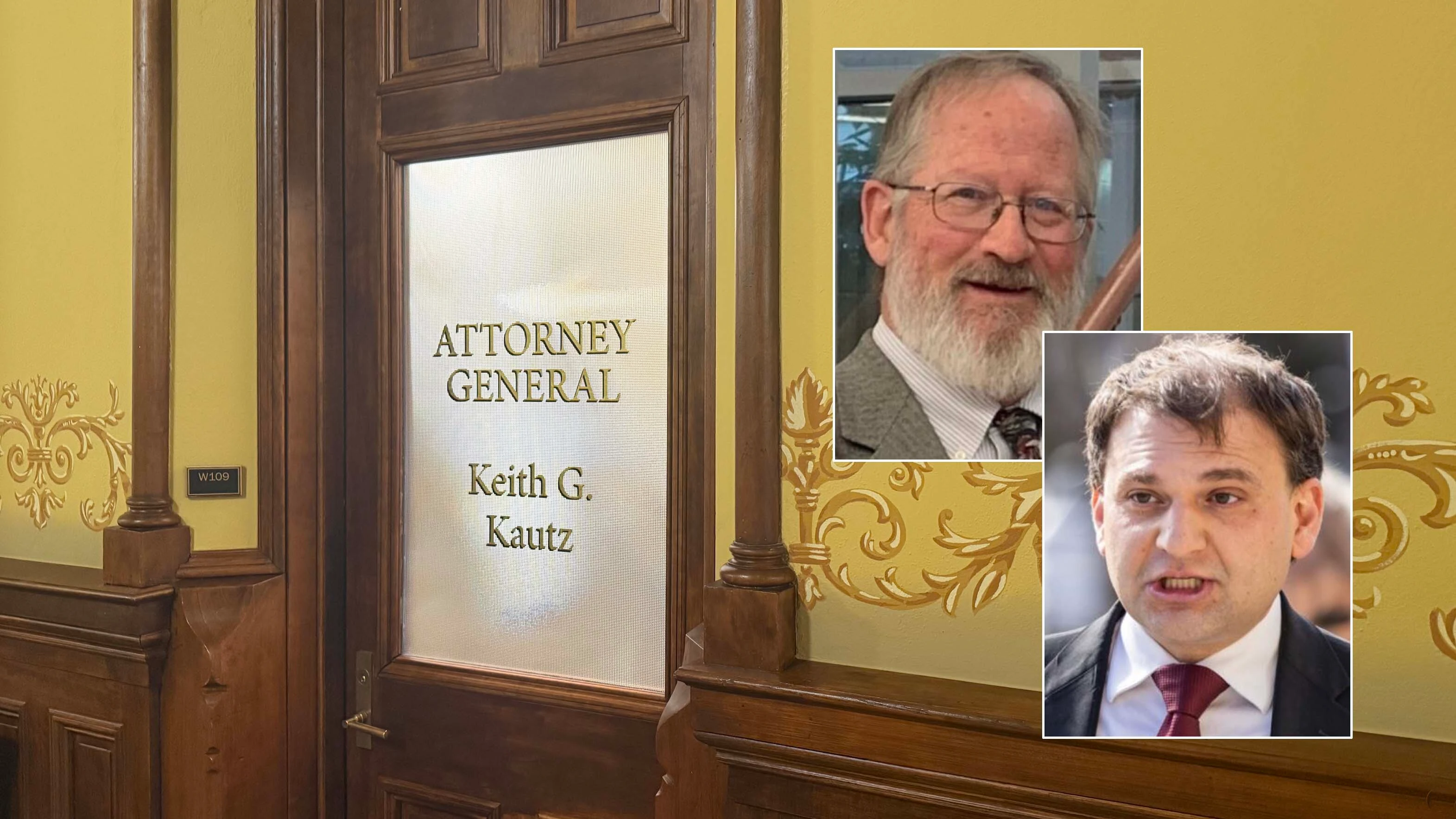
The Wyoming Attorney General’s Office said Monday that Secretary of State Chuck Gray doesn't have to release the legal advice he may have received before handing sensitive voter data to the federal government.
Gray last year gave the U.S. Department of Justice voter registration records for Wyomingites that include birth dates, driver’s license numbers or the last four digits of Social Security numbers, public records indicate.
George Powers, a Cheyenne-based attorney who successfully waged a transparency case against a different state agency in 2023 and 2024, started pushing Gray this year to reveal what legal advice, if any, prompted him to hand voters’ information to the federal government.
Wyoming election law says:
“Election records containing Social Security numbers, portions of Social Security numbers, driver’s license numbers, birth dates, telephone numbers, tribal identification card numbers, e-mail addresses and other personally identifiable information … are not public records and shall be kept confidential.”
Citing that law, Powers in an April 13 filing also asked Wyoming Attorney General Keith Kautz to have a special prosecutor appointed to investigate whether Gray could face a misdemeanor criminal charge under that ban, and an umbrella felony for election officials who violate election law.
In that filing and its April 17 supplement, Powers asserted repeatedly that Gray, by telling the public he’s worked in “close consultation” with the attorney general’s office, and that the attorney general approved the release of voter rolls, Gray has waived his attorney-client privilege.
Waiving one’s attorney client privilege empowers the attorney to tell others what his advice was.
Mackenzie Williams, deputy attorney general for Wyoming, disagreed in strong terms, in a Monday letter to Powers.
“At no time did the Secretary reveal the substance of any attorney-client communications,” wrote Williams. “You are incorrect about the law, and your previous statements to the contrary are irresponsible and mislead the public.”
Williams noted that public records in Wyoming exclude privileged records.
Powers and Williams pointed to cases that support their differing stances on the matter.
“You have publicly and repeatedly stated that by simply noting that he is relying on attorney advice, the Secretary has waived his privilege,” wrote Williams. “I can only conclude that you are unfamiliar with Oil, Chemical and Atomic Workers Int’l Union v. Sinclair Oil Corp.”
That’s a 1987 Wyoming Supreme Court case in which a litigant argued that one of the people deposed in the case had waived privilege for noting he’d received advice from his attorney.
“The Supreme Court quickly and easily rejected the waiver argument,” says Williams’ letter.
Williams pointed to federal trial courts that came to similar conclusions, in cases from Kansas and the Northern and Southern Districts of Ohio.
He also noted that the U.S. Supreme Court has recognized that the privilege’s purpose is "to encourage full and frank communication between attorneys and their clients" and that the Wyoming Supreme Court voiced agreement, writing, "(a) client would be reluctant to confide in his lawyer and it would be difficult to obtain fully informed legal advice" without that confidentiality.
Powers told Cowboy State Daily on Tuesday that he’s still digesting Williams’ letter.
There are ways to settle disputes regarding attorney client privilege, he said, but it’s too early for him to comment on the correct steps in this case.
Meanwhile, around six red states and several more blue states are fighting similar cases in which the DOJ is demanding their voters’ data.
The ‘Lunacy’
Gray in a text message response to Cowboy State Daily’s request for comment on Powers’ April 17 filing said the supplement was “more lunacy and lawfare from a radical leftwing attorney George Powers who has Trump Derangement Syndrome and whose false claims with zero substantiation are being repeated by the leftwing media in a coordinated attack on the truth.”
Gray continued: “Powers (sic) continuing claim that we have waived privilege is ridiculous, and is being sensationalized by the leftwing media.”
He noted the other red states that have handed their voter rolls to the DOJ. The agency and Gray both had that figure at 17.
“After approval from the Wyoming Attorney General, I complied with a lawful request under law to work with law enforcement to advance election integrity,” wrote Gray at the time.
Clair McFarland can be reached at clair@cowboystatedaily.com.


