
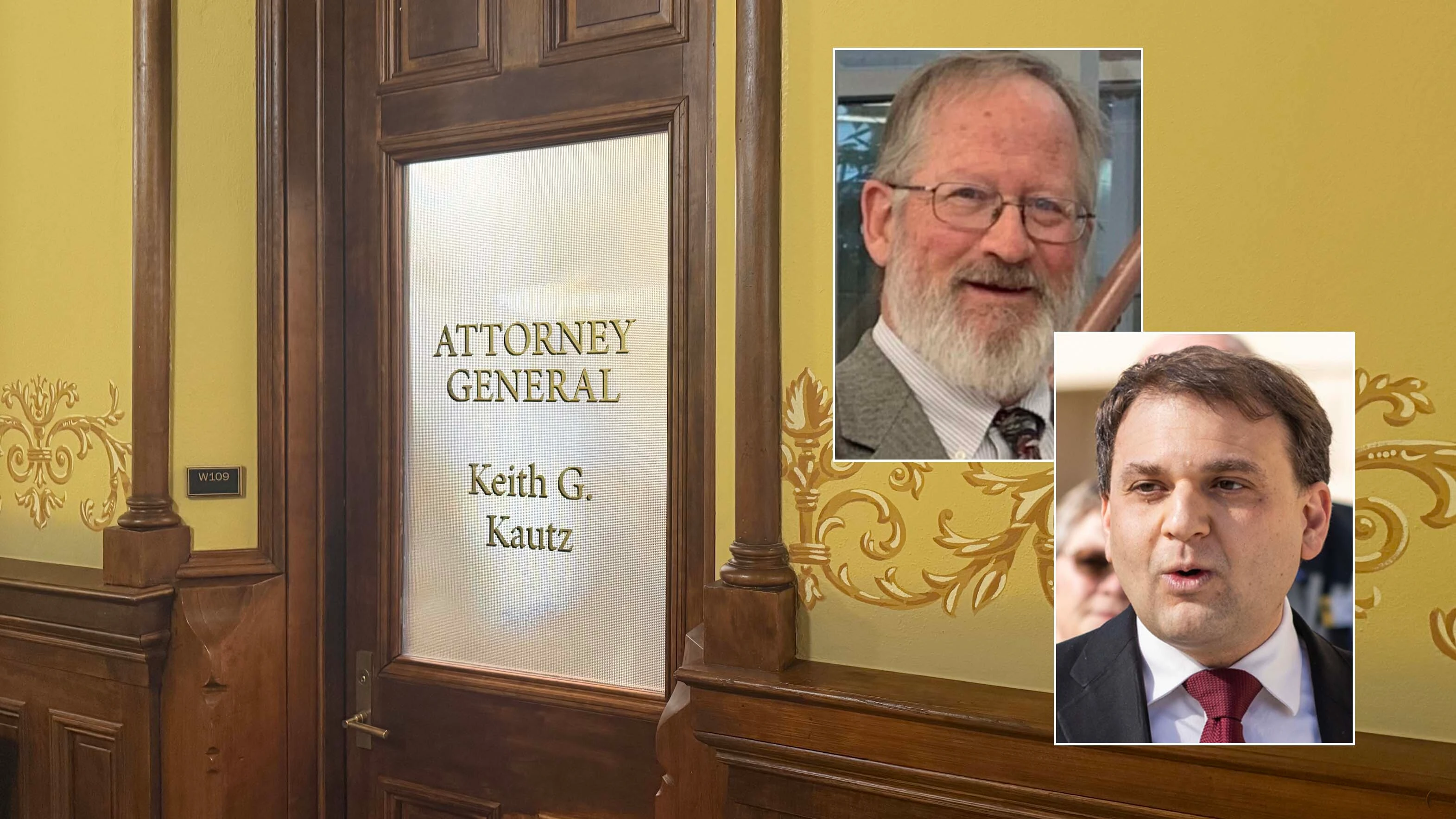
A Cheyenne-based attorney who won a court fight for more transparency in 2024 is now asking Wyoming authorities to investigate Secretary of State Chuck Gray on suspicion of election-related crimes.
George Powers on Monday submitted a complaint to Wyoming Attorney General Keith Kautz, alleging “there is a reasonable basis to believe” that Gray violated the state’s election law by giving sensitive voter data to the U.S. Department of Justice (DOJ).
“When Secretary Gray released the unredacted (voter rolls) to DOJ, he willingly and knowingly released information that was confidential under Wyoming law,” wrote Powers. “He released these confidential records in response to a mere request.
"He was never served with a subpoena or court order. He was never compelled to release these records. He simply turned over records that were protected by Wyoming law without objection.”
Gray in a Monday statement to Cowboy State Daily countered, asserting that, “The radical Left and the media will stop at nothing to undermine our work to ensure election integrity and security, and this is nothing more than Trump Derangement Syndrome, clothed in an attempt to use lawfare and the leftwing media to attack my actions on election integrity.”
Special Prosecutor
Because Gray has said repeatedly in public statements that he complied with a “lawful” request from the federal government “in close consultation” with the Wyoming Attorney General’s Office, Powers is asking Kautz to have an independent third party, like a district court judge, appoint a special prosecutor to consider potential criminal charges against Gray.
That’s to avoid any potential conflict of interest and to recognize that Wyoming Attorney General’s Office personnel may have to testify if a case surfaces against Gray, Powers wrote.
Powers also questioned the extent of Gray’s communication with the attorney general’s office, and disputed that those communications fall under attorney-client confidentiality protections.
Gray has waived that confidentiality protection by making “repeated public statements asserting his reliance on this ‘consultation’ as a possible justification for his decision to release confidential voter information in violation (of state law),” wrote Powers.
Powers pointed to two election laws: a misdemeanor ban on releasing confidential voter information, and an umbrella felony penalty for election officials who violate the election code.
The first is punishable by up to six months in jail and up to $1,000 in fines; the second by up to five years in prison and up to $10,000 in fines, plus removal from office.
‘State Citizenship List’
Powers’ complaint says Gray handed the federal DOJ an unredacted state database of voters’ personally identifying information, including birth dates, partial Social Security numbers, and driver’s license numbers.
The attorney pointed to a March 31 executive order in which President Donald Trump directed the U.S. Department of Homeland Security to develop a “state citizenship list” of eligible voters for each state using all federal databases, to withhold mail-in ballots from anyone not on those lists.
“Nothing will prevent the confidential personally identifying information that Secretary Gray turned over to DOJ from becoming part of those expanding federal data bases,” wrote Powers.
Alongside Laramie-based attorney Rodger McDaniel, Powers in 2023 sued the Wyoming Department of Education for public records act violations it committed during the administration of state Superintendent of Public Instruction Brian Schroeder.
The two won the case in 2024, when a Cheyenne-based judge ordered the department and some of its top officials to pay fines for the breach.
Gray’s Statement
Gray in his Monday statement said Powers is trying to use his law license “to threaten and intimidate our office for our work on election integrity.”
Gray compared this to when another attorney Tim Newcomb, challenged him in 2024 over Trump’s eligibility to appear on the state’s election ballot.
“George Powers is now attempting to use lawfare to remove me from office because of my decision to work with the Trump Administration to advance election integrity and to ensure Wyoming's compliance with federal law,” said Gray.
“But just like Tim Newcomb's repeated attempts to remove me from office for my work on election integrity, the Democrats' false clains (sic) are driven by Trump Derangement syndrome and left-wing hysteria, not the truth,” he said. "These claims are false, defamatory, and made with malice."
Gray said he stands by his decision to work with the Trump Administration “to advance election integrity.”
“I have worked to maintain compliance with the law and these actions have been carried out in close consultation with the Attorney General,” Gray continued, adding that he supports fully Trump’s work “to advance election integrity, and will continue to advance election integrity.”
Gray concluded: “The radical Left's actions here are deeply troubling.”
‘All Fields’
The DOJ last June asked Gray for information about Wyoming’s compliance with federal election laws. It also asked for Wyoming’s statewide voter registration list, public documents show.
Gray wrote the federal agency back July 24. He described Wyoming’s handling of election security and maintenance measures, and said a public-facing copy of the voter rolls had been uploaded into a federal database.
U.S. Assistant Attorney General Harmeet Dhillon voiced dissatisfaction with that in an Aug. 14 response to Gray.
“We have received Wyoming’s statewide voter registration list,” wrote Dhillon. “However, as the Attorney General requested, the electronic copy of the (voter rolls) must contain all fields, including the registrant’s full name, date of birth, residential address, his or her state driver’s license number or the last four digits of the registrant’s social security number.”
Dhillon said that was required under the Help America Vote Act.
Gray wrote back in an Aug. 28 letter.
“We are satisfying this request,” he wrote. “Upon review of the provisions cited in your letter, and discussion of the applicable provisions of the Civil Rights Act with the Wyoming Attorney General, we agree that disclosure of the requested records is proper under the Civil Rights Act.”
Gray referenced “assurances” from Dhillon that federal privacy protections would apply.
Powers’ complaint says the DOJ had no authority to demand the voter rolls under the Help America Vote Act, and the DOJ didn’t make any claim Wyoming had violated the act in the first place.
Dhillon had also hinged her demand on the National Voter Rights Act and the Civil Rights Act of 1960.
Powers noted that Wyoming is exempt from the National Voter Rights Act (NVRA), and he asserted that the Civil Rights Act (CRA) of 1960 doesn’t authorize the DOJ’s demand.
He said the DOJ is trying to “bootstrap” a broad investigative provision in the Civil Rights Act to requirements found in laws Congress passed much later, though the Civil Rights Act “was intended to address racial discrimination.”
“When Congress wrote the CRA, it could not have intended the CRA to serve as a vehicle to mandate disclosure of information in voting records … developed years later,” wrote Powers.
He also claimed that Wyoming’s voter rolls don’t fit the description of shareable documents under the relevant part of the Civil Rights Act.
About 30 civil and appeals cases on this topic are ongoing.
Four federal judges have dismissed the DOJ’s civil-court motions to force out confidential voter information from states. Those are in California, Oregon, Michigan and Massachusetts.
The federal judicial circuit to which Wyoming belongs, however, has an ongoing case of its own in the U.S. District Court for Utah.
Utah’s Republican lieutenant governor asked the court last month to dismiss the DOJ’s case against her. Her request is pending.
As for Powers’ argument, his complaint emphasizes that Wyoming statute 22-2-113(d) says:
“Election records containing social security numbers, portions of social security numbers, driver’s license numbers, birth dates, telephone numbers, tribal identification card numbers, e-mail addresses and other personally identifiable information other than names, gender, addresses, unique identifying numbers generated by the state and party affiliations are not public records and shall be kept confidential.”
The Complaint
Powers cites Wyoming statute 22-26-121(c) as the authority by which he’s filing his complaint.
A higher subsection of that law, subsection (a), says “any person may file a written complaint with the secretary of state regarding any violation of the Election Code,” by certain types of officials and organizations involved with it.
Normally, then, the secretary of state is the investigator when people allege that an election law has been broken.
Subsection (b) makes the county clerk the investigator, when the suspicion falls on certain local entities.
And subsection (c), which Powers invoked, makes the attorney general the investigator when the suspicion falls on the secretary of state.
It is common in Wyoming for the natural prosecutor of a case to ask for a special prosecutor, if the natural prosecutor feels he has a conflict of interest. That is what Powers is asking Kautz to do.
Kautz did not respond by publication to a voicemail request for comment.
Powers gave a brief phone interview Monday.
“I don’t think there’s anything we can do now, to correct the damage Chuck Gray did by releasing that confidential information,” he said. “But perhaps this complaint is one way we can hold him accountable for those acts.”
Clair McFarland can be reached at clair@cowboystatedaily.com.


