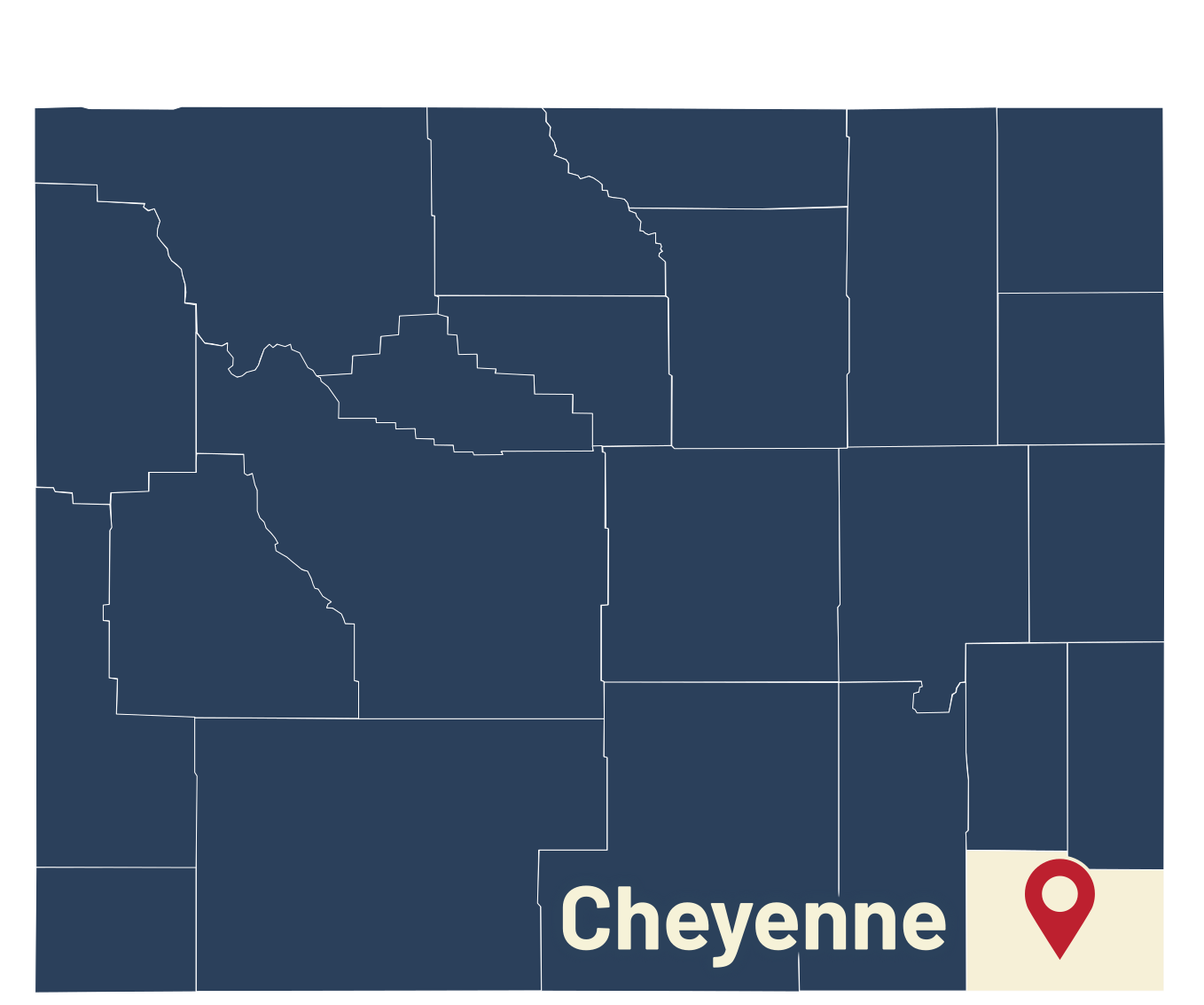
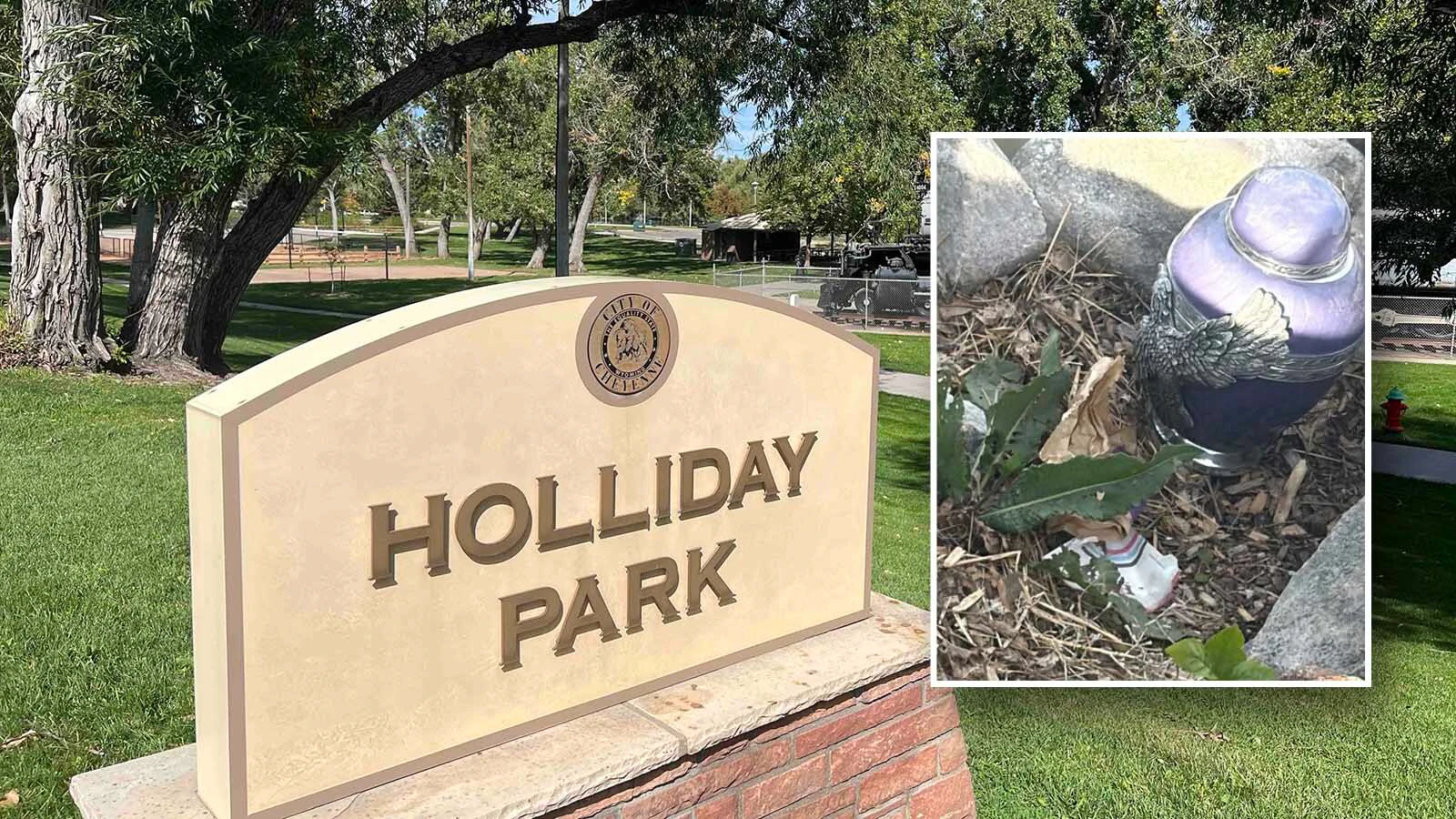
Richard Hartley was enjoying a warm spring afternoon at Holliday Park in Cheyenne when he noticed something strange sitting in the tall grass near a pavilion overlooking a playground.
It was a large purple urn, the kind used to hold cremains of loved ones who’ve died.
Children laughed nearby while families wandered through the park beneath sunny skies, seemingly unaware of the object partially concealed near the gazebo by the water.
Hartley said he immediately felt unsettled.
“I never touched it,” he told Cowboy State Daily. “I left it exactly where I found it.”
Still unsure what he had stumbled across, Hartley snapped a photo of the urn and uploaded it to a local community Facebook group with a simple question asking whether the urn belonged to someone.
The post quickly exploded with speculation.
One person briefly believed the urn may have belonged to his mother before realizing he was mistaken. Others insisted Hartley should leave it alone entirely.
“Mind your business,” another snapped.
A day later, someone else claimed also seeing the “big purple urn” near the gazebo and speculated that somebody may have placed it there intentionally.
Then came another update: “Police are currently trying to find it.”
According to the Cheyenne Police Department, officers were dispatched to Holliday Park around 3 p.m. May 11 on a report about the urn.
Police said officers conducted a “thorough search” of the surrounding area and park structures but were unable to locate it.
Which means that, for now at least, the purple urn remains what it’s been for nearly a week: a mystery sitting somewhere between grief, memory and disappearance.
Ashes To Ashes
For Laramie County Coroner’s Office Coroner Rebecca Reid, death is not only biological, it’s administrative, legal and deeply human.
She also said that people sometimes choose places like parks or public spaces that were special to loved ones to leave some of their ashes or another type of memorial.
“The coroner serves the living and is the advocate for the dead,” his her office's mission statement.
Most days, Reid’s work involves investigating sudden, violent, suspicious or unexplained deaths. Her office identifies the dead, notifies next of kin, signs death certificates and, in some cases, orders autopsies performed by pathologists.
Occasionally, though, the work arrives in the form of forgotten ashes left behind in attics, basements, storage units and, sometimes, public places.
Reid said situations involving misplaced, abandoned or unclaimed cremated remains occur “more often than people may realize.”
The coroner said people frequently leave cremated remains behind in homes and storage units after moving away or dying themselves. In those situations, the remains are eventually returned to the coroner’s office.
“If someone finds an urn in a park or other public area, the appropriate first step would be to contact the non-emergency dispatch line so a law enforcement agency can respond,” Reid said.
From there, law enforcement contacts the coroner’s office, which attempts to identify the deceased and locate relatives or legal next of kin.
Reid advises people not to open or unnecessarily handle urns discovered in public places.
While cremated remains do not pose an infectious disease risk, she said law enforcement and coroners are better equipped to properly document and handle them.
Under Wyoming law, cremains are legally considered human remains.
If the coroner’s office cannot identify the deceased or locate family members after exhausting available resources, the ashes are held for up to a year.
After that, unclaimed remains are buried together during a mass burial at a local cemetery.
It’s a strange and necessary corner of government work — one involving forgotten boxes, abandoned storage lockers and people whose final resting places never fully materialized.
Because officers never located the purple urn at Holliday Park, the coroner’s office was never formally tasked with taking possession of it or attempting identification.
Wyoming’s Geography Of Grief
But Reid said not every urn discovered outdoors is necessarily abandoned.
Sometimes, the place itself is the memorial.
“Often, those locations hold significant meaning to the individual or family,” she said. “It may be a favorite fishing spot, hiking area, park, or a place they frequently visited together.”
That reality makes particular sense in Wyoming, where people often tether memory to landscape.
A mountain overlook. A reservoir shoreline. A cottonwood-shaded park bench.
“For many people, returning to those meaningful places can provide comfort and connection as they grieve and remember their loved ones,” Reid said.
Maybe that’s why the purple urn struck such a nerve with people.
Some viewed it as suspicious. Others reacted almost reverently, as though disturbing it would interrupt something private.
“As we all experience loss in different ways, many people hold onto favorite or meaningful memories that help keep their loved one’s spirit and memory alive,” Reid said.
Kolby Fedore can be reached at kolby@cowboystatedaily.com.