
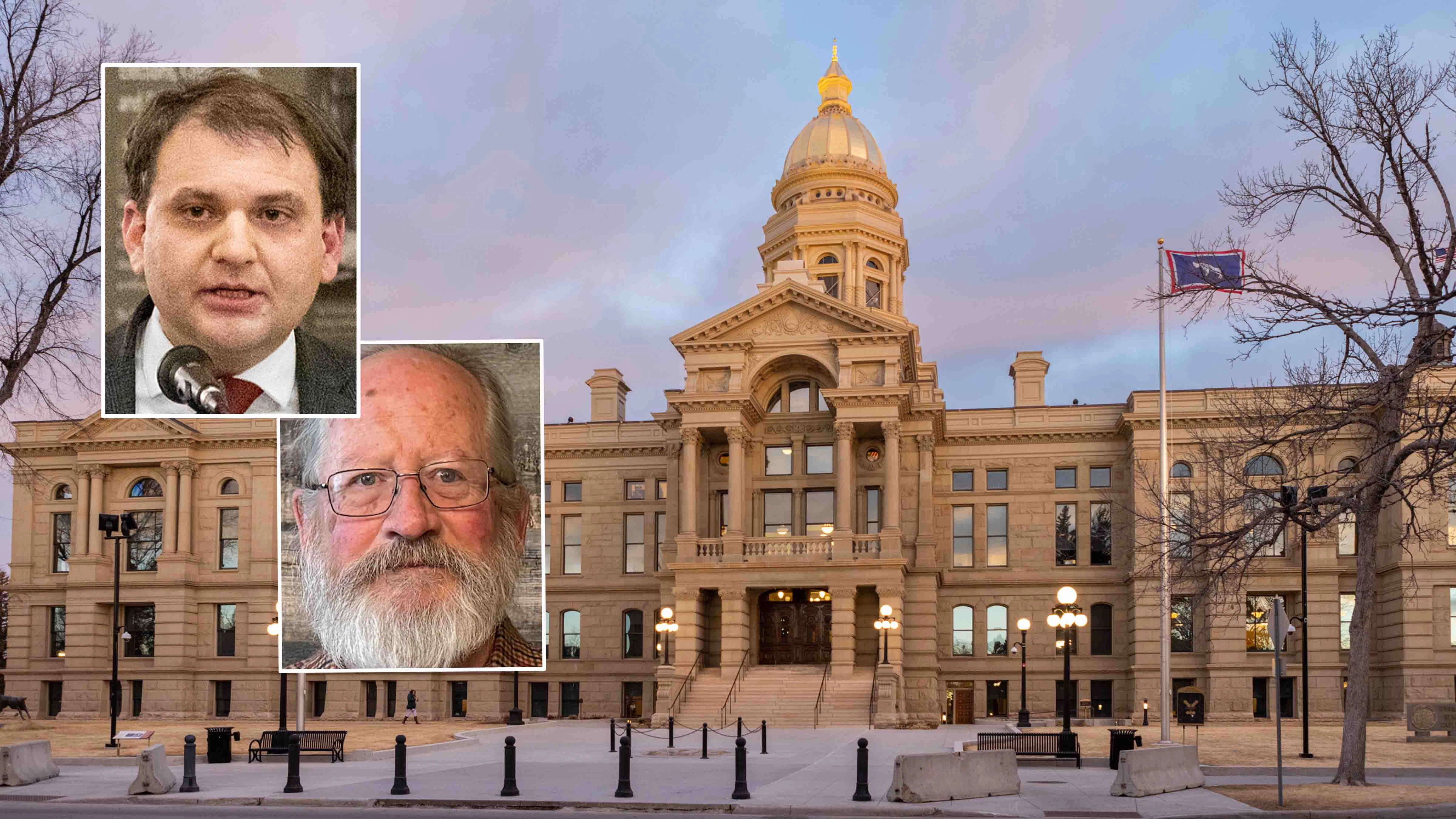
The Cheyenne-based attorney who is asking state authorities to prosecute Wyoming’s secretary of state for handing voters’ personal information to the federal government says it’s time for the secretary to reveal what legal advice motivated him, if any.
George Powers on Friday filed a supplement to his formal criminal complaint of four days prior, saying he learned Wednesday that Secretary of State Chuck Gray told a news outlet that the Wyoming Attorney General “approved the collaboration with the federal government on voter data.”
Gray gave sensitive voter information to the U.S. Department of Justice (DOJ) last year, public records show.
The agency has filed similar demands with nearly every state. Some have given the data over, others have refused and are fighting back DOJ lawsuits to protect the information.
Gray told the public he’s worked in “close consultation” with Wyoming Attorney General Keith Kautz, and responded to a lawful request in handing over the voter rolls.
Powers, who in 2024 won a pro-transparency case against the Wyoming Department of Education, has voiced doubt over the extent and content of Gray’s legal consultation, and has asserted that Gray has relied on it enough to waive attorney-client privilege.
Powers doubled down in a supplemental complaint Friday with what he called new evidence that Gray owes the public an explanation of his legal consultations.
“On January 31, 2026, Secretary Gray sent a text message to Shawn Houck at Oil City News in Casper, Wyoming,” says Powers’ supplemental complaint, adding that he obtained a copy of the text message on Wednesday.
Gray had texted Houck to complain about the outlet’s publication of a press release by the Wyoming League of Women Voters in which the group criticized Gray for releasing confidential information to the DOJ, says Powers’ complaint.
Gray claimed in the text, reportedly, that the story contained inaccuracies and that, “The AG approved the collaboration with the federal government on voter data,” and that the writer, Nick Perkins, hadn’t reached out to Gray for comment.
Houck confirmed Friday the text message is legitimate, but declined further comment.
According to Powers’ complaint, the outlet apparently issued an update to the story adding, “Gray said the data release was approved by the Wyoming Attorney general after collaborating on the ‘routine voter list maintenance effort.’”
Where Does Privacy End?
Generally, people can keep communications with their lawyers private by claiming attorney/client privilege.
Powers’ supplemental complaint says Gray has waived that privilege by talking about his legal advice to outside parties.
Powers cited a 10th Circuit Court of Appeals case saying that “any voluntary disclosure by the client” waives the privilege of confidentiality in legal advice, as well as a Wyoming Supreme Court case saying people who try to use their privilege “in a manner that is not consistent with the privilege” also waive it.
“Secretary Gray knowingly and willingly made a statement to a third party disclosing the content of his consultation with the Attorney General … to secure a favorable modification in a news article that incorporated and republished his statement,” wrote Powers.
“Secretary Gray should immediately produce complete and unredacted copies of all records relating to any communications relating to the alleged ‘close consultation’ with the Attorney General,” wrote Powers.
Lunacy, Lawfare, Leftwing, Media
Gray in a text message response to Cowboy State Daily’s request for comment said Powers’ complaint supplement is “more lunacy and lawfare from a radical leftwing attorney George Powers who has Trump Derangement Syndrome and whose false claims with zero substantiation are being repeated by the leftwing media in a coordinated attack on the truth.”
Gray continued: “Powers (sic) continuing claim that we have waived privilege is ridiculous, and is being sensationalized by the leftwing media.”
He noted the other red states that have handed their voter rolls to the DOJ. The agency and Gray both have that figure at 17.
“After approval from the Wyoming Attorney General, I complied with a lawful request under law to work with law enforcement to advance election integrity,” wrote Gray.
Gray claimed the media’s reporting on former Secretary of State Max Maxfield’s election complaint against him during his first campaign for the statewide office in 2022 was a tactic of “repeating false claims during election season to try to damage America First conservatives and attack my work to ensure election integrity.”
The U.S. Federal Election Commission in March 2023 ruled that Maxfield’s complaint lacked evidence to support its allegations and dismissed it. Wyoming media outlets had reported on its filing.
“Leftwing attorney George Powers and the radical media are using the same dishonest and lying tactics that the national media uses to attack President Trump,” said Gray. “Just like President Trump, I will continue to stand for the truth and my work to advance election integrity, and I will continue to call out the lying of the leftwing media.”
Back This Rig Up
The DOJ last year asked Gray for unredacted voter rolls of Wyoming citizens, to include birth dates, and driver’s license numbers or the last four digits of the registered voters’ Social Security numbers, public documents say.
Gray at first sent the agency the public-facing list, his correspondence says.
Apparently dissatisfied, U.S. Assistant Attorney General Harmeet Dhillon countered in an Aug. 14 letter, saying her office wanted voter rolls containing “all fields, including the registrant’s full name, date of birth, residential address, his or her state driver’s license number or the last four digits of the registrant’s social security number.”
Citing the DOJ’s “assurances” that federal privacy standards would apply, Gray gave the information to the federal agency, says an Aug. 28 letter from him to Dhillon.
The Criminal Complaint
Powers has been plying the secretary’s office with public records requests.
He filed a complaint Monday with the Wyoming Attorney General’s Office, urging the AG to ask an independent third party, like a state district court judge, to appoint a special prosecutor to investigate Gray for potential criminal wrongdoing.
Powers said he’s calling for a special prosecutor because of Gray’s assertions that he’s worked in close consultation with the AG’s office.
Following a Friday voicemail, Kautz did not comment by publication.
Powers’ Monday complaint points to two election laws: a misdemeanor ban on releasing confidential voter information, and an umbrella felony penalty for election officials who violate the election code.
The first is punishable by up to six months in jail and up to $1,000 in fines, and the second by up to five years in prison and up to $10,000 in fines, plus removal from office.
The misdemeanor ban says:
“Election records containing Social Security numbers, portions of Social Security numbers, driver’s license numbers, birth dates, telephone numbers, tribal identification card numbers, e-mail addresses and other personally identifiable information … are not public records and shall be kept confidential.”
Powers in filing his complaint cited another state law that allows people to alert the attorney general when they suspect the Wyoming Secretary of State has violated the state’s election laws.
And The Supplement
Besides asserting that the text to Oil City News waives attorney-client privilege for Gray, Powers’ supplement reiterates his call for a special prosecutor.
“At this time, I do not know what Secretary Gray asked when he consulted with the Attorney General and his staff,” wrote Powers in his Friday supplemental complaint.
If it’s true the AG advised Gray to release the rolls, then the AG would be in “the untenable position of having to investigate the circumstances involved in a decision that was made in reliance upon that opinion,” wrote Powers.
If it’s not true, then the AG and his staff would be key witnesses in any criminal case, the supplemental complaint says.
But, added Powers, “Secretary Gray could greatly simplify this matter, if he would just agree expressly and publicly to waive any further claim of privilege” in legal counsel.
“He could let the people of Wyoming see the facts and judge for themselves,” wrote Powers.
Hours Earlier …
Hours before Powers filed his supplemental complaint with the AG’s office, a federal judge in Rhode Island ruled that the DOJ failed to support its demand that Rhode Island hand over sensitive voter data.
Though a federal law the DOJ cited to back its claim on the data calls for a particular justification, when the federal government interferes in the state’s voting systems, the DOJ pointed back to the law itself rather than factual evidence that there’d been an election violation.
“Congress could not have intended (that law) to be interpreted in this redundant and circular manner,” said U.S. District Court Judge Mary S. McElroy.
The DOJ had asked if it could “cure” its demand by furnishing evidence.
McElroy said no, because the demand still lacks a legally sufficient purpose. She pointed to the Civil Rights Act’s protections for voters, and their history of protecting African American voters from state interference with the right to vote.
The law itself doesn’t say that it exists to stop states from shredding African Americans’ voter registrations, though that was the historical context that helped to birth it.
It does say, however, that the government should furnish a “statement of the basis and purpose therefore” when it wants to scrutinize state voting records.
“But the Court finds that neither the basis nor the purpose proposed by the United States for its demand is legally sufficient to support a claim under (that law),” wrote the judge.
McElroy dismissed the DOJ’s request that she force Rhode Island’s top election official to release the voter data.
She’s at least the fifth judge to issue such a dismissal.
More than two dozen cases of this sort, including six with red states, are ongoing in federal court.
Clair McFarland can be reached at clair@cowboystatedaily.com.


