
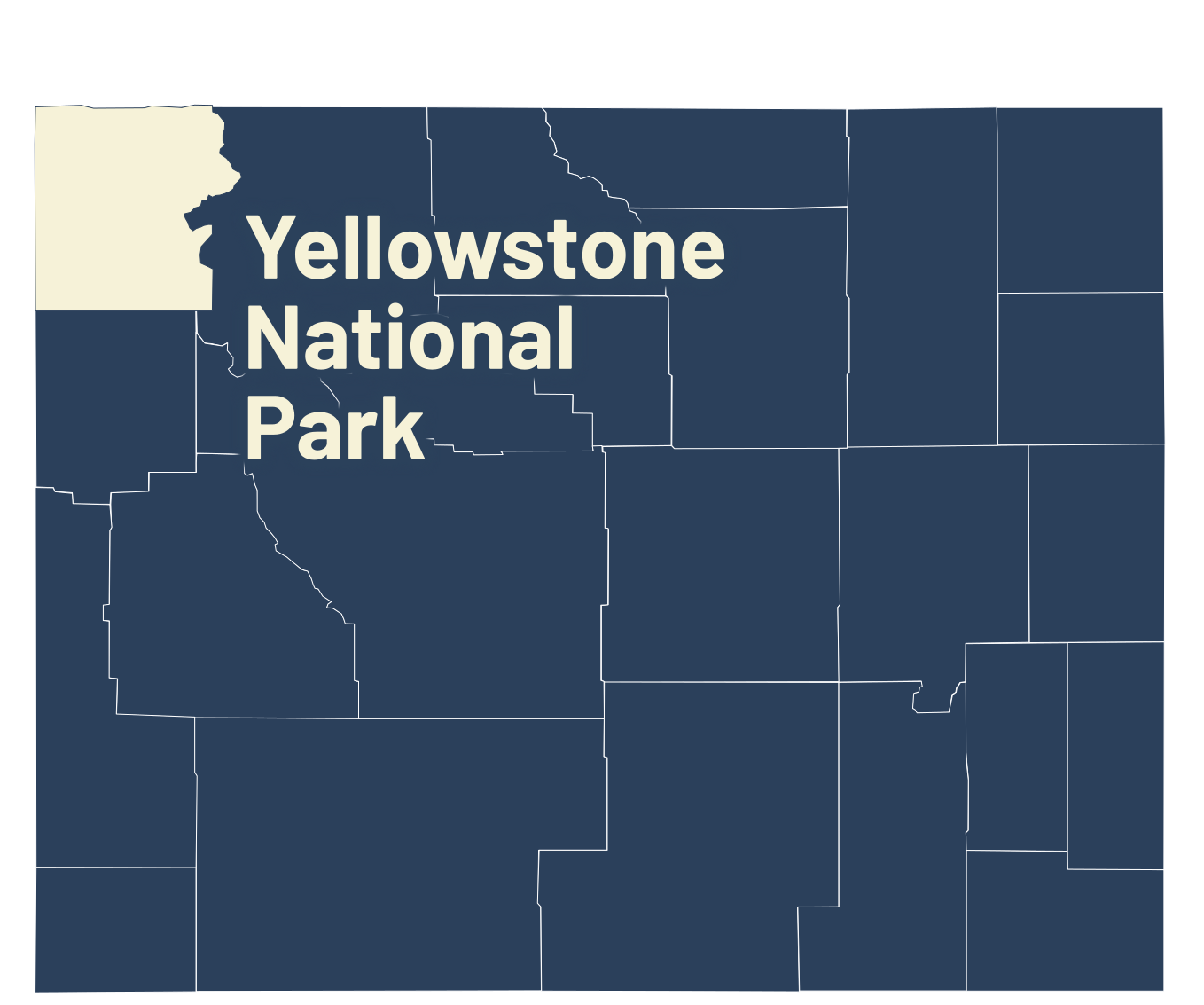
Visitors in Yellowstone National Park are expected to treat the landscape with respect and to refrain from taking or treading on anything they find there.
However, how can anyone expect a tourist to hold that standard when the park’s residents won’t do it themselves?
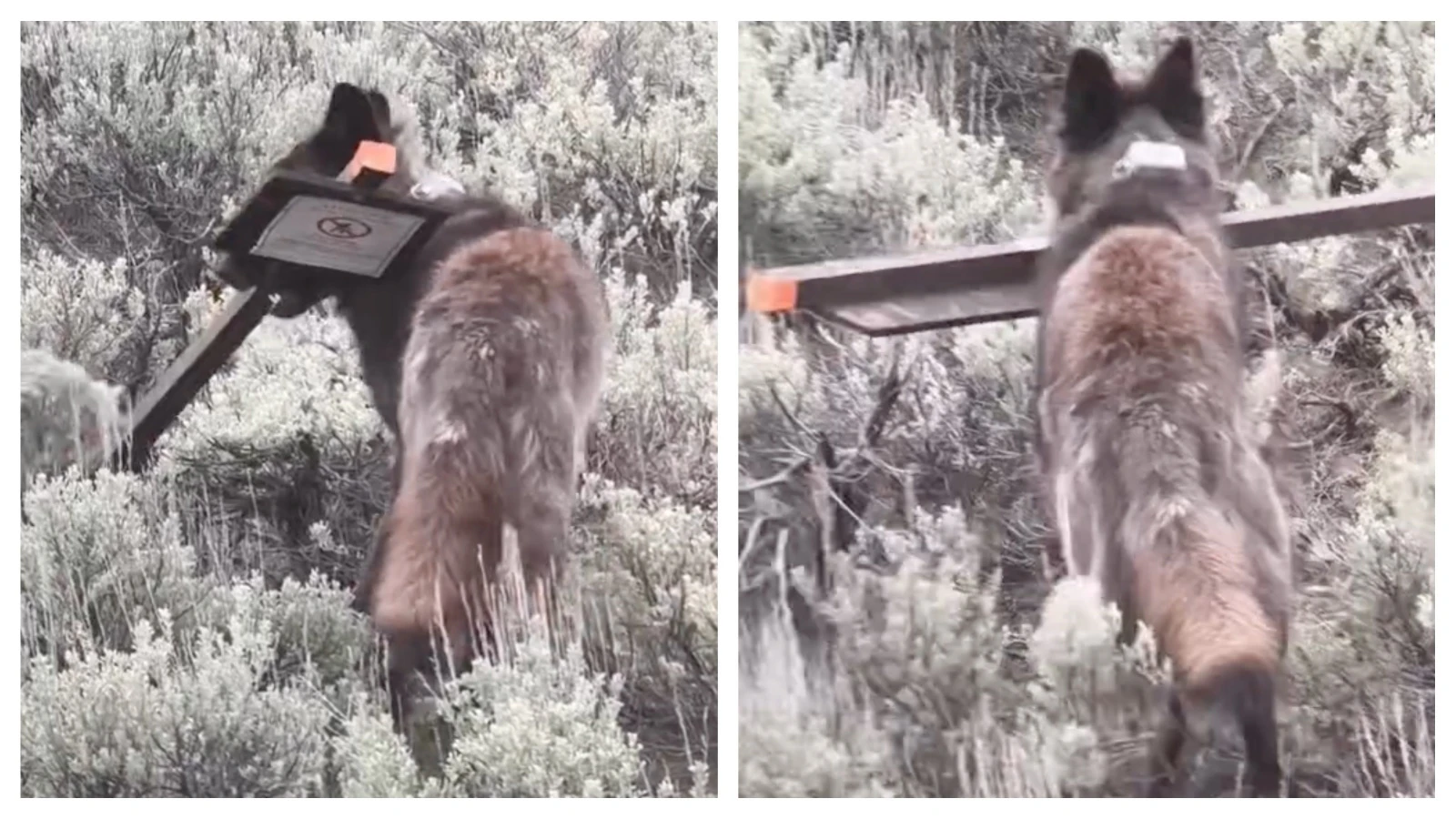
Taylor Rabe, a biological science technician working in Yellowstone, was monitoring the Junction Butte wolf pack on Monday when she noticed one of its puppies running across the road with a long, straight stick in its mouth.
Rabe said she grabbed her spotting scope for a closer look.
The young wolf had somehow managed to dislodge and carry off a sign put up by Yellowstone’s bear management team warning people about grizzlies in the area.
“(The sign) was set up to warn visitors to stay out of an area due to an active carcass with grizzly bears on it,” Rabe said when she posted the video on social media. “Clearly, this pup had better things to do with it.”
Kid Stuff
Rabe has spent the last 13 winters studying wild wolves as part of the Yellowstone Wolf Project, which has been conducting year-round observation and study of the park’s wolves since they were reintroduced in 1995.
Based on her extensive experience and familiarity with Yellowstone’s wolves, Rabe could tell the sign-stealing miscreant was one of the puppies from the Junction Butte pack.
Almost a year old, these pups have survived the winter and wandered away from the adults in the pack.
“This happens often, especially when the pups are interested in sticking around an area for a longer period of time,” Rabe wrote. “Usually, it has to do with something extra smelly, like an old carcass, or maybe something really fun, like a pond full of salamanders.”
Every animal seems to go through a rebellious phase in their youth.
Wolves have been known to use tools, but this young wolf didn’t seem interested in anything but carrying it around.
Rabe believes the sign theft was just a young wolf having a mischievous moment with an incredible stick it found, something any domestic dog could could do.
“This young male found this really fun and interesting toy as he made his way through the valley,” she said. “Whatever the cause, when the pups are away from their elders, this is when we see them being extra mischievous.”
Always The Young Ones
John Baughman, director of the Wyoming Game and Fish Department from 1996 to 2002, got the top job right after wolves were reintroduced to Yellowstone.
It was one of the most contentious moments of his career.
“I was deputy director when wolves came back,” he told Cowboy State Daily. “It was kind of like Republicans and Democrats. You were either pro-wolf or anti-wolf. Nobody in-between.”
When wolf incidents reached his desk, they were primarily damage claims from ranchers who had lost livestock to predation, an ongoing issue in the areas adjacent to Yellowstone.
He couldn’t recall any reports of theft by wolf.
“The main problems we had with wolves were livestock and divisiveness,” he said.
Baughman deferred to Rabe’s interpretation of why a wolf would steal a sign, saying she and the other scientists working with the Yellowstone Wolf Project have “probably seen things that most people wouldn't be aware of.”
However, he wasn’t surprised that it was a young wolf that ran off with the sign.
In his experience, it's always the young wolves that pushed boundaries and stick their noses where they aren't wanted or expected to be.
“When there were sightings of wolves (outside Yellowstone), it was almost always younger wolves,” he said. “They'd end up roaming into other states, the Red Desert, and eastern Wyoming, looking for whatever they’re looking for beyond ‘the dead line.’”
'The Lone Wolf'
Wolves can be self-sufficient very early on, usually when they’re only a few months old, but prefer to live and hunt within the hierarchy of an established pack.
While the “lone wolf” is a longstanding cultural motif of stoicism and self-reliance, most wolves will only go it alone temporarily. They’ll either search for a new pack or try to establish their own.
A lone wolf is also putting its mortality on the line. In addition to finding enough food to sustain themselves, lone wolves are at a higher risk of being killed by other wolves or humans.
The Junction Butte pack is one of the most famous and popular wolf populations in Yellowstone.
Their territory covers a large swatch of the Lamar Valley up to the park’s northern boundary in Montana, and they frequent areas where they can be easily seen and watched by tourists.
According to Yellowstone guidelines, the Junction Butte pack had 15 wolves going into the 2025-2026 winter season.
It tends to be a large pack and produces many pups in the spring, but still maintains a somewhat precarious existence with how they wander.
In September 2025, a 2.5-year-old female wolf from the Junction Butte pack, 1479F, was legally shot by a hunter in Montana after straying beyond the boundaries of Yellowstone.
The young wolf had become a beloved sight among wolf enthusiasts, and news of her loss sparked strong emotions and controversy.
“(She was) always on the go, nothing stopped her,” wildlife photographer Deby Dixon told Cowboy State Daily after her death. “She was independent and always on patrol, and she was a great babysitter for the pups this year.
"She was one of the few wolves in the park that would walk right through a crowd of people to reach her destination.”
Many wolf watchers find independence and a brazen attitude as admirable qualities in a beloved wolf, but they were also among the factors that indirectly led to 1479F’s early death.
Lone wolves can survive on their own, but can just as easily find an early death, by bite or bullet.
Read The Signs
After carrying and chewing on his special stick for a time, Rabe observed the young sign-stealing wolf until he abandoned his new toy and rushed to rejoin the adults of the Junction Butte pack.
There’s no indication that Yellowstone’s rangers cited the young wolf for theft and property damage, as would be expected for any tourist who committed such a brazen act.
Wolves are protected, so long as they remain within Yellowstone’s boundaries. Once they step outside the park, they can be legally killed.
Montana hunters and trappers killed 289 wolves in 2024.
The Montana Legislature has tried to pass bills to extend wolf hunting and trapping seasons by up to three months, but has yet to pass any changes to that policy.
Wolf advocates have tried to extend protections for wolves beyond the park’s boundaries, but those efforts also haven’t manifested in any policy changes in Wyoming, Montana, or Idaho.
On the federal level, the U.S. House of Representatives passed the Pet and Livestock Protection Act (H.R. 845) to delist the gray wolf under the Endangered Species Act in December 2025. It was cosponsored by U.S. Rep. Harriet Hageman.
It has been received and read twice in the U.S. Senate’s Committee on Environment and Public Works, but no action has been taken since then.
If the young Junction Butte wolf could read the sign he ran off with, it wouldn’t have helped him at all, since it was warning visitors to stay away from grizzlies.
If he could read the other signs in the park and the writing on the wall, he would know to stick close to his pack and never venture too far, lest he find himself outside the protection of Yellowstone National Park.
“Whenever you’d get an individual wolf doing damage or coming into a zone where wolves hadn’t been seen before, it’s usually a younger wolf,” Baughman said.
Andrew Rossi can be reached at arossi@cowboystatedaily.com.


