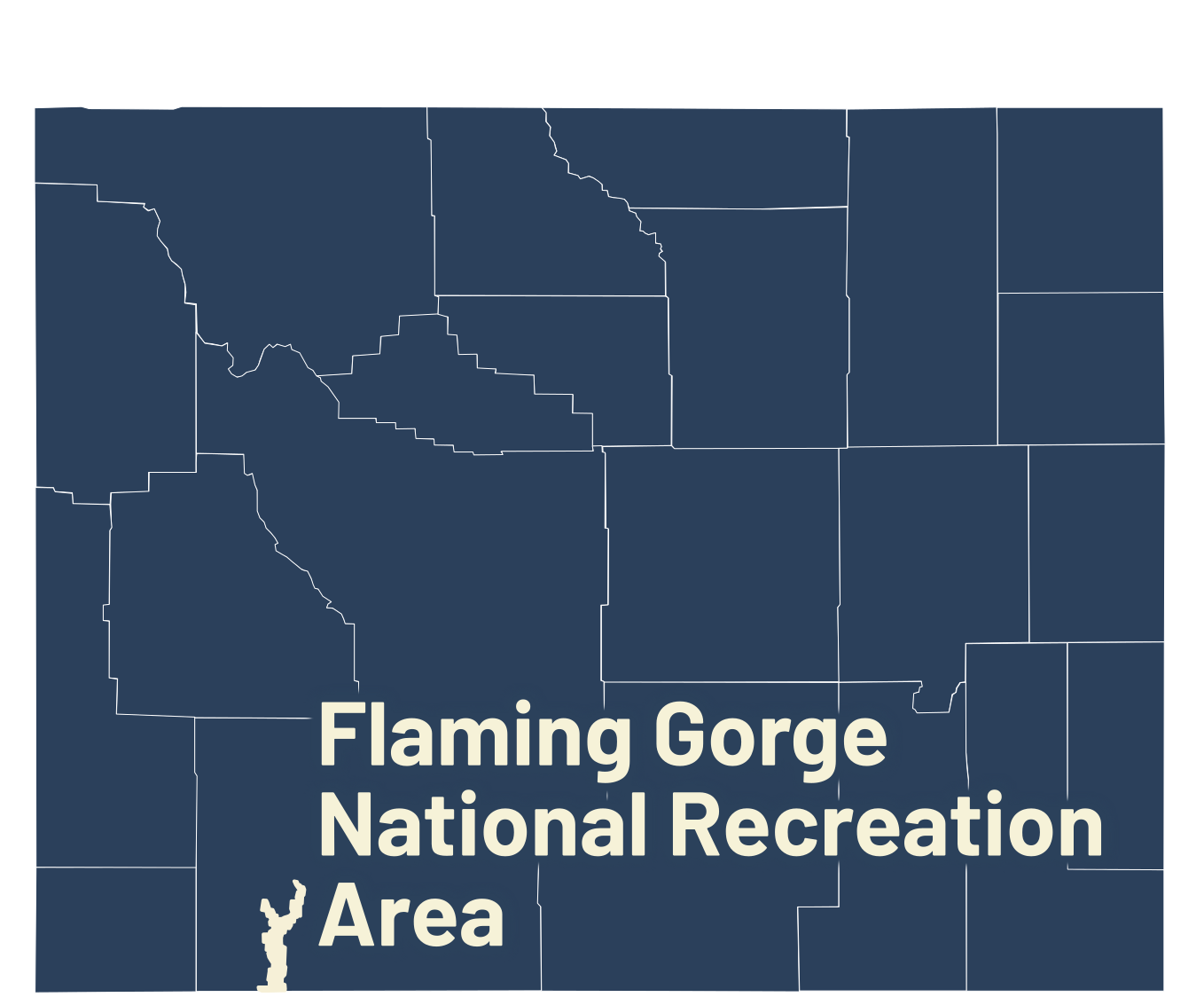
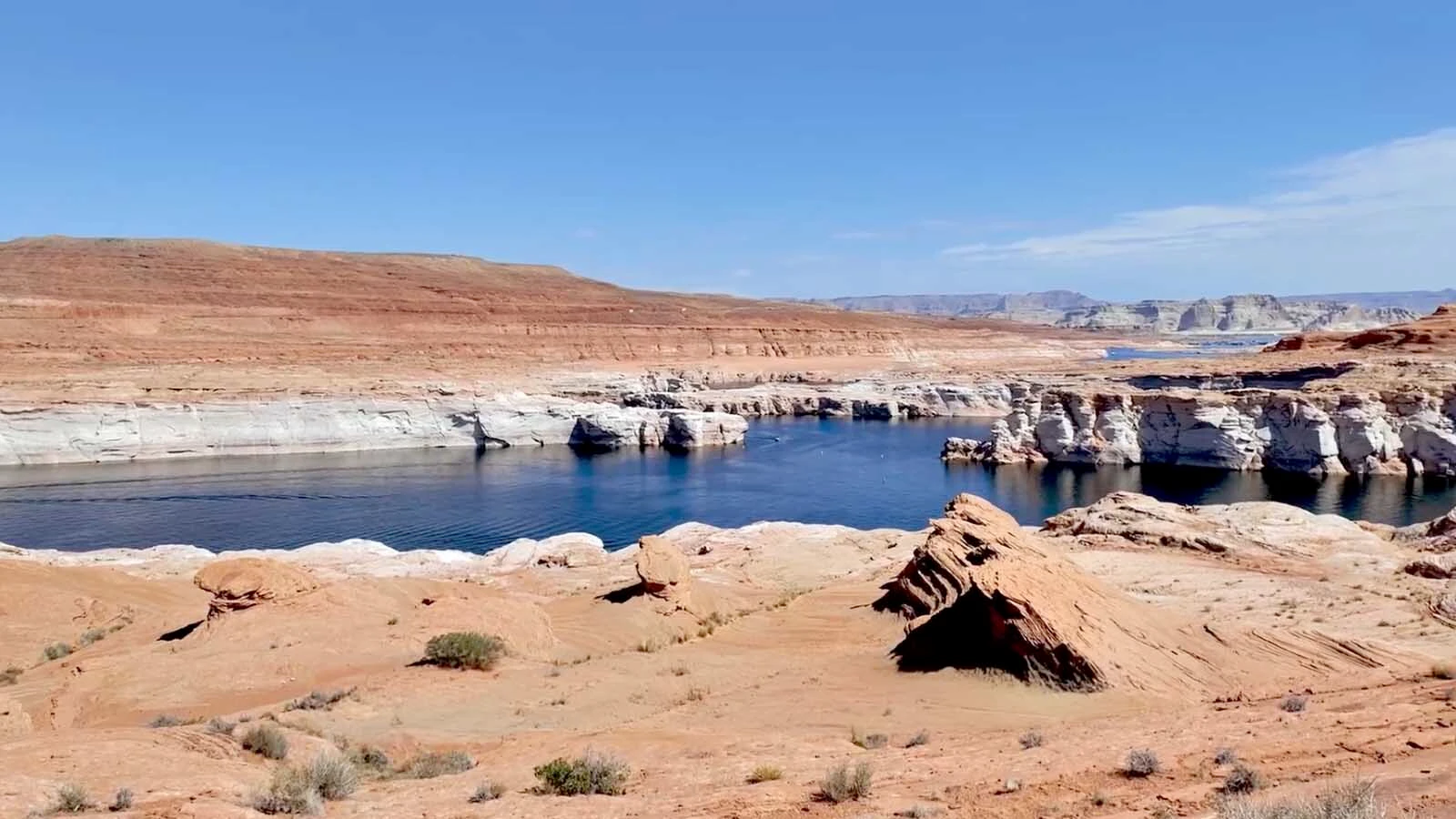
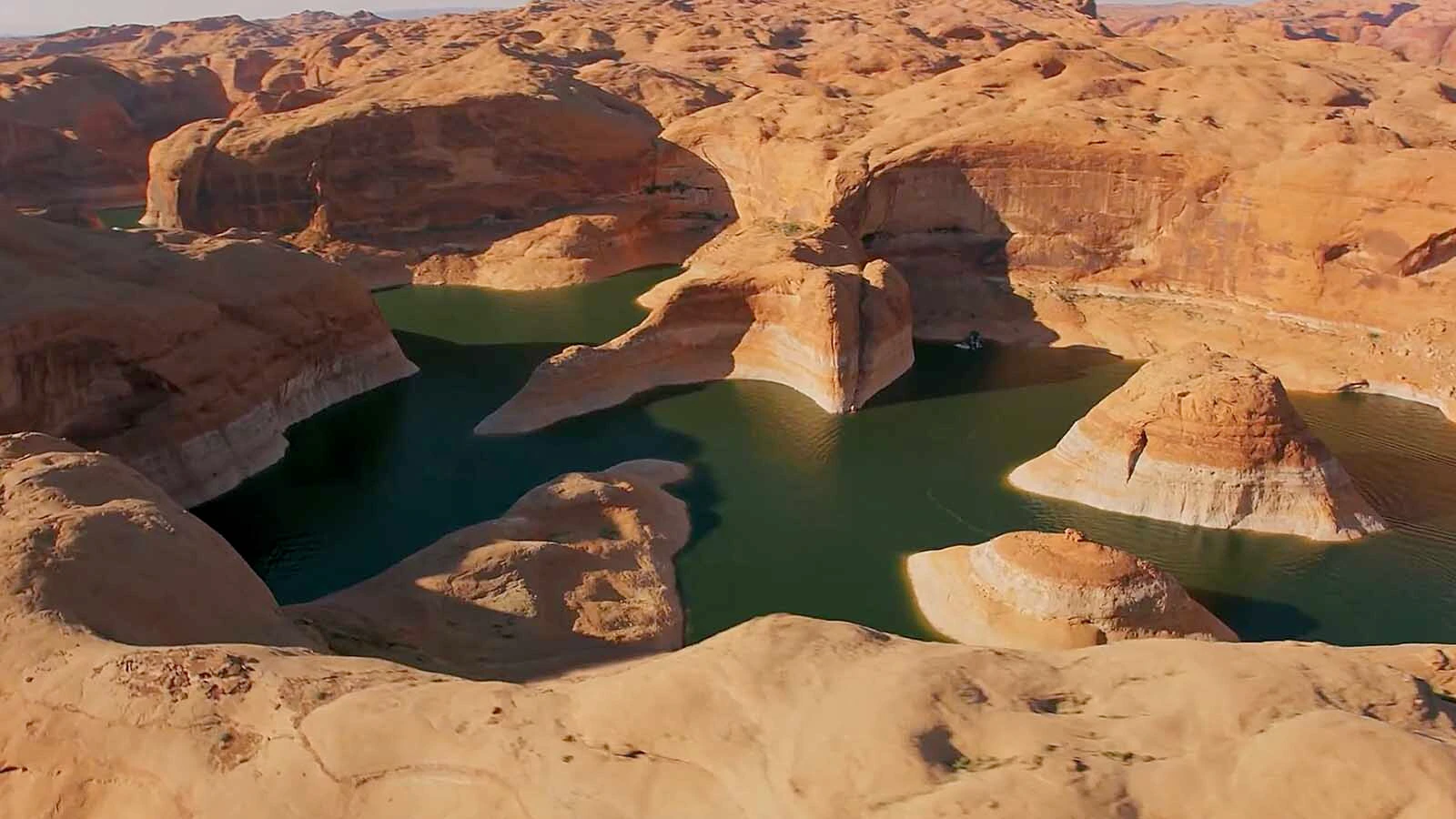
Lake Powell, a key reservoir on the Colorado River, is shrinking toward "dead pool," which means water won't flow downriver anymore — and that could in turn pinch Wyoming’s municipal and industrial water supplies with more demand from Flaming Gorge Reservoir.
Lake Powell, on the Utah-Arizona state line, is in dire condition, USA Today reported.
By next spring, it’s expected to fall into “minimum power pool,” meaning having barely just enough water to generate hydroelectric power at Glen Canyon Dam.
If it falls even farther, that could put the reservoir at “dead pool,” or unable to generate hydroelectric power, according to reports.
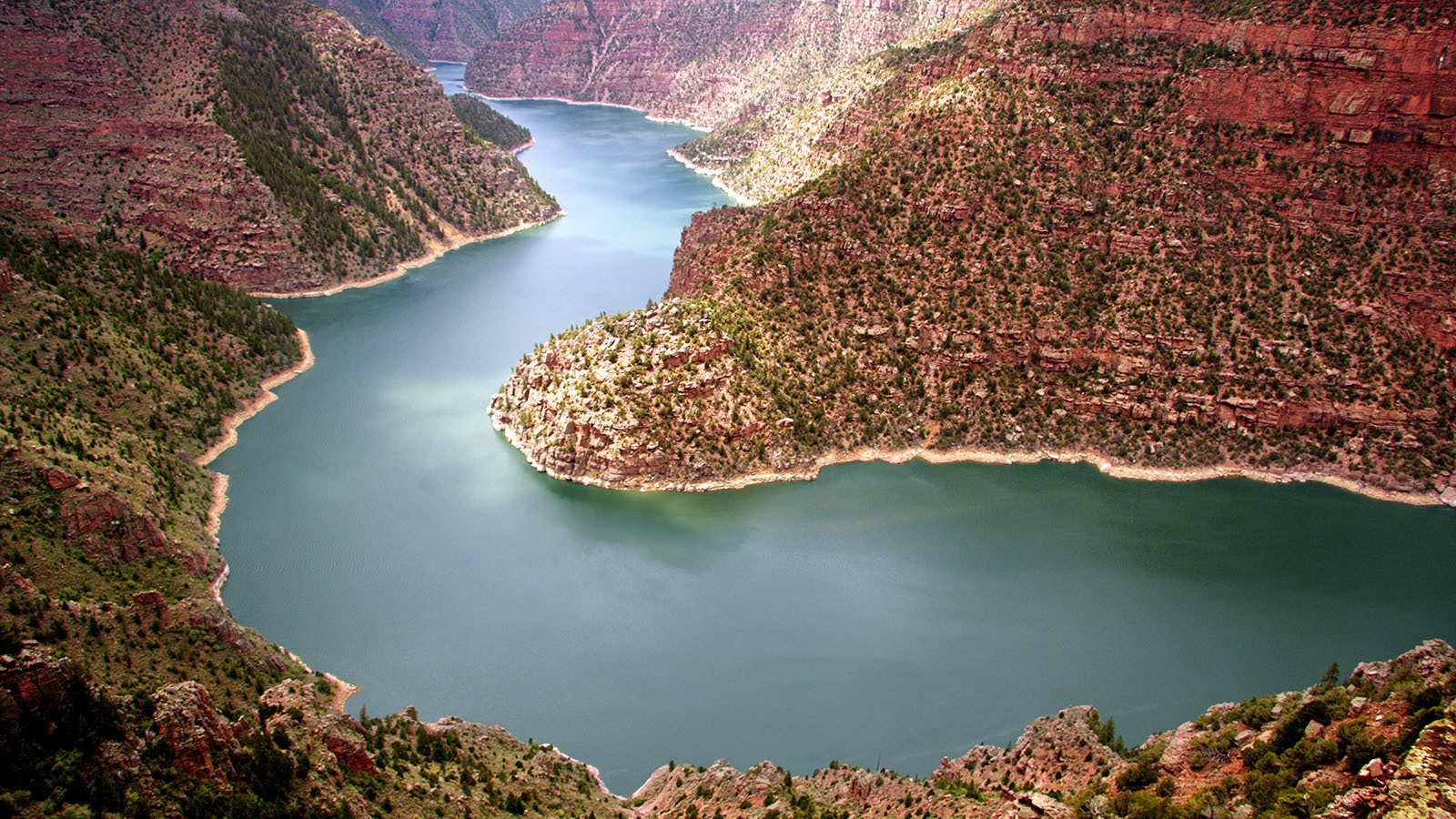
That's despite roughly 1 million acre-feet expected to be pulled from Flaming Gorge Reservoir on the Wyoming-Utah state line and sent downriver through Wyoming to replenish Lake Powell.
‘Paper Water Rights’
Dead pool is considered only a worst-case scenario among water managers.
But if it happens, it could lead to some stark choices, said Wyoming state Sen. Larry Hicks, who served on the Legislature’s Select Water Committee.
In such a scenario, “power generation is subservient” to irrigation water rights, he told Cowboy State Daily.
“Power Generation is important, but it’s not as important as maintaining peoples’ livelihood,” Hicks said.
The looming dilemmas over Colorado River water rest in the fact that water management is rooted in “paper water rights,” he said.
Many of those are tied to the 1922 Colorado River Compact, which includes seven states, Mexico and numerous Native American Tribes.
Just Not Enough Water
In Wyoming, many farmers’ and ranchers’ water rights predate the 1922 Compact, going as far back as the 1880s.
That means if spats break out over Compact water rights as the river’s supply dwindles, farms and ranches along the Green and Little Snake rivers would be largely unaffected, Hicks said.
The Compact designates roughly 15 million acre-feet per year, supposedly evenly split at 7.5 million acre-feet between the Upper Basin and Lower Basin.
The Upper Basin states are Wyoming, Colorado, Utah and New Mexico. Arizona, Nevada and California comprise the Lower Basin.
River flows in recent years have been as low as about 10 million acre-feet, Hicks said.
If the Lower Basin states made an emergency “call on the river” for more access to the Upper Basin allocation, Wyoming’s farmers and ranchers wouldn't catch the brunt of it, he said.
“The Trona industry and big municipalities in Wyoming” would be most at risk of losing vital water, he said.
For instance, even though Cheyenne isn’t physically connected to the Colorado River system, it still depends upon of it because of water-exchange agreements on the North Platte River.
“Arizona is the state that’s most likely to litigate and say, ‘We’re entitled to this water; you need to send it to us’,” Hicks said.
Cheyenne Looking For Alternatives
The growing crisis on the Colorado River “is a concern for Cheyenne and our board of public utility,” Mayor Patrick Collins told Cowboy State Daily.
The city gets about “two-thirds of our water” from sources tied to the Colorado River water contract exchange agreements, he said.
Cheyenne has been preparing for potential water shortages, Collins said.
“If they make a call on the river, it’s going to take a while to take effect,” he said, adding that Cheyenne has a roughly four-year backup storage supply.
Cheyenne has been frugal with its water, typically using about half of its full allocation, Collins added.
Despite growth, the city is using about the same amount of water it was 10 years ago, he said.
In the long term, Cheyenne also hopes to break away from Colorado River dependency.
“We have good leads on replacement water from other areas,” he said, without going into detail.
“There is an irrigation district that we’ve been working with, and some industrial users on the Platte River,” Collins said.
Rock Springs Has Old Rights
Rock Springs mayor Max Mickelson said the city has some water rights dating to 1871, and is therefore immune to any effects tied to the 1922 Colorado River Compact.
“Our system has never overdrawn its allocation the way the Lower Basin has. The current diversion data our Joint Powers Water Board presented to council shows zero deficit under today's conditions. 11,011 acre-feet of annual demand against roughly 2,413 acre-feet available on average, showing no shortfall in any month,” he stated in an email to Cowboy State Daily.
“That's not luck. That's a century of municipal water management that lived within its means. While states downstream built entire metro economies on water that was never really there in average years.”
The local economy has felt the effects of increasing pressure on Flaming Gorge from the Lower Basin, Mickelson said. The city doesn’t draw from it directly, but is tied to the recreation economy.
“Our recreation, fishing, and marinas economies will all take a hit,” he said. "Our exposure so far has been to the regional environment and economy, not to the water coming out of our faucets.”
‘It’s A Concern’
If Lake Powell hits dead pool, that would be a concern for Rock Springs, Mickelson said, noting the federal response to the crisis at Lake Powell is to pull from Flaming Gorge.
“The Bureau of Reclamation's own modeling, presented to council this May, shows a projected shortfall of 2.0 to 2.3 million acre-feet by March 2027,” Mickelson wrote.
“So, yes, it's a concern, but it is fundamentally about fairness. The Flaming Gorge Reservoir is filled by our river and is treated as insurance for a 1922 compact built on flow numbers that were too generous from the start. We watch Powell's elevation because every foot drop is another argument for draining more from our basin,” he said.
Rock Springs, and Wyoming in general, has been proactive, passing voluntary conservation legislation while keeping underlying water rights protected, Mickelson said.
The Upper Basin should continue in that vein, he added.
“Wyoming has a seat at the table and needs to demand a storage agreement that lets Upper Basin states bank conserved water. We need an explicit federally acknowledged agreement that Wyoming, Utah, and Colorado hold unused apportionment under the original compact. We did not overbuild its claim,” Mickelson wrote.
Mark Heinz can be reached at mark@cowboystatedaily.com.