Scuba gear and welding hats aren’t typical fishing tackle. But at Flaming Gorge Reservoir this spring, marina crews are using both as they scramble to move boat docks farther out while trying to keep up with rapidly dropping water levels.
Federal officials announced earlier this year that they will release up to 1 million acre-feet of water from Flaming Gorge to boost critically low water levels down the Colorado River on Lake Powell and protect hydropower operations at Glen Canyon Dam in northern Arizona.
That lifeline for Lake Powell, though, has become a slow-motion disaster upstream for Wyoming and Utah, where Flaming Gorge marina operators are racing a falling shoreline and wondering if the marina side of their business has any future beyond 2026.
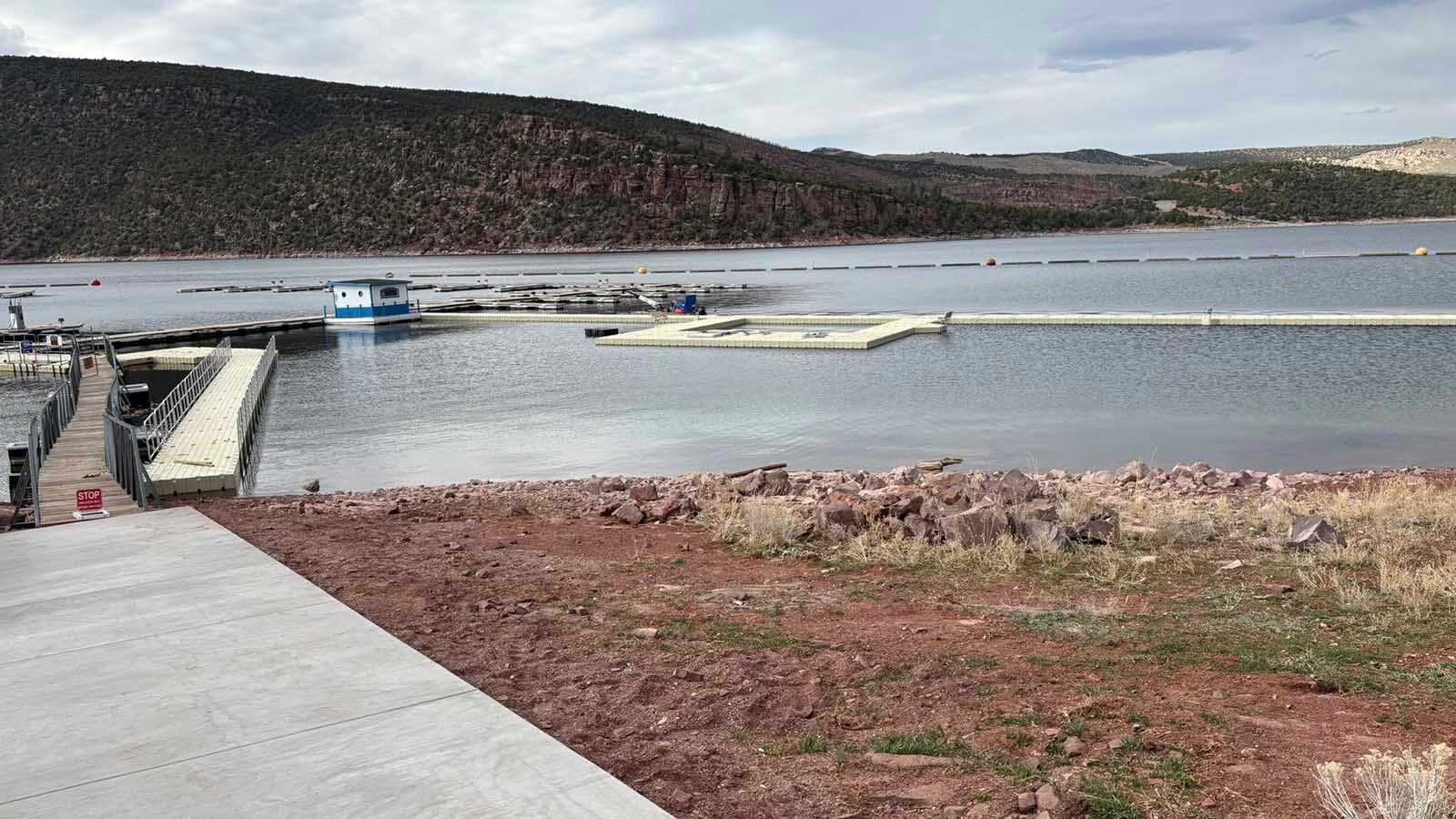
Crews at Cedar Springs, which is at the reservoir’s south end in Utah, are scuba diving to detach underwater trusses and move finger docks toward deeper water, co-owner Stacey Rauch told Cowboy State Daily.
Two shorter gangways have been spliced into one long, steep gangway as the floating marina is pulled away from its protected cove. The fishing pier, which connected the boat ramp to the marina, had to be disconnected and moved.
By fall, Rauch said much of her marina will have been completely taken apart and reassembled in open water, outside its wind-sheltered bay.
“So far, we’re staying ahead of the drop,” she said. “We’re not letting the docks go up on shore and break.”
Damage At Buckboard
Others haven’t been as fortunate.
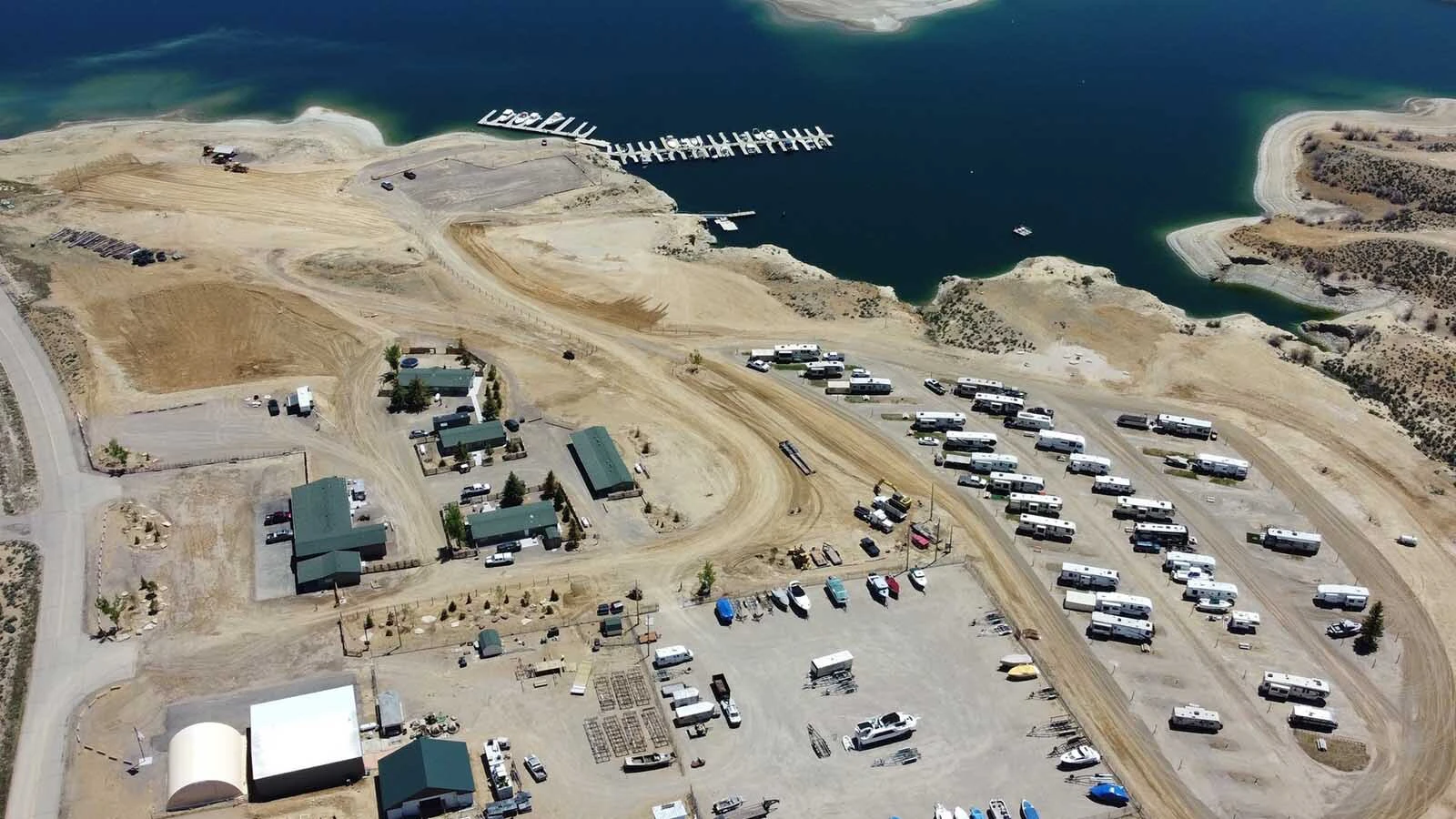
At Buckboard Marina, which is at the north end of the reservoir in Wyoming, water fell too fast and too far for owner Tony Valdez to keep up.
“It’s not a little thing adjusting piers and volume like that,” he told Cowboy State Daily. “I’ve got 100-and-something bow slips, and it’s not like you just go out there and, ‘Oh, I’ll just turn this winch.’ There’s a lot of engineering that goes into this, and there was no consideration for that.
"They just dropped the levels. We’ve already dropped 7 feet, and it literally broke every structure on all three of my piers.”
Now Valdez is hauling in costly steel from Rock Springs, racing to weld his marina back together before his guests begin to arrive for the summer.
“This is devastating,” Valdez said. “It’s damaged everything.”
The broken docks are only part of what keeps him up at night.
Fishery At Risk
It’s the fishing that worries Valdez the most.
Flaming Gorge has become world-famous for its kokanee salmon fishery, attracting anglers from all around the world for the past five decades to haul in one of these prized, landlocked salmon.
The gorge also has record-breaking trophy trout — but it’s the kokanee salmon that are a massive draw.
State and federal wildlife agencies have worked hard to manage the lake’s balance over the years. It's a task that became more difficult after a 2022 drawdown wiped out the kokanee salmon fishery.
“The big, big number is 6,015 feet above sea level,” Valdez said. “Two years ago, when they went down to 6,003, that literally wiped out all the kokanee spawning grounds.”
Kokanee have a three-year life cycle, spawning and then dying at age 3. That means the newly stocked population is just about to finally reach maturity.
“We were just starting to get them back, and now they just destroyed them again,” Valdez said. “They’re literally going to destroy all that again. It will be gone by July.”
The timing of the drawdown couldn’t be worse, Valdez added.
“This is like a holocaust for nature,” he said. “We had a 1.6-mph current going toward the dam the other day. That just pulls all the bait, all the little fish, and it turbulates the water.
"This should be done over the winter, because the kokanee and all the fry, even the lake trout fry, all spawn in September, and they need three months to get out of the rocks.”
The value to Wyoming in this fishery is upward of $330 million, Valdez said.
“It costs Wyoming Game and Fish 2 cents to plant that fish,” Valdez said. “And it’s worth $76 dollars to catch one. So that’s a $75.98 return on a 2-cent investment.”
Flaming Gorge Scenery Getting National Attention
Even as the water draw-down pressures marinas, Flaming Gorge is simultaneously rising in national prominence as a top scenic drive and road-trip destination.
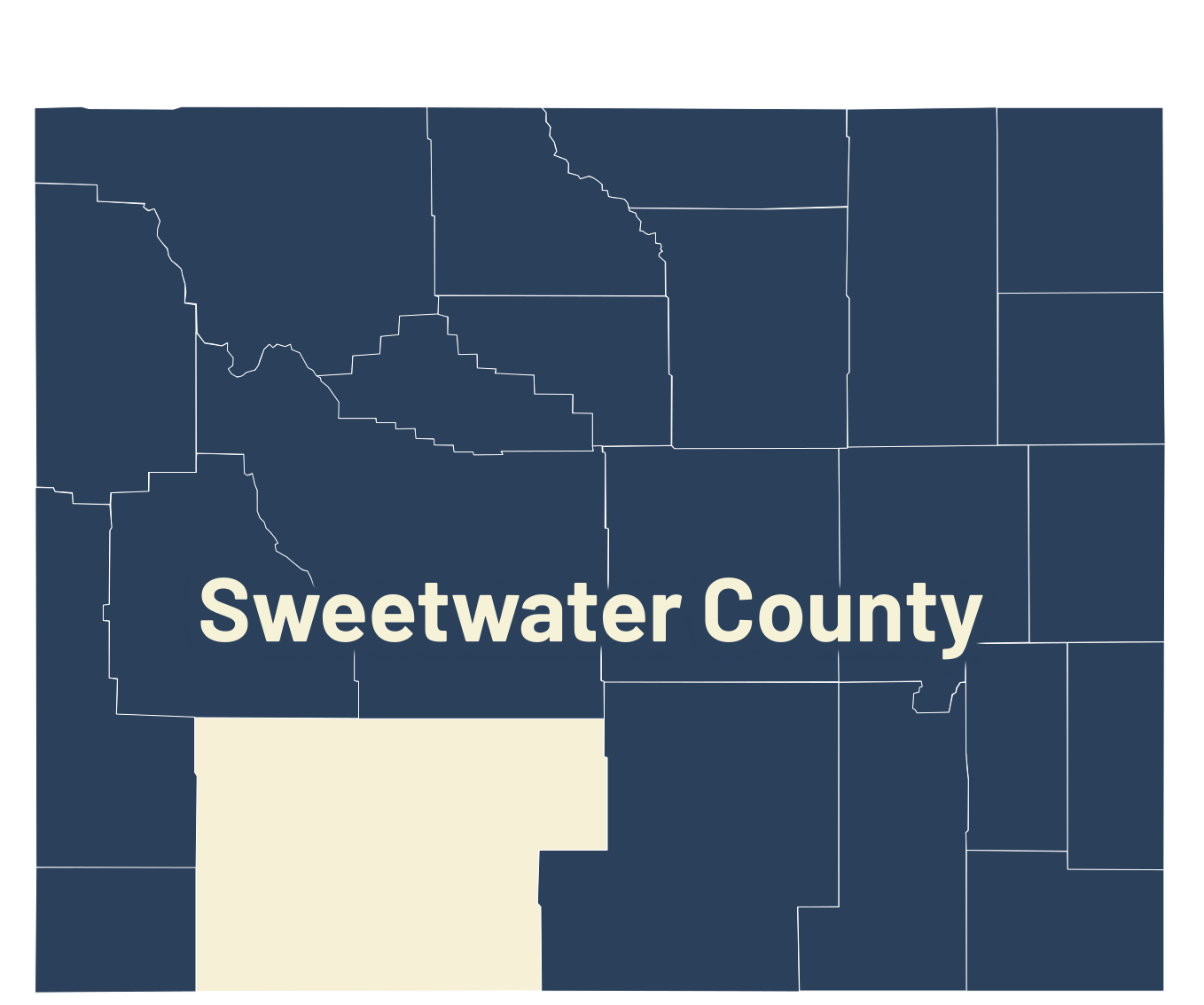
The Flaming Gorge-Green River Basin Scenic Byway was designated as an All-American road in 2021, something Sweetwater County Travel & Tourism Executive Director Jenissa Meredith told Cowboy State Daily she worked on for a decade.
The coveted status is shared by just 37 other routes nationwide and only one other in Wyoming — the famed Beartooth Highway.
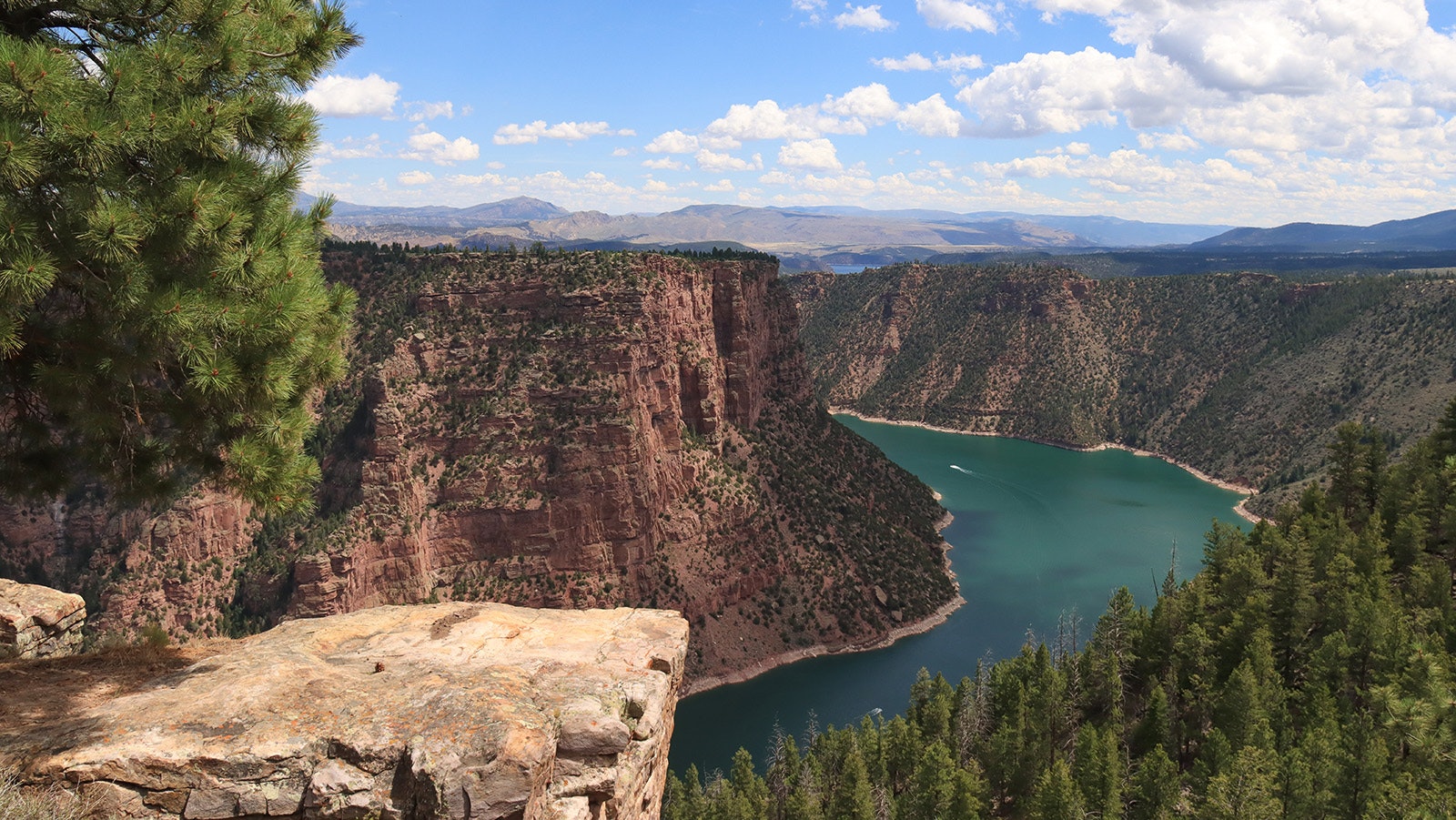
It has helped earn Flaming Gorge national attention for its dramatic red-rock canyons and gemstone-blue water framed by desert vistas and smog-free skies.
Flaming Gorge is now a cornerstone of Sweetwater County’s $160 million tourism economy, which supports almost 1,500 jobs and drawing an estimated 50,000 visitors a year.
Because water isn’t visible for most of the drive, Sweetwater County’s marketing hasn’t focused on boating or water recreation in the past.
The main thrust has always been the guided bus tours, which focus on the broader landscape and tell stories about the area’s unique history.
That includes a variety of famous outlaws, such as Butch Cassidy, who frequented the nearby Browns Park.
“You don’t see a lot of water on that drive,” Meredith said. “So we’re optimistic that folks will still be able to enjoy that landscape, and the wildlife, and all of the scenic beauty. The water will be changing, but hopefully they’ll still enjoy it, as they have in the past.”
So far, tour bookings are as “strong as ever,” Meredith added, with more private, full-bus charters this year than in years past.
Marinas Face Uncertain Futures
Despite all the work Valdez and Rauch are doing to maintain their businesses this year, neither is sure their marinas have a future beyond 2026.
This year’s draw will take Buckboard Marina right to the edge of its existence, Valdez said.
“Literally, in the fall, we’ll be at 5,970 feet,” he said. “My ramp runs out at 5,960.”
Next year, if it’s determined that another million acre-feet of water is needed to prop up Lake Powell, Buckboard becomes a cliffside campground instead of a marina, he said.
“That elevation means there’s no Wyoming marinas at all,” Valdez said. “They’re all gone, and I don’t recover from that. We’re just not a marina anymore.”
Valdez bought Buckboard Marina just six years ago. That makes finding a new way to keep his business afloat imperative. He has already begun to explore options for his business to move forward, such as an outfitter’s license.
“I have a 30-year permitted lease,” he said. “So I’m not going to sell. I will adapt, but what’s in that big picture of adapting?”
Having a marina with direct access to Flaming Gorge Reservoir has been a key selling point for his business, worth at least half his annual income.
Cedar Springs, meanwhile, is a multi-generation operation that Rauch said her family has been operating for 40 years.

Killing Two Reservoirs Instead Of One
Another million acre-feet taken from the lake would be catastrophic, Rauch agreed.
“This whole county relies on recreation and ranchers,” she said. “That is what our small community is made up of. And our ranchers are in a world of hurt, too.
"Water rights have been cut way back, and they’re having to sell their cattle to help pay for the hay they’re now having to order in, because they’re only operating two of the five fields they have.”
Both Rauch and Valdez question whether the juice Lake Powell is getting from Flaming Gorge is really worth the squeeze.
Valdez has heard the 7-foot drop from Flaming Gorge, which has broken all his infrastructure, only translated into 2 inches more water for Lake Powell — a drop in the bucket of what the lake needs.
“It’s crazy,” he said. “It’s absurd. I mean, come on, to even think they’ve just literally compromised so many businesses, so much stuff, and they’re going to keep doing this all year long.”
Rauch wonders if the water would be better used helping area ranchers and questions the “tremendous” amount of water downstream communities are continuing to use.
“It’s staggering compared to our area,” she said. “The areas that this water — our water — sustains are in the middle of the desert and have misters going outside of the buildings to keep people cool, and fountains and golf courses and pools everywhere.
"And here we are with dry-scape yards, conserving as much water as possible. It’s very frustrating.”
Flying over Phoenix, Rauch said she has noticed how almost every house in that arid country has a swimming pool in the backyard.
It feels extravagant to her that such communities would demand more water from states like Utah and Wyoming, which aren’t focusing on swimming pools and are more worried about watering their cattle.
“There’s no question where the water is going and why we’re running out of it,” she said. “They’re squandering it. It’s just a terrible mismanagement of our most precious resource.”
The comments about Flaming Gorge being “low-hanging fruit” were especially galling to Rauch and Valdez. For them, this water is their livelihood, and both are disappearing before their eyes.
“They have to come up with a different solution than this,” Rauch said. “Because this is not something that’s sustainable. This is killing us here and stealing our water to just buy them a little more time.”
What’s already been sacrificed has produced only a drop in the bucket compared to what the lake needs, Rauch added.
“This is killing two reservoirs instead of letting one run its course,” she said.
For Rauch and Valdez, the “low-hanging fruit” is no abstraction. It’s their docks tearing apart, and a way of life that might vanish as well.
Renée Jean can be reached at renee@cowboystatedaily.com.