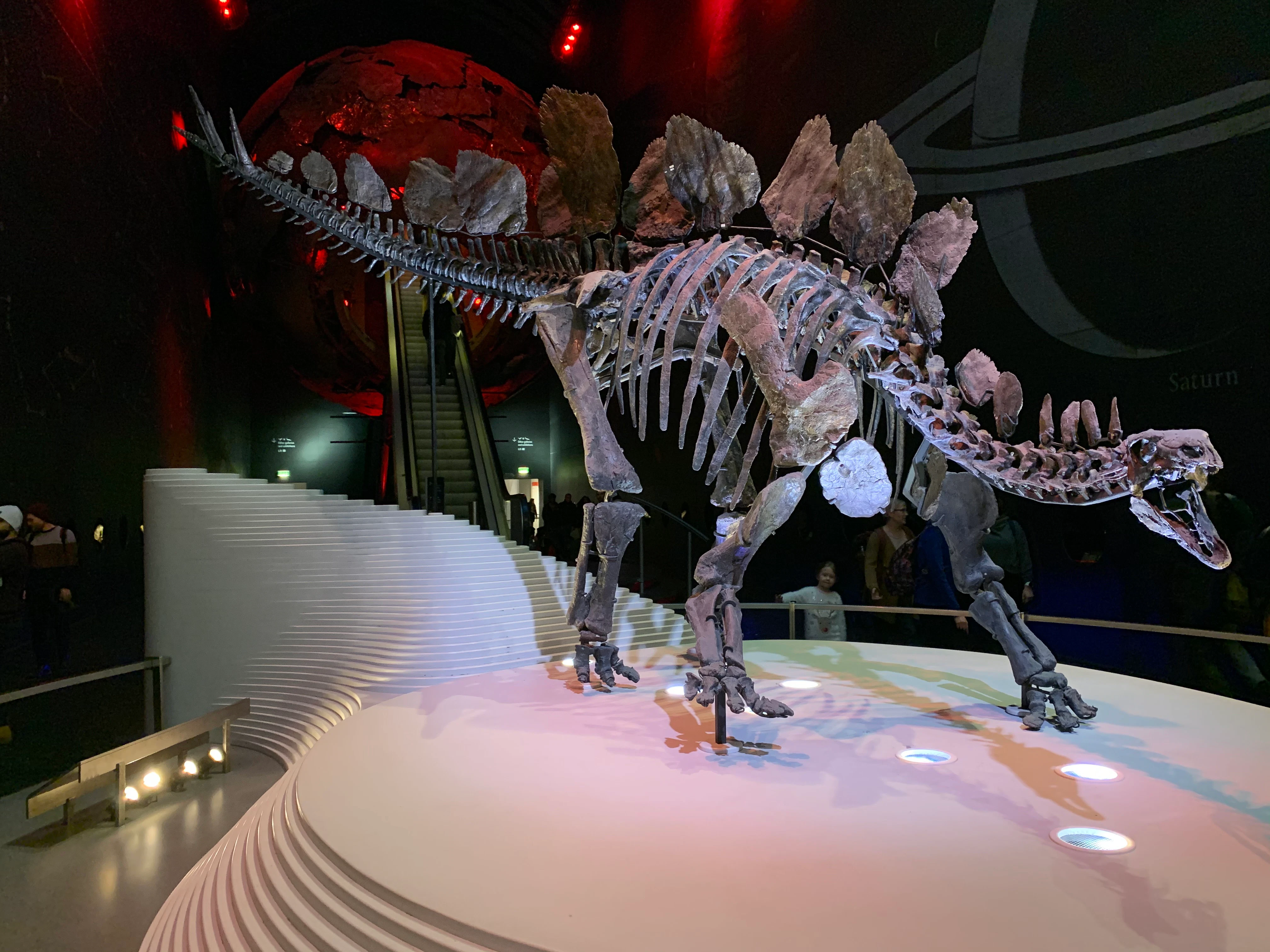
One of the centerpiece exhibits at the Natural History Museum of London is Sophie, one of the most complete and well-preserved Stegosaurus specimens ever found.
When it was unveiled at the museum in December 2014, paleontologist Paul Barrett praised it as the best Stegosaurus anywhere in the world.
“This skeleton is very special, not just because it’s complete, but also because the bones have been preserved in three dimensions instead of being squashed over time, as happens with many other fossils,” he said. “We can get a very accurate view of how the whole body looked.”
That wasn’t news to Bob Simon and Robert Boscarelli. They were two of the three-man crew that found and excavated the stellar Stegosaurus near Shell in 2004.
“I didn’t know what happened to it once we got it out,” Boscarelli told Cowboy State Daily. “When my family went to London, we walked up the stairs into the museum, and there she was. It was incredible to see her mounted there.”
The Tail End
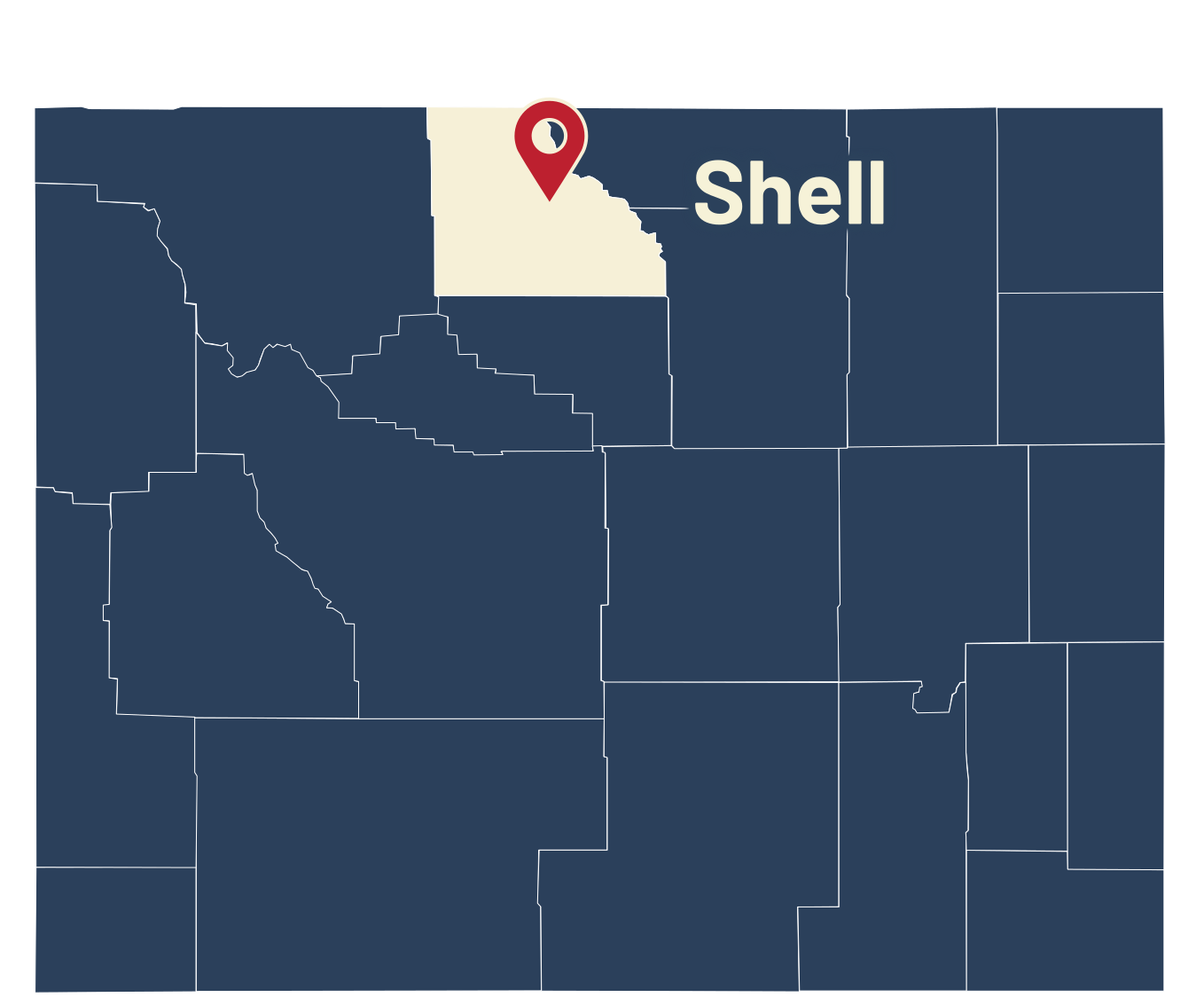
Sophie, a Stegosaurus stenops, was found in the Morrison Formation near Shell, dating to the Late Jurassic, around 150 million years ago. She escaped the prehistoric mudstone encasing her perfectly preserved fossils between 2003 and 2004.
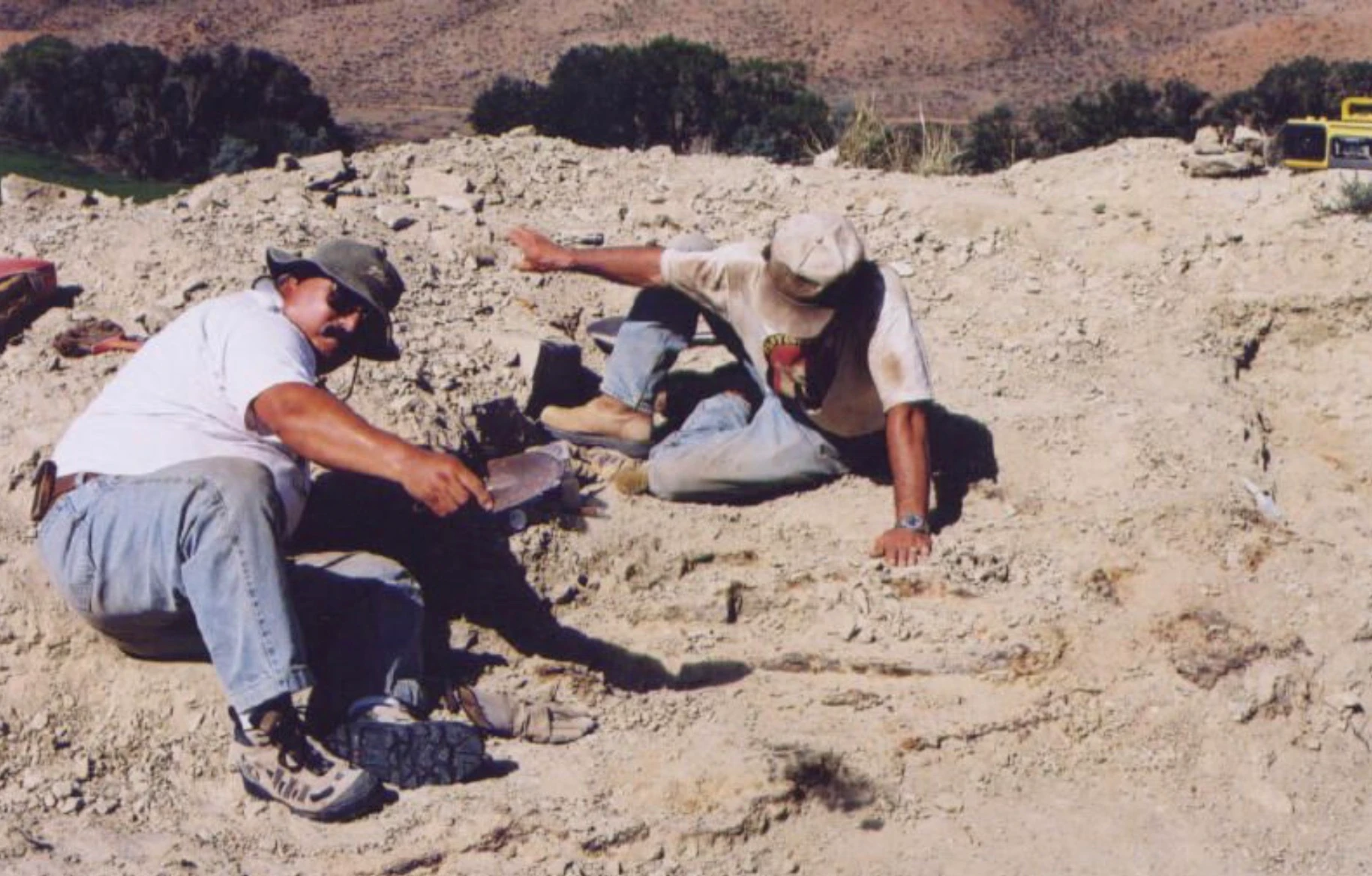
Boscarelli got in on “the tail end” of the excavation. He spent the summer of 2004 excavating the 360 fossilized bones, teeth, plates, and spikes with Simon and Don Pfister.
It remains one of the most fulfilling experiences of his life.
“When I was young in Cleveland, Ohio, I got an encyclopedia and read about paleontology and dinosaurs,” he said. “I never forgot it, and after getting out of the Marines and getting an anthropology degree from the University of Florida, I finally got an opportunity to get into it.”
Boscarelli had been traveling to Wyoming for years to dig dinosaurs when he reached out to Simon. He was looking for anyone interested in helping him excavate a promising spot near Shell.
“At the end of 2003, Bob told me that they did a big dig and saw some bones coming out of the side of the hill,” he said. “I knew that he had already found something that he thought was a stego. When I got there in 2004, that's when we started digging on it.”
The most distinctive parts of a Stegosaurus are the ornate plates on its back and the thagomizer, the paleontological term (co-opted from Gary Larson’s The Far Side) for the long spikes at the end of the tail.
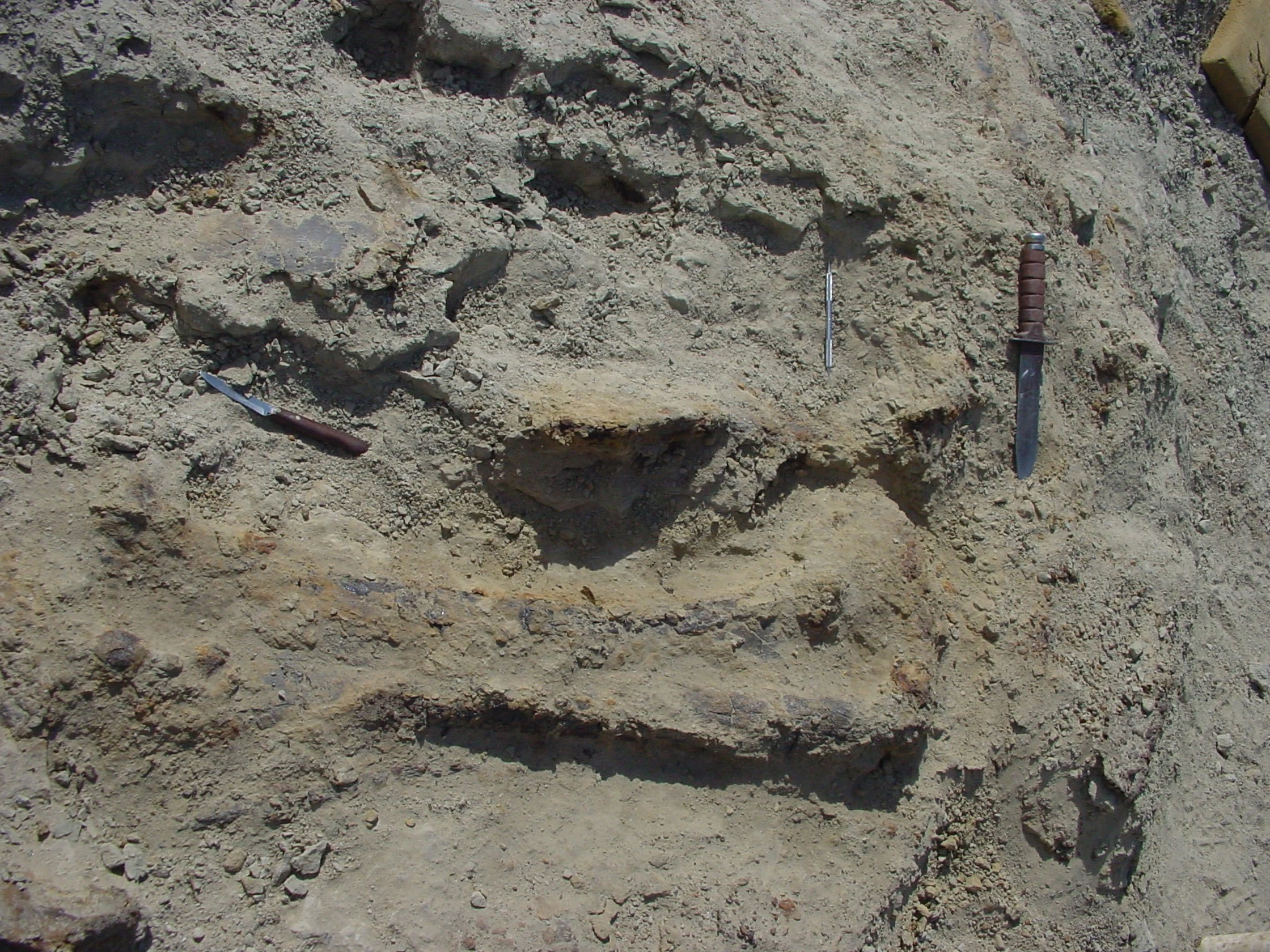
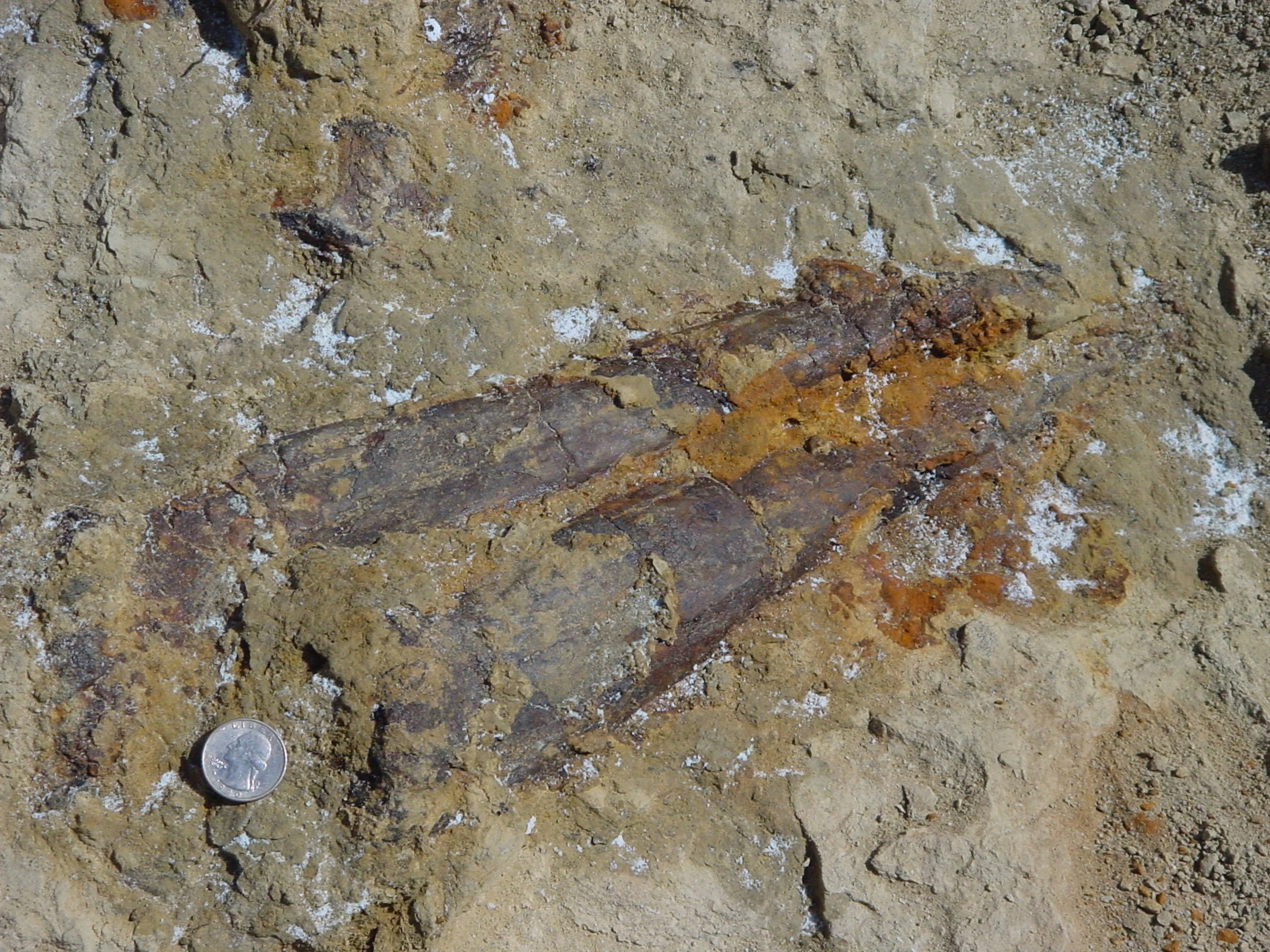
Boscarelli had his camera ready when Sophie’s thagomizer saw sunlight for the first time in 146 million years. It was the tail-end of the dinosaur and the crowning moment of validation.
“That’s when we knew it was a Stegosaurus,” he said. “I was there for Sophie.”
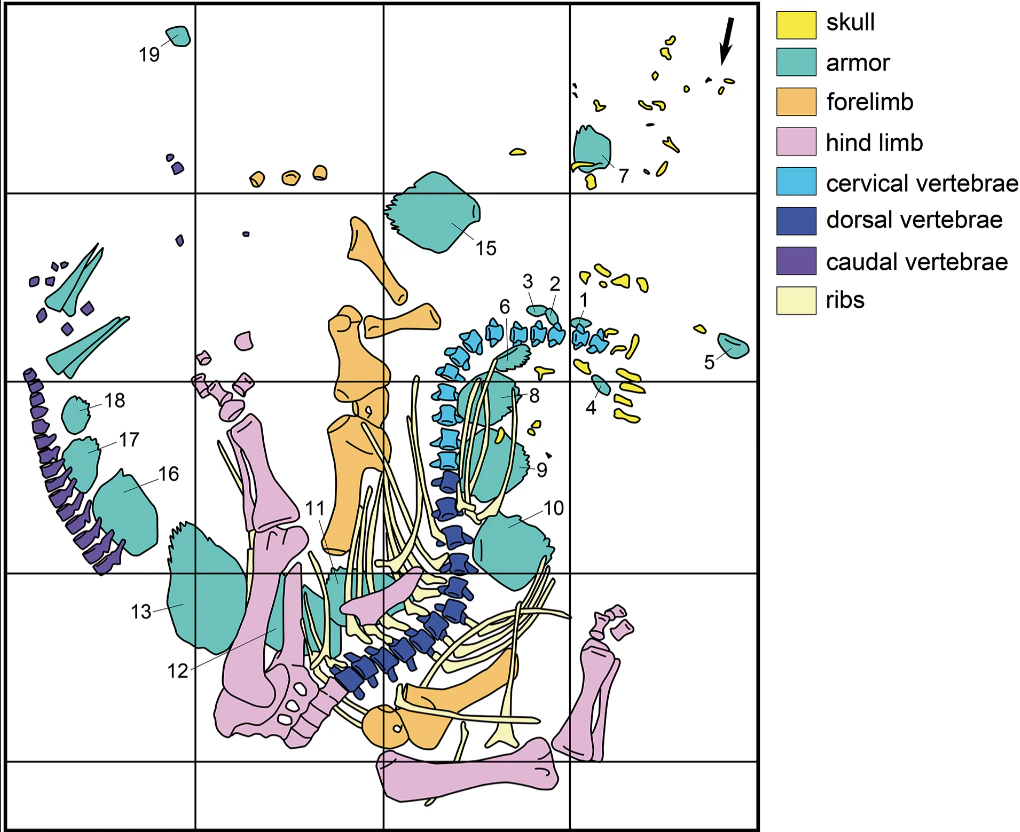
The excavation revealed a nearly complete Stegosaurus skeleton, including articulated sections of the back, hips and tail, nearly articulated arms and legs, a significant portion of the skull, and most of the iconic back plates.
The fossils were also preserved three-dimensionally, meaning the weight and pressure of hundreds of millions of years hadn’t flattened them. It was, then and now, one of the most anatomically accurate and important Stegosaurus specimens ever found.
“It was amazing. It was incredible. I loved it,” Boscarelli said.
Following The Lost River
Bob Simon is a legendary figure in the paleontological world. He has the distinction of finding some of the best skeletons ever found, and all from the same spot near Shell.
“I tell people that finding dinosaurs is 30% skill and 70% luck,” he told Cowboy State Daily.
Simon, who has a Master’s Degree in geology, worked for an oil company before founding DinoSafaris in the 1990s. After scouting out an optimal spot to dig on a private ranch, he got permission from the landowners to start excavating and went to work.
The key to a successful dinosaur dig, according to Simon, isn’t to go looking for dinosaurs. Instead, look for a river – or, at least, the evidence of a river that disappeared thousands of millennia ago.
“What I tell people is that to find dinosaur bones, first you look for evidence of water,” he said. “If you have water, you have plants. If you have plants, you have plant eaters. If you have plant eaters, you have meat eaters and then flooding events to cover things up.”
Simon picked the spot where Sophie would be found because the geology indicated it was an optimal place to look. Based on the rocks and depositional environment, Simon realized the spot was a large bend in a meandering river system during the lush, sub-tropical Late Jurassic period of Wyoming.
“The (dead dinosaurs) just stayed there, and they were covered quickly,” he said. “If the bones aren't covered quickly, they get destroyed by nature.”
Simon’s geological survey immediately struck gold. One of the first things he excavated was one of the best dinosaur specimens ever found: a massive Camarasaurus, over 60 feet long, with nearly every bone in its body preserved.
“We pulled up some toe bones with the bucket of a backhoe,” he said. “After that, we went sideways and took out part of a hill, and started to expose it, real careful.”
Simon’s Camarasaurus was as close to perfect as a paleontologist could get. He was able to follow the toes to the legs, and then found every bone in both directions, from the tip of the neck to the end of the tail.
The only thing missing was the ever-elusive skull, which wasn’t waiting at the end of the neck. Refusing to give up, Simon read the landscape once again.
“I went up 30 feet onto the hill, looked down, and could see the ancient motion of water,” he said. “I could see the way the bones had shifted a little bit, and I knew if the skull was still in existence, it was where I hadn't dug yet.”
Simon identified the spot where the skull should be. Sure enough, after a few days of digging, there it was.
“That was the moment where everything was right,” he said. “That's where you say, ‘OK, we're good. We've done our job.’”
That Camarasaurus is on display at the Fukui Prefectural Dinosaur Museum in Japan.
Emotions Of Excavation
After finding the perfect Camarasaurus, a smaller and slightly less impressive Stegosaurus might seem underwhelming. Simon said he felt the same emotions when they uncovered Sophie: excitement and fear.
“People say, ‘Oh, it must have been amazing when you found it,’ but no, it wasn’t,” he said. “You know you have something that might be unique and important, but you don't know until you see it all. It was great that we were starting to find something, but until we could find all of it, it's always kind of a scary situation.”
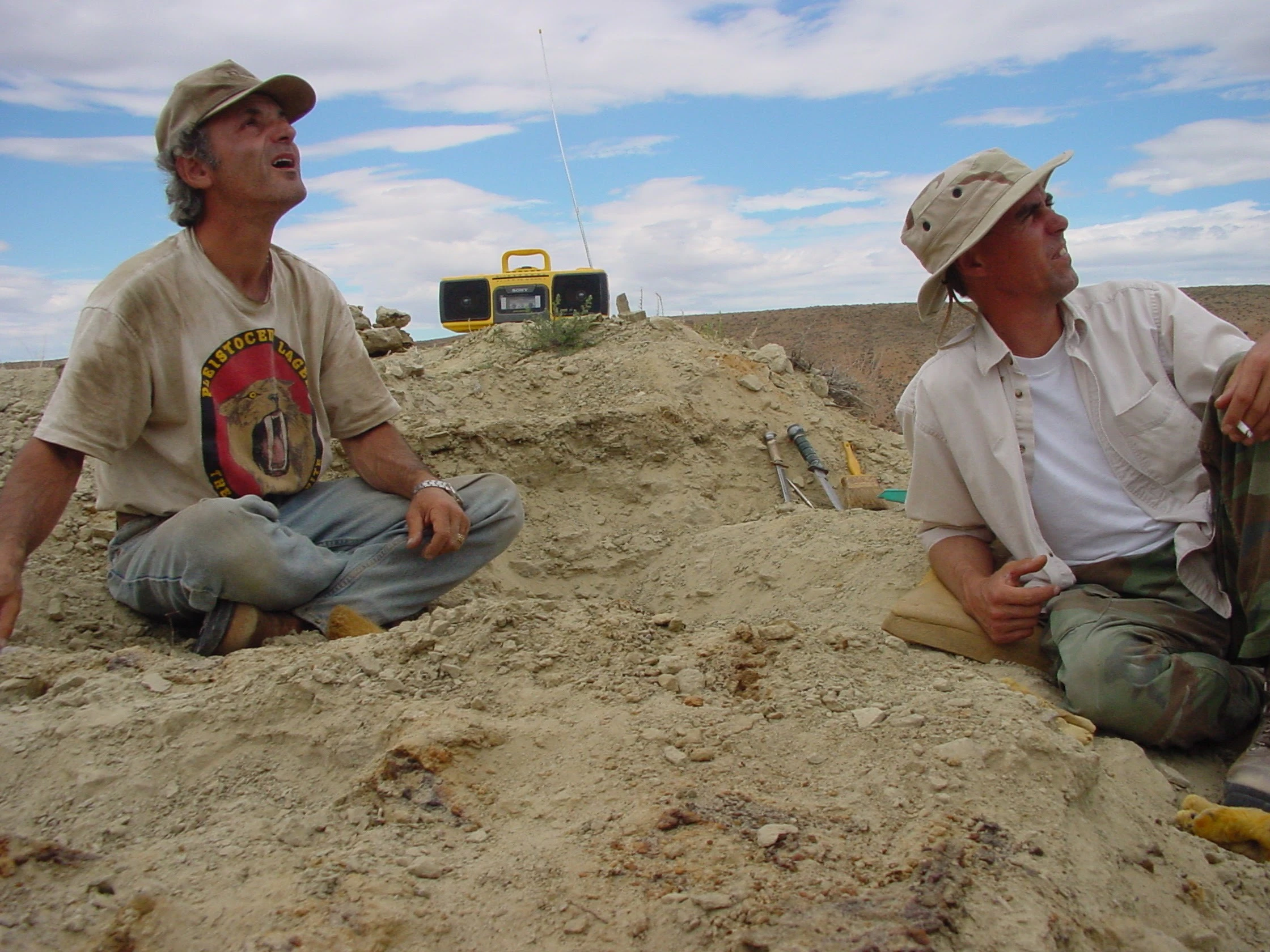
Boscarelli, meanwhile, was jubilant from the get-go. As soon as Sophie’s thagomizer was found, he was having the time of his life.
“We had a lot of visitors come out to see the site,” he said. “Bob ran the system, and by the end of the season, we had uncovered about 80% of it.”
The only important part missing was, yet again, the skull. Boscarelli recalled following a crumb trail of fragments in the hope of finding the Stegosaurus skull.
“I traced a lot of bone fragments and shed teeth to a big boulder,” he said. “Bob's like, ‘Yeah, get that thing,’ and we got that thing out. It took a lot of work, but we found the skull under there.”
One highlight of the excavation for Boscarelli was meeting Paul Sereno, the paleontology celebrity from the University of Chicago, who came out to Shell to see Sophie in situ.
Another notable visitor was Hans Jakob "Kirby" Siber, founder of the Aathal Dinosaur Museum in Switzerland. That museum is filled with Late Jurassic dinosaurs that Siber and his crew found not far from where Simon was digging.
“I left before Kirby visited, but I’ve met him since,” Boscarelli said.
Simon, meanwhile, kept his emotions in check. As incredible as Sophie appeared in the ground, it was still a jumbled pile of bones that could ultimately be just as disappointing as they seemed extraordinary.
“You're always assessing how much you have, but it’s in the back of your mind,” he said. “You hope it doesn't stop, because that’s always a possibility. You hope it keeps going. You hope there’s a skull. That’s why it’s always a little scary.”
From Sarah To Sophie (?)
While Simon and Boscarelli were excavating their stellar Stegosaurus, they named it Sarah after the landowners' daughter.
“I got to meet her once,” Boscarelli said. “She was a nice girl.”
When all of the fossils were excavated, the plaster jackets encasing them were shipped to Switzerland. Siber and his team at the Aathal Dinosaur Museum spent the next several years meticulously removing the rock and strengthening the fossils.
Sarah remained an open secret among paleontologists until 2013, when it was revealed that the Natural History Museum of London had acquired the specimen for its permanent paleontological collection. They got all 360 Stegosaurus bones, roughly 85% of the total skeleton.
That’s when Sarah became Sophie. It was a name honoring a different daughter, whose father’s donation made the acquisition possible.
Sophie finally got her moment in the 2015 paper, “The Postcranial Skeleton of an Exceptionally Complete Individual of the Plated Dinosaur Stegosaurus stenops (Dinosauria: Thyreophora) from the Upper Jurassic Morrison Formation of Wyoming, U.S.A.”
In the study, Barrett and other paleontologists determined that the Stegosaurus wasn’t fully grown. It was either a young or sub-adult dinosaur when it died and was buried, entirely undisturbed, according to Simon.
“There was no evidence of scavenging on any of the bones, and (the bodies) weren't torn apart,” Simon said of Sophie, the Camarasaurus, and other dinosaurs found in that spot. “That led me to think that the scavengers couldn't get there. They couldn't cross the water to get to where the floods had piled up the dinosaur remains.”
Also, Sophie might not be a Sophie. Despite the name, there is no conclusive way, minus some exceptional circumstances, to identify the sex of a dinosaur.
'Wow, That’s Pretty Cool'
Over 20 years after Sophie’s discovery, both Boscarelli and Simon are out of the dinosaur digging gig.
“As you get older, you miss it less and less,” Simon said. “It cost a lot of money to be out there and do what I was doing. It was a fantastic time. The rancher was fantastic. The land was fantastic. The community was great. I had a blast, and I miss it, but I don't think I could do it again.”
After leaving Shell in 2004, Boscarelli didn’t hear or see anything about Sophie until her glorious arrival in London. A few years later, when he was going on a family trip to Sicily, he decided to stop in London to see the fruits of his labor.
“They have an escalator going up to the dinosaur part of the museum, and Sophie’s right in front,” he said. “We uncovered most of it, but to actually go up there and see it was unbelievable.”
Today, Boscarelli, who lives in Soquel, California, has two cats he fondly named Sarah and Sophie. Finding the Stegosaurus was “the biggest moment” of his foray into paleontology, but he admitted he still has mixed feelings about where Sophie ended up.
“I still have my ‘Keep It in Wyoming’ shirt from the other digs I did with Bob Bakker at Como Bluff,” he said. “I'm not a big fan of the fossils going out of the country. When I met Dr. Barrett (in London), I told him, ‘You take a girl out of the country, you shouldn't change your name too.’”
That’s why Boscarelli was happy to hear the Wild West Dino Den in Shell, which recently unveiled a cast of the famous Allosaurus “Big Al,” intended to acquire a replica of Sophie for the museum they intend to build in Greybull.
“It’s really amazing that their museum is coming to fruition,” he said. “I wanted Sophie to be there.”
Simon, who is in Spotsylvania County, Virginia, finally got his moment of vindication when he saw a fully mounted replica of Sophie. It was the moment he let himself be engulfed by the wave of emotions his spectacular Stegosaurus has and will continue to inspire in others.
“I was very fortunate that most of the dinosaurs that I found were very complete and are in museums,” he said. “When everything was found and prepared, and I saw a cast of (Sophie) on display, that’s when it really hit home. That's when you sit back and go, ‘Wow, that's pretty cool.’”
Contact Andrew Rossi at andrew@cowboystatedaily.com

Andrew Rossi can be reached at arossi@cowboystatedaily.com.