CHEYENNE — There was a seismic shift months ago behind the scenes with Wyoming’s largest data center development, Project Jade.
Crusoe, the company that was constructing the buildings for the massive 2.7-gigawatt data center, packed up its stuff and left.
The exit happened quickly and quietly, without the fanfare of press releases and company statements that had preceded the project, which at buildout would use nearly triple the power consumption of the entire state of Wyoming.
Crusoe’s about face was so quiet, in fact, that few people outside the project even realized anything had happened at all.
That was until Tuesday, when the company was quoted in passing in a Bloomberg article saying that its data center client had asked Crusoe to pause construction of Project Jade, even as the company announced another 5 gigawatts worth of data center infrastructure for Crusoe Cloud.
Crusoe’s statement made it seem as though Project Jade itself might be on hold or looking for a new partner, but nothing could be further from reality, officials for partner Tallgrass Energy told Cowboy State Daily on background.
Work on Project Jade never stopped — not even for a minute — following Crusoe’s exit roughly two months ago, Cowboy State Daily was told Wednesday morning.
Tallgrass officials are now working directly with the data center client and have been “full steam ahead” since Crusoe’s exit.
Black Hills Corp., the parent company of Black Hills Energy, meanwhile released a statement to the same effect, saying that the data center project has not been on pause.
“We remain committed to supporting the project’s data center customer and delivering the infrastructure necessary to meet their long-term energy needs,” President and CEO Linn Evans said. “The project has not been paused and continues to represent a significant opportunity for the company. Our efforts remain fully directed toward successfully delivering the project.”
Black Hills Corp’s statement added that its Wyoming subsidiary, Black Hills Energy, agreed in April to procure long lead-time generation equipment with the prospective customer to support the project, which will be served under Wyoming’s large-load tariff.
“The customer has provided over $200 million in refundable contributions in aid of construction to date in support of milestone payments to secure generation equipment,” the statement says. “Additionally, the company executed a substation agreement with the large-load customer, and filed a CPCN (Certificate of Public Convenience and Necessity) for a substation to support the project in January 2026.”
Project Jade’s Unprecedented Scale
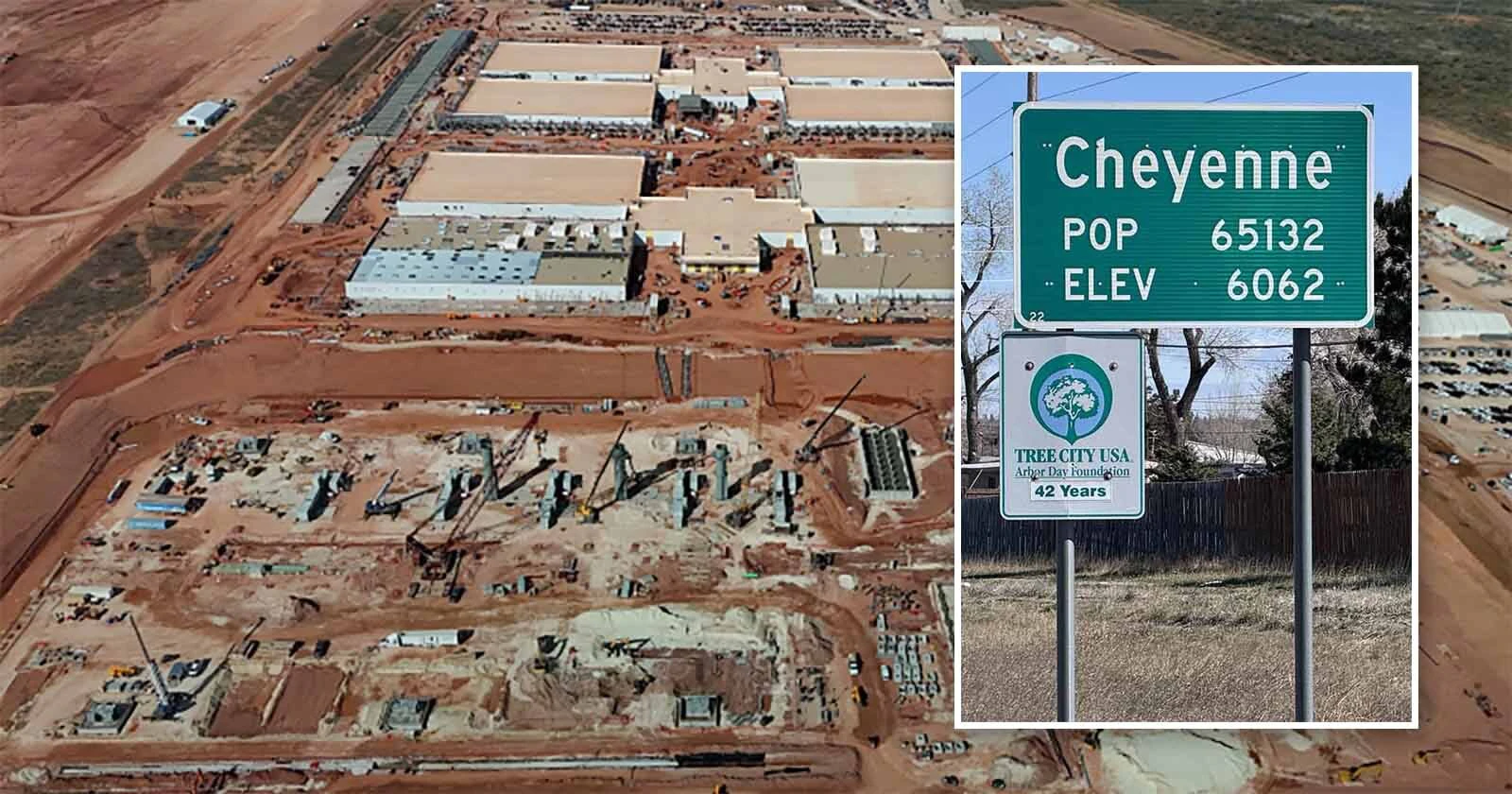
Project Jade, located in the Switchgrass Industrial Park along Highway 85 south of Cheyenne, is the largest data center yet announced in Wyoming and has received widespread attention because of that.
Initially, the data center was announced as a 1.8-gigawatt facility. Later, during a Laramie County Commission meeting, company officials said the facility had grown to 2.7 gigawatts — almost three times what the entire state of Wyoming uses when it comes to power.
The facility can ultimately scale to 10 gigawatts of capacity.
Project Jade has always planned to build its own power, which company officials said avoids burdening the local power grid. It will also use a closed-loop system to cool its servers to minimize water use.
The closed-loop system will take an initial 20 households worth of water to fill, company officials have told Laramie County commissioners, and will come from aquifers far below those that supply water to residents of Laramie County and Cheyenne.
Annual water use will be around three households, once the closed-loop system is filled.
Project plans show five buildings of up to 800,000 square feet. These will have their own onsite wastewater treatment and septic systems.
The company’s efforts to mitigate impact to the community do not stop at water and power. It also included building new roads into its facility to relieve pressure on existing routes, as well as a $2.9 million commitment to help the city of Cheyenne build affordable housing.
The company doesn’t plan to use man camps to house construction workers. Instead, it plans to use a range of local housing, including long- and short-term rentals, hotels and motels, RV accommodations, and other solutions.
Three Projects In One
What the public has been calling Project Jade has actually always been three distinct but intertwined projects, Tallgrass officials said.
There was the power plant itself, a natural-gas-fired facility that includes large turbine generators and fuel-cell systems, which is what Tallgrass is developing.
That is now being referred to by the company as the Cheyenne Power Hub.
There are the data center buildings, which are essentially warehouse-like shells that will one day hold the racks of computing power for the unnamed data center client.
That was in Crusoe’s court as the data center client who will eventually use all the computing capacity that’s built out in the data center.
Crusoe’s exit, which happened early this year, changes just one thing in all of that, Tallgrass officials said — the eventual sign on the buildings.
Everything else has stayed functionally the same, including the client.
Dirt work at the site has already begun, Tallgrass officials say, leading up to construction of the power plant itself, which is the longest lead-time item.
Work on the power generators is expected to ramp up this summer and will be brought on in phases. The first available phase is expected to begin operating sometime in 2027.
Service to the data center client is targeted for early 2028, after which the project is expected to create more than 100 permanent jobs.
Who Is Tallgrass
Tallgrass has long operated large-scale, multi-commodity infrastructure, including more than 10,000 miles of pipeline and energy-related assets across 14 states.
The company has been in Wyoming for the past 10 years, where it has its third largest employee base at more than 200 existing employees. It operates more than 3,000 miles of natural gas, crude oil, water, and carbon dioxide pipelines.
Some of its infrastructure includes carbon dioxide wells for carbon capture, including some assets that are in the vicinity of Project Jade. The carbon capture capabilities have been touted as a vital element of building out the data center.
In the last three years, Tallgrass has invested almost a billion dollars into Wyoming’s economy. Its investment on Project Jade dwarfs that at $7 billion.
Crusoe Still Busy
No one is saying publicly why Crusoe left the project, or whether the data center client is the one who asked them to leave.
Crusoe did not respond to Cowboy State Daily inquiries about its exit, and Tallgrass officials said they learned of Crusoe’s public statements the same way everyone else did — by reading about it in Bloomberg’s article.
While the reasons Crusoe exited the project remain unclear, one thing that isn’t unclear is just how busy Crusoe is right now.
Even after stepping away from Project Jade, Crusoe has more than 40 gigawatts worth of projects either in its total development pipeline or under active negotiation, according to its website.
Its Bloomberg comments, meanwhile, came with an announcement of 5 more gigawatts for the Crusoe Cloud.
The company is widely expected by industry experts to go public and has been actively working on a pre-IPO funding round north of $10 billion.
Expect More Shifts In The Future
Carson Kearl, a data center analyst for energy data analyst Enverus, said more dance steps are ahead for the data center space.
“There are a bunch of these Crusoe-like developers across the Lower 48 with announced projects of significant scale and capacity,” he told Cowboy State Daily. “I would say a majority of them do not have a publicly disclosed tenant or an off taker.
"Our view is the reason they don’t have those disclosed is because they don’t have them, period.”
Kearl has been tracking data center capacity in various stages of discussion across the nation and said he expects as much as 80% to 85% of the projects to get canceled purely as a function of "supply chain constraints on the data center side of things, like how many chips are actually available between now and about 2030.”
Wyoming, as a state with lots of wide-open space and abundant energy, meanwhile, is well-positioned, to capture the real projects, Kearl added.
In the race to build out data centers and capture market share first, Wyoming offers exactly what these companies want.
“The ability to do behind-the-meter projects in an area where you would have faster interconnection times or power timelines … is super attractive,” Kearl said. “Everyone’s kind of working to try and make that faster, to level the playing field.”
Building your own power is not an inexpensive tactic, however.
“You’ll be well into the $100-plus-a-megawatt-hour range,” he said. “And then if you layer in the CCS (carbon capture and sequestration), it would probably be even higher, into the mid-$100 range.”
Renée Jean can be reached at renee@cowboystatedaily.com.