
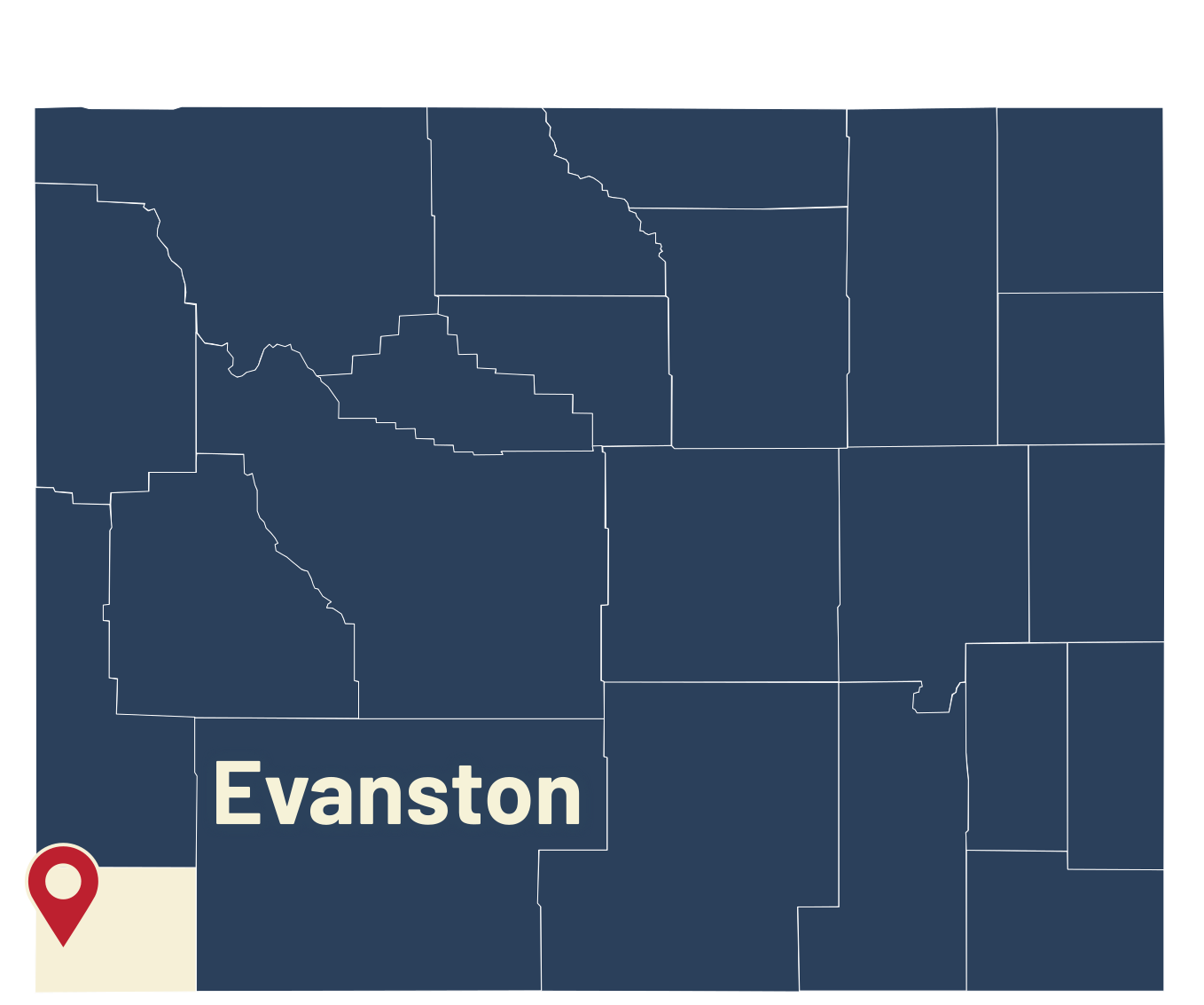

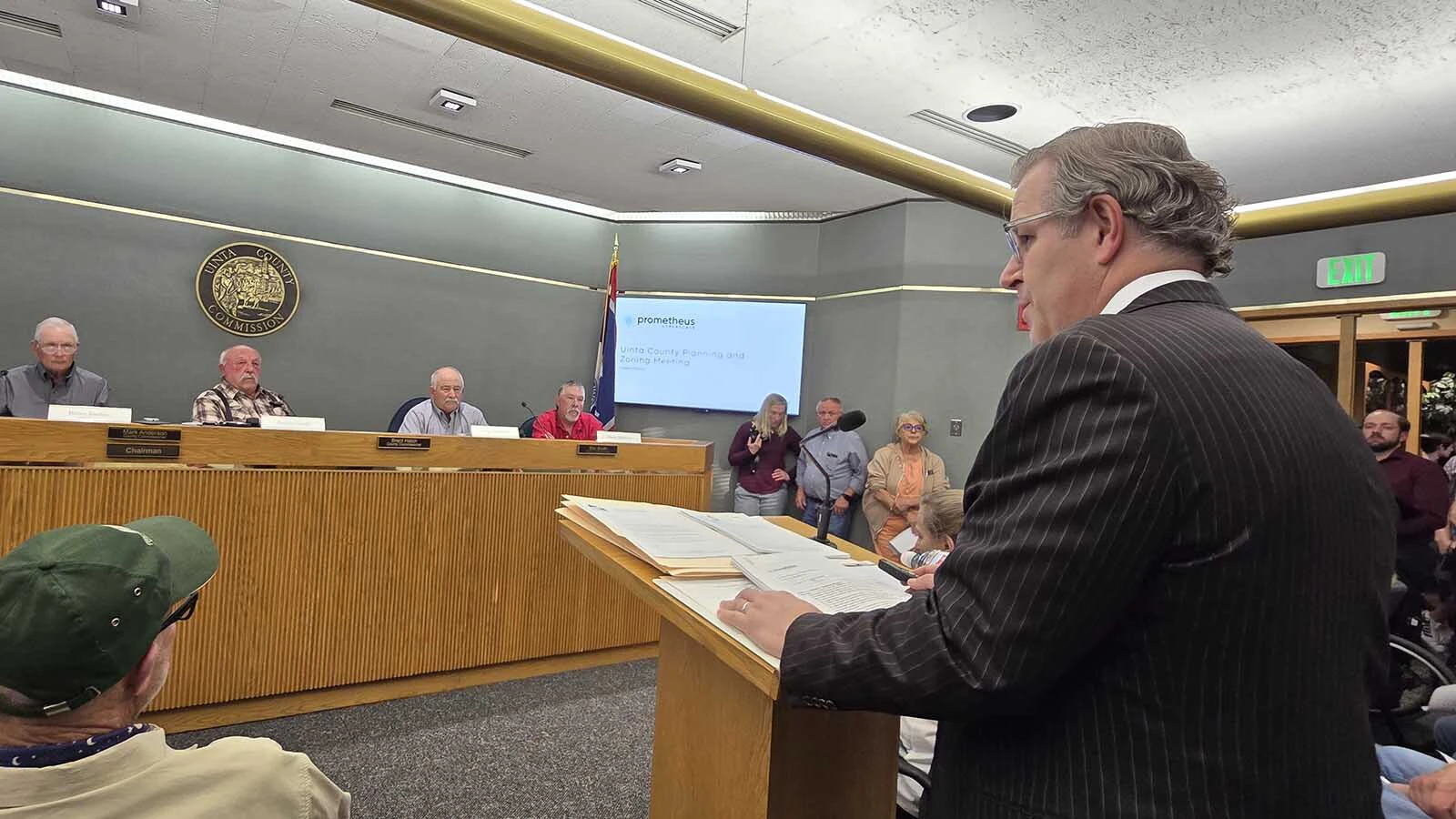
EVANSTON — Uinta County’s Planning and Zoning Commission chamber was packed from wall to wall Wednesday night with residents spilling into the hallway as Prometheus Hyperscale’s massive data center on the Thornock family ranch came up for a key vote.
But when it was time for the public to step up to the microphone, only a handful of people did.
After weeks of questions and skepticism at public forums and on social media, most of the standing-room-only crowd listened quietly as commissioners voted unanimously to recommend zoning and conditional use permit approvals to Uinta County commissioners for the proposed 1.25 gigawatt, 500-acre, off-grid campus.
The quiet was a stark contrast to the tone of an earlier meeting the night before, where hundreds turned out to ask questions, and at times became emotional.
Uinta County resident Keaunna Archuleta, one of those who did step up to speak Wednesday, told Cowboy State Daily she’d filled “five notebooks” with questions about the project that wants to become Evanston’s neighbor.
“In regards to the coolant system, in the event of an emergency, like a leakage, what kind of response plan do we have for that?” she asked in the packed meeting room.
“As far as what that could look like, you know, severe weather, fires, things like that. I think that’s an important thing to know about,” she said.
Archuleta also wanted to know how much water would be needed to charge the closed-loop cooling system Prometheus founder Trenton Thornock had mentioned during his presentation at the beginning of the meeting.
“What happens to the coolant?” she asked. “Where does it go? How does that affect the environment?”
And what about the facility’s diesel generators, she wondered.
“Those are generally the size of a rail-car,” she said. “How many of those are going to be used, and what type of emissions are going to be contaminating our air? I think these are things that affect everyone and need to be considered. Those are my questions, thank you.”
Roddy Martin, meanwhile, who lives in Lyman, wanted to know how much natural gas the turbines would use to produce 1.25 gigawatts of power and Barbara Lowe wanted to know just how many decibels and what frequencies the data center would cause.
“You mentioned the decibels were low,” she said. “My question is about the frequencies and how it affects our animals and wildlife and people’s livestock.”
Thornock had earlier said the sound levels would be between 60 to 70 decibels at the fence line — about the same as a dishwasher running in the kitchen.
Another 1,000 feet away, the decibels drop to between 45 and 55, which Thornock said is quieter than a normal conversation, and quieter than his current speaking tone.
Holly Pfeiffer, who lives up in Robertson, wanted to know what makes Prometheus Hyperscale different than all the other data centers being protested around the country.
“People are having problems with contamination of their water, their soil, their air,” she said. “Others have no water, they ran out of water.
"How is that any different from what they’re doing, what you guys are doing here? If I could get that answered, that would be fantastic.”
The questions came out rapid fire, in intermittent batches toward the end of each hearing. What stood out just as much was how many people never spoke at all. Most had come simply to listen.

Prometheus Will Be Cleaner, Quieter, Off-Grid
Thornock took notes on each question, and answered them in small batches.
“So regarding the frequencies, there have been a number of studies done,” he said. “Most low frequency comes from natural sources like thunder, waves, earthquakes, and some unnatural sources like concealed nuclear tests. We will study all of the frequencies that are available to us when we do our acoustic study.”
That study will include a baseline before the data center is built.
“We’ll be happy to share ongoing measurements once we start the facility,” he said.
As far as the coolant response plan, the data center will have catchment basins that are part of its engineering plan from the get-go, he said.
“In the unlikely event there is a spill, it will go into a containment area,” Thornock said. “How much water does it initially use? Well, it’s 75% water and 25% propylene glycol.
"It will take approximately three Olympic swimming pools worth of fluid to do the initial fill, which lasts six years for each building.”
Even though propylene glycol is nontoxic, coolant will not be discharged, Thornock added.
“The same supplier who supplies the coolant will be responsible to remove the coolant and dispose of it properly under EPA rules,” he said. “Diesel backup generators are fully scrubbed with the latest scrubbing technology.
"The emissions are subject to the EPA and the Wyoming Department of Environmental Quality, so we will be applying for the appropriate air permits when it’s time.”
The data center Thornock has proposed to build on his family’s ranch land is different, he said, because he has seen the problems the woman mentioned and decided to try and solve them.
“The problem that I saw with the industry when I started is that the industry did not care how much power it consumed,” he said. “It did not care how much water was consumed for the compute. The whole point of starting this company was to provide a new type of infrastructure that was more environmentally responsible.”
The closed-loop system Thornock plans to use alone makes his data center different from 98% of them out there, he said.
“If you go to Dulles, Washington, on the Washington River, the Umatilla tribe fought for years, filed lawsuits to find out how much water Google was using on a daily basis, because everyone had signed NDAs, including the city officials,” Thornock said.
“Eventually, that had to be disclosed,” he added. "The Umatilla tribe got their wish, and I supported them in their efforts. So that’s how we’re different.”

'This For Me Is Home Still'
Before public questions and comments, Thornock tackled the “sell-out” accusation he’d heard the night before at a three-hour public forum Prometheus Hyperscale hosted at Evanston’s Roundhouse, which drew hundreds.
“I want you all to know this,” Thornock said. “This for me is home still. This land in the community matters to me in a way that goes well beyond business.”
As far as leaving the state goes, the story behind that is short and telling. It’s the same story for a lot of his classmates too, who left Wyoming to find high enough paying jobs to support a family.
“The day after I graduated from high school, I went to work for a company in Afton called Trio Electric as a welder,” he said. “Trio, at that time, could not find any work in Wyoming, so I moved to Colorado. That’s the end of my story.”
Thornock said he’d rather earn everyone’s trust with facts than ask for approval without facts.
“I didn’t start Prometheus and then come here looking for land,” he said. “I started it after looking at the land with my brother. We have known for a long time, and we saw an opportunity to bring generational wealth to a community that we’re already a part of.”

Exactly Where The Campus Would Go
Thornock first put up slides showing exactly where his project will be.
“As things have evolved, the section of land that we’re proposing to build a data center campus on has shifted, and we are now in Township 15 North Range 118 West, Section 13,” he said. “It’s right off exit 13 on Interstate 80. Most people blow by that, unless they’re working on the wind farms on the north side of the freeway. We are on the south side.”
The data center would be 500 acres, a size Thornock said would allow the company to maintain a buffer around the data center to help minimize its visibility to neighbors.
“The closest land use to us is the Evanston Silver Eagle refinery, which you can see is the postage stamp to the left of the little BLM section,” he said. “The rest of the land is vacant.”
The initial campus will support more than 1.25 gigawatts of computing capacity, which Thornock said would be developed over five phases.
“The build footprint, which is the actual buildings, is expected to cover roughly eight to nine football fields worth of space,” he said. “And for perspective, your county planner and GIS specialist asked me to arrange a tour for them of an operating data center that’s more or less like this one.
"It exists in West Jordan, Utah, and in that case it’s directly across from a single-family subdivision.”
Water use, once the facility is completed, will be around 15 homes’ worth.
“That’s the entire campus, not per building,” he said. “And again, your county planning folks have seen a facility very similar to this one in size, and it uses that amount of water. They can say that because they’re up and running.”
Water will not be drawn from Uinta County’s water supply, Thornock added, nor will waste water be discharged to any local systems.
“The cooling system is closed loop, which means it circulates internally,” he said. “The only wells on site serve the office buildings and bathrooms for basic domestic use. We understand that water supply is foundational to this county. Our design was built around that reality.
"From Day One, zero demand on the county and zero discharge. It’s not a footnote, it’s a core design requirement that we gave to our tenant.”
Power, meanwhile, will be generated on site and off-grid.
“It does not draw from the public grid, because it’s not even connected,” he said. “That means your power bills cannot be affected. The reliability of electricity for homes and businesses in Evanston is not affected. We’re not competing with you for grid capacity. We’re building our own.”
Job Promises
Thornock is taking extra care when it comes to hiring locally, he said.
“I know this is not a technical requirement of the subdivision process or the conditional use permit,” Thornock said. “This is presented to you just for color.”
Thornock has instructed his contractors that any person with a Wyoming license wins when it comes to a “tossup” during the hiring process.
“This project will create 3,800 temporary construction jobs,” he said. “These folks are not all going to show up at once. There’s going to be a long ramp. It’s going to take a while for us to spool up.”
Once the earthwork is done and the project goes vertical, there will be hundreds of positions for electricians, iron workers, pipe fitters, fiber technicians, HVAC crews, and surveyors.
Once operational, the campus will have 200 long-term jobs for facility technicians, network and data center operations staff, mechanical and electrical maintenance, security and site management.
“These are skilled, well-paying positions,” Thornock said. “And then there’s the multiplier. For every direct job this project creates there will be an estimated six additional jobs supported in the broader economy.”
That’s data based on a PricewaterhouseCoopers study, Thornock said.
Construction could start within the next six months, pending receipt of required permits, and the full buildout of the 1.25 gigawatts of power will be delivered in phases over a period of roughly 48 to 60 months.
That will be four to five years of activity.
“That phased approach means that Uinta County will see sustained construction activity for several years,” Thornock said. “And it also means you will have ample opportunity to observe how we operate, hold us accountable, and see our commitments in action before we get to scale.”
Thornock not only committed to showing water usage on a public portal, he asked planning commissioners to add the stipulation to his conditional use permit.
He also committed to repairing or replacing a bridge on County Road 1818 and performing a complete analysis of heat from the data center and how it is dispersed and asked that these be added as conditions of the permit.
“We’ve committed to hiring locally, supporting the community, and remaining accessible throughout this entire process,” Thornock said. “And when the time is right, I will insist that our tenant come here and work on our community benefits agreement, which is a contract that we intend to make among ourselves and the community.
"We do want to answer every question you have tonight, and we want you to have a direct line to us going forward.”

Some Uncertainties Remain
After the meeting, Archuleta said she is still making up her mind about the data center project.
“It seems like they’re going as clean as they possibly can when it comes to a lot of the emissions, when it comes to the environmental stuff,” she said. “But some of it was kind of vague, like the natural gas and things like that. That wasn’t hit on as much as I would have liked.”
There was also talk about jobs that she felt was also somewhat vague.
“We don’t know what type of training, what type of apprenticeships, age limits there will be,” she said. “Is this something that the younger people going into the workforce can get into, or is this only for people who have certifications? It is going to supply jobs, but jobs to who? And how is it going to be accessible for those who don’t have the training.”
There will be economic benefits, she acknowledged. But she wants to see details like that discussed.
“There’s a lot to know,” she said. “And I think (county) officials need to do their research on data centers before they come to a council like this.
"I think they should do their research if they’re going to approve or not approve something like this.”
Renée Jean can be reached at renee@cowboystatedaily.com.


