
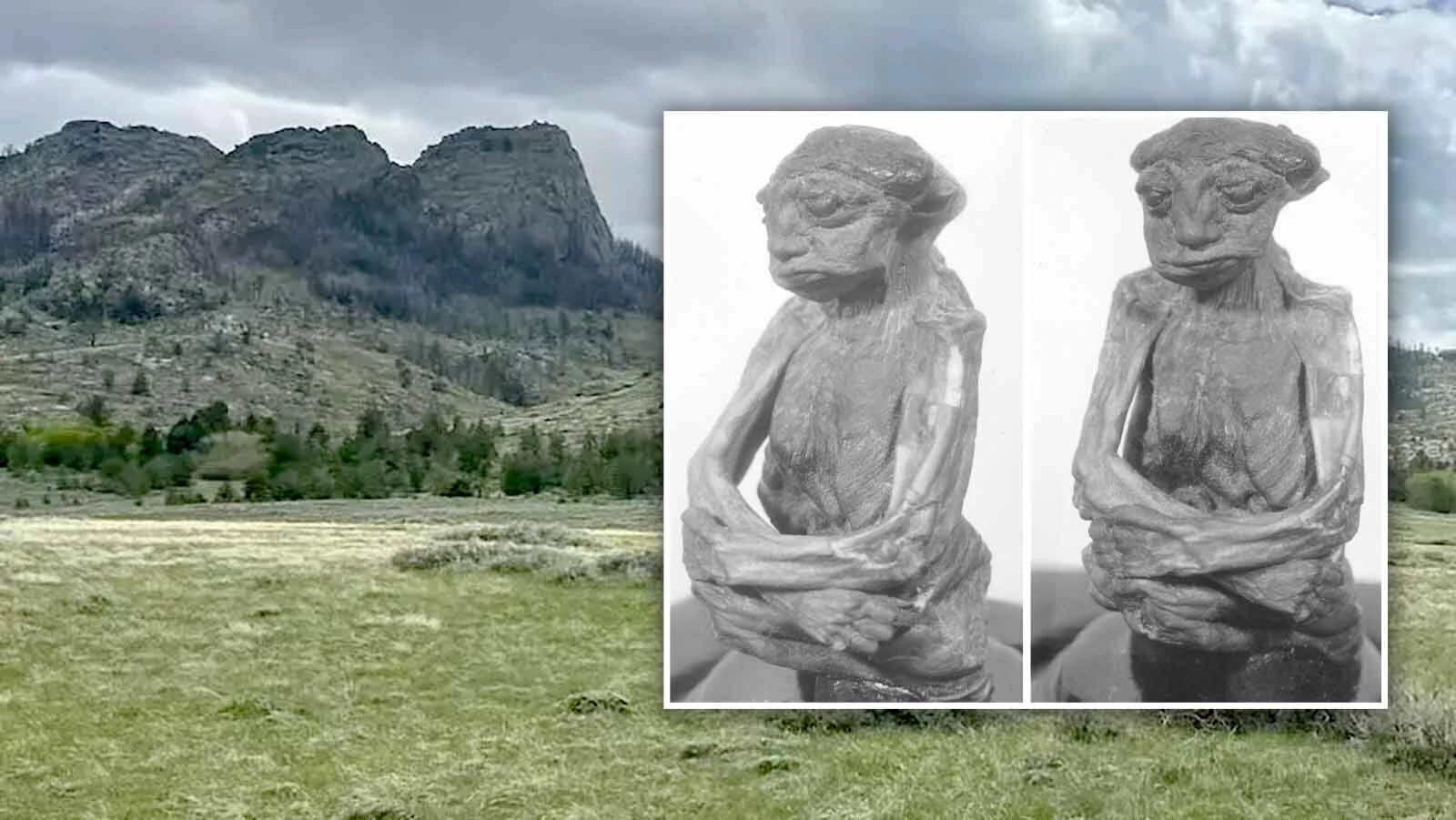
John Adolfi, a creationist in Syracuse, New York, searched for many years for Noah’s Ark and a race of giants who supposedly walked the Earth. But until he died last November, the elusive Pedro Mountain Mummy found in Wyoming in 1932 still clearly haunted him.
In 2005, Adolfi posted a $10,000 reward for the tiny mummified remains of the 7-inch-tall “Pedro,” as he came to be known in the region. Pedro hasn’t been seen in public since 1950, but in the past 76 years the mummy has been the source of extraordinary speculation about its origin.
Adolfi’s goal was to have the mummy tested through DNA samples, magnetic resonance imaging, and improved X-ray technology to establish exactly what it was so he could disprove the theory of evolution.
Countless newspaper and magazine articles have been written about Pedro, who is also the subject of a host of videos on YouTube and was featured on an episode of “Unsolved Mysteries” in 1994.
Some of the videos make sensational claims, including that he was a member of a tribe of “Little People” of Indian legend.
But was the human-like Pedro an example of the Nimerigar, a mythical tribe of savage pygmies with sharp teeth that Native Americans thought were hiding in the mountains?
Nimerigar is literally translated as “people eaters,” and it’s said they shot their Indian prey with tiny bows and poisoned arrows.
In 1941, the Milwaukee Journal asked in a headline, “Did a Race of Pygmies Once Live in America?” According to this account, the preserved mummy was a 65-year-old man.
Most disturbing was the article’s claim that X-rays showed “food in the stomach appears to have been raw meat. The teeth in the front of the mouth are pointed and of the flesh-eating variety.”
Or was the mummy an example of a benign race of humanoid pranksters?
One aspect of the legend is that people who go near the San Pedro Mountains in southern Wyoming should carry something shiny to offer the Little People as a gift, so they knew no harm would come to them.
Perhaps all the fascination is due to the fact that while so little is known about the mummy, including its whereabouts, there is no doubt that it existed, that it looked freakish, and there are still copies of X-rays — but not the X-rays themselves — that have led to scientific speculation that Pedro was either a full-grown adult or an infant with an abnormality called anencephalus, in which only the brain stem develops.
Complicating matters was the appearance of a large wound on top of its head.
There is just enough photographic and other evidence left for people to claim Pedro was anything they want it to be.
Wanted To Disprove Evolution
Two decades ago, Adolphi told then-Casper Star-Tribune reporter Brendan Burke — who became so curious about the mummy that he added Pedro to his unofficial beat — that he realized proof of a previously unknown prehistoric relative of man would not disprove evolution.
But Adolphi maintained that a new humanoid species would poke holes in the paradigm evolutionists have created regarding human origins.
Six months later he was interviewed again by Burke, who reported that while Adolfi said he received many leads, none had panned out.
A Wyoming woman told him the mummy was in the possession of an Indian tribe not based in Wyoming. But Adolfi investigated and determined that tip was a dead end.
So was another person who reported seeing Pedro at a garage sale in New Jersey. And an 86-year-old Wyoming man who had what appeared to be a hominoid mummy that could fit in the palm of one’s hand.
But the man was not willing to have the artifact X-rayed, Adolfi said, because he didn’t want to know if it was an authentic Nimerigar corpse or a vegetable carving. And the man wanted to continue believing that his mummy was “the real deal.”
Adolfi said he was willing to pay less money for evidence of other pygmy mummies, but he apparently never got his hands on one.

A poster showing the Pedro Mountain mummy. 
There was much speculation about the Pedro Mountain mummy after it was discovered. 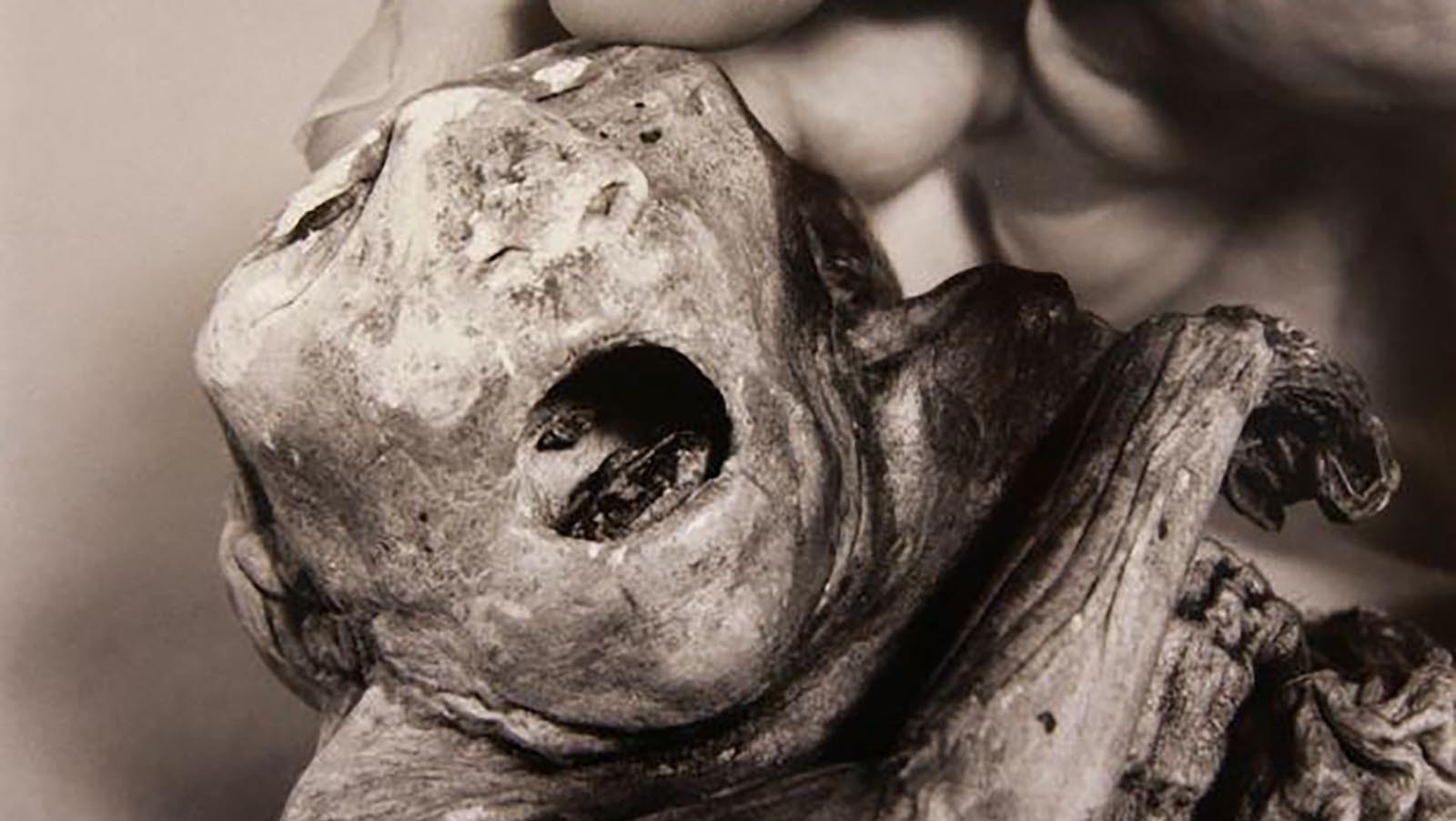
Chiquita is another tiny mummy found near where Pedro was discovered. (University of Wyoming) 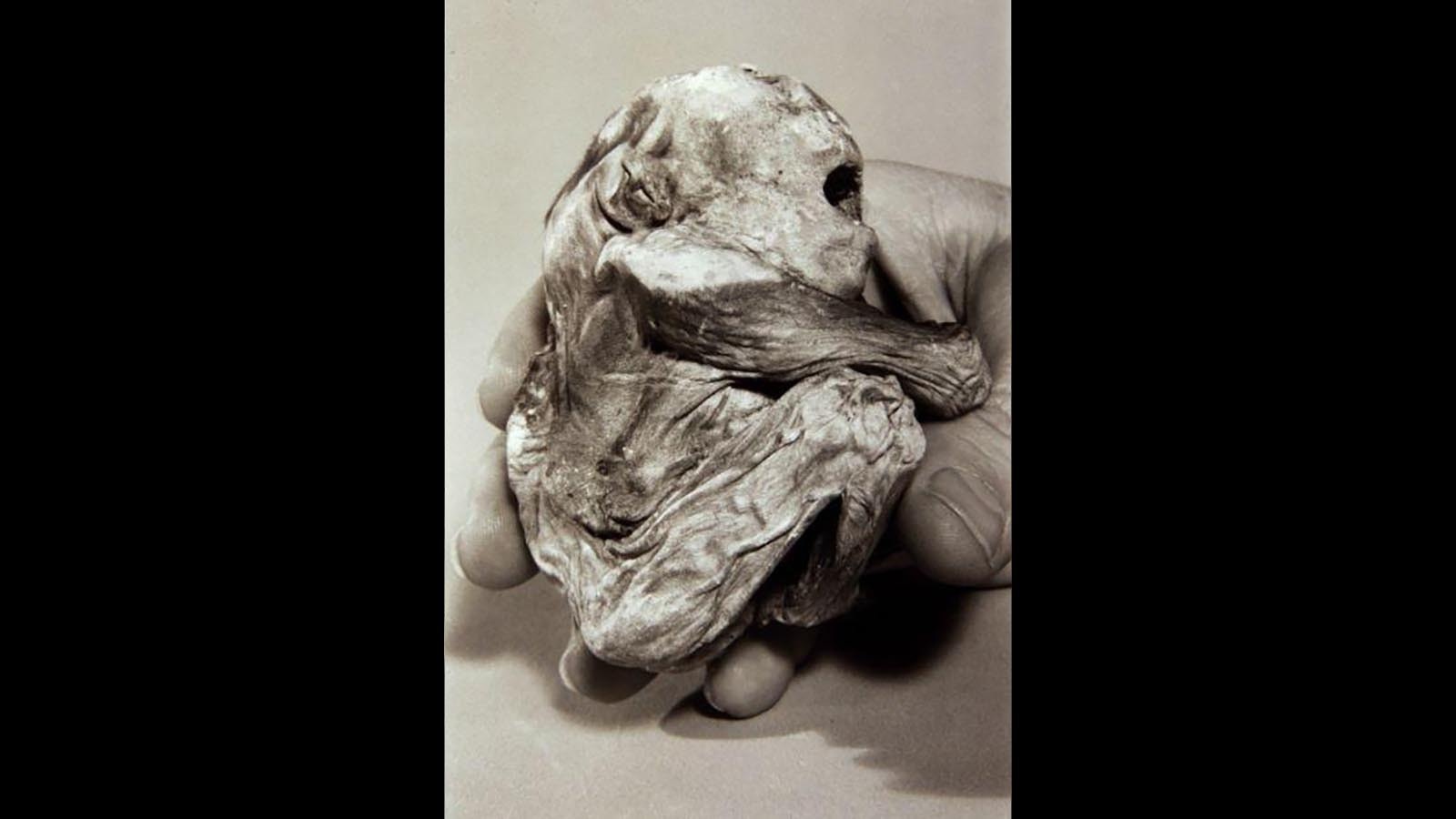
Chiquita is even smaller than the Pedro Mountain mummy. (University of Wyoming)
A Middle Eastern Cousin?
One of the videos on his YouTube channel Lost World Museum, though, is fascinating.
Adolfi interviews a man with a Middle Eastern accent and wearing clear plastic gloves who wants to show him his own find. The man speaks in a foreign language to someone off camera, and relays the answers in English.
The man unwraps what looks much like Pedro from Wyoming, but in a slightly different pose and with a lot more hair. He says the artifact was discovered about a half-meter underground by accident.
“Unfortunately, we can’t share too much with (viewers) about location or what’s going to happen with this little fella,” Adolfi says. “But I wanted you to see this for yourself, examine it, and ask yourself, ‘Is this a full-grown human? Or is it just a mummified fetus?’"
“The doctor here says it is fully human,” the man volunteers. “It’s estimated to be 1,500 years old.”
“They do have plans for it,” Adolfi says when the man is gone. “I know there are some questions about the legalities of it. I know if this was in the United States, such as the Pedro Mountain Mummy, there’s Native American rights there, and obviously there's archaeological rights there, there are human rights there.
“But over in the Middle East, Far East, there are laws and whatnot that you have to follow. But they’re big boys, and they’re going to do whatever they’re going to do, I guess.”
Adolfi speculates that the mummy “is going to be put in someone’s private collection, and it’s never going to be seen again.”
Wherever Pedro is, or whether he still even exists, George Gill, a University of Wyoming anthropology professor, has seen the medical research and he said it’s definitely an anencephalic infant.
He said in 2013 that further testing on a female pygmy mummy later brought to Gill and sent to Children’s Hospital in Denver to obtain X-rays, a DNA sample and a radiocarbon date yielded the same result.

Pedro’s Strange Journey
The Pedro Mountain Mummy was discovered in 1932 by two gold prospectors, Cecil Main and Frank Carr, who detonated some explosives near the Pathfinder Reservoir and opened up a cave, according to an article in the Oct. 21, 1932, Casper Tribune-Herald.
Inside on a ledge by itself was Pedro, sitting with his feet tucked under him and his arms crossed.
In 2013, the website Atlas Obscura described Pedro: “His skin was brown and dried by the arid Wyoming climate, his mouth was drawn into a placid scowl — a lean Buddha with a misshapen head.”
It was estimated that if the mummy had been standing, it would be about 17 inches tall. It weighed less than a pound.
The prospectors brought their find to Casper, where some were sure it was a hoax and others didn’t know what they were looking at. The pair sold it for the not-too-princely sum of $25.
The mummy apparently exchanged hands several times and was seen at various sideshow exhibits in the region.
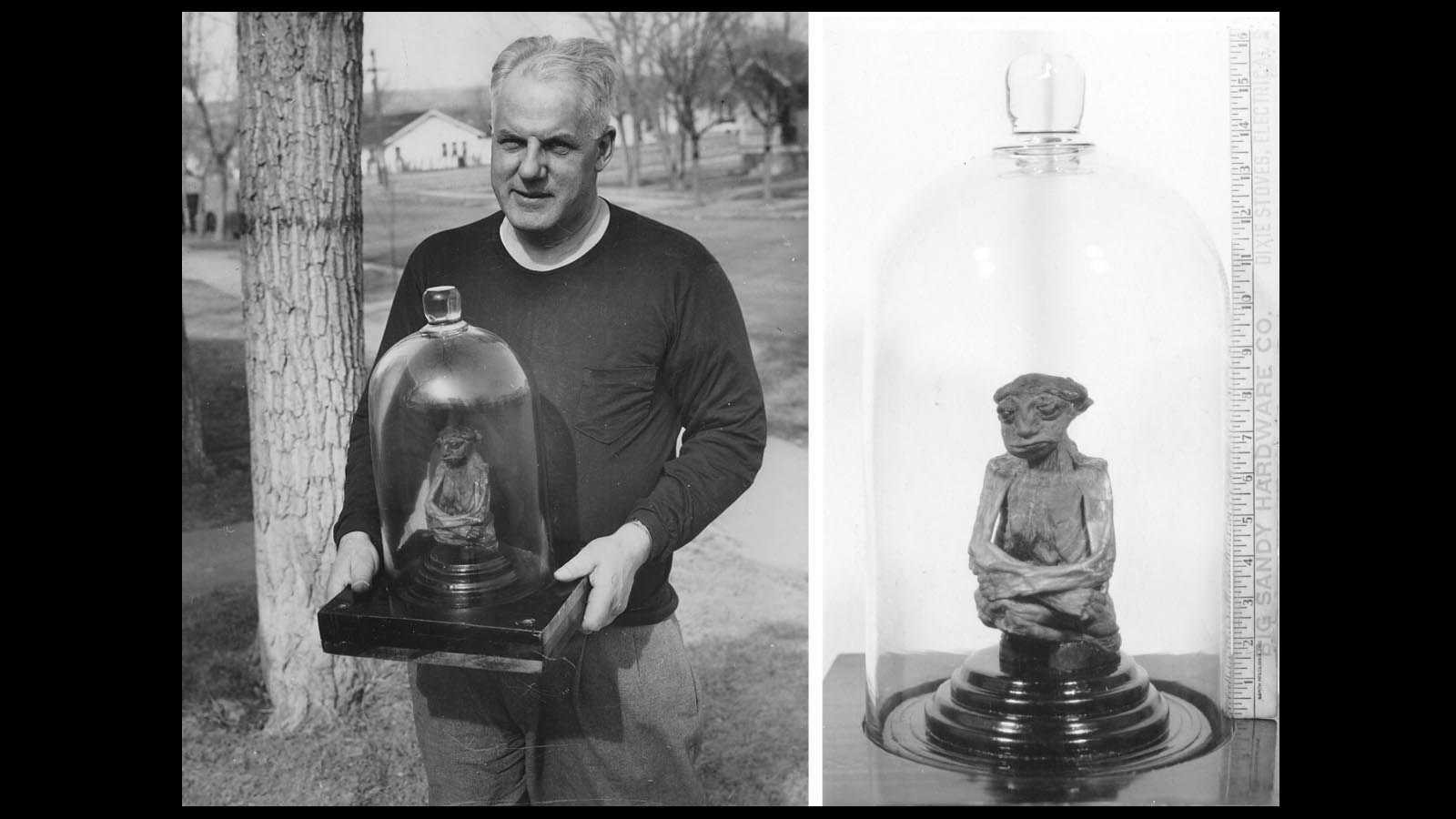
It wound up at the Jones Drug Store in Meeteetse for several years before a curious Casper car salesman named Ivan Goodman paid several thousands of dollars for it and brought it back to his showroom, where it acted as a mascot for the dealership.
It was also a place guaranteed to attract business, and Goodman was a showman of sorts. The most well-known photo of the Pedro Mountain Mummy depicts Goodman holding it in a glass case.
Main once signed an affidavit in 1941 that said the mummy was brought to the Chicago Field Museum, but there was no record of it ever being seen there.
It’s known that Goodman did have the artifact analyzed on one of at least two trips he made with it to New York City, where it was X-rayed and examined by scientists.
“After an exhaustive study by the scientists it was agreed that it was the only specimen known of a human race of that type which perhaps dated back a million years,” Goodman told the Tribune-Herald on March 5, 1950.
The car dealer didn’t leave New York City with Pedro. It’s not clear whether he was swindled by a con man, as one story purported, or he sold it to a man named Leonard Wadler, who according to a 1979 Casper Star-Tribune article took it to Florida.
Only two things are certain: Goodman died in 1950, and Adolfi’s research showed Wadler died in the Sunshine State in the 1980s. The creationist told reporters he always expected Pedro to show up somewhere in Florida.

True Believer In Montana
Interest in the mummy has remained high in the Rocky Mountains.
One of the foremost true believers in the region in the existence of the Little People was Shirley Smith, who owned the Little Cowboy Bar and Museum in Fromberg, Montana, for decades before it burned down in 2013.
Smith had many exhibits in her museum related to Little People of the Pryor Mountains, but apparently none survived the flames.
Her longtime partner, John Hanson of Bridger, said school children would visit the museum, and Smith had a popcorn machine.
“She would make sure that every kid got a bag of popcorn so they could give it to the little people,” Hanson told Cowboy State Daily with a laugh.
Hanson said it was all a myth.
“I think every civilization … the people of Hawaii have their little people, the Irish have their little people. I think it’s a worldwide phenomenon in that sense," he said. "Everyone seems to have some kind of little people.”
Smith grew up near Byron, in the boondocks, Hanson said.
“She spent all her life calling to (the Little People] and going up and down the mountains,” he said. “She would get some of the Crows to come over, and some of the older ones were true believers. Shirley and them would be thick as thieves talking about them. She was a true believer too.”
Diana Shaffer of Thermopolis was one of Smith’s daughters.
“She told me that when she was young, someone brought a mummy of one to school,” Shaffer told Cowboy State Daily.
That was an experience Adolfi couldn’t claim. Nobody ever claimed his $10,000 reward, either, though many people tried to get in on his treasure hunt but never passed his truthfulness test.
Then again, he never met Smith, who died in Thermopolis in 2022. If her finds hadn’t been destroyed in the fire that claimed virtually everything in her museum, one can bet they would have found plenty to talk about.


