
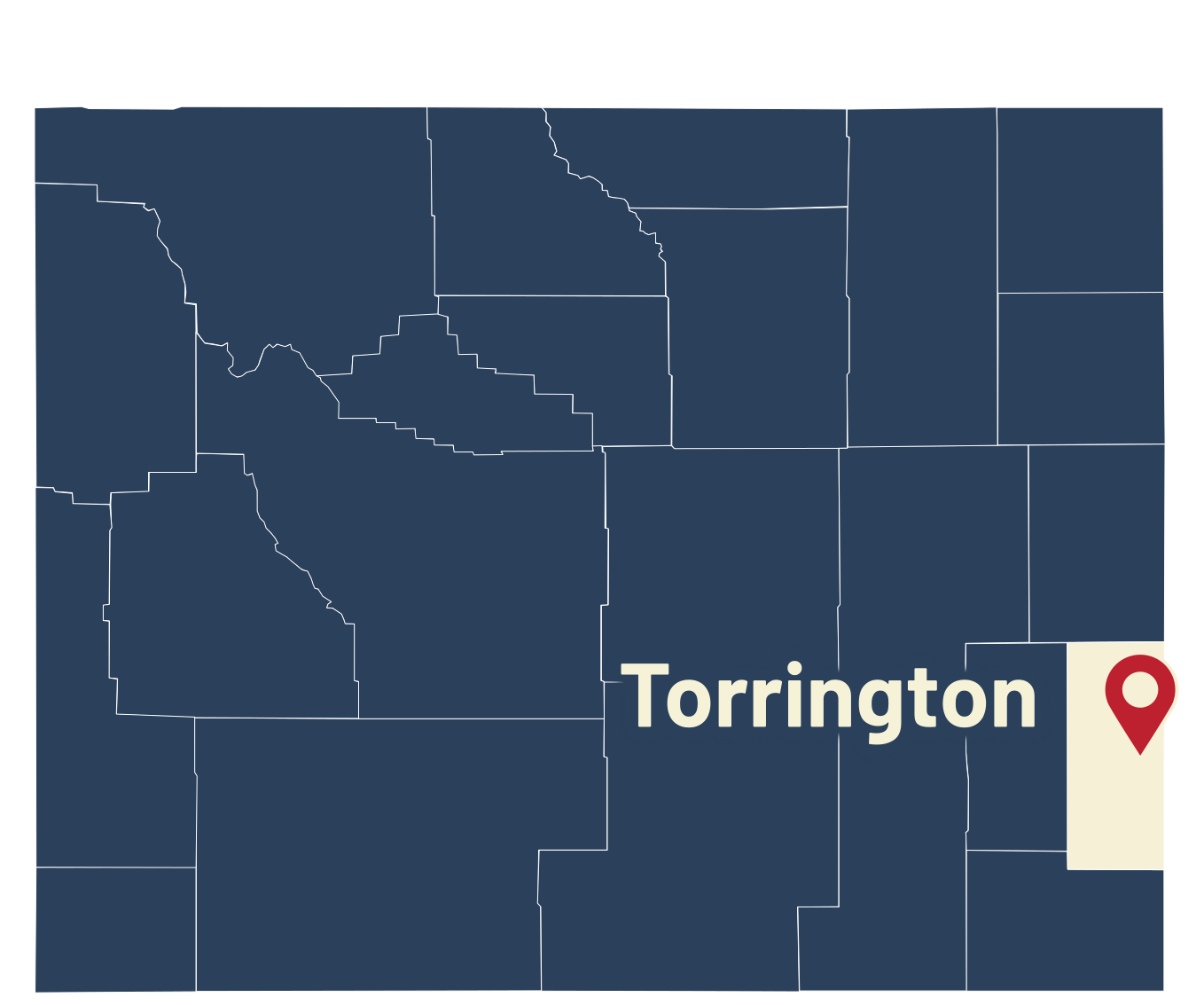
Seven years in prison beginning at 19 for putting a club into the head of a Swiss miner was followed by a couple of decades as a preacher and labor movement orator.
His personal reformation rewarded him with a Wyoming state role enforcing children and animal welfare.
But after just months on the state job, allegations of “white slavery” involving two teenage Casper girls in 1924 meant Baptiste John Minort needed to resign his state position and pulpit role.
Those charges were eventually dropped and he was back filling a pulpit in Torrington when a “disturbing the peace” charge in 1926 was filed, alleging he had been in a rooming house with a woman in Nebraska he claimed was his wife under an assumed name.
An old character that many believed was buried and destroyed for the 42-year-old Torrington grain store manager and police court judge suddenly had resurfaced.
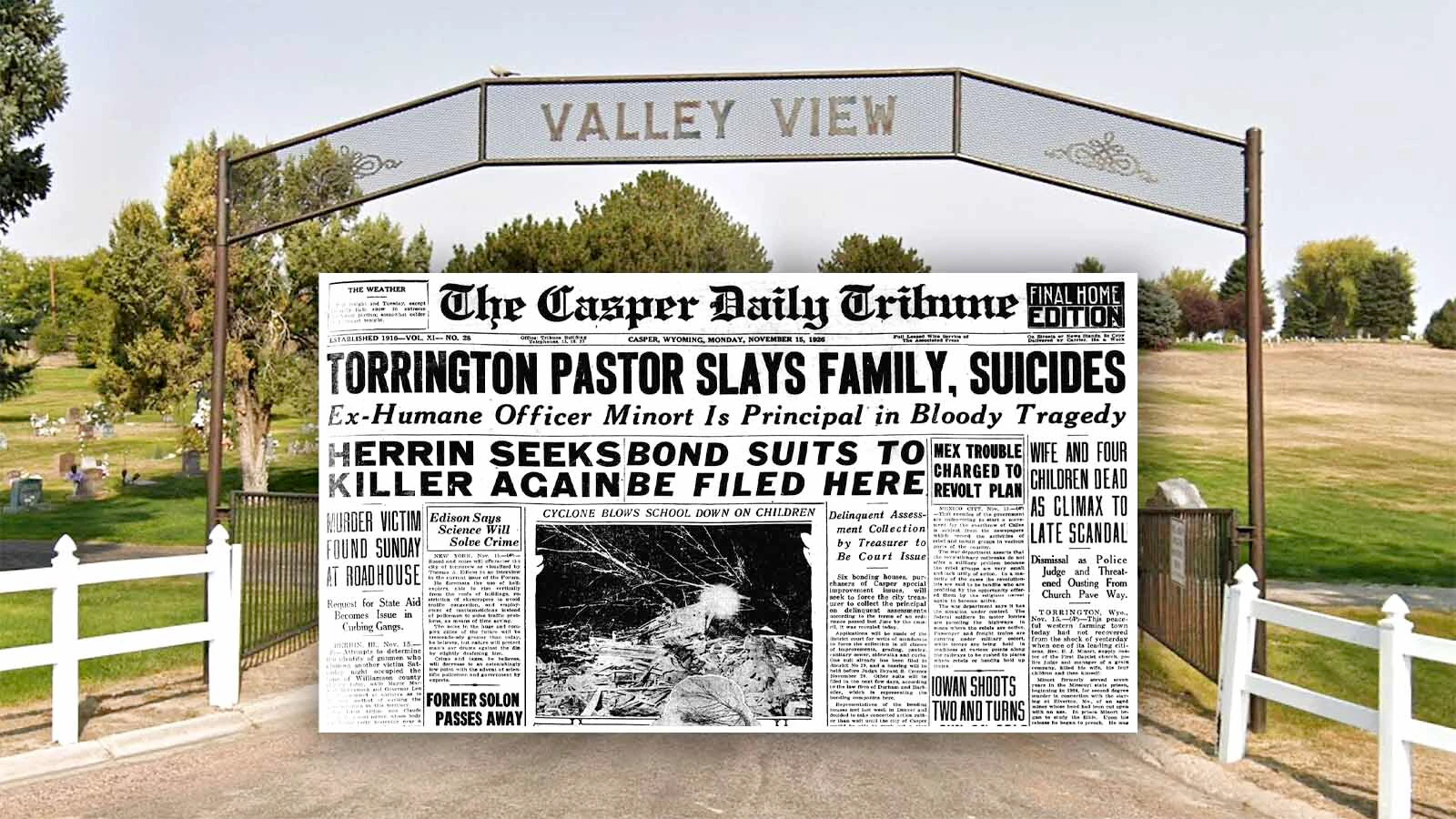
“Torrington Pastor Slays Family, Suicides,” the Casper Daily Tribune reported on Nov. 15, 1926. “Wife and Four Children Dead as Climax to Late Scandal.”
Newspapers across the country carried the headlines that an Associated Press reporter wrote likely were caused by “wagging tongues” and “domestic difficulties.”
Minort was born Feb. 20, 1884, in France and emigrated to the U.S. in 1892 to Missouri.
In 1901, at 17, he married Luisa Elizabeth Huber and they had five children, including Baptiste John Jr. in 1902, sons Carl, David and Clarence in 1912, 1915, and 1917, and daughter, La Von in 1922.
When he was 19, Minort was charged and convicted for killing a Swiss miner, Vincent Gaffney, at a coal camp in Riverton, Missouri, in March 1903 after a dispute about missing money from Gaffney’s room. Gaffney boarded with the Minort family.
“Minort claimed that Gaffney drew a revolver on him, then, in order to protect himself, he struck Gaffney twice on the head with a club, knocking him against a barbed wire fence, after which he choked him,” the Henry County Democrat reported on March 26, 1903. “Gaffney died as a result of his injuries.”
Second-Degree Murder
After his conviction on a second-degree murder charge, Minort was sentenced to 10 years in prison but was released after seven.
Newspaper accounts state that while in prison he started reading the Bible and when he got out moved to Nebraska. Whether he pursued formal religious training is not known.
In May 1914, he took a role as a pastor at a Sterling, Nebraska, church and also had a role as the chairman and clerk of a Sunday school convention.
The Sterling Sun reported he was helping at a revival meeting in Falls City, Nebraska. His efforts in evangelism and teaching grew his church by 200 people, according to a report in the Norfolk Daily News.
By 1922, he was serving as a pastor in a church in Alliance, Nebraska, and was the main speaker at a Labor Day gathering in Casper.
The Casper Daily Tribune on Sept. 5, 1922, reported that Minort delivered an “inspirational address” that promoted the idea of trade unions and how they eliminated “classes” in society. Hundreds gathered to hear him.
“America has no class from which it is impossible to emerge,” he said. “America is distinguished throughout the world by the high standard of living which the masses of her people enjoy.”
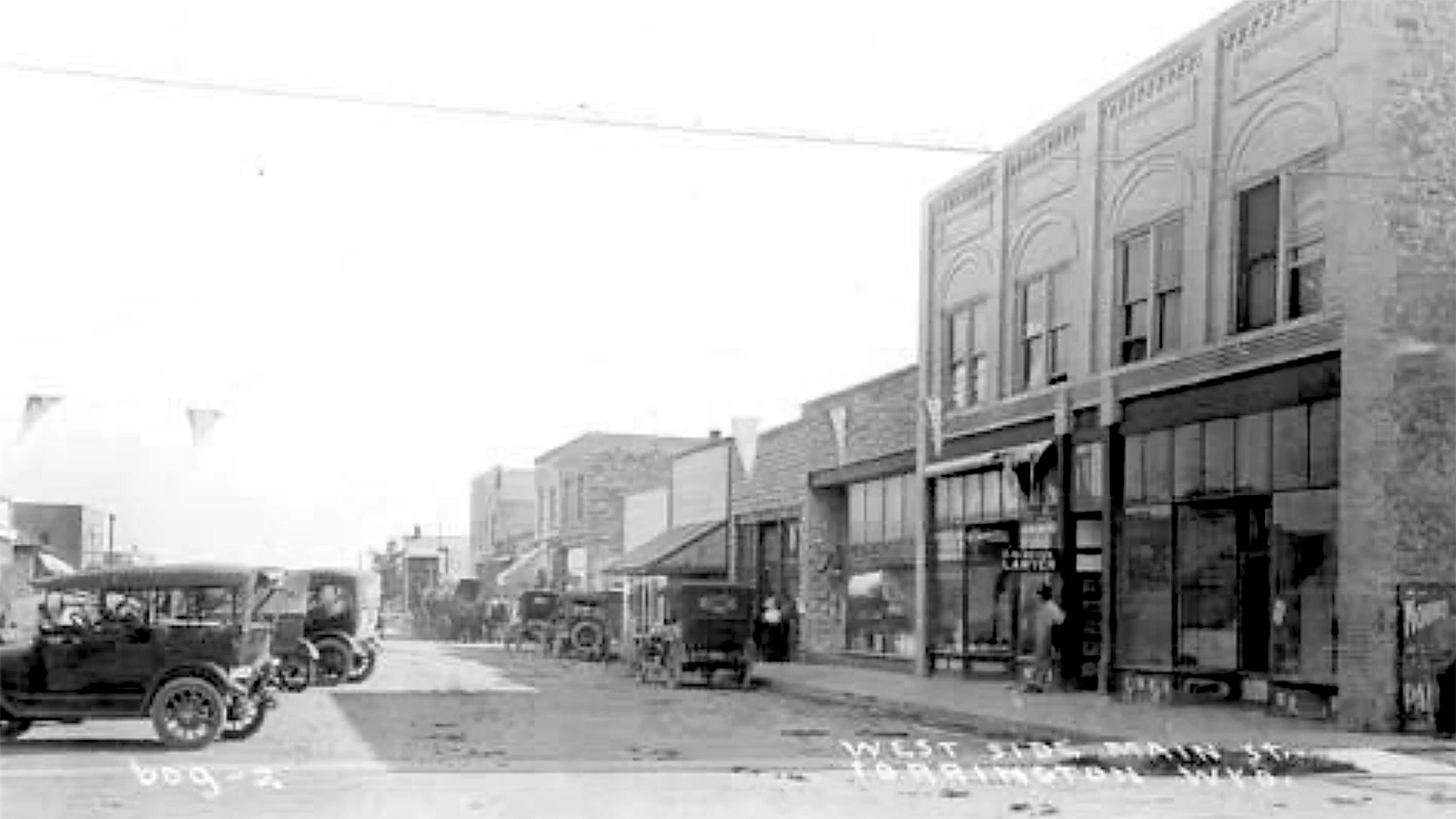
By 1924, he had moved to Torrington and taken the pastorate of a Baptist church. He was appointed by Gov. William B. Ross to be the state commissioner of child and animal protection on July 22. Minort embraced the role by bringing charges against 22 boys and girls involved in a wild Cheyenne party in October of that year at the YWCA and Pine Cove.
He blamed the parents for allowing their children to be at the party.
He also made headlines by uncovering a plot of a stepson to accuse his stepfather of choking an old man to death so he could inherit his mother’s property.
Mann Act Violation
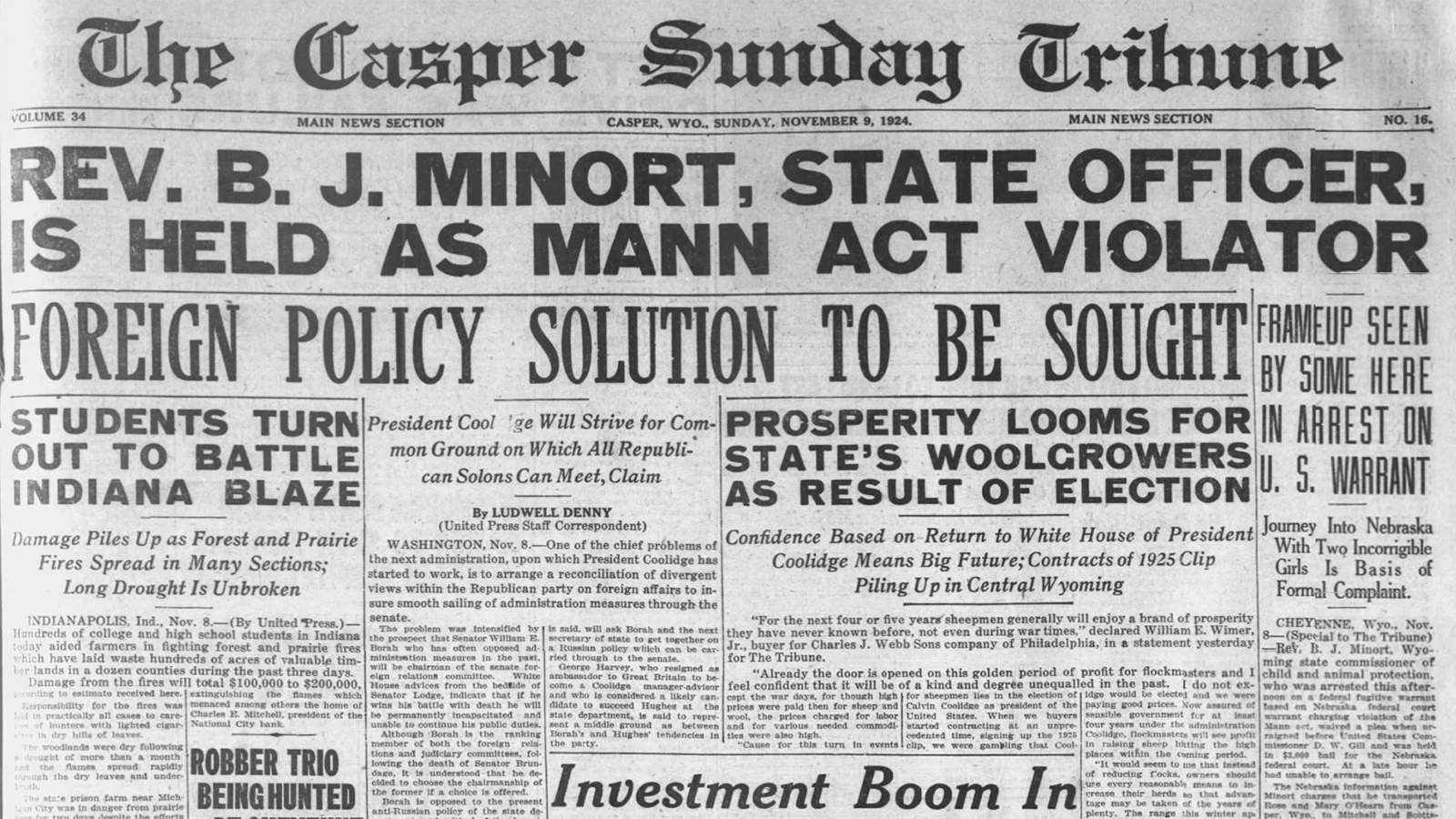
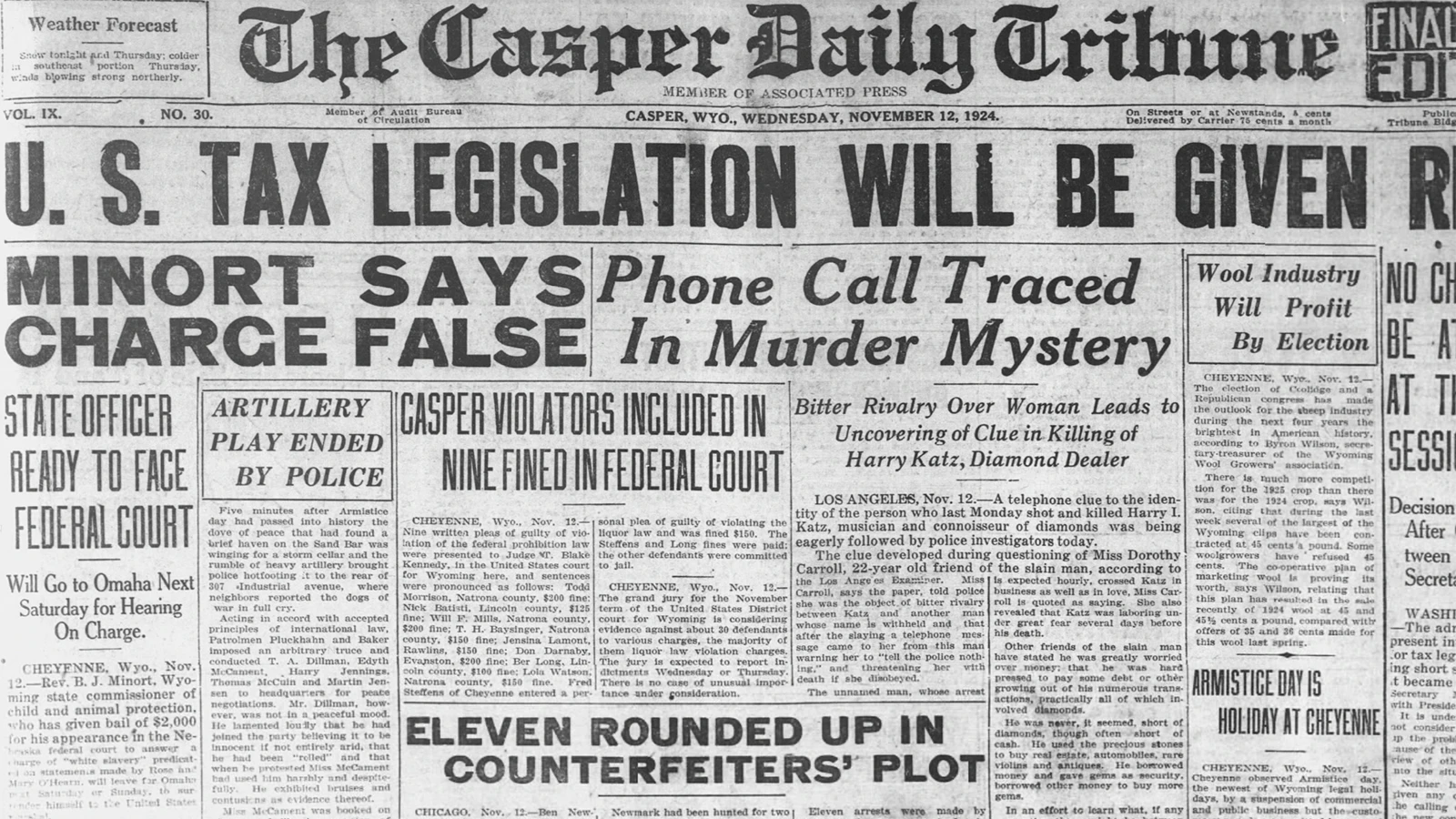
But on Nov. 8, he was accused by a federal grand jury of transporting two juvenile delinquent girls across the state line to Nebraska for immoral purposes under the Mann Act. Minort had taken the pair from their uncle in Casper and was supposed to take them back to a Cheyenne facility.
“The girls told police and federal authorities that Minort, instead of going to Cheyenne, stopped in Mitchell, Nebraska, where he is alleged to have mistreated them,” the Grand Island Independent newspaper reported on Nov. 12, 1924.
Minort responded that the charges were false and he had taken the girls there to be under the care of an aunt. Still, he resigned from his role as the state commissioner and stepped down from the pulpit. The Torrington community rallied around him and a fund was set up for his defense.
Those charges were eventually dropped by the federal district court in April 1926 because the girls could not be located to testify.
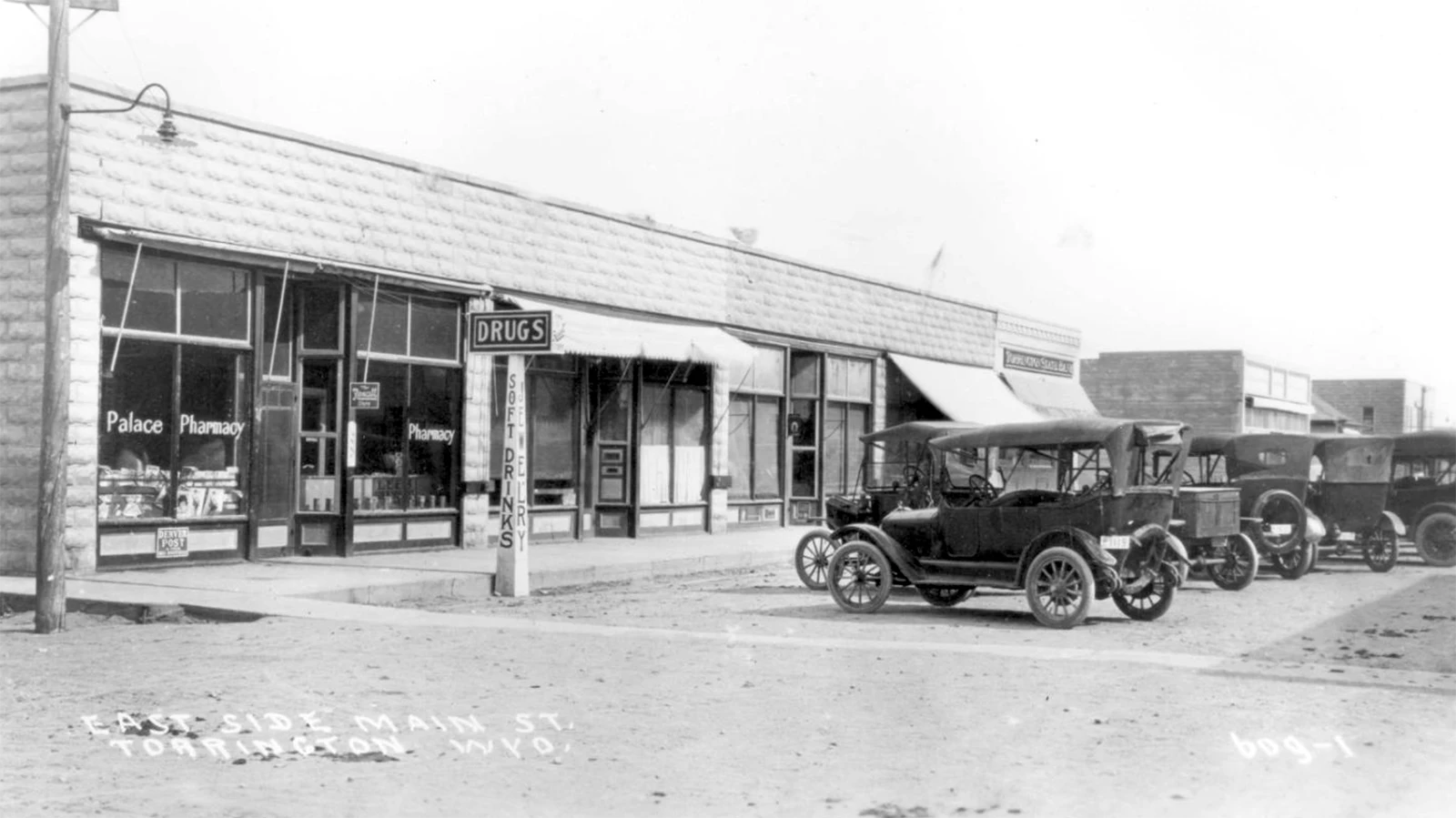
Meanwhile, Minort worked for the Cheyenne Police Department supervising chain gangs and then got a job managing the Torrington grain elevator. When the charges were dropped, he was named as a police court judge in Torrington and he resumed preaching at a church in the city.
On Nov. 7, 1926, Minort was caught by Bayard, Nebraska, police in a rooming house with a woman from Torrington who was not his wife. He had registered under the name of “Joe Lander and wife.”
A man from Torrington saw him and remarked he looked like Minort. The town’s marshal investigated and called Minort’s wife in Torrington at 3 a.m. on Monday, Nov. 8.
“Minort, after admitting his identity, asserted that he had been the victim of a ‘frame-up’ and that he had been forced at the point of a gun at Bayard (by men) to get into the automobile with the woman and had been intimidated into registering with her as husband and wife,” The Wyoming State Tribune reported on Nov. 15, 1926.
The newspaper reported that the landlady of the rooming house did not confirm his story. Minort was fined $25 and ordered to pay costs of $15.
On Saturday, Nov. 13, Minort resigned his post as a police judge for Torrington.
Taking His Family’s Lives
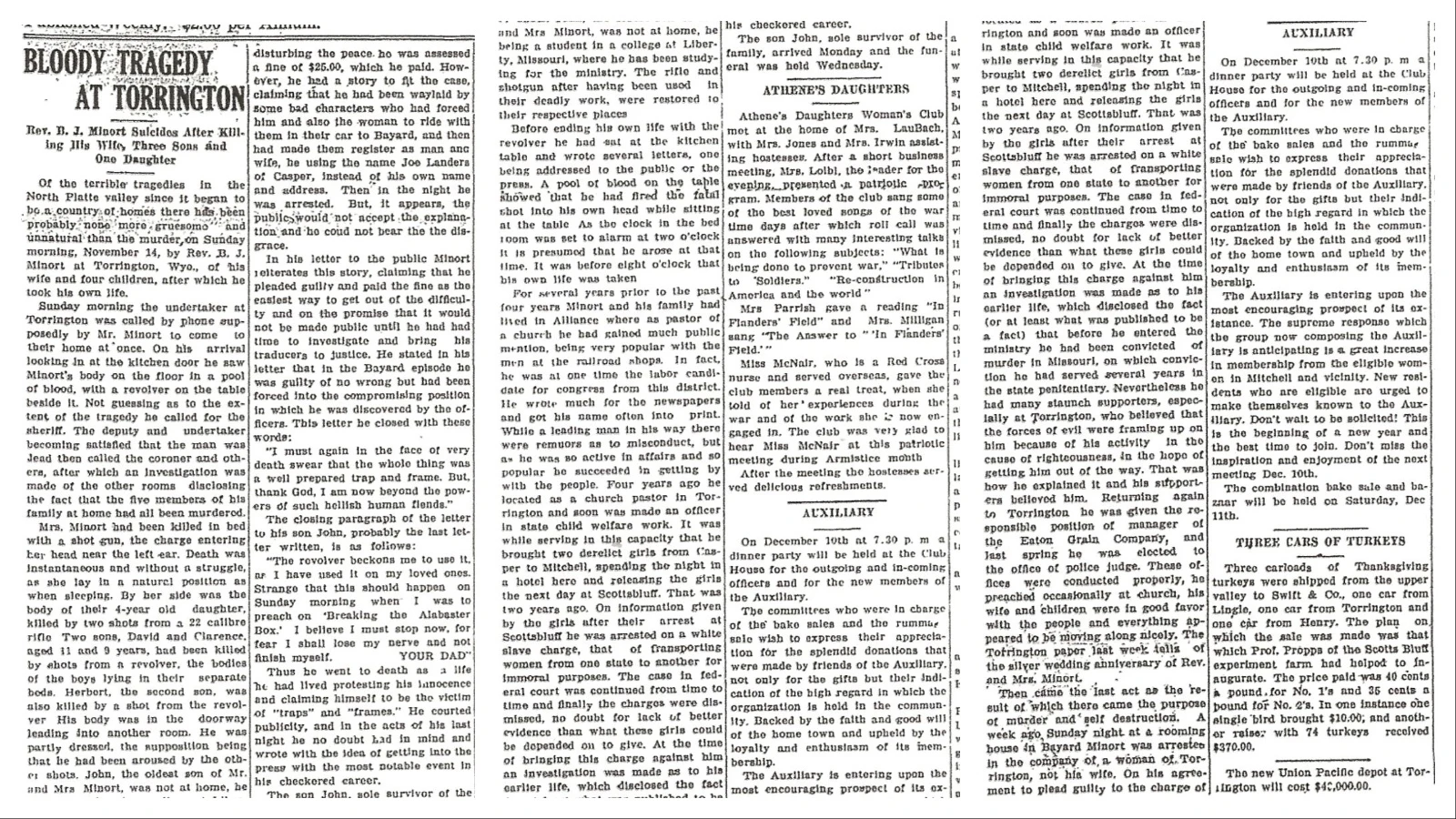
Early on Nov. 14 Minort, who had prepared a sermon he called “Breaking the Alabaster Box” for church that morning, took a 12-gauge shotgun and shot his wife in the head as she lay sleeping in a bed with their young daughter, 4. He then used a .22-caliber rifle to shoot his daughter twice in the head.
Two sons, who lay in their beds, were killed with one bullet to the head from a .32-caliber revolver. His second-oldest son was killed as he entered his mom’s bedroom with a shot to the head. He was dressed and, according to the Wyoming State Tribune on Nov. 15, had been working for another family in the country and likely returned home for church before being shot.
Minort took time to write letters to the sheriff, his surviving son at a college in Missouri, and to the public as well as to a religious rival in Casper.
Then he called the local undertaker just after 9 a.m. and told him he needed him at the house.
When the undertaker arrived, he could see Minort on the kitchen floor, gasping for air before he died, the Wyoming State Tribune reported. Police were summoned and found a mirror on the kitchen table that he apparently set up so he could shoot himself in the head.
They then discovered the breadth of Minort’s actions in eliminating his family.
In his letter to the public, Minort asserted that he had been framed in the incident with the Torrington woman in Bayard. In his note to the sheriff, he gave his son’s address at college in Missouri.
In a letter to his son, he explained that his mother had told him she would kill herself if he brought shame to the family again. Minort wrote he was going to save her from “spiritual torment” by killing her.
“I killed her and the rest of them rather than have the shadow of the past upon them,” he wrote. “Mother and children are in heaven and I suffer my own fate through the hands of destiny.”
No Caskets, One Grave
Minor told Baptiste John Jr. to just dig a hole and bury the family in one grave to save on burial costs and that he could sell a box of shells he had at the grain elevator for $20 to get some money to help with costs.
“Well my son, I must hasten, as the gun beckons to me and I must hurry before I have lost my nerve,” he wrote, adding that the rest of his son’s life was his own. “So, do the best that you can.”
A coroner’s grand jury ruled that the murders and suicide were all the responsibility of Minort. The family members were buried in Valley View Cemetery in Torrington.
Minort’s surviving son was a sophomore at William Jewell College in Liberty, Missouri, and learned of the shootings from the college dean as he wrote a letter to his father during the afternoon on Tuesday, Nov. 16, according to the Daily Standard newspaper in Excelsior, Missouri on Nov. 17, 1926.
John Minort along with Minort’s brother, Louis, the mayor of Lexington, Missouri, attended the funeral, which was packed with mourners from the Torrington community. All the slain were in caskets, Minort’s exhortation to his son ignored.
The community bore the costs of the funeral and burials, the newspaper reported.
The Western Nebraska Observer reported on Nov. 25, 1926, that the son “bore up bravely” to the tragedy.
Forgiving Mourners
“It was remarked that the crowd seemingly were forgiving and even sorrowful in their attitude toward the dead man,” the newspaper reported. “Many were seen to pause beside his casket and drop a tear. … Torrington people, heard to comment on the affair after the funeral, declared that Minort had not been himself, to all appearances for several weeks past.”
Three years after the tragedy, the young Minort returned to Torrington and visited old friends.
The Scottsbluff Daily Star-Herald reprinted a story from the Torrington paper on June 16, 1929, that stated that Baptiste John Jr. had been involved in a cafe business and had to quit college due to lack of funds.
“He has enjoyed a fair success and will continue in the cafe business,” the newspaper reported. “His friends in Torrington are glad to learn that he is pleasantly located and making a success of his efforts.”
Minort went on to marry twice, once in 1934 in Missouri. The marriage lasted a year. He married his second wife in 1945 and became a member of the Church of Jesus Christ of Latter Day Saints.
Baptiste John Minort Jr. lived his last years in Utah and died on Aug. 16, 1970.
Heworked as cook for most of his life and is buried in Price City, Utah.
Dale Killingbeck can be reached at dale@cowboystatedaily.com.


