
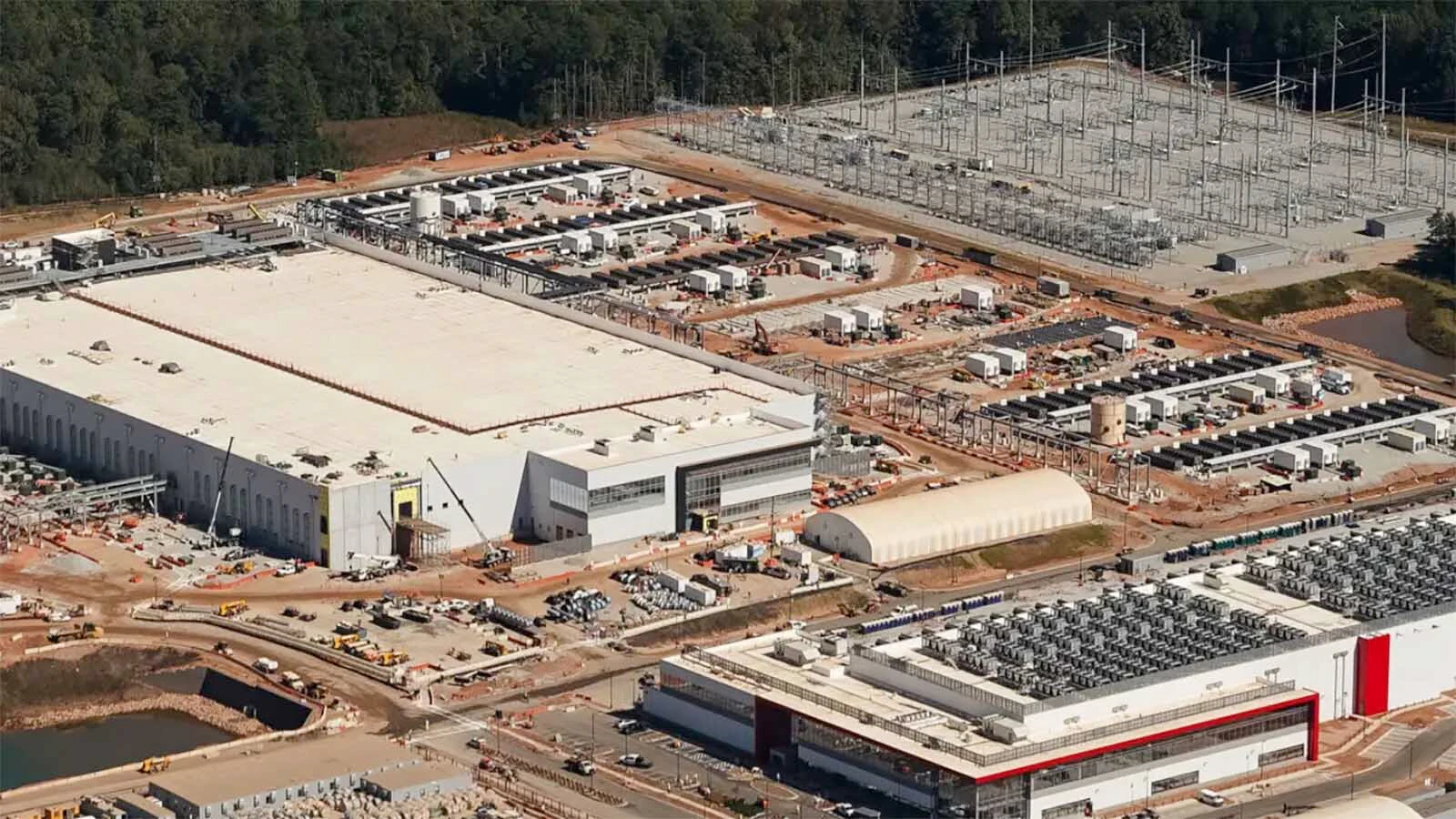
A Georgia data center’s 30-million-gallon water use over an unspecified timeframe is sparking concern in Cheyenne, where 70-some data centers are in various stages of discussion. City officials say safeguards exist, but critics and farmers warn of long-term water, housing, and economic impacts.
When a Georgia data center quietly drew 30 million gallons of water during a drought, no one noticed until residents’ water pressure dropped, prompting questions. Only then did community officials discover that a high-tech data center had been pulling tens of millions of gallons from a strained system without paying for it first.
The story, reported by Politico and other national media outlets, is popping up across Wyoming social media, including Cheyenne, where 70 data centers are in various stages of discussion.
According to the article, the unauthorized, use happened over either a four month or nine to 15-month period, depending on which official was asked, and the company has retroactively paid for the use after it was discovered.
One notable point about the situation is that the company, Quality Technology Services, had promised it would only be using four households’ worth of water once the 615-acre campus is fully operational.
QTS officials said their water use was still so high because the campus is only partially operational. Construction is still ongoing.
The incident is driving a new round of questions from residents who are concerned about how much water future data centers might consume, and who would lose out if supplies run short.
To critics, including Cheyenne resident Heather Madrid, who is circulating a petition that calls for a moratorium on more data centers in Cheyenne, Georgia’s 30-million gallon surprise doesn’t surprise her at all.
She plans to bring her petition to upcoming City Council and county meetings, so residents can sign it in person.
“I have publicly said many times that trusting the Mark Zuckerbergs and the Bill Gates of the world seems pretty foolish considering their history of violating our first-amendment rights during COVID, among other things,” she told Cowboy State Daily. “These corporations ‘fess up after they’ve been caught, which isn’t honest. It’s a forced confession.”
Water Monitoring In Cheyenne Is High-Tech
Cheyenne city leaders, including Ward I Councilman Larry Wolfe, say the Georgia situation isn’t something that’s likely to happen in Cheyenne.
The incident in Georgia involved unauthorized or misaccounted-for connections and a lack of monitoring, Wolfe said. He sees that as localized to that utility, which has acknowledged it was understaffed. That’s not the case in Cheyenne.
“The Cheyenne Board of Public Utilities monitors water usage all over town,” Wolfe said. “And they have, as I understand it, a really sophisticated system. Heck, we get notices if we’re using more water than we have on a regular basis. So it strikes me that (Georgia incident) is a localized problem.”
Not only that, but data centers who buy water from Cheyenne are required to use a closed-loop system, Wolfe added.
“That wasn’t true with the early ones, which are really Microsoft or the early crypto miners,” he said. “But for anyone new in the last four or five years, that’s the state-of-the-art requirement.”
Mayor Patrick Collins declined to comment on the Georgia data center incident, but has previously told the Select Water Committee that overall water use by Cheyenne data centers is 200 acre-feet per year, or about 1.5% of overall city water use.
By comparison, irrigating alfalfa typically uses 3.3 acre-feet of water per acre, or 412 acre-feet of water annually for 125 acres. That’s double what all of Cheyenne’s data centers use.
“These public utilities, ours included, have become so sophisticated at being able to monitor all water usage around the system,” Wolfe said. “We can tell you what every data center uses that is in existence and hooked up to the BOPU system.”
That’s not the case, however, for any data center outside city limits, like the recently announced Project Jade, Wolfe added. That one comes under Laramie County’s jurisdiction.
Water Supply Is Finite
Water is one of the primary issues that concerns Laramie County farmer Cody Smith when it comes to the influx of data centers to Laramie County.
While he does sell some water to data centers and doesn’t think a moratorium is viable, he also sees the Georgia incident as a wake-up call for Wyoming, one that officials should pay closer attention to.
“Thirty-million gallons is roughly 92 acre-feet of water,” he said. “That’s like watering 50, 60 acres for the summer, so that’s a lot of water.”
Wyoming is an arid state, Smith pointed out. It only gets 12 to 13 inches of precipitation annually on average. This year it is so far on track to receive much less.
“The state has monitoring wells all over the state,” he said. “There’s hundreds, if not thousands, of them in Laramie County. And most of them have active, real-time measuring devices in these wells.”
Smith frequently goes to the website where those levels are displayed to see how they’re doing.
“For the most part, all of them are down every year for the last 30, 40 years,” he said. “You’ll get a wet spring and they’ll come up some, but then it’s down again. We’re seeing aquifer levels drop, and that means we’re pumping more water out than is being recharged. Therefore, we’re using it beyond its capability of recharging.”
Moratoriums and bans, though, are unrealistic, he believes. He would rather see energy channeled in other directions.
“We’re not going to stop it,” he said. “Rather than scream about (that) … what we need to do is emphasize the fact there’s a finite amount of water here, and it’s all currently being used.”
Especially this year, where 97% of the state is experiencing some level of drought, according to the U.S. Drought Monitor, there’s no extra water in the system at all, Smith said.
“So if we have an additional draw on the system, you’re taking it from someone,” he said. “So it needs to be emphasized, if you guys want to be here and do this, that’s fine, but you need to purchase that water from someone, because we can’t just have additional usage on the system.”
Officials with the State Engineer’s Office could not be reached in time for a direct comment, but an aide in the Cheyenne office did confirm for Cowboy State Daily that monitoring wells do show water levels have been down for decades, and said that the trend has been particularly noticeable for the last five years.
That has prompted the state legislature to approve a water study during the last budget session, which will look more closely at water usage.
Issue Worthy Of Legislative Attention
Rep. Daniel Singh, R-Cheyenne, told Cowboy State Daily the Georgia incident does underscore why water policy matters so much in the West, and particularly in Wyoming.
“Article 8, Section 1 of the Wyoming Constitution declares that the waters of the state are the property of the state itself,” he said.
“Because of that constitutional framework, Wyoming legislators have a clear responsibility to act as careful stewards of our water resources and ensure they are managed responsibly for the people of Wyoming.”
That’s a significant distinction from Georgia, Singh added.
“Cheyenne is especially sensitive to conversations around large-scale water use because much of our municipal water supply is tied to Colorado River Basin through transbasin diversions and exchange systems connected to the Little Snake River and North Platte system,” Singh said.
“Our water situation is directly connected to broader interstate water realities in the West,” he added, "and the long-term pressures surrounding the Colorado River Compact system.”
That makes data center water use an issue he believes worthy of special attention from Wyoming legislators.
“We are responsible for stewarding water that begins here in Wyoming,” he said. “While also protecting our communities as that water moves into systems used by other states.”
Broader Impacts Also Important
Water is just one of the many issues to question when it comes to data centers, Madrid said. She is also concerned about what the data center boom will do to Cheyenne’s housing markets and to its local businesses.
“At this point it seems like city council is only focusing on the water because closed-loop systems do use less water in theory, which is a good argument, but it’s not the full picture,” she said. “The focus on water seems like a distraction from the multitude of other problems with data centers.”
Madrid also believes housing prices are being artificially inflated, an opinion she bases on seeing more homes selling for $800,000 to $1 million.
“This was almost unheard of prior to the data center boom,” she said. “This is partially driven by the high wages paid by data centers for relatively short-term jobs.”
Those kinds of salaries won’t be sustainable post-boom, Madrid believes.
“Data centers are also poaching employees from local businesses,” she said. “In my conversations with community members some people who are employed locally have shared that data center people are coming onto construction sites to poach people and local companies are regularly having to ‘run them off.’”
The situation has forced some local businesses to raise wages — costs that get passed on to consumers.
Madrid wonders how long that will be sustainable, noting, “it’s hard to compete with billionaires.”
“Land values are increasing,” she said. “This is pricing out agricultural development, housing development, and diverse business development. It’s paving the way to oversaturation.”
Madrid also wonders what happens in the aftermath of the data center boom.
“When the bubble bursts — and it will — we will be left with little to nothing to show for it,” she said. “When construction ends, where will the laborers go next?”
Many will likely have to follow the work to maintain their lifestyles, creating what Madrid predicts will be an economic vacuum in Cheyenne.
“The majority of us regular folk can’t afford their million-dollar leftovers,” she said. “We’re being priced out of our own community. Closed-loop systems and ‘bring-your-own-power’ strategies won’t solve the long-term problems our communities face when the new wears off.”


