
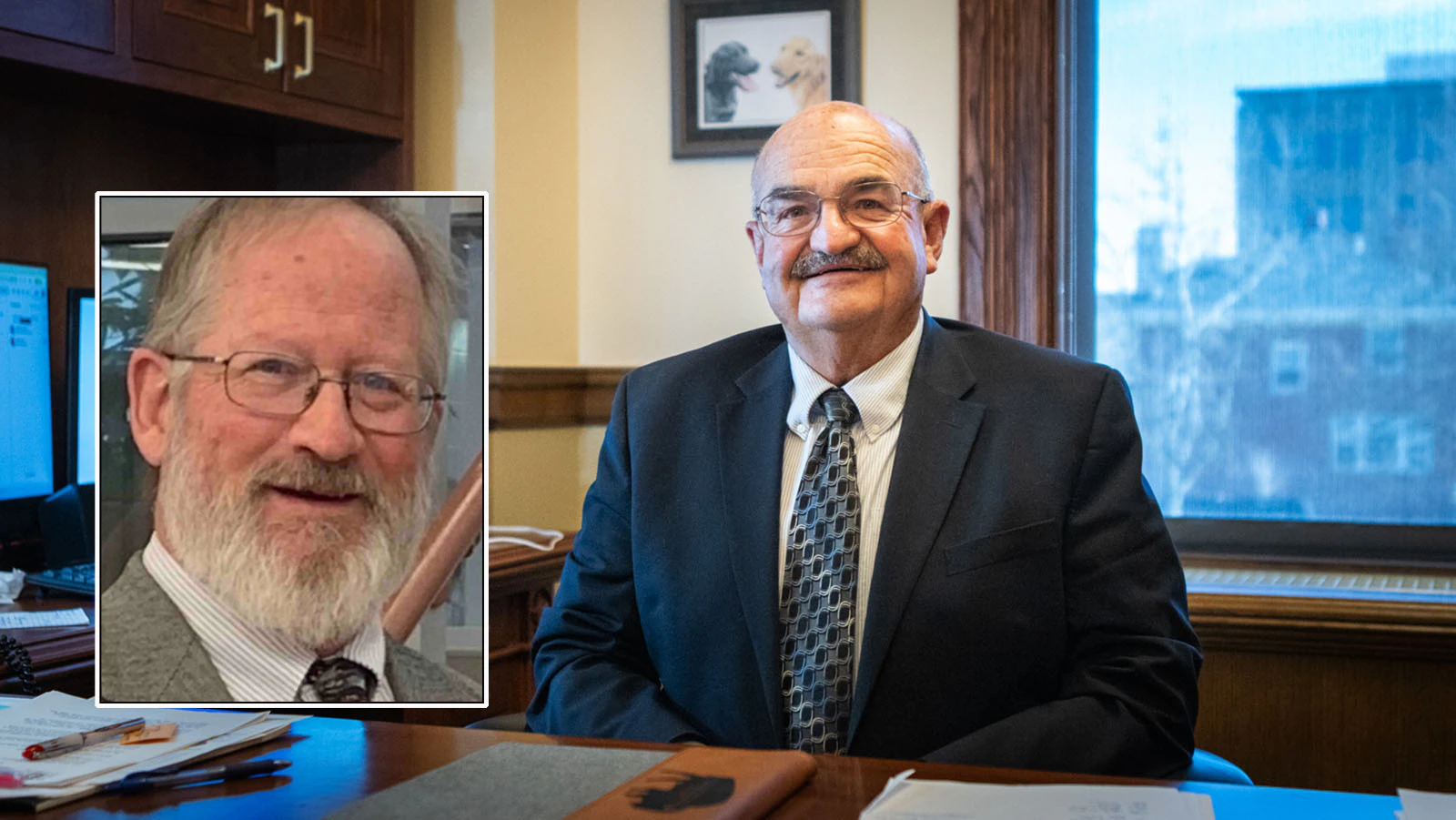
A Cheyenne-based attorney who filed a complaint calling for a criminal investigation against Secretary of State Chuck Gray for releasing sensitive voter data to the federal government, asked the Wyoming Supreme Court on Tuesday to appoint a special prosecutor to investigate the matter.
George Powers also asked the high court to issue an order “commanding” Wyoming Attorney General Keith Kautz and the AG’s office to recuse themselves from investigating whether Gray could have committed a crime.
The Journey Here
Powers started filing public records requests after news broke that Gray had released sensitive voter data to the U.S. Department of Justice last year. The department had asked Gray’s office to hand over Wyoming voter rolls including driver’s licenses or partial Social Security numbers.
Powers, an attorney who beat the Wyoming Department of Education in a different public records challenge in 2023, has pointed repeatedly to a state law that says election records containing portions of Social Security numbers and driver’s license numbers are not public record.
He filed a formal complaint against Gray with the Wyoming Attorney General’s Office on April 13 alleging “there is a reasonable basis to believe” that Gray violated the state’s election law.
Gray has said repeatedly in public comments that he released the rolls after “close consultation” with the AG’s office. He’s also told reporters the AG approved the release of voters’ information.
Because of that attorney-client relationship, Powers has said that the AG has a conflict of interest and cannot investigate Gray for potential criminal culpability himself, but should task a judge with appointing a special prosecutor.
It is unconfirmed whether Wyoming Attorney General Keith Kautz has appointed a special prosecutor.
His deputy AG Mackenzie Williams parried with Powers initially on whether Gray has waived his attorney-client privilege to keep any advice the AG’s office gave on this matter private.
Powers had requested documentation of that advice, in public records requests.
Williams pointed to cases indicating that Gray hadn’t waived attorney-client privilege. Powers pointed to cases indicating that he had.
The Final Letter
Then Kautz, who is also a former Wyoming Supreme Court justice, told Powers in a May 4 email that the matter would be handled, but that it wouldn’t be a public display.
“This response is not an invitation for further communication,” wrote Kautz, according to the Tuesday petition. “A prosecutor’s investigation and exercise of prosecutorial discretion are not conducted in the public square. I previously told you that your complaint would be addressed in accordance with our office policies, the law and the Wyoming Rules of Professional Conduct for Attorneys at Law.”
Powers sent Kautz “one final letter” on May 20, saying once again that Kautz cannot investigate Gray for potential wrongdoing in this matter, and warning that, “if necessary, (Powers) may seek a writ of mandamus concerning AG Kautz and the AG’s office to recuse themselves from investigating this complaint against Secretary Gray should AG Kautz and the AG’s office continue to refuse to do so voluntarily.”
Cowboy State Daily has not seen evidence that Kautz is investigating Gray himself.
Powers’ petition says that based on Kautz’s final, May 4 email to him, “Mr. Powers understands and believes” that the office is still processing, reviewing or investigating Powers complaint against Gray – “despite the conflict of interest here.”
Kautz declined Tuesday to comment on the petition.
Gray did not respond by publication to a text message request for comment.
A Little Law
A writ of mandamus is a request for a court to make an official perform a duty that the law "specifically" requires from that office.
A relevant case also says this mechanism is meant to command the performance of a "ministerial duty which is plainly defined and required by law," and that the function only works when the duty is "absolute, clear, and indisputable. The law must not only authorize the demanded action but require it."
Casper-based attorneys Rob Shively and Ryan Semerad filed the writ Tuesday on Powers' behalf.
Some More History Stuff
The DOJ last June asked Gray for information about Wyoming’s compliance with federal election laws. It also asked for Wyoming’s statewide voter registration list, public documents show.
Gray wrote the federal agency back July 24, 2025. He described Wyoming’s handling of election security and maintenance measures, and said a public-facing copy of the voter rolls had been uploaded into a federal database.
U.S. Assistant Attorney General Harmeet Dhillon voiced dissatisfaction with that in an Aug. 14 response to Gray.
“We have received Wyoming’s statewide voter registration list,” wrote Dhillon. “However, as the Attorney General requested, the electronic copy of the (voter rolls) must contain all fields, including the registrant’s full name, date of birth, residential address, his or her state driver’s license number or the last four digits of the registrant’s social security number.”
Dhillon said that was required under the Help America Vote Act.
Gray wrote back in an Aug. 28 letter.
“We are satisfying this request,” he wrote. “Upon review of the provisions cited in your letter, and discussion of the applicable provisions of the Civil Rights Act with the Wyoming Attorney General, we agree that disclosure of the requested records is proper under the Civil Rights Act.”
Gray referenced “assurances” from Dhillon that federal privacy protections would apply.
Powers’ complaint says the DOJ had no authority to demand the voter rolls under the Help America Vote Act, and the DOJ didn’t make any claim Wyoming had violated the act in the first place.
Dhillon had also hinged her demand on the National Voter Rights Act and the Civil Rights Act of 1960.
The Complaint
Powers noted in his complaint that Wyoming is exempt from the National Voter Rights Act (NVRA), and he asserted that the Civil Rights Act (CRA) of 1960 doesn’t authorize the DOJ’s demand.
He said the DOJ is trying to “bootstrap” a broad investigative provision in the Civil Rights Act to requirements found in laws Congress passed much later, though the Civil Rights Act “was intended to address racial discrimination.”
“When Congress wrote the CRA, it could not have intended the CRA to serve as a vehicle to mandate disclosure of information in voting records … developed years later,” wrote Powers.
He also claimed that Wyoming’s voter rolls don’t fit the description of shareable documents under the relevant part of the Civil Rights Act.
Many states, including multiple Republican-led states, are fighting the DOJ to keep their non-public-facing voter rolls private. Numerous cases on the matter are ongoing, and courts in Massachusetts, Oregon, Rhode Island, Arizona, California, Maine, Michigan, and Wisconsin have found that the DOJ lacked legal authority under any federal law to compel the states to release those unredacted voter rolls.
Powers has emphasized Wyoming statute 22-2-113(d), which says:
“Election records containing Social Security numbers, portions of Social Security numbers, driver’s license numbers, birth dates, telephone numbers, tribal identification card numbers, e-mail addresses and other personally identifiable information other than names, gender, addresses, unique identifying numbers generated by the state and party affiliations are not public records and shall be kept confidential.”
A Word From Gray
Gray is currently running a campaign for the state's lone U.S. House representatives seat. He faces nine contenders in the Aug. 18 Republican primary, as well as whoever wins the Democratic primary election that same day - and Libertarian Party nominee Shawn Johnson.
Gray in a Tuesday text message called the petition a "clear attempt by Leftist attorney George Powers to weaponize the legal system against a conservative for my work on election integrity during a campaign, just like the radical Left did against President Trump."
"I stand by our office's election integrity work with the Trump Administration," wrote Gray. "We have maintained compliance with the law and these actions have been carried out in close consultation and approved by the Attorney General."
Gray said 20 states have worked with the top law enforcement agency "on this election integrity work," including Utah, "making almost every single red state in the nation to engage in this important work that is in compliance with the law."
Utah has not capitulated fully, and its lawsuit with the DOJ is ongoing. The state has, however, completed an audit of its voter rolls that revealed found 27 confirmed noncitizens, whom clerks have since removed from the voter rolls, says a May 27 report by the office of Utah Lt. Gov. Deidre Henderson.
Idaho continues to fight the DOJ's push for sensitive voter data, though its case is stayed while the Ninth Circuit Court of Appeals evaluates the law in other, similar cases.
This story has been updated to include a post-publication comment by Secretary of State Chuck Gray.
Clair McFarland can be reached at clair@cowboystatedaily.com.


