
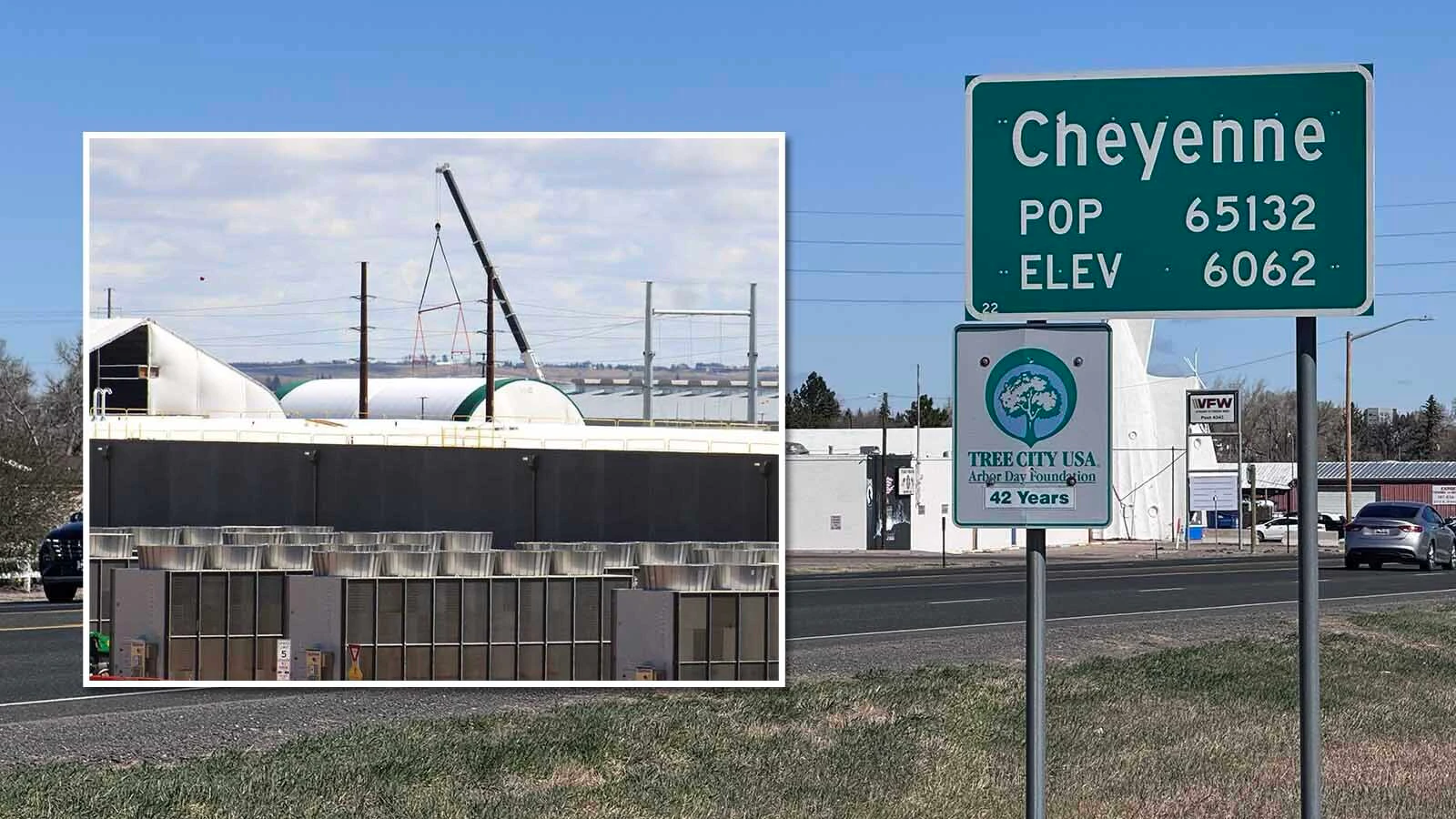
CHEYENNE — A grassroots push to pause data center development in Wyoming’s capital city, where as many as 70 projects are in various stages of discussion, has prompted a city councilman to propose a 12-month moratorium on them.
Meanwhile, at least one council member is warning that the moratorium may not be legally sound, signaling that it's is far from a done deal.
The moratorium follows a grassroots petition seeking 7,000 signatures to halt new data center construction amid questions about power and water use.
Organizers have planned multiple signing events through May to collect the signatures.
Councilman Mark Moody’s proposal would give city staff one year to study the effects of the unprecedented surge in data centers on electricity rates, water usage, and the environment, as well as anything else related to the health, safety, and welfare of city residents.
Moody’s ordinance also would direct city staff to prepare a report on data center impacts by April 1, 2027, and recommend any changes to existing codes, rules, or regulations that pertain to data centers.
In response to questions about his proposal, Moody has written a column explaining it.
“This discussion is not about rejecting data centers altogether,” he wrote. “They play a role in national security and economic diversification. Most of the data centers currently operating or under construction in Cheyenne’s business parks have been net positives.”
But he said it’s fair to question how many data centers Cheyenne can reasonably support without compromising “infrastructure, safety, agriculture industry, or quality of life.”
Moratorium Is Committee-Bound Without Discussion
The moratorium proposal will immediately be referred to the Public Services Committee without discussion when it comes to the City Council on Monday night, Mayor Patrick Collins told Cowboy State Daily.
“That’s the way it always is,” he said. “There’s nothing different here. This is how we’ve done it for 25 years. First reading is only a referral, and then once it’s referred it goes to the committee process.
"Then it comes back to the governing body, back to the committee, back to the governing body. There’s no difference here.”
Collins said that process makes the most sense because it is the committee members who have the expertise and who are being directed to make recommendations to the governing body.
“It would be backwards to do it any other way,” he said.
That said, Collins said he doesn’t believe a moratorium is the best way to handle questions about data centers.
“The Wyoming way is to look at each individual opportunity that comes and make the best decision for our community,” he said. “An outright moratorium or a ban, that’s not our way.”
Legality Of Moratorium Questioned By Some
The big problem Cheyenne attorney and Ward I Councilman Larry Wolfe sees with a moratorium is he’s not sure the city even has the authority to enact one, much less money to pay for a comprehensive study like Moody is calling for.
“We only have powers that are granted to us by the Constitution and the state legislature,” he said. “All these projects are done by private companies. They’re not done by governments.
"Really our only involvement in them is if they want their land annexed, that’s the first stage, and then, after it gets annexed, they have …. to submit documents as they start to build the thing out through the site plan process.”
While questioning the legality and logistics of a moratorium, Wolfe acknowledged there is a need for major planning efforts, and he believes there’s enough time for that.
“That’s actually already contemplated as part of Plan Cheyenne,” he said. “There’s nothing stopping us from initiating a whole bunch of studies about this, if we wanted to, and if we had any funding to do that, which we don’t. So that’s part of the issue.
“But I’m going to listen,” Wolfe added. “I go to all the Public Service Committee meetings, and I will listen to that debate.”
Moratorium Could Affect Microsoft Expansion
The moratorium would not apply to data centers where substantial construction activity has already begun, including physical site work such as grading, excavation or foundation installation.
Nor would it apply to existing data centers that are being repaired or replaced.
Activities such as design, engineering, permitting, financing, equipment procurement, or contractual commitments would not count.
Applications that have not begun onsite construction would be put on hold during the moratorium, unless the applicant withdraws their project, in which case fees would be refunded.
That would present a major obstacle for some very large projects that have been announced but have not yet started moving forward through city processes, Collins confirmed.
That includes the recent Microsoft annexation proposal, which will involve 3,200 acres for a recently announced expansion that will triple the company’s footprint in Cheyenne.
It would also apply to the data center seeking to locate on the 1,200-acre Cox Ranch, which drew dozens of angry Cheyenne residents. Cheyenne City Council has paused the rezoning of that project, pending additional information about the project.
State-Level Changes Also Being Considered
Sen. Cale Case, R-Lander, meanwhile, believes Wyoming cities do have that authority under their zoning ordinances to impose moratoriums on an influx of projects if the reason for the moratorium is revamping zoning rules and regulations.
“They could do emergency zoning to effectuate a ban if they wanted to or a moratorium,” Case said. “But I think, fair enough, we should also give cities more power to reject these applications outright.”
Zoning regulations in cities have long been used to keep incompatible developments from locating in the same area, such as a noisy industrial development planting itself inside a quiet residential neighborhood.
Case has proposed implementing a gross receipts tax on electricity for data centers, as well as redirecting revenue generated from data centers to support local governments across the state.
He’s also questioned the longevity of current sales and use tax exemptions, and has pushed for stronger regulatory frameworks around water and power consumption.
Case isn’t the only lawmaker who is mulling state-level changes when it comes to data centers, though. Rep. Daniel Singh, R-Cheyenne, told Cowboy State Daily he’s also been thinking about these issues.
“I do see the potential benefits of this particular industry, how they use Wyoming energy, how they want to come to Wyoming because of the positive environment,” he said. “And I don’t blame them for that, but I do think we need to, as lawmakers, protect our home, protect our people, protect the nature of the community that we represent.”
Slowing Down Vs. Moratorium
With as many as 70 data centers in various stages of discussion converging on Cheyenne, Singh feels many of the questions he has heard people ask about data centers are fair.
That’s had him “flirting” with the idea of a moratorium, even though it’s a “scary” word to someone with Libertarian tendencies.
“I think ultimately what the people want to see is a slow-down,” he said. “Not just blindly saying ‘no’ to a new industry just because it’s new, but we need to slow it down, see how our city reacts with the growing pains.”
The number of data centers headed to Cheyenne is unprecedented, he added, and could put a demand shock on important resources.
“This would require us to amplify our electricity production by over 10-fold,” he said. “Which we don’t have the electricity right now to come anywhere close to (that.)”
It’s also fair to question water use, he added.
“What kind of water are they using?” he said. “We just don’t have rules on the books about that … And it’s not unreasonable to have rules about how people use water, especially when the water is being competed over, not just amongst technology and agriculture, but also with the Colorado River compact.”
Setting reasonable expectations around limited resources like land, water, and power doesn’t necessarily have to be burdensome to industry, Singh added.
By creating reasonable standards, it helps ensure no one data center is overusing an important resource that everyone needs.
More Transparency Needed
Singh’s other concern about data centers revolves around transparency issues. He wants to see easier ways for the public to weigh in on future projects.
“If we’re using things like non-disclosure agreements, if people are seeing themselves forcibly annexed against their will, those would indicate to me that the city is making a decision against what the people actually want,” Singh said. “So I think a lot of the frustration is coming from a lack of transparency in their local government. And that isn’t unreasonable at all.”
A pause to give the community time to react and air its concerns would just help ensure that developments which are likely to have a lifespan of decades better fit the community.
“I just think there are a lot of things we need to talk about,” he said. “How’s this going to affect your ability to have just a quiet 'Little House on the Prairie' if your neighbor is a super loud data center with super bright lights?
“Some of these things can be solved legislatively,” Singh continued. “Some of them are a result of municipal issues.
"But at the end of the day the relationship between the citizen and its government should be that the government serves the citizens, not that the citizen should have to deal with the decisions of government.”
Pushing Back On ‘Foreign Dark Money’ Idea
Singh also didn’t like the implication that legitimate concerns that people have are being downplayed or minimized as the result of “foreign dark money.”
“People have been worried about data centers for years, ever since the first Microsoft data center came in,” he said. “In 2012, people started ringing the alarms.
“So, I don’t think it’s right to discredit the legitimate concerns of the citizens when you have a municipal government that, up until very recently, has not really shown that they really care about what the people have to say about the data centers or the annexations or things like that.”
Opposition, Singh added, has been bipartisan in nature.
“People from all sides of the political spectrum are coming together on this one issue and saying, ‘We just want to hit the brakes,” he said. “‘We just want to slow down and figure out exactly what this is going to do to our state, how this will affect those shared resources.’”
Renée Jean can be reached at renee@cowboystatedaily.com.


