

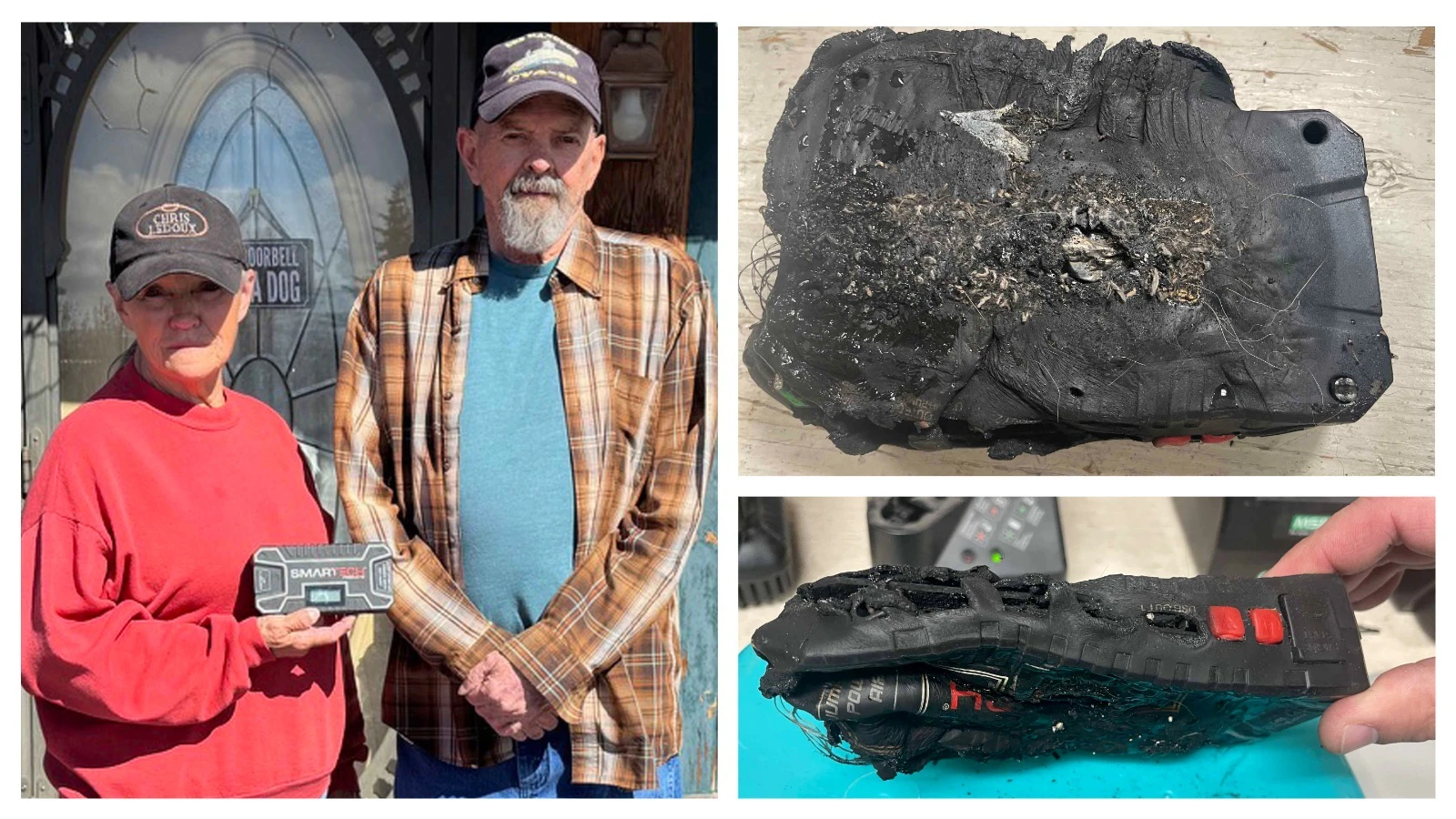
Daniel resident Jack Morey Jr. was still waking up when he thought he smelled something like spilled paint in his living room.
“That’s what we thought it was at first,” Morey said.
It seemed like a typical morning for Morey and his girlfriend, Diana Gunderson, who were drinking coffee and feeding their animals. They noticed a strange, paint-like chemical odor coming from Gunderson’s work area.
At first, Gunderson thought she might have spilled some paint. But then her eyes fell on a lithium-ion battery she was charging. It was visibly swollen.
“I picked it up and I was taking it to the door,” she said. “It started smoking and sparking in my hand.”
She tossed the suddenly smoking battery onto a rug by the door. Within seconds, flames were shooting out of the device, scorching the floor.
“The flames, my God, I couldn’t believe it,” Morey said. “It just blew up and shot flames I’d say about a foot up.”
Morey, a volunteer firefighter, smothered the battery with a towel and tossed it outside onto a concrete pad well away from the house, while Gunderson called 911.
“A lot of people would have thrown water on it or whatever,” he said. “But I knew better than to do that.”
Water Least Effective Approach
Fire officials say what happened in Daniel is part of a fast-growing wave of lithium-ion battery fires showing up in homes across Wyoming and the nation.
In many of those incidents, people try water. But it’s absolutely not the right approach, Sublette County Unified Fire Deputy Chief Bob Kladianos told Cowboy State Daily.
“Water is not an extinguishing agent for these batteries,” he said. “A bucket of water would actually retain the heat, and it doesn’t control the chemical chain reactions.”
When they arrived, firefighters used a thermal scanner to determine the battery was still at 300 degrees when they arrived.
They let it sit in the gravel driveway until it cooled enough to handle. Two fire trucks, each with a thousand gallons of water, stood by to keep anything nearby from igniting.
“When these batteries are burning during thermal runaway, they’re anywhere from 390 degrees Fahrenheit at the beginning and can go all the way up to 1,800 degrees,” Kladianos said.
Kladianos agreed that quick action by Morey and Gunderson to remove the battery from their home and get it away from anything flammable probably saved the structure.
“This could have ended very differently,” he said. “Had this happened at night, or if they had left the house, things could have ended very differently.”
As it is, Morey said the battery scorched the throw rug Gunderson tossed it on and left an 18-inch burn mark on the floor.
The smell of smoke has also spread throughout the home, leaving behind a stubborn chemical odor that has lingered even after extensive airing out and washing.
Toxic fumes from the device caused some difficulty breathing.
Firefighters donned full self-contained breathing apparatus to enter the house, where they established positive pressure ventilation to remove the fumes.
Now that the incident has passed, Morey is concerned that not enough people know about the dangers of lithium-ion batteries.
“There’s a million of these things out there,” Morey said. “This needs to go public. We could save somebody.”
Never Leave Charging Battery Unattended
Rock Springs Fire Chief Jim Wamsley, an expert on lithium-ion battery “thermal runaway,” said the Daniel-area incident mirrors a growing number of fires involving consumer lithium-ion batteries in everything from power packs to hoverboards.
“We’ve had at least two of those fires in Rock Springs that I can think of right off the top of my head,” he said. “Ideally, these should never be left unattended while they’re charging.”
Once the reaction begins, the intensely hot fire proceeds quickly, Wamsley added, and there’s no stopping it.
“My best advice would be don’t leave small appliances like that with lithium-ion batteries charging,” he said. “I mean, don’t just plug it in and go out to dinner or go to work or go to sleep, because when they get to that thermal runaway — it’s swift and dramatic.”
Most of the problems so far don’t seem to be with cellphones, Wamsley added. It’s more with lower-quality batteries, such as those one might buy on Amazon that haven’t had to comply with more stringent rules.
“Part of the issue is we have appliances coming in that have not been through rigorous testing,” he said. “That perhaps don’t follow the same manufacturing standards as we would require locally in the United States.”
Wamsley recommended looking for a “UL listing,” which stands for Underwriters Laboratories.
“That’s not a guarantee there won’t be a fire,” Wamsley added. “But they do extensive testing before they put their stamp on anything.”
Charging Stations Should Be Nonflammable
Wamsley said it’s also a good idea to set up charging stations on a surface that can withstand high heat, such as ceramic tile. There should be nothing flammable around the charging station for at least 3 feet.
If a battery does catch fire, he recommends immediately calling 911 rather than trying to put the fire out.
“Get everyone out of the house, get yourself out,” he said. “Because it really does happen fast.”
If the battery hasn’t yet caught fire and it’s possible to quickly remove it from the home to a nonflammable area such as concrete, that is also effective, but the fire department should still be called immediately.
Water, he agreed, is the least effective approach and shouldn’t be tried.
“I’ve read accounts of people or fire departments that have put 50,000 to 60,000 gallons of water on a single vehicle fire in an attempt to extinguish it before it got cool enough for them to actually do anything with regard to moving it,” Wamsley said.
Fire Departments Scrambling to Adapt
Given that tens of thousands of gallons of water are ineffective at putting out lithium-ion battery fires, fire departments across the nation are playing catch-up when it comes to handling such fires, Wamsley said.
“That lithium just wants to continue to burn,” he said. “It’s a series of small cells or interconnected cells. When you get one (cell) that gets an insult and it wants to ignite, generally, it talks to its closest neighbor, which does the same thing, and on and on and on.”
Wamsley and Kladianos both said their departments are looking for a dedicated facility where such batteries could be placed so the chain reaction can proceed without endangering anything.
“We haven’t identified anything concrete yet,” Wamsley said. “But we’re looking around. Because, again, just by nature, this is such a new phenomenon and we’re all just trying to figure it out.”
Wamsley’s department has also purchased blankets for EV fires, which can help reduce radiant heat coming off the fire. It’s not ideal, however, Wamsley added, because the blankets also trap potentially flammable gases that are being released by the burning battery.
“It’s not the best answer,” he said. “It’s a short-term answer.”
Renée Jean can be reached at renee@cowboystatedaily.com.


