
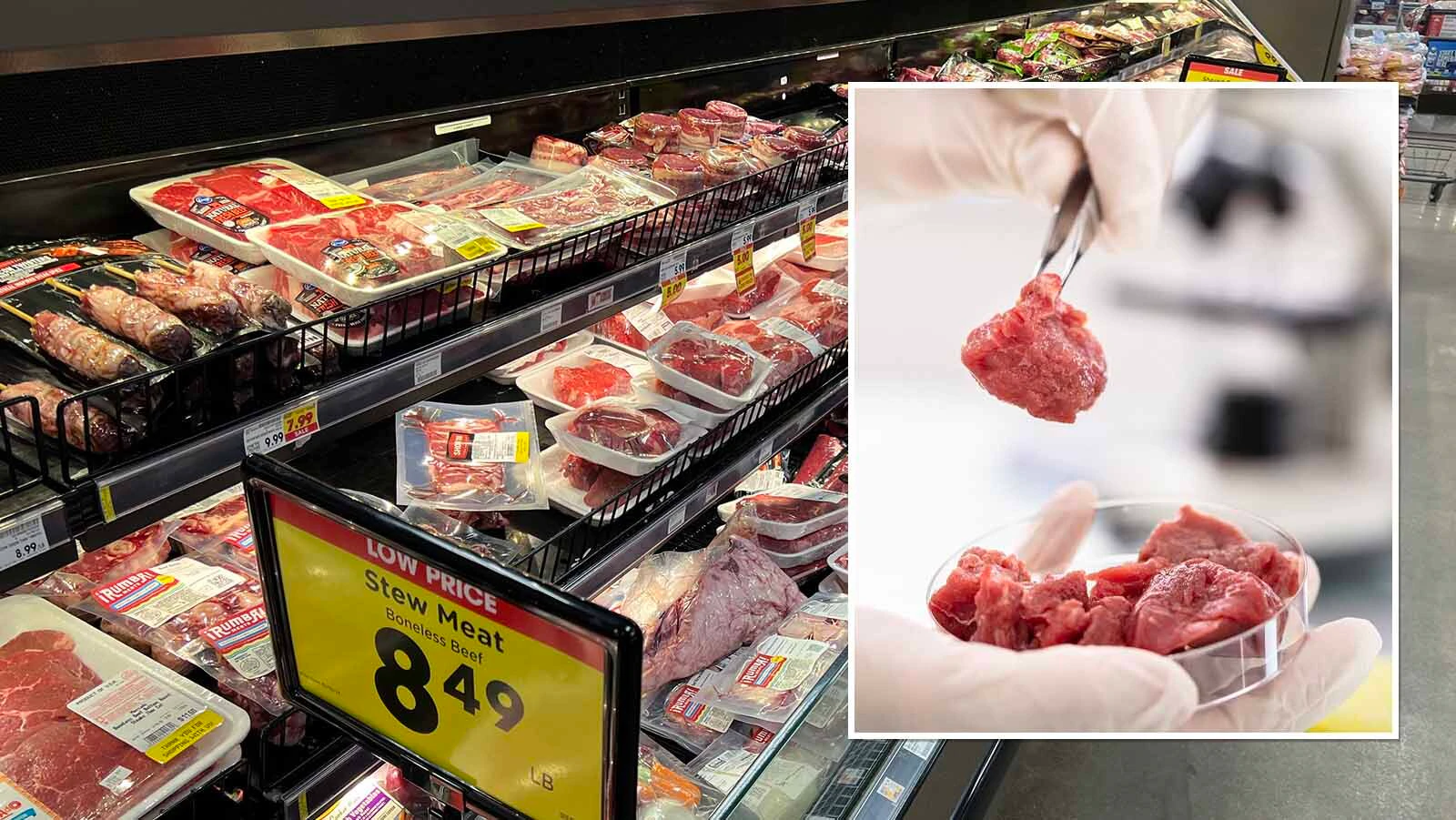
Wyoming ranchers support a new federal bill that would ban plant-based and lab-grown alternative protein products being passed off as farm- or ranch-raised meat or poultry.
The federal Fair and Accurate Ingredient Representation on Labels (FAIR) Act calls for those types of products to be clearly labeled as “lab-grown” or “imitation.”
The bill, introduced by Missouri Republican Rep. Mark Alford last week, is “really critical (and) something we’ve wanted to see for a long time,” said Jim Magagna, executive vice president of the Wyoming Stock Growers Association.
It’s important for Wyoming beef producers in the long run because consumers are becoming more and more conscious of where their food comes from, he told Cowboy State Daily on Monday.
The National Cattlemen’s Beef Association (NCBA) has endorsed the bill, saying that a rise in plant-based and “cell-cultivated” protein — real animal protein grown in a lab from animal cells — is blurring the lines for consumers.
Alternative proteins are creating confusion over the value of traditional beef labeling, said NCBA Senior Vice President of Government Affairs Ethan Lane.
Lane said that lab-grown and plant-based protein products have for years used traditional beef labeling terms, which confuses people into thinking they’re buying “real” meat.
“The FAIR Labels Act is a critical step toward protecting the integrity of real food animal products and ensuring consumers have clear, accurate information at the meat case,” he said.
Mark Eisele, a Laramie County cattle rancher and former president of the National Cattlemen’s Beef Association, praised the association’s endorsement.
“If they’ve endorsed it, I can tell you they’ve done their homework,” he said.
Republican U.S. Rep Harriet Hageman told Cowboy State Daily in an email statement Monday that she had not had a chance to review the finer details of the FAIR Act, but said she has long supported anything that provides additional information to consumers on what they are eating.
“I think it’s long overdue (that) Congress design guardrails to prevent mad scientists from masquerading as meat producers,” she said.
What’s In The Bill
The FAIR Act was introduced by Alford and seven other U.S. representatives last week.
It would require lab-grown protein products to bear the term “cell-cultivated protein” and plant-based “meat” products to display “plant-based alternative protein” on their labels.
They would be required to include a disclaimer stating the product in its final form did not come from a live animal.
There is now no federal rule for labeling cell-cultivated protein products in the U.S. marketplace, according to NCBA President Gene Copenhaver.
Real vs. 'Fake' Meat
The cultured meat market has been struggling, both Eisele and Magagna said. Eisele calls it “fake meat” and said it is losing its value.
“Lab-based meat has pretty much been a failure,” echoed Magagna. “Those companies have struggled to keep going. I’ve not found anyone yet whose said this is a good product.”
Copenhaver said in a statement that lab-grown protein companies have “exploited the use of terms like ‘meat’ and ‘beef’ to describe their products” for far too long, “creating the potential for consumer confusion through misleading marketing.”
Magagna said that, while he feels the FAIR ACT is strong, one thing that would shore it up more is prohibiting companies from referring to any plant-based or lab-based protein as “meat."
“There is nothing in the bill I see that would preclude them calling it ‘meat,'” he said.
Proponents of alternatively produced proteins say such products offer sustainable and ethical alternatives to conventional meat.
They say cell-cultivated and plant-based proteins contribute to greater food security and conserve limited natural resources. Plant-based proteins are high in fiber, which help regulate the body’s sugar use.
Educated Consumers
Wyoming livestock experts say the bill would help consumers make more educated choices.
Magagna said he has talked with a few Wyoming residents who say they wish they could more easily distinguish plant-based and lab-based protein with real meat.
Eisele agreed, saying, “Producers of real meat want to make sure there is a distinction. If consumers want to make that choice, they should be able to. That means honest labeling.”
The Camel In The Tent
Wyoming has no lab-grown protein companies. However, Eisele said Wyoming beef producers should absolutely be wary of competition from companies that produce cultured meat, because most of the state’s produced beef is sold outside Wyoming.
“We don’t sell a lot of our product within the state of Wyoming,” Eisele said. “We don’t have enough people.”
Wyoming-produced beef is sold to restaurants and retail stores nationwide.
Eisele said it is critical that the U.S. agriculture industry stays on top of clear labeling to protect its products against foreign competition.
“It’s kind of like the camel putting his nose in the tent,” Eisele said. “If you ignore the nose, pretty soon here comes the face, then the leg. And before you know it, you’re losing ground.”
Eisele compared the beef industry to the auto industry. The auto industry wasn’t worried about quality control, he said, and lost 50% of its market share to foreign competitors.
“It’s the same thing with beef,” he said. “Our producers are worried about fake meat. It’s all about the market share.”
Magagna said there was heightened concern among Wyoming beef producers when plant- and lab-based protein started coming on the market, but those proteins haven’t really taken off.
However, high beef prices could lead people to switch to buying more alternatively produced protein.
The MCOOL Connection
The “real” vs. “fake” meat debate isn’t the first food labeling throw down for U.S. agriculture producers. Country-of-origin labeling also has been a hotly contested issue.
In 2023, U.S. Rep. Harriet Hageman sponsored a bill that, had it passed, would have prohibited beef sellers from designating foreign beef as American.
In her Mandatory Country of Original Labeling (MCOOL) bill, anyone caught trying to pass off foreign beef as American could have been fined $5,000 a pound.
The bill died, but Hageman reintroduced it last October, along with Congressman Ro Khanna, D-California.
While the FAIR Act introduced last week has a different focus, it points to the same call for clear and transparent labeling, Eisele said.
“We were working hard to make the label not just what the ingredients are, but where they came from,” Eisele said about country of origin labeling. “There was tremendous confusion as to what that meant.”
Hageman told Cowboy State Daily in an email Monday that “Americans want to know where their meat comes from just like they know where their fish is caught, avocados are grown, and cherries are harvested.
“I reintroduced the Country of Origin Labeling Enforcement Act to reinstate mandatory country of origin labeling (MCOOL) for beef to provide American consumers with the tools they need and deserve to choose the product they feed their family,” she said. “Transparency in the marketplace has never been more important to increase national cattle herd numbers and protect America’s proud agricultural heritage.”
Meanwhile, Across the Country …
A bill similar to the FAIR Labeling Act, which would have banned the sale of cell-cultured meat in South Dakota, was recently vetoed by South Dakota Gov. Larry Rhoden, who instead favored a five-year moratorium on lab-grown meat products.
The South Dakota Cattlemen’s Association urged the governor to veto the ban.
In January, Wyoming Rep. Tomi Strock, R-Douglas, introduced a bill calling for the prohibition of cultivated meat manufacturing, sales and distribution in Wyoming. The bill did not advance through the Committee of the Whole.
According to the National Agricultural Law Center, seven states have passed laws banning cell-cultured meat: Alabama, Florida, Indiana, Mississippi, Montana, Nebraska and Texas
Kate Meadows can be reached at kate@cowboystatedaily.com.


