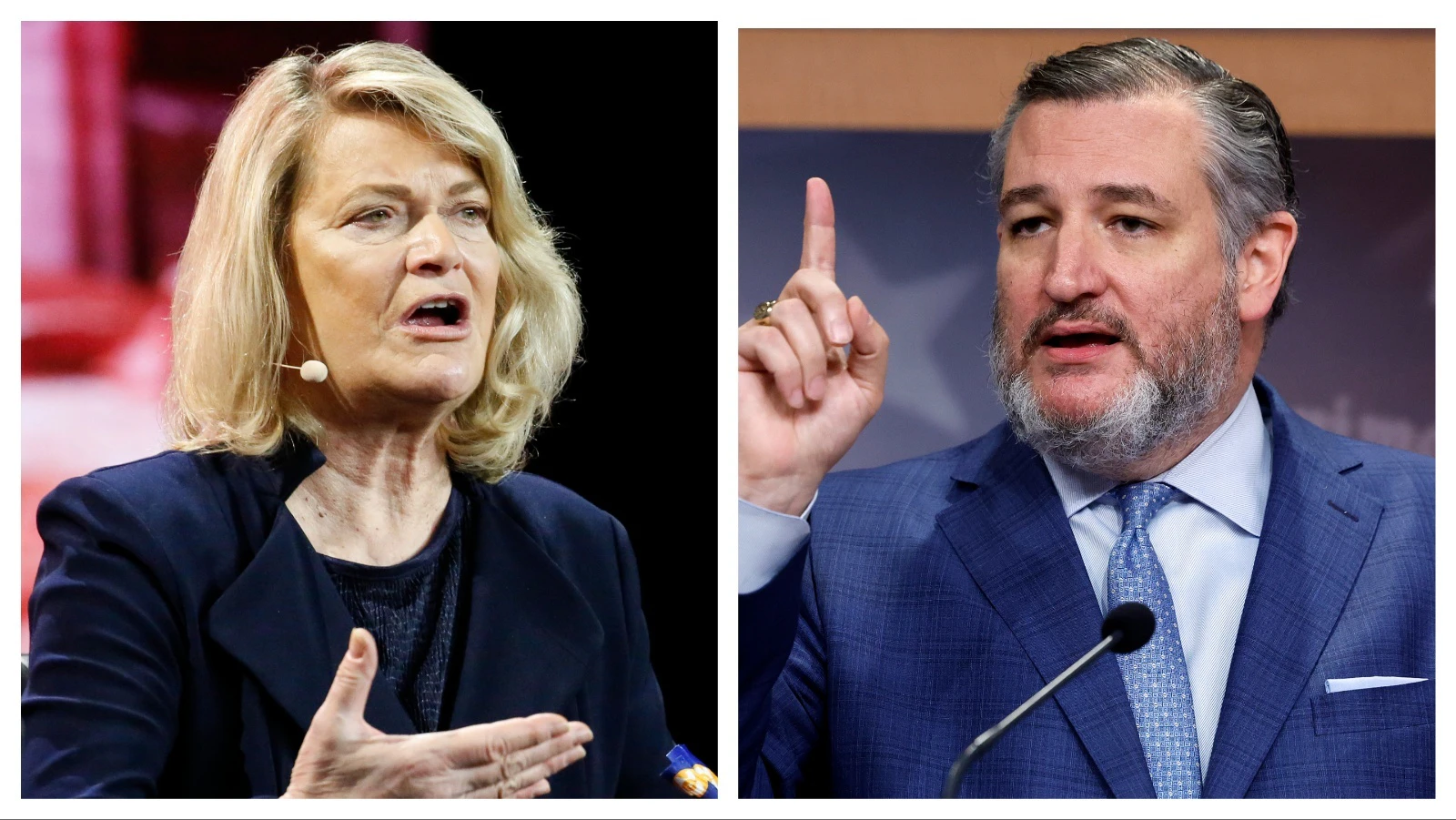
Wyoming's Sen. Cynthia Lummis has teamed with Texas Republican Sen. Ted Cruz to defend the EPA's about-face on regulating greenhouse gas emissions.
They argued the agency was right to deregulate itself, and regulation of that magnitude should be left to Congress.
The U.S. Environmental Protection Agency (EPA) decided in February that it had gone too far in 2009 when it declared certain greenhouse gases a public health threat in the “endangerment finding.”
Seventeen health and environmentalist groups asked a Washington, D.C.-based federal appeals court to consider that the agency’s about-face was merely random and spontaneous or, in legal speak, “arbitrary and capricious.”
The groups asked questions of the U.S. Court of Appeals for the District of Columbia Circuit, like:
• whether the agency is correct in concluding that its years-long war on greenhouse gases had so little impact on the environment it was futile;
• whether the scaling-back of agency authority was itself a violation of administrative law;
• and whether the agency’s change failed to explain why it would depart from “long-standing agency practice.”
“Repealing the Endangerment Finding endangers all of us. People everywhere will face more pollution, higher costs, and thousands of avoidable deaths,” said Peter Zalzal, counsel and associate vice president of clean air strategies at Environmental Defense Fund in February.
“The Trump EPA’s action tramples mountains of scientific evidence, ignores the law, and is fundamentally at odds with EPA’s core responsibility to protect us from dangerous pollution,” Zalzal said. "We are challenging this action in court, where evidence matters, and we will continue working together to build a better, safer and more prosperous future.”
The challenge sparked a flurry of outside parties entering the case as amici, or “friends” there to advise the court -- ranging from individuals, to groups in the trucking, manufacturing and private sector, to numerous states.
Wyoming joined the fray, filing a March 6 argument asking the court to let it defend the EPA’s recent change.
Then Came Monday
Then on Monday, Lummis filed a brief in the case alongside Cruz – also backing the EPA’s deregulation move.
Lummis pointed to her role as chair of the Subcommittee on Clean Air, Climate and Nuclear Innovation and Safety. Cruz pointed to his chairmanship over the Subcommittee on Federal Courts, Oversight, Agency Action and Federal Rights.
“Both have a strong interest in judicial interpretations that preserve the legislative powers that Article I of the Constitution vests exclusively in Congress,” says the senators’ brief. It adds, “The legislative power resides in Congress – not unelected bureaucrats.”
They argued that the EPA was right to rein its regulatory powers back to pre-2009 levels on the greenhouse gas issue, and said the court should curb agencies from rulemaking in ways that settle “major questions” best left to Congress.
Asking Congress to accomplish law changes is difficult in 2026, the senators conceded.
“In times of heightened political polarization – like shortly after the Founding and today – the Constitution’s insistence on consensus can seem like an insurmountable hurdle to meaningful policy change,” the brief says.
“Given this frustration, it is perhaps inevitable that some would seek to circumvent the Constitution by attempting to enact significant policy change through administrative regulations, which require no debate, no compromise and no vote,” Lummis’ and Cruz’s say in their brief.
But the nation’s framers believed the legislative process was essential to preserving individual liberty, says the brief, citing both a U.S. Supreme Court Justice Neil Gorsuch concurrence and a James Madison quote from Federalist letter No. 48.
The brief goes on to quote U.S. Chief Justice John Roberts: “The Framers could hardly have envisioned today’s vast and varied federal bureaucracy and the authority administrative agencies now hold over our economic, social and political activities.”
Lummis and Cruz called the EPA’s repeal of the endangerment finding correct, and correctly deferential to Congress.
And, Denver
The City of Denver, Colorado, announced via case filing Wednesday that it is joining the case on the health groups’ side, but has not yet filed its argument.
Meanwhile, Wyoming and the other 24 states hoping to enter the case to bolster the EPA’s departure from 17 years of greenhouse gas regulation said in their March 6 argument that all that regulation “reached beyond the vehicle-emission context and fundamentally reshaped America.”
The court had upheld the 2009 endangerment filing, the states noted, but the U.S. Supreme Court has since sustained two challenges to major rules stemming from that finding.
Wyoming Deputy Attorney General D. David DeWald is representing the state in that action.
Clair McFarland can be reached at clair@cowboystatedaily.com.