
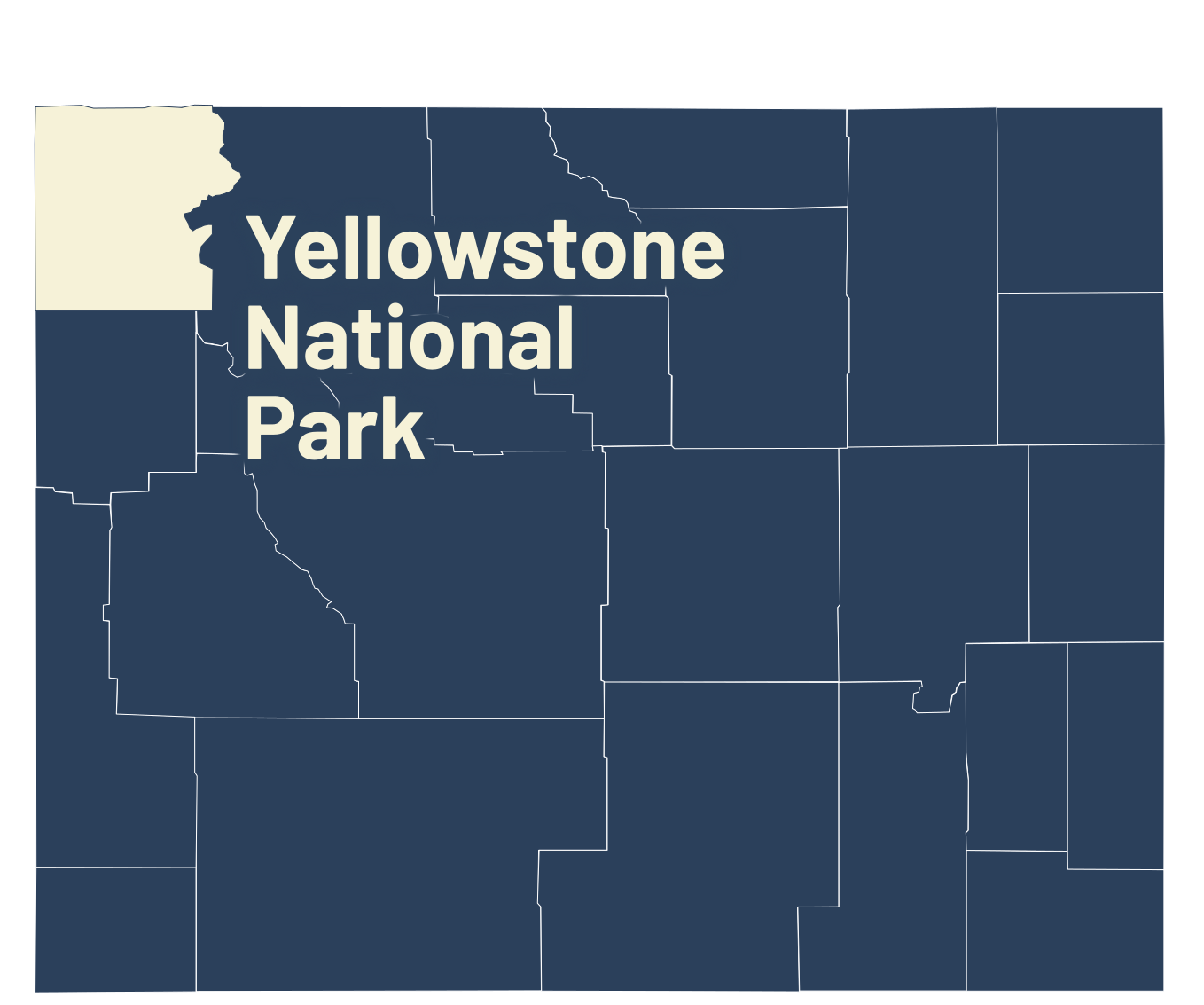
It started with an oil furnace in the blacksmith shop 101 years ago.
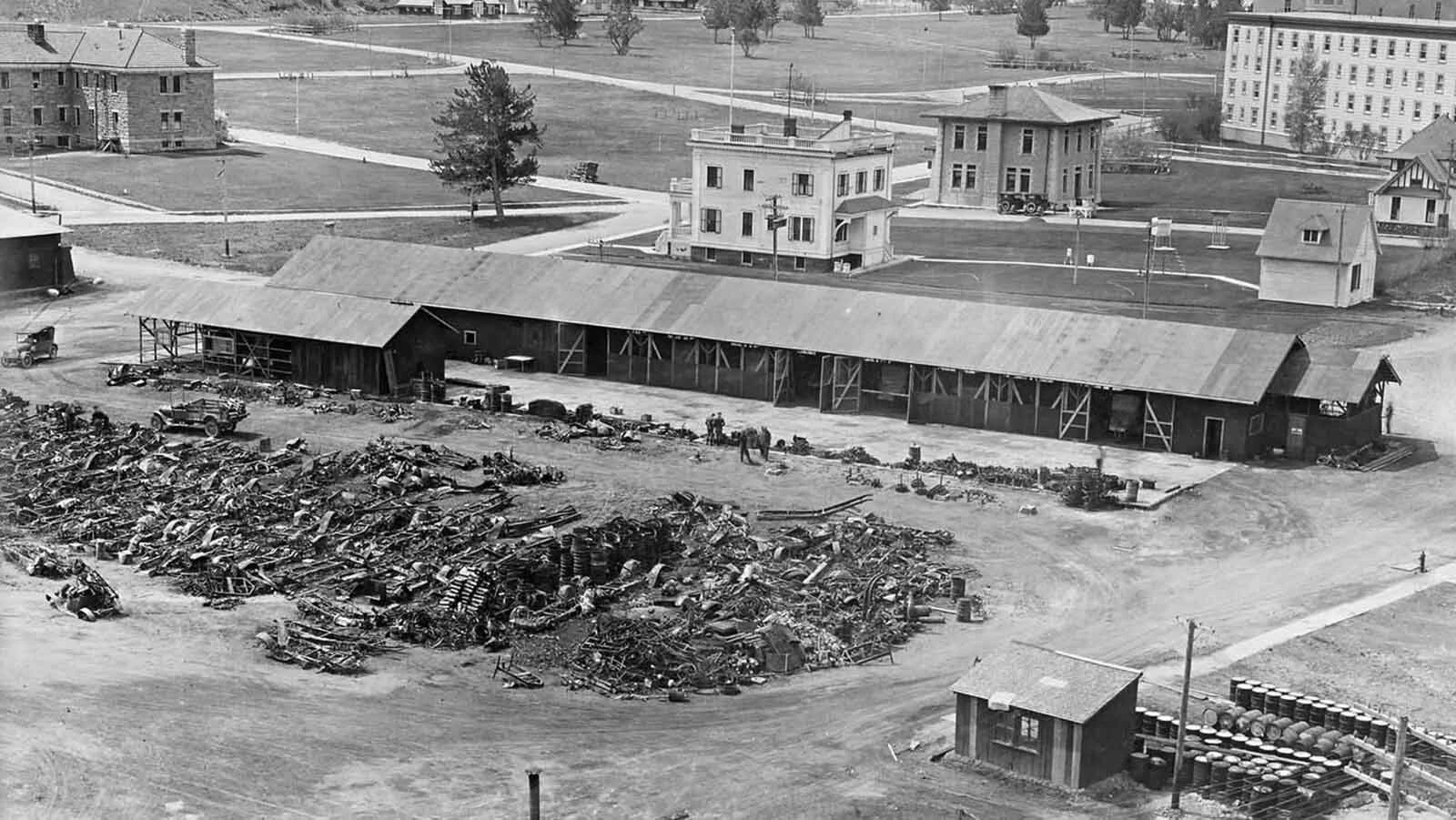
On the afternoon of March 30, 1925, the furnace exploded inside the Yellowstone Park Transportation Company's repair and maintenance complex at Mammoth Hot Springs, scattering burning fragments across the building.
A strong wind from the south did the rest.
"Fanned by a stiff breeze the flames advanced with such great rapidity that it seemed for a time the historic barracks of old Fort Yellowstone and the present home of Superintendent Horace M. Albright ... were doomed," the Helena Independent Record reported the following day.
About 20 men — mechanics and residents of Mammoth Hot Springs — fought the blaze, hampered by a lack of water pressure and firefighting facilities.
For more than an hour the flames threatened the entire north end of the little town.
The fire came on so suddenly to one home in Mammoth that a woman was caught inside with the entrances blocked by flames. Rescuers pulled her through one of the house's rear windows.
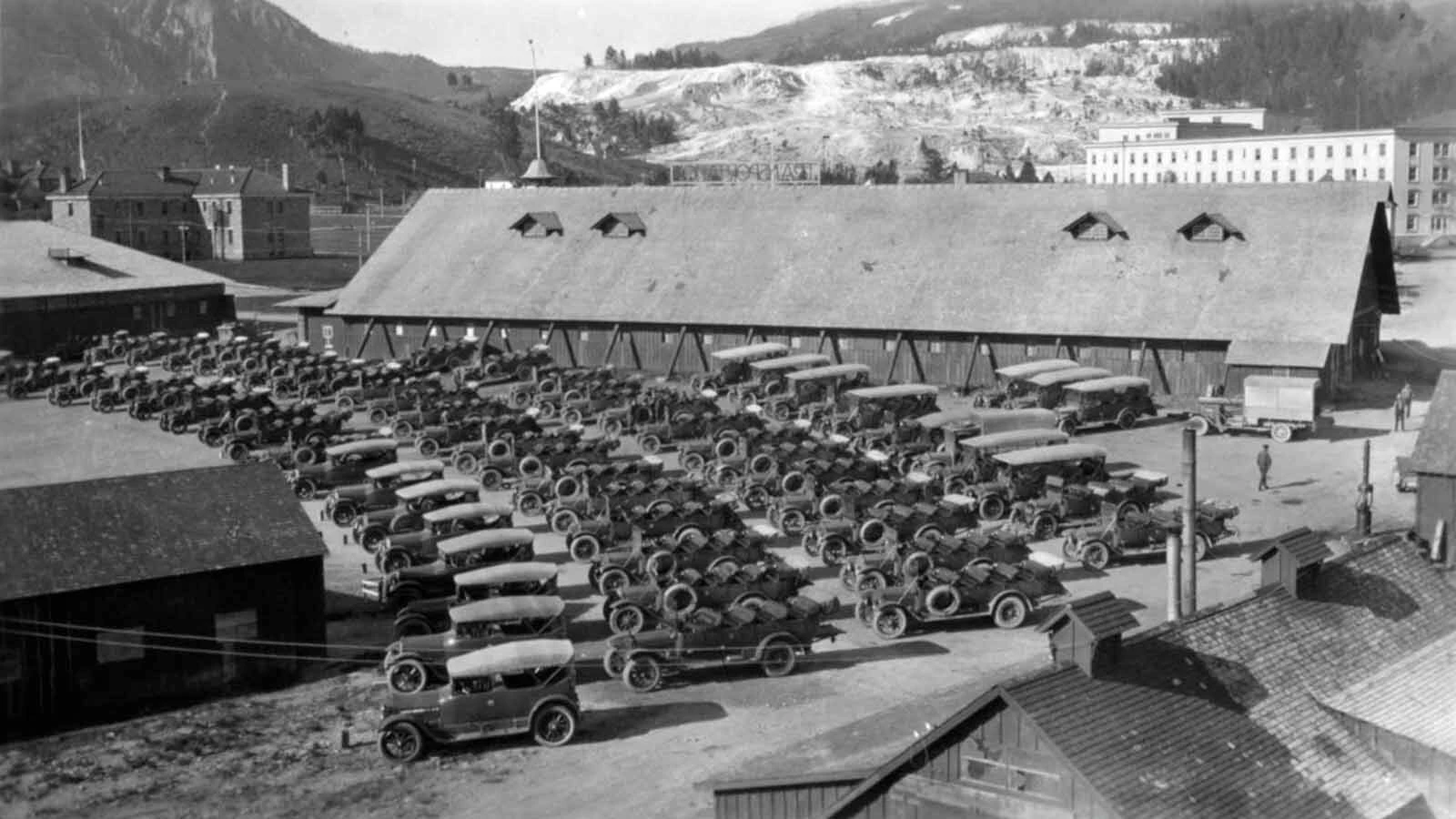
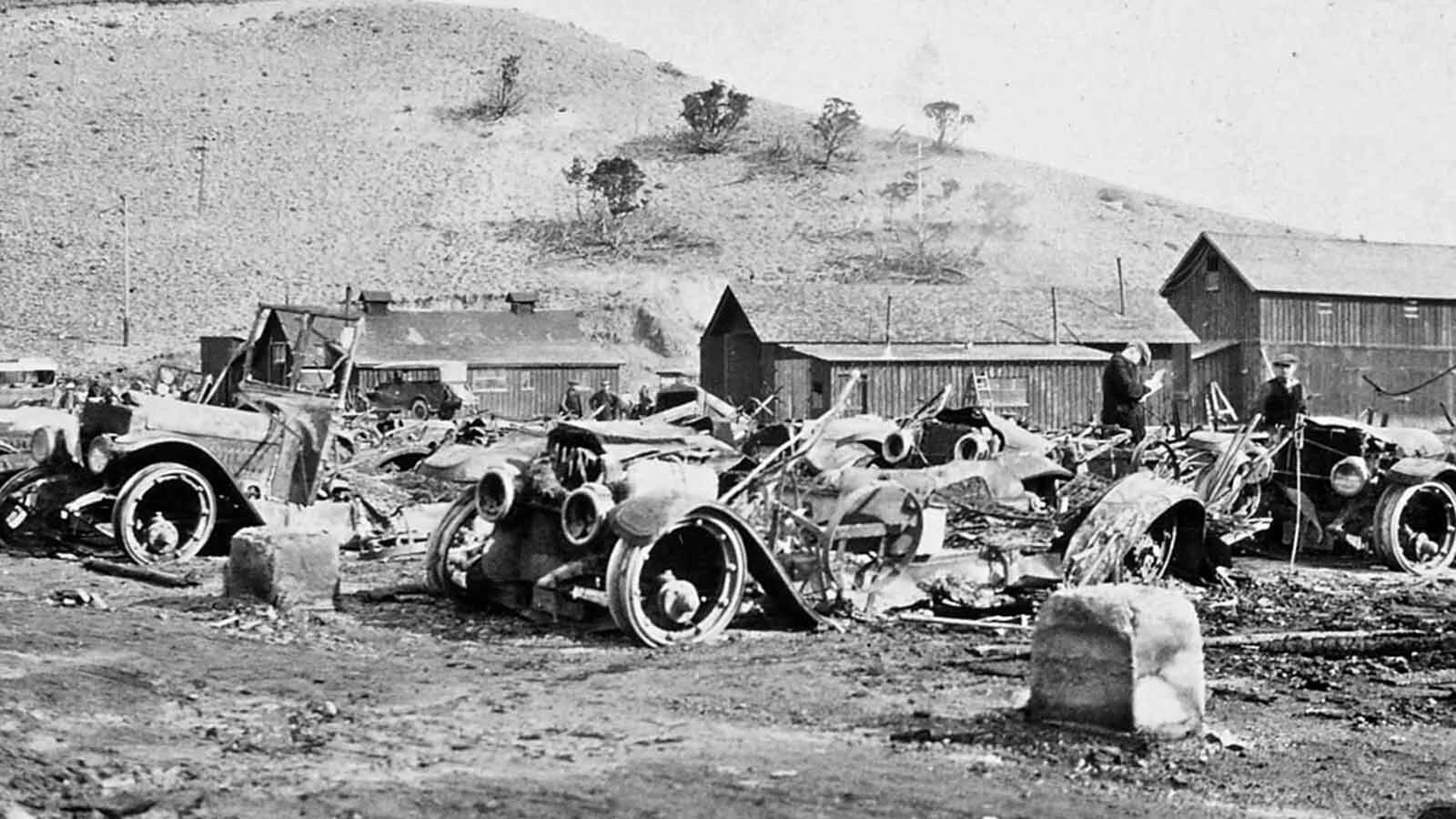
In slightly more than an hour, the ground was burned clean and the storage garage containing 81 passenger buses was completely destroyed.
According to a detailed inventory compiled by the Buses of Yellowstone Preservation Trust, the losses included 22 White touring cars, 27 White TEB buses, 26 White Model 15-45 buses, six trucks, and several vehicles belonging to the Yellowstone Park Camping Co.
The machine shops, paint shop, and top shop were total losses. The home of the transportation superintendent was gone.
One thing kept the disaster from becoming a catastrophe.
40,000 Reservations
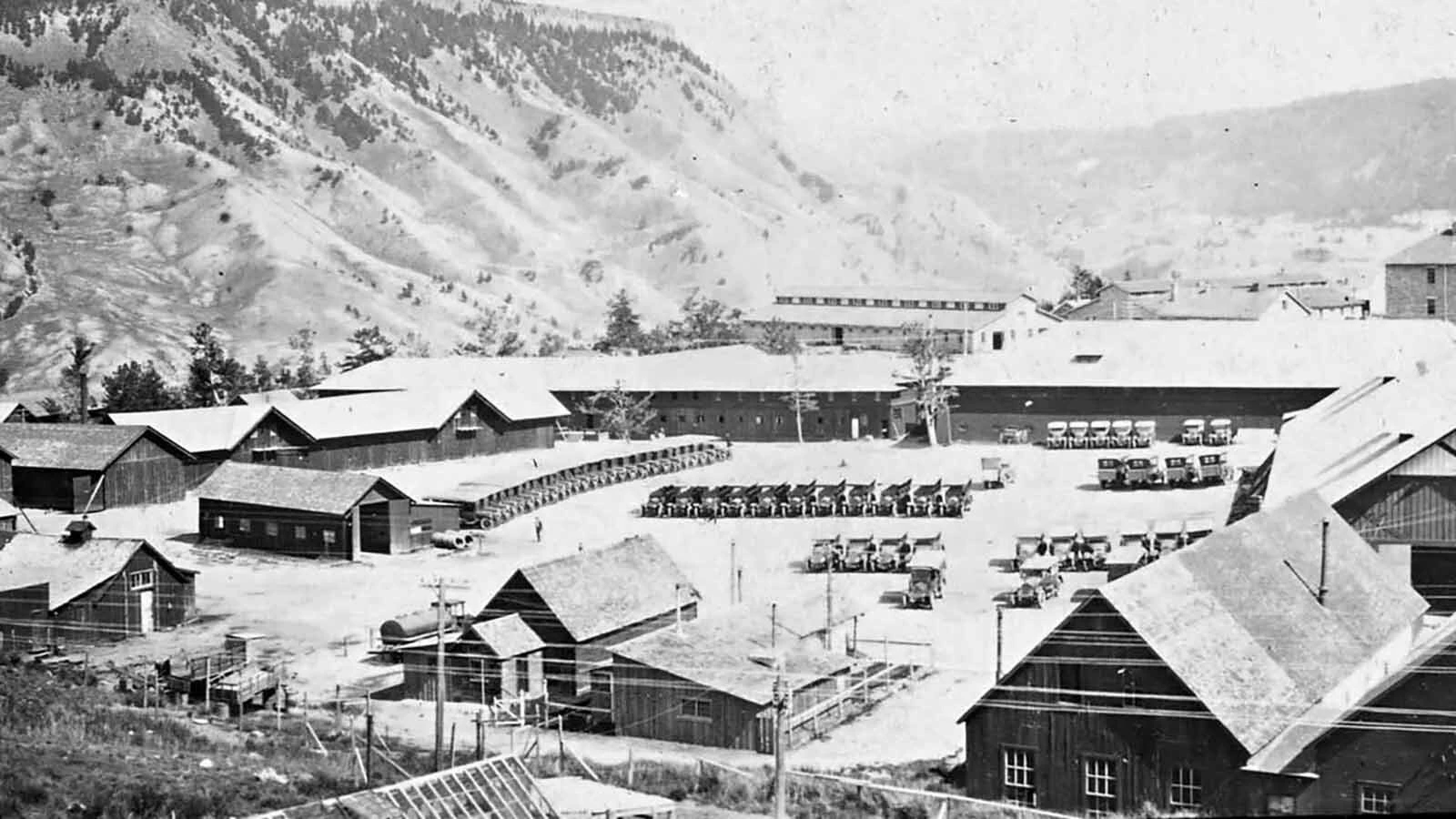
On the other side of the complex, a large storage garage held 215 additional vehicles.
The firefighters, despite being outmatched, got the blaze under control before it reached that second building.
"No fatalities were listed and only minor burns resulted for the mechanics who fought valiantly to save the big garage," the Billings Gazette reported on March 31, 1925.
The area's hotels were spared, as the wind carried the flames and sparks away from them.
With the last embers glowing dully at midnight, the exhausted mechanics took stock.
Officials estimated the total loss including the incinerated buildings at $600,000 — the equivalent of roughly $10.5 million today.
The Billings Gazette's headline at the time put the figure even higher at $750,000, calling it the most destructive fire ever in the park.
The tourism season was scheduled to open June 18. There were 40,000 reservations already on the books and more than 100,000 visitors expected.
And a quarter of the park's bus fleet was now a charred ruin.
Charged With The Rebuild
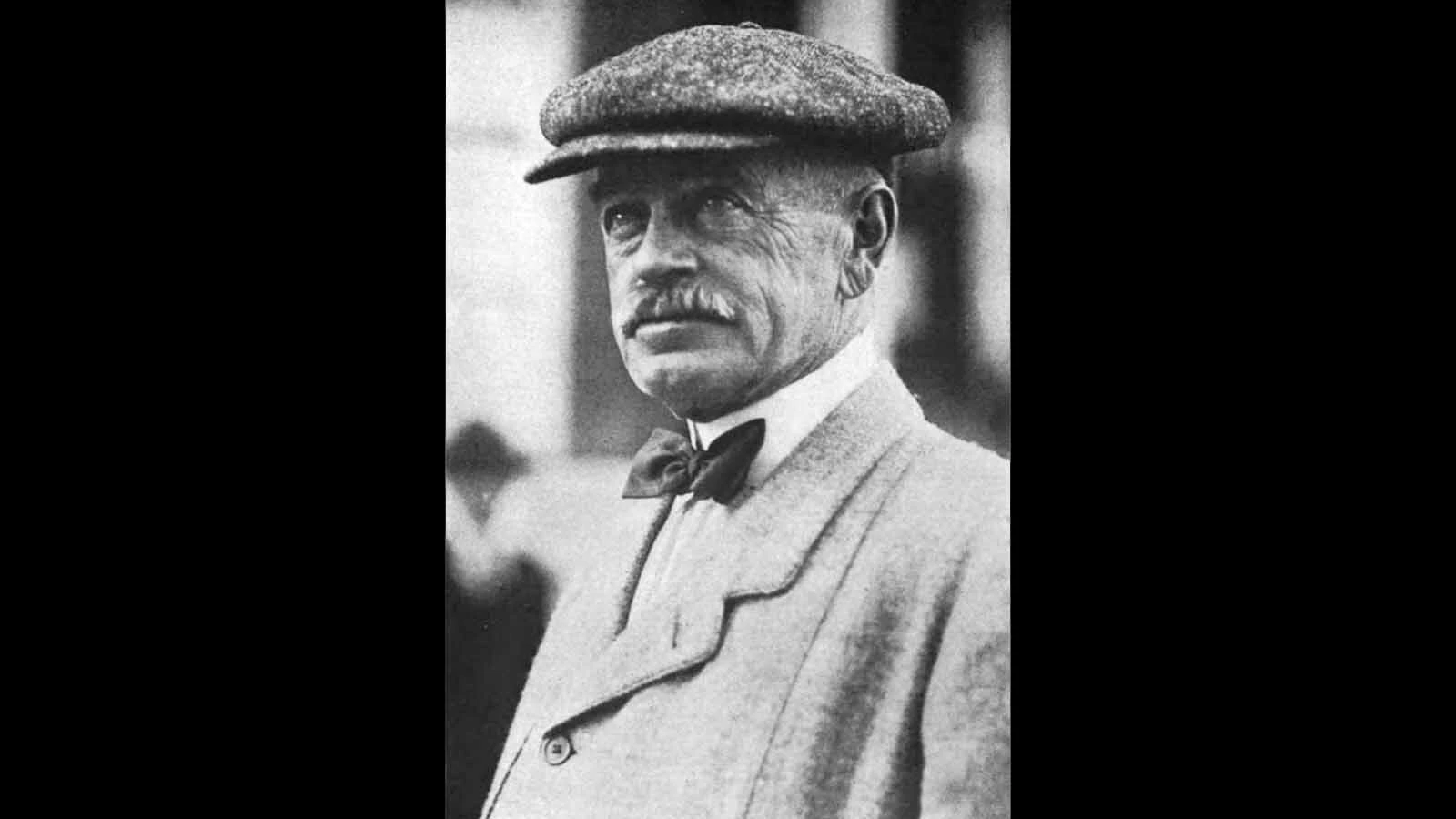
The crisis landed squarely on the shoulders of Harry W. Child, who spent more than three decades assembling every piece of Yellowstone's visitor infrastructure, from the stagecoach lines to the hotels to the fleet of distinctive yellow buses.
In 1916, the newly created National Park Service consolidated all concessions under Child’s control and mandated the switch from stagecoaches to automobiles.
Gone were the 800 horses and 500 coaches. In their place, Child began negotiations with Walter C. White of the White Motor Co. in Cleveland, Ohio, for a fleet of custom-built motorized touring buses and cars.
By March 1925, the park's motor fleet numbered around 400 vehicles.
About a quarter of them were stored in garages at Mammoth Hot Springs, where mechanics spent the long winter months between tourist seasons maintaining and repairing the fleet.
A new, modern garage complex was already under construction at Gardiner, just inside the park boundary at the north entrance, scheduled to be finished by that fall.
It was that fleet, and those garages, that the oil furnace explosion reduced to a charred mass of ruins on the afternoon of March 30.
What happened next became a story the Child family would remember for four generations.
Before he had even received the official damage report from his own company officers at Mammoth, the 68-year-old company president read an Associated Press dispatch sent out from Livingston — and immediately wired the White Motor Co. factory in Cleveland.
"A few hours later, according to the report, a wire came back from the east, 'work has started on 100 11-passenger buses and order will be shipped by special train June 1,'" the Independent Record reported on April 10, 1925.
On April 7, the Associated Press reported from Chicago that Child had finalized arrangements to ensure the park's normal opening.
The contract was enormous: 102 sightseeing motor cars and 20 trucks to carry supplies. It was taken by the White company with an agreement to operate day and night until June to complete the order.
It was, the AP reported, the largest contract for motor coaches ever recorded.
The finished vehicles would fill a special train of 65 railcars, running directly from Cleveland to Livingston, the nearest station to the park, and then driven 60 miles to YNP, according to press coverage.
Built By Hand
Cheryl Whitcomb, a volunteer and historian for the Buses of Yellowstone Preservation Trust in Red Lodge, Montana, recently dove into the details of the fire and the recovery that followed.
The nonprofit houses pre-World War II Yellowstone buses in a historic 1936 garage in Red Lodge and works to preserve the transportation history of the park.
What struck Whitcomb most about the story was the sheer improbability of the manufacturing timeline.
"There were no assembly lines. Everything was built by hand," Whitcomb told Cowboy State Daily. "The White Motor Co., Walter White in particular, put on whatever shifts they could and produced all those vehicles."
According to Whitcomb's research, White built 90 replacement vehicles in 59 days. The last one arrived at the park on June 9, about one week before the season opened.
In her recent Facebook post, Whitcomb reported, “Estimated replacement costs for all were $500,000.”
The timing of the new garage complex already under construction at Gardiner proved equally critical.
"How fortunate they were that that was in the process of being built and that they had a place for the transportation company and all the vehicles to be housed," Whitcomb said. "I mean, wasn't that something?"
The new facility covering 2 acres was rushed to completion in time for the 1925 summer season.
It included modern mechanics stalls, body and upholstery shops, a carpenter shop, blacksmith shop, tire and battery shop, paint shop and a coal-fired heating plant.
That building is still in use, housing Xanterra Parks & Resorts' Transportation and Human Resource divisions, a direct physical link to the crisis of 1925.
Opened On Time
Child didn't just send a telegram and wait, he headed to Cleveland to personally oversee the work on his new fleet.
"Mr. Child did not stop in Livingston, but continued his trip east and expects to remain away until the first of next month, when he will return to Mammoth, to prepare for the big tourist rush that is expected by all park officials and concessionaires," the Independent Record reported.
The park opened on time.
More than 100,000 visitors toured Yellowstone that summer, as Child had promised they would.
On the 101st anniversary of the fire, Harry Child, a direct descendent of Harry W. Child, left a comment on the Buses of Yellowstone Preservation Trust's Facebook memorial post.
"The family never forgot this day," he wrote.
Child himself would continue running the park's visitor operations for another six years.
He died in 1931 in La Jolla, California. His son-in-law, William M. Nichols, merged all the concession operations into the Yellowstone Park Co. in 1936, an entity that continued operating until the federal government bought its assets and terminated the lease in 1980.
Whitcomb said she and her husband David recently visited the site of the fire at Mammoth Hot Springs and found it difficult to visualize the devastation that unfolded there a century ago.
"It sure could have been worse than what it was, even though it was quite devastating," she said, reflecting on her response to seeing the photos from the scene and the devastation they revealed.
“The photos, you know, they speak a thousand words,” she said.
David Madison can be reached at david@cowboystatedaily.com.


