
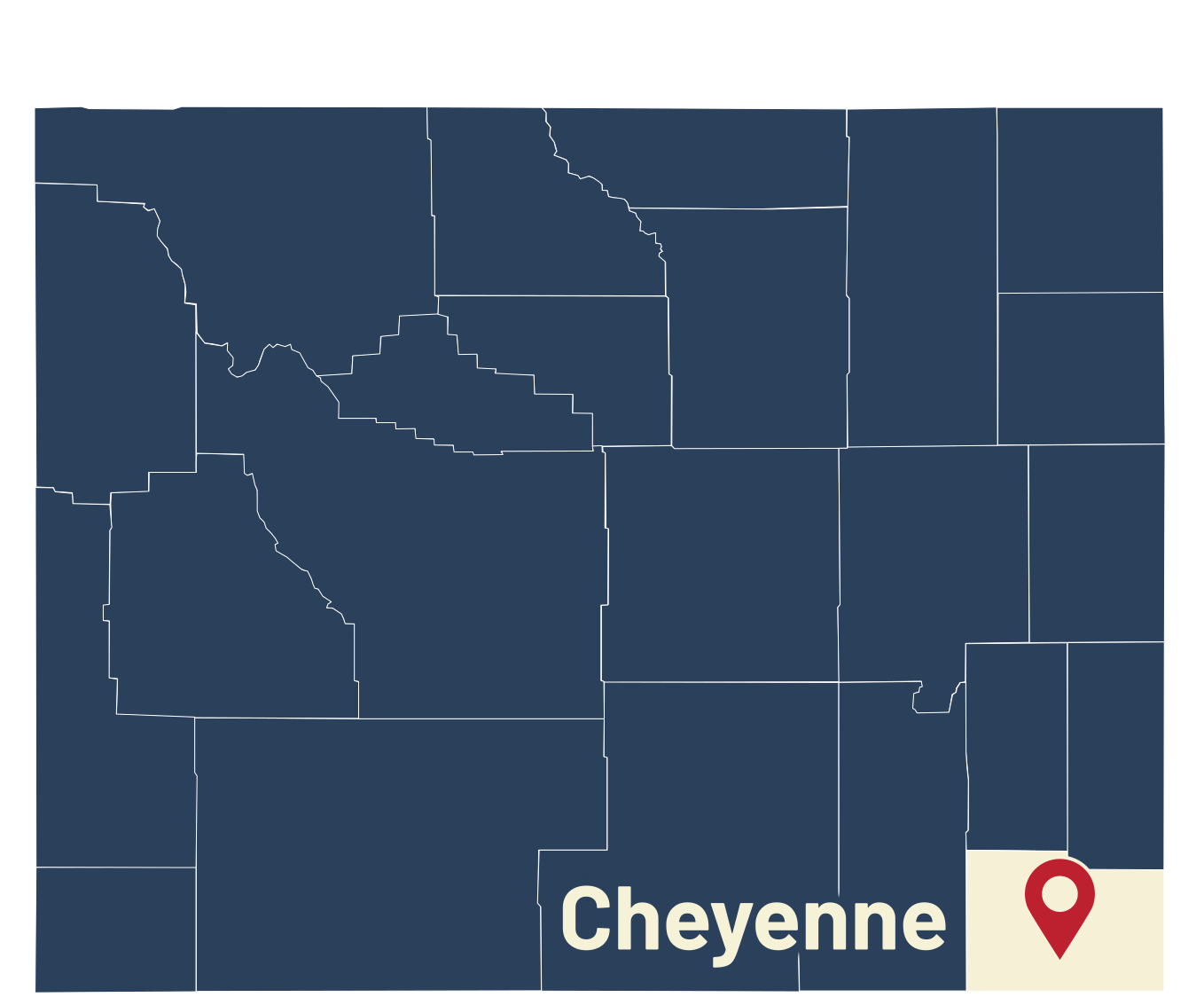

Libraries were the original data centers, as far as Laramie County Library Executive Director Antonia Gaona is concerned.
When Microsoft came through with a $120,000 donation last month for the library to build a new makerspace, Gaona told Cowboy State Daily it was a full-circle moment for knowledge centers that began with books on shelves and are now moving into the digital age.
“We like to say it’s Microsoft giving back to the OG data center,” Gaona said. “That’s truly what a library is — a warehouse for knowledge and hub for information.”
The donation was part of Microsoft's commitment to the community as it builds a new data center in east Cheyenne, a project that, like data centers in general, has been highly controversial.
As recent annexations, many for data center development, have expanded the city’s footprint by 20%, Cheyenne residents have turned out in force at city council meetings as the stakes hit home.
Some have given emotional testimony about noise and pollution, others warn of strain on the power grid and plenty have aimed their anger at council members who keep approving new projects.
As a Cheyenne resident, Gaona understands these concerns.
Still, she said she's already seeing what the industry could mean for the community, starting with Microsoft's donation to the library.
“It did actually spur a little bit of competition,” Gaona said. “We’ve had people from Meta and from Google reach out to us since the Microsoft partnership was announced to see how they might be able to invest."

‘They Chose To Be Proactive’
It wasn't the first time the big-tech boom in Cheyenne has come with a big donation for Wyoming.
In October, Tallgrass, the energy company powering Google's data center in the city, announced a $105 million gift to Yellowstone National Park, the largest donation in National Park Service history.
Gov. Mark Gordon previously told Cowboy State Daily he suspected some might be less than “copacetic” about the donation to the park, and Gaona said she fielded similar skepticism when the library accepted Microsoft's $120,000.
“A lot of people assumed their donation came with strings attached,” Gaona said. “It absolutely did not. They did not expect anything for their donation, no recognition or naming rights.”
Microsoft's donation is covering about one-third of the makerspace, Gaona said. Another third is coming from the sixth penny, a voter-approved sales tax that funds specific local projects, with library foundation contributions making up the rest.
While adding a makerspace had been part of the library's strategic plan, Gaona said that without Microsoft's contribution it could not have been realized as thoroughly or as quickly.
“It was a big deal,” Gaona said. “I’m incredibly grateful that they chose to be proactive about supporting the community’s dreams in this way.”
Industry Saved The Library
Gaona knows not every library has been so fortunate. Across Wyoming, smaller libraries have struggled to keep their doors open as local budgets have shrunk.
The permanent 25% homeowner property tax cut that Gordon signed into law in 2025 reduced the revenue that funds local services, and Gaona said it forced a lot of small libraries to close.
“Some libraries got their budget cut by over 50%,” Gaona said. “Here in Laramie County, because we have a diversified economy because of industries like data centers, our budget stayed relatively stable.”
Cheyenne City Council member Michelle Aldrich told Cowboy State Daily that the Carbon County Public Library was among those that saw its budget slashed, leaving it open just four to eight hours a week.
Without big industries in the community, Aldrich said, Cheyenne's library and other public services could have faced the same fate when the property tax cut hit.
“Had we not annexed in the North Business Park, where Microsoft is located, we would not have received the tax revenue from that as a city,” Aldrich said. “There would have been implications to our budget when that property tax cut went through.”
Microsoft is now the largest taxpayer in Laramie County, Aldrich said. That money goes toward things like street and water system improvements, but those upgrades are far less noticeable to Cheyenne residents than a hyperscale data center rising under construction.
“It’s not like one week Meta announces it’s going to be in Cheyenne and the next week people are seeing the benefits of it,” Aldrich said.
‘A Lot Of Investments’
Taxes aren't the only way data center money has reached Cheyenne, Aldrich said.
Meta runs a grant program for local nonprofits and schools, and Microsoft joined three other companies in pledging $1.3 million over 10 years to the Boys & Girls Club of Cheyenne.
Trammell Crow Company, developer of the Orchard Hills data center, went further with a community benefits agreement that includes an estimated $15 million road and a fourth well for nearby residents.
“They’re making a lot of investments in our community in addition to what they’re paying in property tax and sales tax for their electricity,” Aldrich said.
Aldrich is accustomed to angry crowds at city council meetings as the council continues to approve more data centers. She said tensions escalated a few months ago to the point where a resident made a death threat against her and other council members on social media, and the person was ticketed by police.
“Between annexations and data centers, this person had just reached their limit,” Aldrich said. “If you start threatening me with bullets, that’s where it crosses a line for me.”
Short of crossing that line, Aldrich said she welcomes the passion residents are showing for a city they all love.
As a lifelong Wyomingite, Aldrich also said she’s not shocked by the spirited debate over data centers. In the 1970s, she said the state experienced almost the same thing with the coal boom.
“There was a huge outcry and people were convinced it was going to destroy their community,” Aldrich said. “Thank God they went forward, because if it weren’t for the coal industry our public education would barely exist.”
Aldrich said many Wyomingites have long known the state would need a new source of revenue to sustain those benefits as the extraction industry becomes less profitable. Data centers, she said, are that next chapter.
“We have an opportunity to diversify our economy,” Aldrich said. “It might not be everyone’s cup of tea but, in a lot of ways, it’s the perfect industry for Cheyenne.”
Jobs for Veterans
Unlike the boom-and-bust cycles of the past, Aldrich said she has taken a long-term view of data centers.
She said part of the appeal is the jobs, which pay well and come from large companies with room to grow, but not in numbers high enough to cause a problematic influx of new residents.
“We have to have jobs that will let people continue to live here,” Aldrich said. “We can’t just live on agriculture and tourism.”
Scott Gromer, CEO of Mesa Power Solutions, told Cowboy State Daily the data center boom is a particularly good fit for veterans like himself, who have long made up a large share of his company's workforce.
"Folks leaving the military have very, very good skill sets,” Gromer said. “But those skill sets don't often and always transition over into civilian life.”
Gromer said industrial jobs, like building generators for data centers, offer veterans a workplace that echoes the military in some ways.
"A lot of the folks that are leaving the military have the culture that we've got,” Gromer said. “You want to work hard. You're humble. You're not looking for your own gratification. You're doing something for the greater mission, the greater cause.”
Wyoming veterans in the labor force had a 4.5% unemployment rate in 2025, according to the U.S. Bureau of Labor Statistics, higher than the 3.5% rate for veterans nationally.
Gromer said Mesa is glad to teach the technical side to veterans who didn't learn it in the service, so the data center boom can become a new chapter for them and their families.
One veteran has already made that path work. Tommy Martin, a Cheyenne native who completed five deployments to Afghanistan, came home and built a career at Microsoft's data center in Cheyenne.
Martin previously told Cowboy State Daily that he works alongside other veterans and former oil field workers who were laid off.
“People see the fence line, they see the walls, and they don’t really see behind the scenes,” Martin said of data centers. “But it’s built up by hundreds of employees who work together to achieve a common goal, which is to deploy technology that supports what we do every single day.”
‘Excited For Cheyenne’
Beyond the jobs at data centers themselves, the artificial intelligence they power is also changing workplaces across Wyoming.
Eric Trowbridge, who works at Blue Federal Credit Union in Cheyenne, is integrating the technology into the credit union's work culture and he also serves on the Wyoming Workforce Development Council's AI Task Force.
He told Cowboy State Daily that it’s already become something people depend on at work and in daily life.
"AI is not a fad,” Trowbridge said. “This is here to stay, and we just got to learn how to live with it and accept what it is, what it does well, what it doesn't do well, and where humans come to play. It's a new era for humanity.”
It’s become so ubiquitous that even social media posts opposing data center development use AI-generated images, Trowbridge pointed out.
“The irony is very thick right now,” he said. "Everyone is using it, but they don't understand what it takes to power AI."
Still, Trowbridge said he understands the opponents’ reticence, acknowledging that AI is a "scary place" for many people. But he said that's almost always the case with new technological development.
“The changes are happening so rapidly that everyone is kind of just dazed right now,” Trowbridge said. “There's all these data centers coming in, so I don't blame humans for getting a little bit like, 'What's going on?’”
Trowbridge said he understands why the boom feels fast, but if data center development moved any slower, it couldn't keep up with the explosion in demand for AI.
“I don't think anyone's doing this maliciously,” Trowbridge said. “This is happening so fast because the demand is there.”
Fears Aren't From Nowhere
But the data center fear doesn’t come from nowhere.
In Memphis, residents say they're choking on the pollution from the supercomputer Elon Musk's xAI built there. In Sterling, Virginia, neighbors have put mattresses and plexiglass in their windows to block a high-pitched whine from the gas turbines that power a nearby data center, and residents say its lights shine through even their blackout curtains.
For Trowbridge, those horror stories are case studies of how not to build a data center and something the city is learning from.
“I'm actually excited for Cheyenne,” Trowbridge said. “I think some of the new data center developments that are happening here are going to be so much more modern.”
Trowbridge said he'd like to see the companies and the city take that a step further, with the data center developers in Cheyenne agreeing to a shared code of conduct on things like noise, light pollution and water and electricity use, then reporting back to the community and city government on how they're doing.
By now, he feels confident that the developers know they need to come to the table.
"Every single company that's building data centers right now knows loud and clear that these buildings need to be more efficient,” Trowbridge said.
For Aldrich, holding developers accountable is exactly the role of the city council. Even when residents don't agree with the outcome, she said that's what she tries to do with every decision.
Wyoming, she said, is also well-positioned because the booms of the past left behind legal guardrails to keep this one in check.
“People just need to understand that what they see on social media or the news isn’t what we’re experiencing here in Wyoming,” Aldrich said. “Part of that is because we’ve had the coal mines and oil and gas in the past and we have protections.”
Emma Jane Jackson can be reached at emma@cowboystatedaily.com.


