
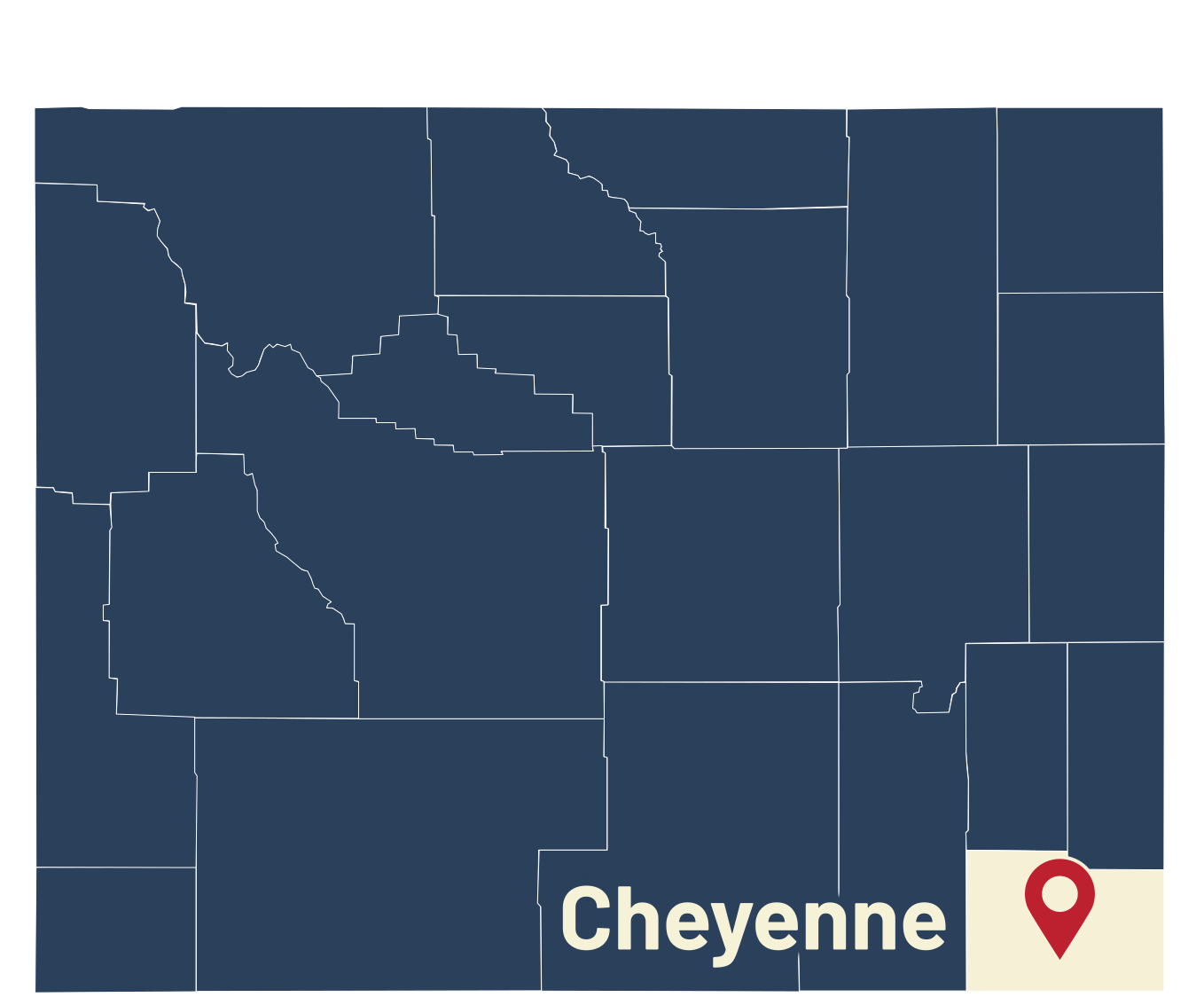

Data centers have a reputation for being massive water hogs, fueling plenty of worry over Cheyenne’s recent building boom.
Actual usage, however, tells a different story.
Frank Strong, engineering and water resource division manager for Cheyenne’s Board of Public Utilities, told Cowboy State Daily that data centers accounted for about 2% of the city’s water sales in 2025.
"We sold about 3.5 billion gallons of water in 2025, and 93 million went to data centers,” Strong said.
‘Significantly Less’
Strong said the 93 million gallons was lower than the water usage laid out in the data centers' initial proposals to the city.
The difference, he said, comes down to chips, the small processors inside the servers that run the data center's computing.
When developers first proposed data center projects to the Cheyenne City Council, the chips they were using needed more water-based cooling to run.
“New chip technology can run at higher temperatures,” Strong said. “Newer technology has allowed them to consume less water than they had planned.”
Strong did not have the exact difference in gallons between the proposed water usage and what the data centers are using now, but he said it is not a marginal one.
“I would say it’s in the significantly less range,” Strong said.
Almonds, Golf and AI
Cheyenne’s numbers line up with a new report comparing AI water use against everyday habits.
The analysis from Enverus Intelligence Research, a Calgary-based energy analytics subsidiary of Enverus, modeled water use per $25 spent across cooling scenarios and consumer benchmarks, finding AI inference uses far less water than golf or almond milk.
“The research finds that skipping one almond latte saves more water than spending $100 on AI inference,” the analysis states. “Skipping one round of golf saves more than $16,000 of it.”
Ryan Luther, EIR’s director of Energy Transition Research, told Cowboy State Daily that the analysis isn't a pitch for data center developers. It’s just looking at the numbers, he said.
"Our reputation lives and dies on our ability to do science-based research,” Luther said. “We have clients on both sides of everything, so we're not trying to pick a side here.”
Luther said the analysis was built around four different cooling methods, which he said cover just about every data center operating today. He said it also counted the water used at the power plants that generate the electricity to run those facilities, not only the water used inside the data center itself.
About 90% of the water the analysis attributed to AI use was consumed at those power plants. Even with all of it counted, the total water usage still came out low.
”The amount of power used for $25 of compute is pretty low compared to $25 of power,” Luther said.
‘Different Type of Cooling’
The biggest swing in the analysis came down to how a data center is cooled.
In the earliest cooling systems, $25 a month of AI use corresponded to about 21 gallons of water. Now that same usage corresponds to about a quarter of a gallon of water, which Luther said is due to modern, closed-loop systems.
"There's been a huge improvement on the efficiency,” Luther said. "They still need a lot of cooling, but it's a different type of cooling. It’s not necessarily just pulling in water and evaporating it. It's more like a radiator.”
As closed-loop systems become the norm, Luther said, data centers' water use will approach zero, though he said it will take a while for the whole industry to get there.
Golf courses and almond farms are widely known as heavy water users. But the analysis found that AI also uses less than household electricity on an all-natural-gas grid.
That same $25 a month in household electricity on a grid powered entirely by natural gas corresponded to about 31 gallons of water, compared with about 1.9 gallons for AI use in the base case, according to the analysis.
Everyone Hates Infrastructure
Still, Luther said some communities have reason to be concerned. As little water as a data center uses, some areas with a low water table don't have any to spare.
"In places like Nevada and Utah, you have very real water constraints,” Luther said.
Luther started his career in oil and gas at Enverus and has spent years studying energy projects ranging from pipelines and transmission lines to power plants and data centers.
Across all of them, he said, community pushback is something he has come to expect.
“Generally, the community seems to hate all infrastructure,” Luther said. “No matter what it is, if it's in your backyard or in your community, they'll find reasons to tear it down.”
Though the analysis is titled "Setting the Record Straight,” on data center water usage, Luther said he doesn't necessarily expect it to change anyone's minds.
But among the concerns people typically have about a new data center in their neighborhood, Luther said water use should rank low on the list.
As for the others, like noise and air pollution, he said it could always be worse.
“They do have noise, but they're not very loud compared to a power plant," Luther said. “A lot of the communities want the data center to invest in green spaces around them, or sound barrier walls, which I think almost all developers are more than happy to do.”
Emma Jane Jackson can be reached at emma@cowboystatedaily.com.


