

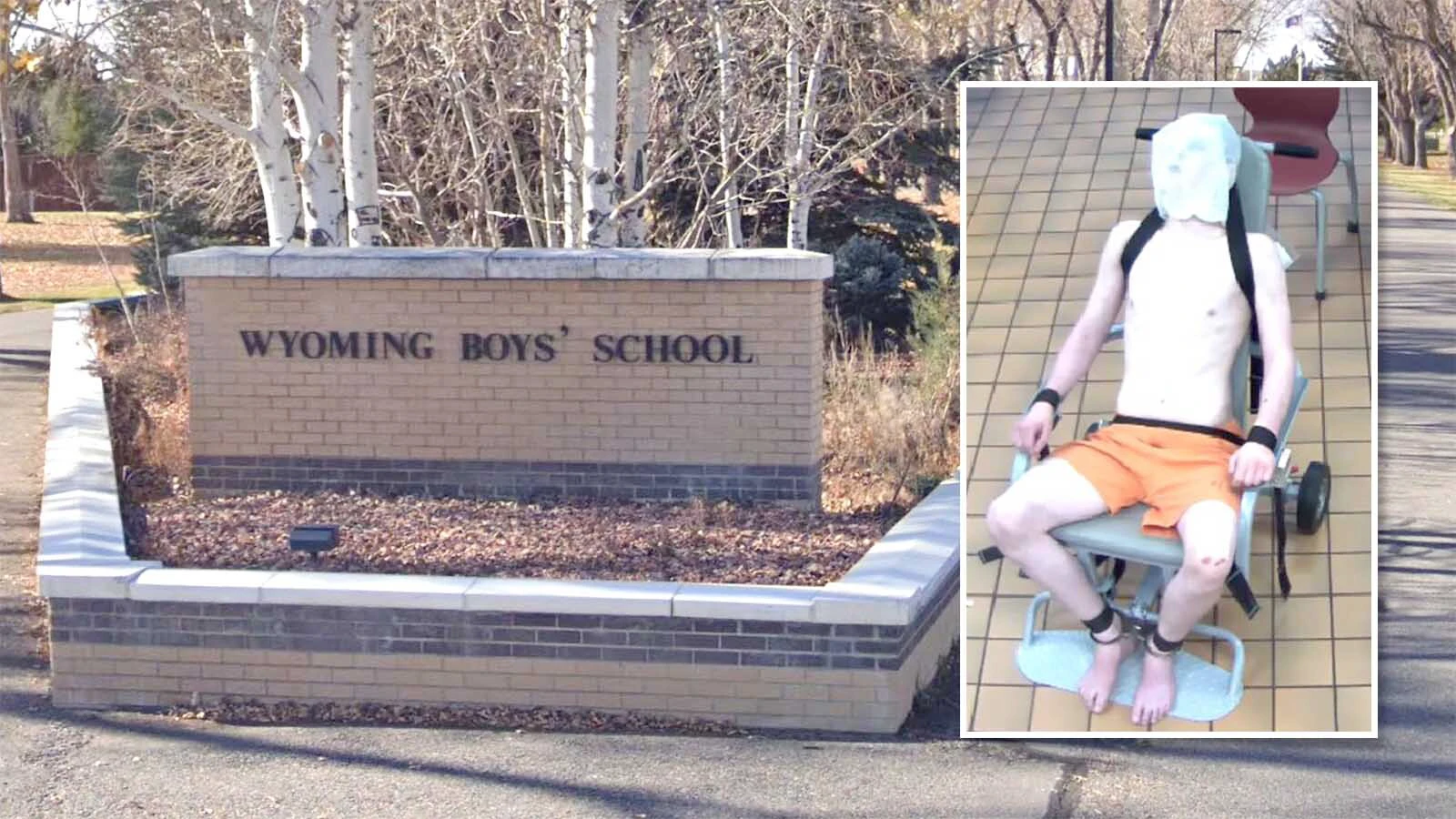
A Wyoming lawmaker says the state had years to confront and fix the abuse happening to children behind the walls of the Wyoming Boys' School near Worland.
Instead, questions went unanswered, meaningful reforms never came, and the reckoning arrived Thursday in the form of a $6 million federal jury verdict in favor of a former resident.
Of that award, $5 million is for punitive damages — money intended to punish particularly wrongful conduct — and another $1 million is for compensatory damages, attorney Ciara Anderson Boerman, who represented former Wyoming Boys' School resident Blaise Chivers-King, confirmed to Cowboy State Daily on Friday.
The award followed an eight-day trial in Casper that peeled back years of allegations about the treatment of children at the state-run institution.
For state Rep. Karlee Provenza, D-Laramie, who says she began in 2021 questioning officials about solitary confinement and restraints used at the institution, the verdict was long overdue.
"The state completely failed these boys, and I think the $6 million price tag associated with that failure is entirely appropriate for the trauma that they have endured," Provenza said.
Boerman said the bulk of the damages stemmed from a punitive-isolation claim.
The jury also found in Chivers-King's favor on a due-process claim, although the defendant successfully asserted an affirmative defense that prevented that finding from producing liability. Jurors did not find liability on a separate excessive-force claim.
"I think that this verdict sends a loud and clear message that the children in Wyoming's care must be cared for," Boerman said.
The attorney said the jury heard eight days of difficult evidence before reaching its decision, and she expressed gratitude for the jurors' willingness to examine the treatment of a child in state custody.
"This verdict sends a message that the Wyoming community and frankly, the community at large, cannot and will not stand for this type of abuse," Boerman said.
The constitutional protections at issue, she added, don't disappear because a child is troubled, difficult or struggling with serious behavioral problems.

Warnings Were There
In 2021, long before Chivers-King's allegations reached a federal courtroom, Wyoming lawmakers were already examining how the state handled children caught up in the juvenile justice system.
The Legislature's Joint Judiciary Committee had made juvenile justice its top interim priority.
Provenza said she used those discussions to press officials about solitary confinement and restraints at the Boys' School, a state-run juvenile institution near Worland.
She wanted answers about what was happening to children inside the facility and how often they were being isolated.
What she got, she said, was not enough.
"My questions to the boys school director and director of DFS did not get addressed," she said.
The committee considered juvenile justice reforms during that interim, but Provenza said it failed to pass meaningful changes addressing the problems she raised.
She eventually resorted to a public records request to find out how frequently children were being placed in solitary confinement.
Even then, she said, the information offered only a glimpse of what was happening.
"Based on my questioning in committee, we knew that children were being put in solitary confinement and restraints were being used," Provenza said. "We did not know the extent of the abuse."
The allegations that later emerged in the federal lawsuit went beyond what she had uncovered.
The state wasn't operating in complete ignorance, she said. Lawmakers had been asking questions about isolation and restraints for years.
The problem was what happened afterward.
Behind The Doors
The conditions at the center of Chivers-King's lawsuit were described in stark detail in an October ruling by U.S. District Judge Scott Skavdahl.
The detention rooms were small, about 8 by 10 feet, with cinderblock walls, concrete floors, metal toilets and sinks, and no windows looking outside.
They were rooms designed to separate children from the rest of the institution. The school called the practice "detention status."
Skavdahl wasn't persuaded that the name settled the question of what was happening inside.
"WBS does not use the terms 'solitary confinement' or 'isolation' to describe its practices, but many of its uses of detention status … bear the hallmarks of isolation," the judge wrote in an order previously reported by Cowboy State Daily.
Court records showed Chivers-King spent more than 75 days in isolation at the institution.
Some placements followed incidents in which he threatened employees, damaged property or tried to hurt himself. The judge recognized that staff sometimes had legitimate reasons to separate him from other children.
The question was how long those reasons remained legitimate.
In one instance, Chivers-King was assigned four days in isolation even though his behavior had calmed substantially by the evening of the first day.
The defense maintained throughout the trial that Boys' School employees were trying to keep Chivers-King, other residents and staff safe.
Attorneys described violent outbursts, threats, assaults and self-harm, arguing that isolation was a necessary response to dangerous behavior rather than a form of unconstitutional punishment.
Employees testified that they regularly checked on him, offered schoolwork and other activities, and provided opportunities for human contact.
On Thursday, the day before the verdict, defense attorneys filed a motion asking Skavdahl to rule in their favor rather than leave the claims to the jury.
The jury ultimately awarded Chivers-King $1 million in compensatory damages and another $5 million in punitive damages, the bulk stemming from the punitive-isolation claim, Boerman said.
The State Said It Wasn't Happening
When Chivers-King and two other former residents filed their federal lawsuit in February 2024, the allegations were explosive.
The boys accused employees of beating, humiliating, restraining and isolating children.
The original complaint described what the plaintiffs called "sadistic levels of cruelty."
Chivers-King alleged that employees deliberately provoked him, knowing his behavioral and emotional difficulties could trigger reactions that would give staff a reason to restrain or isolate him.
Another plaintiff described being strapped into a restraint chair and subjected to prolonged isolation.
The Department of Family Services, which oversees the Boys' School, rejected the allegations.
"The Department refutes any allegations of wrongdoing," a department spokesman said in February 2024.
"We look forward to formally responding to the complaint and having our day in court."
The denials continued as more former residents came forward.
In July 2024, DFS again defended its treatment of children at the institution.
"Safety and security continue to be priorities for all boys court-ordered to the Wyoming Boys' School," the department said. "We do not tolerate abuse and deny any allegations of wrongdoing."
'The Buck Stops Here'
Provenza said she believes the reckoning should reach the top of the institution's leadership.
She said Dale Weber, a defendant in Chivers-King's case and the superintendent overseeing Wyoming's Boys' and Girls' Schools, should be removed as director "and there should be a full investigation into the facilities."
Provenza said she is particularly concerned that the Wyoming Girls' School in Sheridan remains under the same leadership as the Boys' School.
She doesn't know whether conditions have improved at the Boys' School since the events described in the lawsuits.
"A third, independent party should be responsible for investigating youth-detention facilities," Provenza said.
She wants an examination that goes beyond the actions of the employees named in the lawsuits and considers whether Wyoming's institutions are adequately protecting the children entrusted to them.
Provenza isn't limiting her demands to an investigation. She wants Wyoming to reconsider how it handles young people from the moment they enter the juvenile justice system, including whether detention is appropriate and whether children receive the mental-health care they need.
The Legislature and Wyoming's incoming governor should be part of that conversation, she said.
"There are many aspects of how we handle youth that are not adequately addressed, most importantly mental health," Provenza said.
She also said she believes lawmakers must confront their own role in allowing problems at state institutions to persist.
"That is our duty as the legislative branch, but we rarely hold agencies accountable and do deep dives like what was required here," she said.
What Now?
Chivers-King's case is only the first of six plaintiffs' claims brought against the Wyoming Boys' School and its employees as part of the same federal litigation.
Five other former residents are still waiting for their day in court, with another plaintiff's trial expected to begin Dec. 7.
For Chivers-King, Thursday's verdict represents a major victory, but it does not necessarily mean $6 million will soon land in his bank account.
Those damages were assessed against two of the three defendants, Boerman confirmed Friday.
The court must still enter judgment, and the defendants could ask the judge to overturn or reduce the award or pursue an appeal. Those proceedings could delay payment, and the amount Chivers-King ultimately receives remains uncertain.
Boerman said it is too early to know whether the defense will challenge the verdict.
"There's a lot of things that are up in the air as far as what could happen next," she said. "There could be appeals, or it's unclear what the defense will do."
Kolby Fedore can be reached at kolby@cowboystatedaily.com.


