

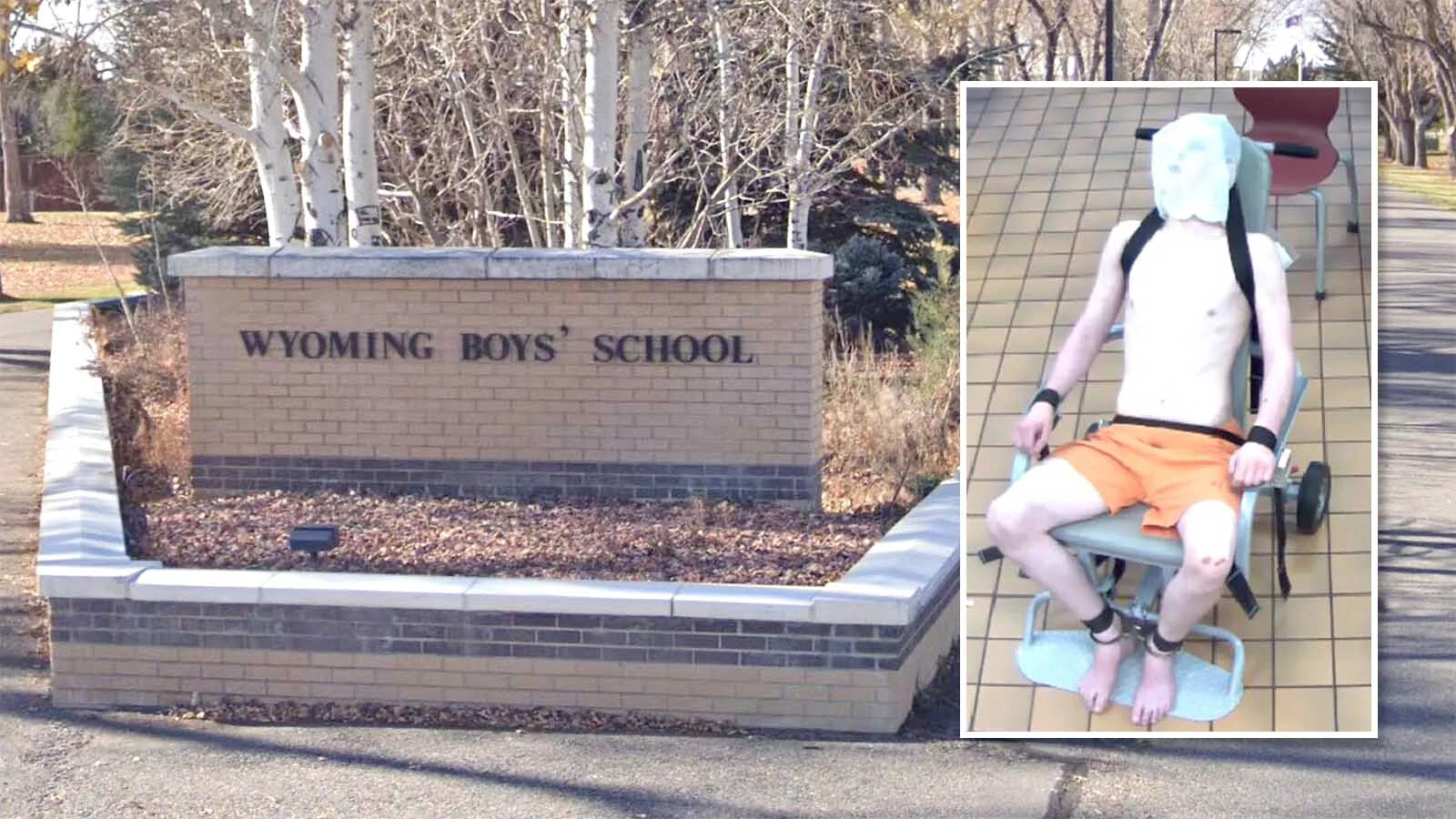
A federal judge ruled Friday that for one of the young men suing the Wyoming Boys’ School there’s at least enough proof that staffers violated his rights with unconstitutional solitary confinement and physical force to send the case to trial.
The order by U.S. District Court Judge Scott Skavdahl is the latest development in a civil lawsuit filed by many former detainees at the Wyoming Boys' School.
Three men — Blaise Chivers-King, Charles “Rees” Karn, and Dylan Tolar — sued the Wyoming Department of Family Services, the Wyoming Boys’ School in Worland, and 10 former and current employees in 2024.
The plaintiffs, all boys who were committed to the school in 2018 and afterward, alleged that school staffers confined, beat, humiliated and abused them. More plaintiffs joined the case later that year: Haiden Willis, Koby Cranford, and a minor identified by the initials “DH.”
Chivers-King did two stints at the school between ages 15-17.
Not all of Chivers-King’s claims against Boys’ School personnel are viable enough to go to trial, Skavdahl concluded Friday.
For example, an incident in which Chivers-King claimed school risk management officer Mike Nelson tackled him to the ground as he stood with his arms crossed in his room doesn’t match the video surveillance account, Skavdahl noted.
The video shows Chivers-King slamming his body against the door, punching the light in the ceiling, kicking the door, and yelling, the order says.
Chivers-King had accused Mike Nelson of violating his rights with excessive force.
Normally such a claim would fall under the Eighth Amendment’s ban on cruel and unusual punishment. But for juveniles, who are merely judged delinquent rather than technically convicted of a crime, they file excessive force complaints under the 14th Amendment, which protects people’s due-process rights.
Chivers-King stood 6 feet tall and weighed 225 pounds around that time. He was defiant in the video and twice raised his fist to threaten Mike Nelson during this incident, Skavdahl wrote.
When staffers grabbed his arms, Chivers-King wrestled and tried to headbutt them, added the judge.
“The only objectively unreasonable amount of force displayed in this May 30th video is that by Mr. Chivers-King,” said Skavdahl.
Skavdahl isn’t sending that incident to a jury trial because no reasonable jury could find a 14th Amendment violation from it, he added.
But other incidents aren’t so clear-cut, and are worthy of a jury’s review, the judge said.
The judge wrote that in a Nov. 3, 2020, incident, risk management officers Mark Nelson, Thad Shaffer and seven other staffers tackled Chivers-King to the ground after he stood up from a couch, took off his face mask and threw his glasses to the floor.
A staff incident report claimed Chivers-King took an aggressive step toward staff, but video footage doesn’t show that, the order says.
A claim against dorm director Del Olson over that incident remains alive as well. Olson didn’t attack Chivers-King, but was sitting in a wheelchair nearby and rolled out of the way, Skavdahl related from the video.
Officials may be liable for excessive force if they didn’t intervene but could have, said the judge.
On Nov. 23, 2021, Chivers-King alleged, he was in his room when Shaffer charged in with a riot shield and pushed him against the far wall, while several other staff followed and took the boy to the floor.
The more toned-down staff report of this incident is disputable, and nothing in the video footage indicates Chivers-King posed the kind of threat that merits such force, wrote Skavdahl.
“Further, the video footage shows Mr. Chivers-King complying with instructions, not actively resisting – at least until being slammed with a riot shield,” the judge added.
Isolation
The Boys’ School has denied using solitary confinement as punishment.
Skavdahl wrote that some of the 17 isolation stints to which Chivers-King was subject during his two stays at the facility might be unconstitutional instances of punitive solitary confinement.
Whether they were is up to the jury.
“WBS does not use the terms ‘solitary confinement’ or ‘isolation’ to describe its practices, but many of its uses of detention status … bear the hallmarks of isolation,” the judge wrote.
The detention rooms are about 8-by-10-foot cinderblock and concrete rooms with no exterior windows or carpet. The doors have interior windows covered with a large magnet most or all of the time, and the only furniture is a metal toilet-sink attached to the wall, the order notes.
The 10th Circuit Court of Appeals has voiced “clear skepticism of the use of isolation, especially for children,” Skavdahl wrote.
The 10th Circuit is the umbrella court to Wyoming’s federal court system, among others in the region.
A series of cases put reasonable officials on notice that putting children in isolation for punishment, or longer than necessary, to manage a safety threat violates the 14th Amendment, the order says.
During his two stays, Chivers-King spent more than 75 days in isolation. Some may have been legitimate, wrote Skavdahl.
For example, Chivers-King once punched and kicked the walls of his room and yelled he wanted to kill himself, according to a 2021 incident report.
But evidence persists that the Boys’ School wasn’t always managing threats alone by confining Chivers-King, the judge wrote, adding that the most compelling piece of evidence is the predetermined sentences to isolation.
Skavdahl noted that Chivers-King was sentenced to four days’ isolation in 2022, but had calmed down from his original high-risk level the evening of the first day.
Disabilities
Skavdahl was unconvinced by Chivers-King’s assertions that Boys’ School personnel punished him in allegedly unlawful ways because of his disabilities, which he lists as anxiety, conduct disorder, and adjustment disorder with depressed mood.
Skavdahl chose to assume without deciding, at this juncture, that Chivers-King is truly disabled.
But the plaintiff didn’t show that the sometimes-intense disciplinary measures he endured were because of those disabilities, so those claims won't go to trial on the laws – which require the “because” element – that Chivers-King invoked.
Skavdahl kept alive a claim against Weber that Chivers-King was put into punitive isolation without giving him notice or a hearing. That’s under a “procedural due process” claim that cries foul not at the substance of an alleged violation of rights but the allegedly wrongful process by which it unfolded.
And lastly, Chivers-King concedes that he’ll drop his claims that officials showed deliberate indifference to his medical needs.
Clair McFarland can be reached at clair@cowboystatedaily.com.


