
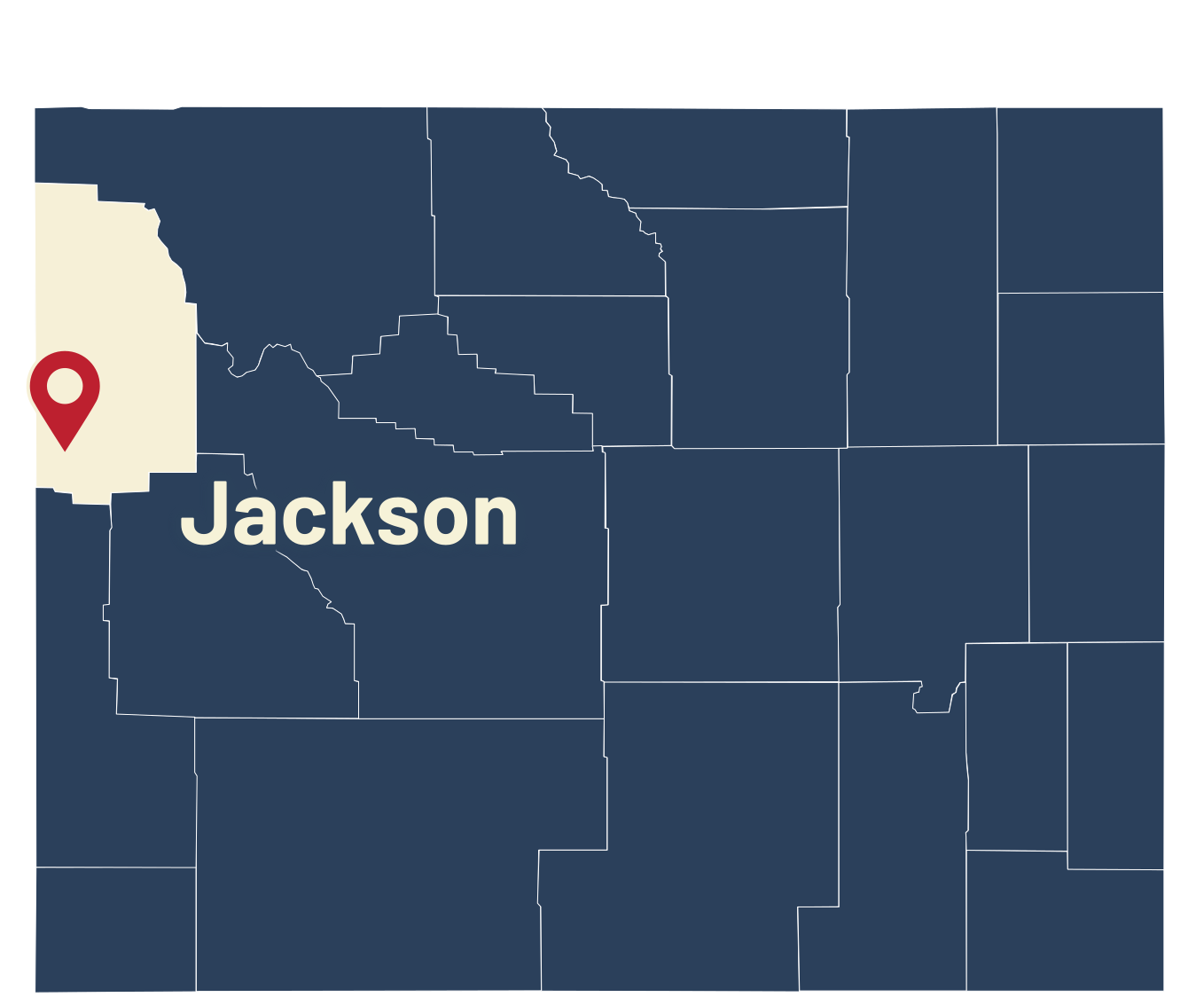

Visitors to Skywolf’s Gallery in Jackson were sold a story of authentic Indigenous craftsmanship for a decade. Now, the gallery's longtime owner has admitted in federal court that much of that story was a lie.
Jose Martinez, known professionally as Joseph Skywolf, pleaded guilty on Nov. 3 to felony charges for systematically misrepresenting fake artwork as genuine Native American creations.
He sold counterfeit headdresses, jewelry, paintings and beaded hides from his Jackson storefront, as well as from a mobile gallery, Indian art markets and other craft fairs.
Martinez pleaded guilty to one felony count of violating the Indian Arts and Crafts Act, a federal truth-in-advertising law that makes it illegal to market or sell art in a way that falsely suggests it was made by a Native American artisan or tribe.
He was sentenced to 24 months of supervised probation and ordered to pay $14,100 in restitution.
Meridith Stanton, director of the U.S. Department of the Interior's Indian Arts and Crafts Board, said in a statement that Martinez exploited false claims of Chiricahua Apache, Apache and Navajo heritage to dupe buyers and undercut genuine Indigenous artists and their cultural traditions.
“Martinez is being held accountable and the message is clear,” Stanton said. “For those selling counterfeit Indian art and craftwork it is important to know that wherever you are we will diligently work to find you and prosecute you.”

Past Claims
According to Skywolf's Gallery filings with the Wyoming Secretary of State, Martinez maintained the Jackson storefront between 2005 and 2015.
In April 2008, Martinez, under the name Joseph Skywolf, was profiled ahead of a two-day art exhibition in Crosby, Texas, according to Chron.
He identified himself as a Chiricahua Apache artist who grew up in Arizona and graduated from Sterling High School in Baytown, Texas, before settling in Jackson Hole.
He claimed that a cradleboard he beaded by hand ended up in the Smithsonian when he was just 10, and that his work later shown at art museums in Scotland and Japan.
“Everything I know about my craft I have learned from the elders of my family,” Martinez told Chron.
He also won third place in the Cultural Items, Personal Ornamentation category at the 2010 Red Earth Festival in Oklahoma City for a piece titled “Horse Nation.”
Skywolf’s Gallery remained in good standing with the state until its trade name registration naturally expired in June 2015. He later relocated to Las Vegas.

‘It’s Infuriating’
For Northern Arapaho beadwork artist Mirae Yellow Bird, a scam like Martinez’s is hard to stomach.
“I work four jobs,” Yellow Bird told Cowboy State Daily. “Beadwork is one of them, and it's on the back burner because I can't get people to pay for the work that I do.”
Yellow Bird said she constantly faces lowball offers on her beadwork despite the time she devotes to every piece she makes and the rising costs for materials like beads, hides and thread.
To hear that someone fraudulently posed as a Native artist in a wealthy resort town like Jackson hit especially hard, Yellow Bird said.
“People in Jackson can afford what our work is really worth,” Yellow Bird said. “For him to have a storefront for 10 years just blows my mind. It’s infuriating.”
Even so, Yellow Bird said it’s hardly surprising.
Through the Wind River Artists Collective, she has sold her beadwork in Jackson for years and has long seen shops flooded with pieces that either borrow Native motifs or get marketed as Native art outright when they aren't.
“Our art is so appropriated and the market is so saturated with fake art,” Yellow Bird said. “True Indigenous artists cannot get ahead.”
To Yellow Bird, a scheme like Martinez’s is plain theft. She said it not only robs working Native artists of opportunity, it also steals from a history that has already been stripped away again and again.
“For somebody to be basically stealing our culture and our identity is what white people have been doing for years,” Yellow Bird said.

‘Nuanced and Complex’
Yellow Bird and Charlene Sleeper, a Billings-based artist who is Crow and Southern Cheyenne, noted that in a sense Martinez’s claims of Indigenous roots were not completely off base.
Pointing to his surname as a sign of Hispanic heritage, they said people with roots south of the border often carry Indigenous ancestry of their own.
“It’s a little more nuanced and complex,” Sleeper told Cowboy State Daily. “He is native to the Americas. But he’s not in a federally recognized tribe, which then that opens up a whole other conversation.”
That conversation, Sleeper said, gets at deeper questions tribes have wrestled with for generations over what defines Native identity.
Depending on the tribe, citizenship and authenticity can hinge on federal recognition, lineal descent or controversial blood quantum requirements.
“Blood quantum is a colonial construct,” Yellow Bird said.
Still, both artists said the nuance around Martinez’s background did not change the damage done to working Native artists who struggle to get paid fairly for their craft.
“He should have used his own heritage and his own culture and his own last name,” Yellow Bird said.
‘A Serious Offense'
The Indian Arts and Crafts Act, the federal statute under which Martinez was prosecuted, was enacted by Congress in 1990 in response to a surge in counterfeit Native American art sales.
Enforcement of the law relies heavily on people reporting sellers suspected of violating it, and there are loopholes.
“White people can still sell items like dreamcatchers if they put a certain disclaimer on it,” Sleeper said.
That’s because the law doesn’t ban anyone from making and selling traditionally Indigenous mediums, like beadwork or dreamcatchers. It just prevents sellers from labelling their work as Native-made unless it actually is.
Even with those loopholes, Sleeper said the law still matters because it helps protect contemporary Native artists as well as the handling of historical Indigenous items.
“There’s so much that needs to be protected,” Sleeper said. “Art is a form of resistance for us because the federal government tried to take it from us. A lot of the ways that people learned how to make things was passed down from families. Some items are used for religious purposes.”
With so many gaps in the system, Yellow Bird said she hopes Martinez’s prosecution stands out as a deterrent to others who might attempt to do what he did.
“I really hope that this will show people that it can be a serious offense,” Yellow Bird said. “It’s a federal offense, and most federal offenses carry heavy penalties.”
Emma Jane Jackson can be reached at emma@cowboystatedaily.com.


