

It was the year of “celebrity bison” in Yellowstone National Park.
Millions of people followed the stories of bull bison who seemed to survive against all odds or assert their dominance as heavyweight champions of the Greater Yellowstone Ecosystem.
Now that the summer season is over, people are curious about what happened to “Spinny,” “Tiny Tim”, and the belligerent bull that flipped and seriously injured 65-year-old Carl McDaniel.
Where are they now? The Yellowstone photographers who have been following these bison for months have some closure that many will find morbid.
“Most people can’t understand why the park didn’t intervene,” said wildlife photographer Tammy Neufeld. “I try to stress the importance of these intact, wild ecosystems in our country. There’s not much of this country left where (nature) plays out naturally.”
Tiny Tim's Demise
“Tiny Tim” was the name affectionately given to a bison seen hobbling in a lush meadow near Canyon Village. The bull’s left front leg was injured, so Tiny Tim hopped around on three legs without letting the fourth touch the ground.
Wildlife photographer April Holm started sharing regular updates of Tiny Tim, with photographs and videos, in June. The bison garnered an enormous following of international fans happy to see the big bull endure against the odds.
“It’s amazing to watch him,” Holm told Cowboy State Daily in June. “It’s a sad situation, but he’s survived this long, and that takes resilience and tenacity.”
On Oct. 30, Holm posted “the last Tiny Tim update.” Based on anecdotal and circumstantial evidence, she believes the bison’s limited mobility finally caught up with him.
Tiny Tim was last seen crossing the Yellowstone River in Hayden Valley on Sept. 9. After nearly two months without any sign of him, Holm decided to explore the area.
“I tried to do the Howard Eaton Trail, but it was blocked,” she said. “Everywhere I went, it was blocked. I finally spoke to bear management, and they said, ‘Oh, there's a bison carcass back there.’”
According to Holm, Yellowstone’s bear management team became aware of a bison carcass in the area a week after Tiny Tim disappeared. The Howard Eaton Trail has been blocked off since then because several wolves and grizzlies have been feeding on the carcass.
When Holm started “putting the pieces of the puzzle together,” she reached the saddest but most logical conclusion.
“The bison carcass was in the exact same area where Tiny Tim crossed the river,” she said. “It's all speculation at this point, but it's a pretty safe assumption that he is no longer, unfortunately.”
Tiny Tim had survived in the same meadow near Canyon Village for at least two winters. Nobody knows why he was forced to leave, moving 10 miles in six weeks, but Holm said she believes tourists got too close and made the bison feel unsafe.
“A lot of people knew about him, and we all of a sudden had people approaching him because they knew he was injured,” she said. “I think that was his demise.”
Spinsters Celebrate
In mid-September, a bison was spotted spinning along the shores of the Yellowstone River in Hayden Valley, not far from where Tiny Tim was last seen. This bison had all four legs intact, but his eyes were bloody and bulging, and he seemed to circle endlessly.
Neufeld has been following the saga of “Spinny” ever since. Like Tiny Tim, the bison became a social media star.
“People went wild over his story, messaging me all hours of the day and night for updates,” she said. “I started calling his fans the Spinsters.”
Nobody knew exactly what was wrong with Spinny. Explanations ranged from severe head trauma to infectious diseases.
Given Spinny’s impairment, everyone assumed he was living on borrowed time. It was only a matter of time before a pack of wolves recognized him as an easy target.
However, Spinny has survived. Neufeld has seen him several times, as recently as Oct. 29, foraging in a meadow near the river and "still going strong."
“He seems to be doing better,” she said. “He’s put on weight and is in a good area where he has access to food and water. He’s been there for several weeks, sometimes in the company of a few other bulls or a small herd.”
Spinney hasn’t entirely recovered from whatever ails him. Neufeld said he still “gets confused” and slowly spins, especially when he enters the nearby grove of trees, even though he’s moving “more confidently” overall.
Neufeld said the most likely explanation for Spinny’s condition is that he took a particularly hard blow to the head while sparring with another bull.
“His eyesight still seems heavily impacted,” she said. “I really believe it was an eye infection or a head injury rather than a disease or parasite.”
Winter is coming. Can Spinny survive the heavy snow and subzero temperatures that lie ahead?
“Hopefully, he can find enough forage to make it through winter,” Neufeld said. “He’s improved, for sure.”
Not Tossed Out
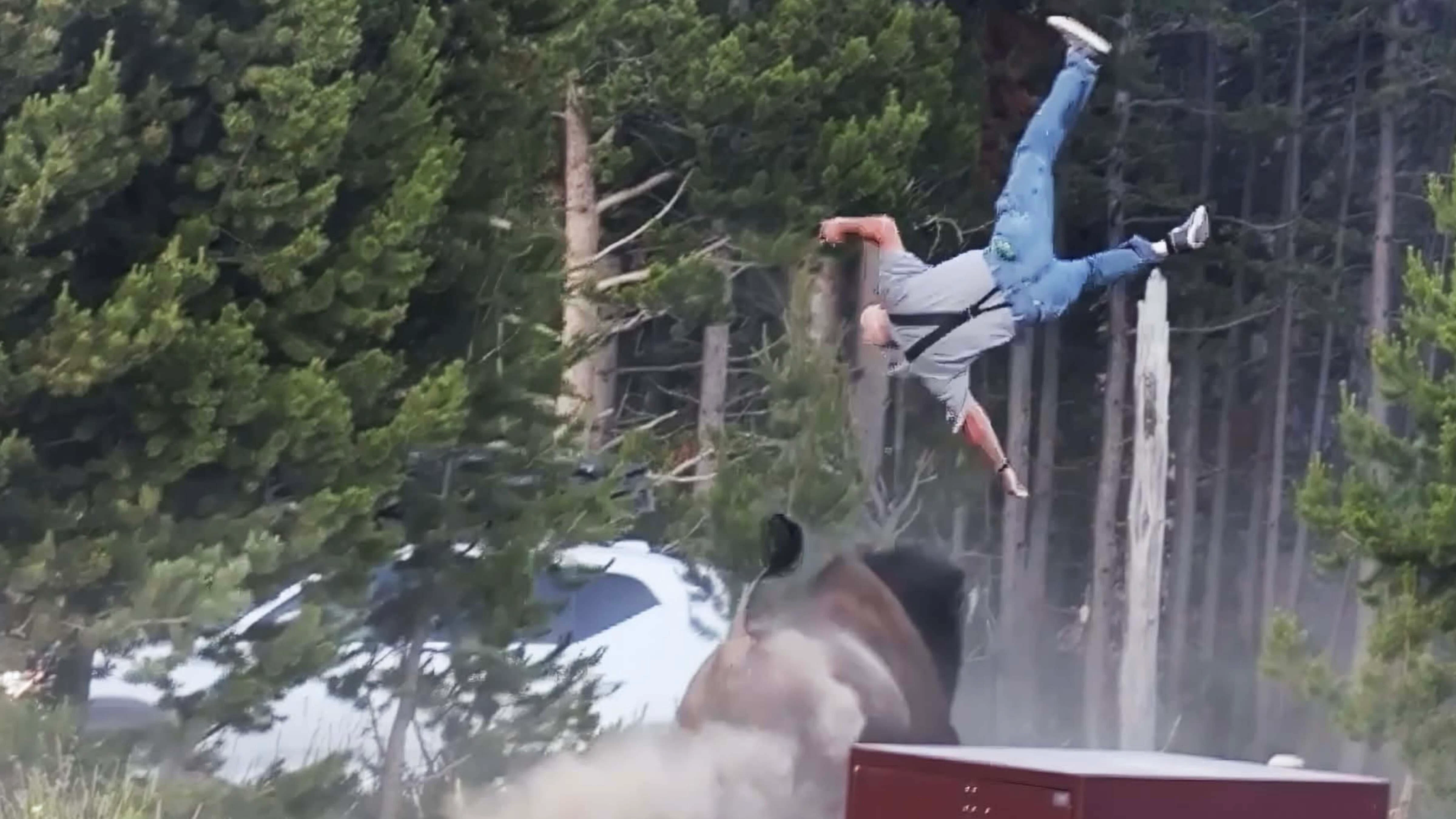
The most infamous bison of the 2026 summer season doesn’t have a name, but his victim does.
Carl McDaniel, 65, was tossed eight feet into the air by an aggressive bull at Bridge Bay Campground on July 10. His femur was broken in four places, requiring surgery and extensive recovery in a Bozeman hospital.
Mike MacLeod, the photographer who captured the entire incident and saved McDaniel by rushing the bison in his flip-flops, is still in contact with McDaniel and his family. He told Cowboy State Daily that McDaniel is back home in Kendall, Washington, and recovering well.
“He is finally able to drive again, and completed a 5k charity walk using a cane,” MacLeod said.
Despite being in the international spotlight for its aggressive actions, the bison that injured McDaniel escaped into anonymity.
Yellowstone officials decided to take no management action against the bison, meaning they wouldn’t attempt to euthanize or relocate it. It’s a decision McDaniel supported.
“He didn’t want the bison killed,” MacLeod said. “They put animals down for these things, for animals being themselves, and Carl didn’t want that.”
Harsh Reality
Spinney survives. Tiny Tim is lost, presumed dead. The Bridge Bay bison is somewhere in Yellowstone, free from death or relocation.
These bison have given Yellowstone enthusiasts plenty to see and discuss. One of the biggest questions is why the park’s rangers and biologists didn’t intervene, leaving Tiny Tim and Spinney to whatever fate awaited them.
Holm, Neufeld, and MacLeod shared the same answer: The best thing for these bison, and the park overall, is to let nature take its course.
“You never know who's going to make it and who's not going to make it,” Holm said. “It's real out there. It’s wildlife, and you never know what will happen.”
Many people wanted Tiny Tim to be humanely euthanized rather than left defenseless to predators. Even if that was his fate, Holm is glad they didn’t.
“I’m glad (the rangers) didn’t put him down,” she said. “He was a fighter, and nature should be allowed to take its course. Stepping in would be going against the odds, and it’s unfair to the bison.”
Neufeld has used her ongoing Spinny updates to communicate the same message to “the Spinsters.” It can be difficult to watch a wild animal endure a prolonged struggle, but that’s what makes Yellowstone so special.
Spinny could survive the winter, and Tiny Tim could defy all expectations by reappearing in his meadow. No matter what happens, their lives will be no different than any other bison in Yellowstone.
“If the park intervenes once, it sets a precedent that they are expected to intervene all the time,” Neufeld said. “That's just not the nature of Yellowstone. It’s not the way it’s meant to work.”
Andrew Rossi can be reached at arossi@cowboystatedaily.com.


