
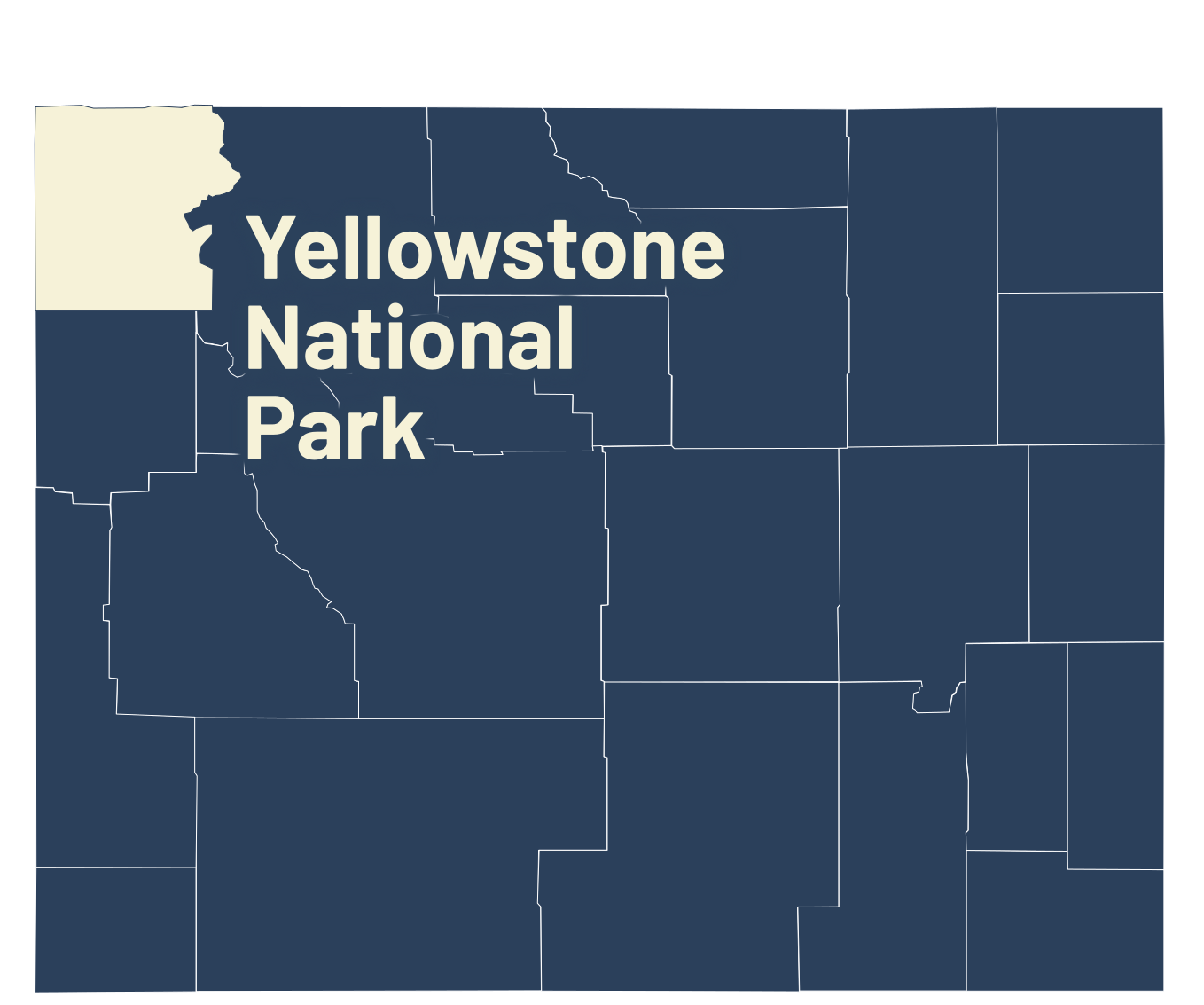
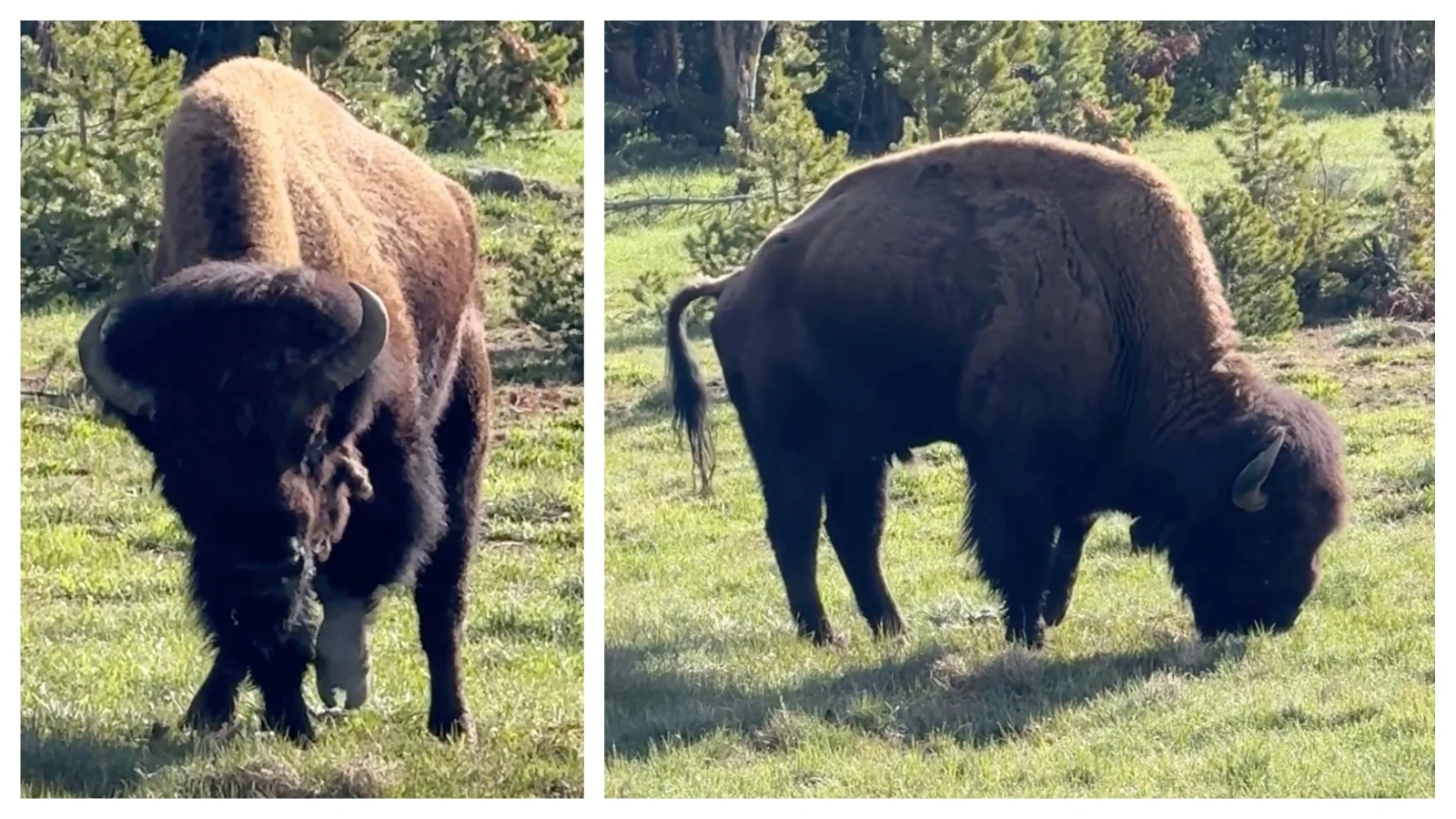
Anyone enjoying an adventure in Yellowstone National Park might notice a bull bison lying in a lush meadow near Canyon Junction. If they see him stand up, they'll notice that he doesn't walk, but hops on three legs while keeping the fourth tucked up close to his body.
That’s Tiny Tim, a well-known and easily identifiable bison that has been a cause of concern for many, but people who've followed his story of survival for the past two winters believe this bum-leg bison has been doing just fine for himself.
Instead of walking, Tiny Tim literally hops through his meadow to find food and shelter. He's a little skinny, but seems to be healthy, and the majority opinion is that he should be allowed to live on his own terms.
“You can tell right before he's getting ready to hop, because he's having to really shift everything to get that hop done,” wildlife photographer April Holm told Cowboy State Daily. “It takes him a while to get anywhere, but he always gets there.”
Poor Wretch
Holm and her family were on one of their weekly trips to Yellowstone last month when they had their first encounter with Tiny Tim. He was lying down in his field near Canyon Junction, close enough for a great photograph.
“We just thought it was really cool that he was lying there,” Holm said. “It looked like he was just tired and resting. Then my daughter said, ‘Mommy, it looks like he’s dying. Look at his breathing.’”
Holm looked more closely. The bison’s breathing seemed labored, and his eyes looked like they were “rolled back into his head.”
When the bull bison finally stood up, Holm noticed his left front leg was “just hanging there.”
He was clearly keeping it off the ground as he hopped around the field looking for fresh grass to graze on.
“He hopped around on three legs, and then he lay back down,” she said. “His leg doesn’t have any cuts or anything that we can see, but he was shifting all his weight and licking that front hoof.”
Sharing some sympathy for the bison’s predicament, the Holms got their photos and moved on.
Two weeks later, they were passing by the same spot and decided to see if the bull bison was still there.
Remarkably, he was.
“He was lying there in the field again, not getting up and flopping his head up and down,” Holm said. “Then, we saw him get up and start eating.”
Three weeks after their first encounter with the bull, he’s in the same field.
“He hasn't moved more than 30 or 40 feet total that we've seen, or anybody else that we've talked to has seen,” Holm said.
Holm was concerned about Tiny Tim thinking he was living on borrowed time. While that may be true, Tiny Tim has borrowed a lot of time and doesn’t seem to be facing an imminent demise.
Village Grump
After Holm posted several videos of Tiny Tim hobbling in his field, expressing concern about his condition and well-being, dozens of people have reached out with their own concerns for the bison.
One of those people was a year-round Yellowstone employee at Canyon Village who wanted to set the record straight.
“She said she was very familiar with the animal,” Holm said. “He first showed up sometime during the summer before last, so he has survived one full summer and two winters, at least.”
Many Canyon Village residents keep tabs on Tiny Tim. Everyone calls him Tiny Tim because he hobbles around, even though he's a fully-grown adult with a bad temperament.
“Apparently, he gets quite defensive and grumpy if you get too close,” Holm said.
During the winter, Tiny Tim left his field and moved into the employee housing area at Canyon. He was a stubborn, surviving roadblock for the entire season.
"He’s blocked the road for days at a time, and that’s caused some trouble," Holm said. "You can’t just go around him in the winter.”
As for his condition, there’s something clearly wrong with Tiny Tim’s left front leg, but nobody can determine exactly what that is.
“His leg doesn’t have any cuts or anything that we can see,” Holm said. “Nobody has seen anything wrong with it, other than it looks swollen.”
Tiny Tim avoids putting any weight on that leg, but that hasn’t stopped him from finding enough to eat. Holm said he looks a little skinny, but seems “otherwise healthy.”
Furthermore, Tiny Tim seems to know he’s safe where he is. He’s not very mobile, but doesn’t seem eager to move out of the Canyon Village area.
“People who’ve watched him for a while say he never goes far,” Holm said. “He’s just that resilient.”
A Natural Environment
Amidst the massive parking lots, snack-stocked general stores, and throngs of thousands, people can forget that Yellowstone is a natural ecosystem that’s mostly allowed to exist without interference.
Yellowstone’s bison aren’t commercial cattle or zoo attractions. They naturally move through the park and live as they have in the wild for millennia, which means enduring or succumbing to any injury and malady that afflicts them.
Regular Yellowstone visitors, like the Holms, are used to seeing the spectacular sagas of nature play out in the park. That’s why Tiny Tim’s survival is so surprising.
“I would’ve thought the wolves would’ve got him by now,” Holm said. “I’ve seen how wolves hunt bison, hanging off them and trying to rip their flesh apart. I wouldn’t think he’d be able to defend himself against wolves.”
Given his obvious point of weakness, Tiny Tim probably wouldn’t survive a wolf attack. The fact that he’s survived two full winters when wolves more actively target and bring down bison is nothing short of a Christmas miracle.
Nobody wants to see an animal suffer. A Scrooge would say that if Tiny Tim were going to die, he’d better do it and decrease the surplus population.
While the bison doesn’t appear to be suffering, sometimes an animal’s natural plight prompts an unnatural end to its life.
When To Humanely Euthanize
Holm has posted multiple videos of Tiny Tim since mid-May, garnering hundreds of thousands of views and a flood of comments and messages concerned about the bison’s ongoing plight.
“Every time I post a video, I have so many people reaching out to me asking what they’ve done about him,” she said.
“They” meaning Yellowstone rangers and park biologists. Holm knows that they are aware of Tiny Tim and have declined to do anything about it.
“I spoke to somebody who actually works in the park and knows all the rangers,” she said. “She told them that he doesn’t look good, and they told her that if he’s up and feeding himself, they won't do anything.”
Rangers and biologists rarely intercede in Yellowstone’s daily life-and-death struggles, unless it's an animal that poses a direct threat to humans. That's usually bears, not bison, but there are occasional instances where rangers decided to end an animal's suffering.
When a bull elk got stuck up to its shoulders in the muddy “No Moose Pond” last September, Yellowstone rangers humanely euthanized it after 24 hours of observation.
In that instance, the rangers determined the elk had no chance of escaping the muddy pond. Euthanizing the elk spared it from a long, agonizing death.
“I 100% support how they handled that situation,” wildlife photographer Jule Argyle told Cowboy State Daily. “I don't like to see anything suffer, and most of the time, (the rangers) won't interfere. I think this was one of those unique situations where you know that animal was suffering severely, and it needed to happen.”
Argyle, who’s the postmaster at Lake Village, is familiar with Tiny Tim. In her opinion, his story of survival is enough to justify leaving him alone.
“He’s been surviving on his terms,” she said. “He’s a fighter, and nature should be allowed to take its course. Stepping in would be going against the odds, and it’s unfair to the bison.”
Doesn’t Need A Crutch
When Holm first saw Tiny Tim, she didn’t know whether he had been injured recently. If he was slowly wasting away from a fresh injury, she hoped that might be enough to prompt a human intervention.
“I assumed the wolves were going to get him before it’s all over, and there'd be nothing he could do about it,” she said. “I’d thought it was better to let the old guy go out with dignity rather than be eaten alive.”
Now that she’s learned more about Tiny Tim’s story, Holm is firmly on the opposite side of that argument. She wants to let nature take its course, as Tiny Tim seems to be doing OK.
“I’m glad (the rangers) haven’t and aren’t going to put him down,” she said. “He's survived and is doing a good job surviving.”
There’s no denying that Tiny Tim will remain an obvious target for any predator daring enough to take on a bull bison. Bulls are solitary by nature, so there’s no herd near Canyon Junction that’s going to defend Tiny Tim if he’s threatened.
Whenever Tiny Tim’s story ends, it’ll be of natural causes in an environment like Yellowstone. It can be sad and tragic in some people’s view, but that’s nature.
“Things like this happen all the time,” Argyle said. “This time, it just happens to be a bison near the road where people can see it. These types of things are what make Yellowstone wild.”
God Bless Us, Everyone!
When a sudden snowstorm swept through Yellowstone on Tuesday, Holm circled back to Canyon Junction to visit Tiny Tim. The bison had managed to hop around 100 yards out of his meadow and found shelter in a nearby forest of lodgepole pines.
For someone who’d only seen Tiny Tim hop an inch at a time, seeing the bison keep himself safe from the snow convinced Holm that she doesn’t have to worry.
“If he’s made it this long, I’m guessing he will continue to make it even though it is a challenge,” she said. “Yes, it’s a sad situation, but nature is unfair and cruel a lot of the time.
"But at the same time, it’s amazing to watch him. He’s survived this long, and that takes resilience and tenacity.”
Holm finds Tiny Tim as inspiring and heartwarming as his Dickensian namesake, and that’s worth something to everybody.
“I think we need hope in this world, and (Tiny Tim) is an uplifting story of survival,” she said.
Andrew Rossi can be reached at arossi@cowboystatedaily.com.


