
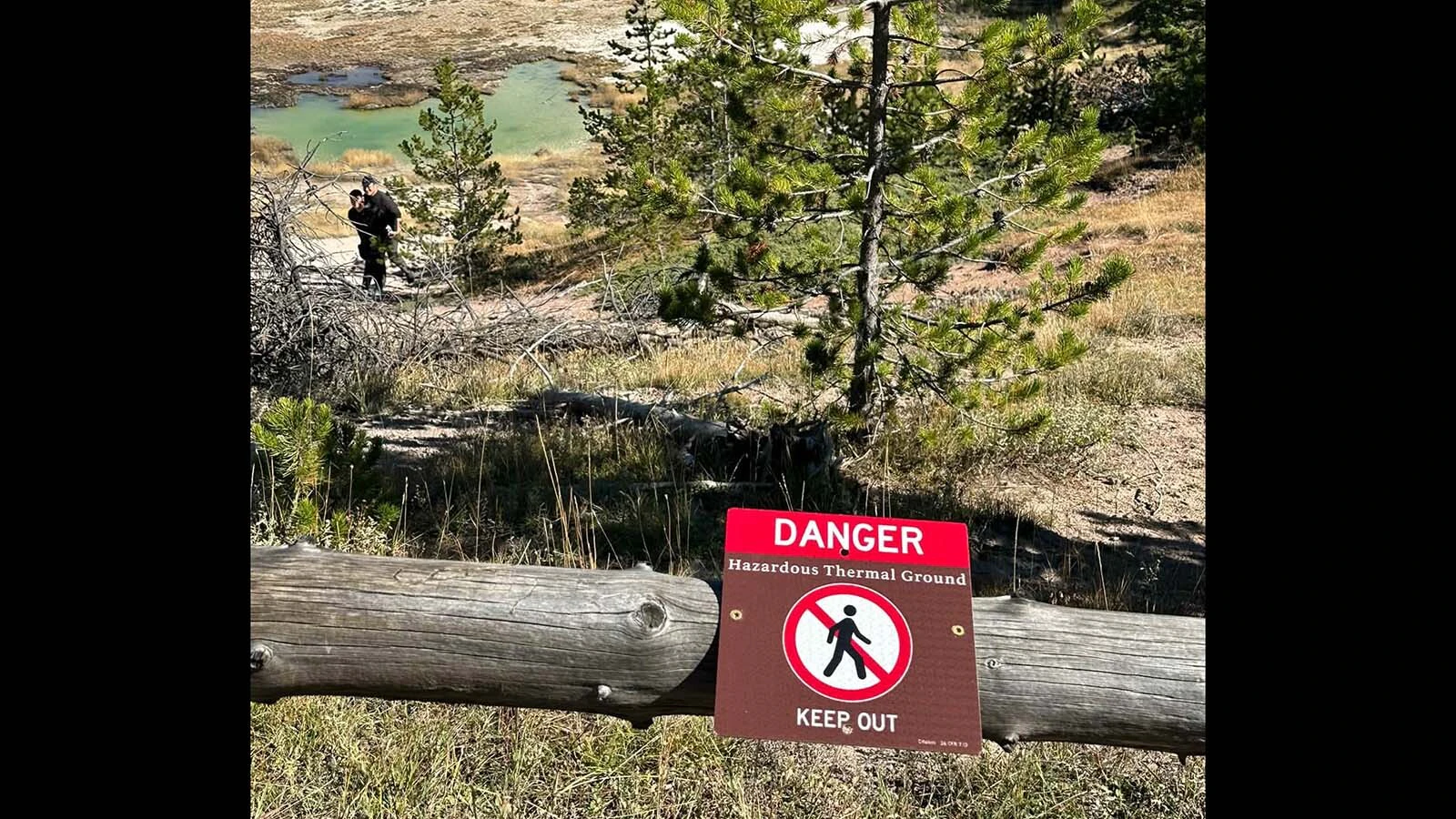
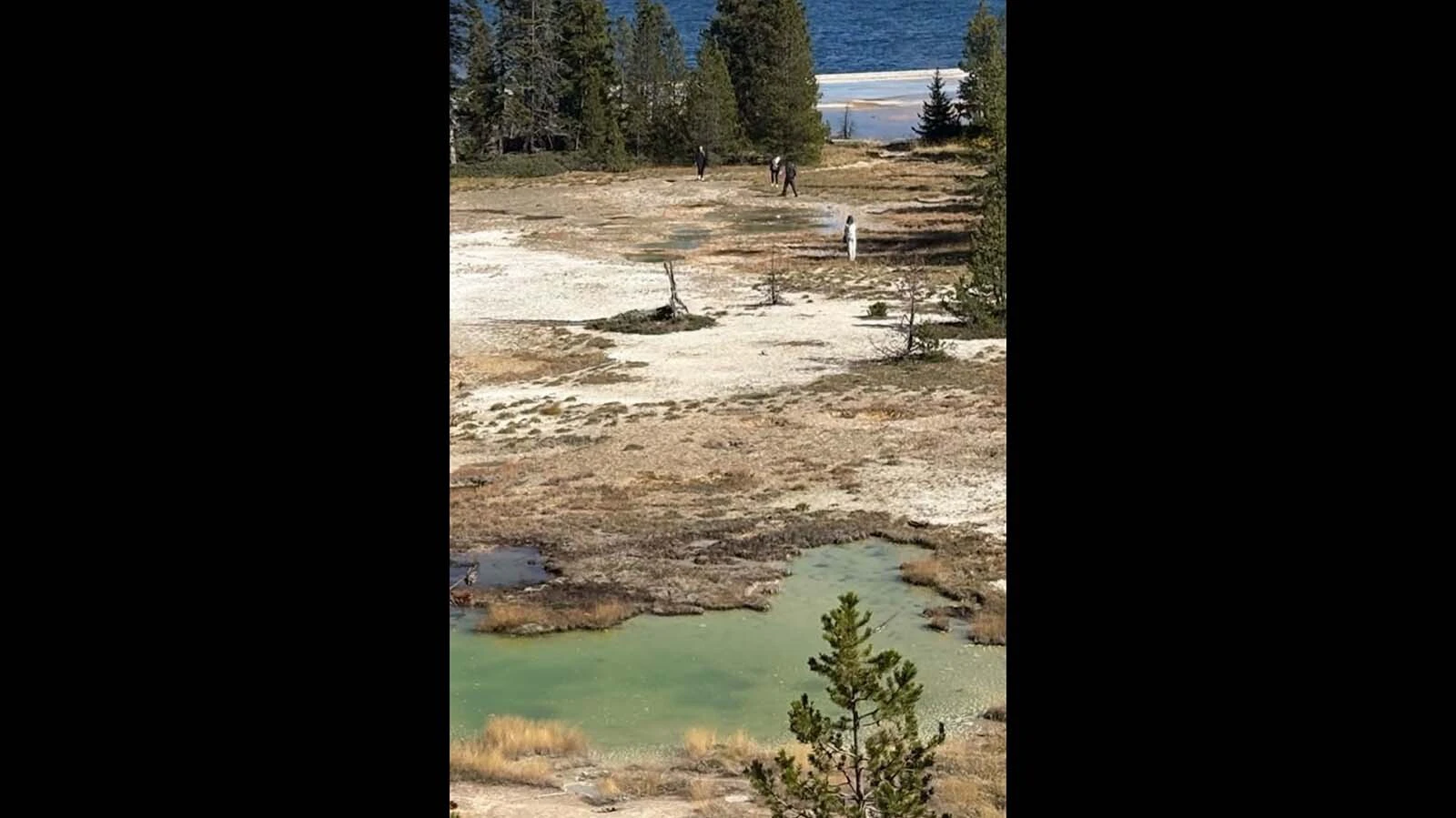
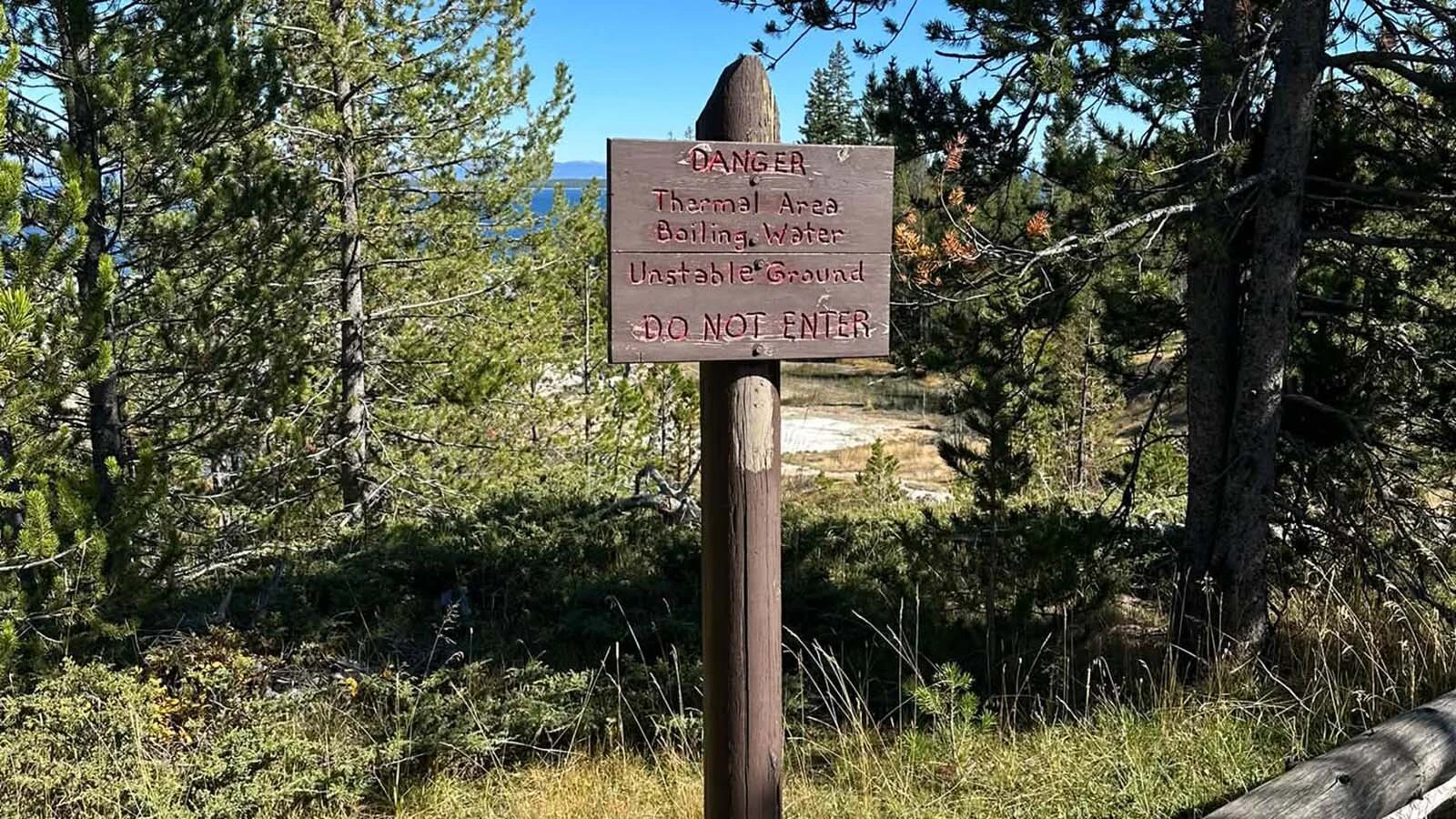
Eileen Gorndt of Ohio was enjoying a visit to Yellowstone National Park last week when she saw something frustrating: a group of tourists well past a “Danger: Keep Out” sign near the West Thumb Geyser Basin.
“Four individuals were down in a restricted area, clearly where they were not supposed to be,” Gorndt told Cowboy State Daily. “We stopped to take pictures when we noticed them.”
When the trespassers noticed her snapping photos of them, they didn’t seem overly upset to be caught in the act, she said.
“Two girls hid behind a bush,” Gorndt said. “The two guys started walking uphill once they saw us, but we were leaving by then.”
After sharing the photos on social media, people recommended she “casually follow” the illegal thermal trespassers to their vehicle so she could get and report their license plate to park rangers.
“I didn’t even think to do that,” Gorndt said.
Her photos are among a growing number of rule-abiding Yellowstone tourists outing those who don't follow the rules, and say they're getting sick and tired of watching them do it.
At The Edge Of The Yellow
Glenn Osborn of East Stroudsburg, Pennsylvania, had what he said was an even more frustrating experience Sunday.
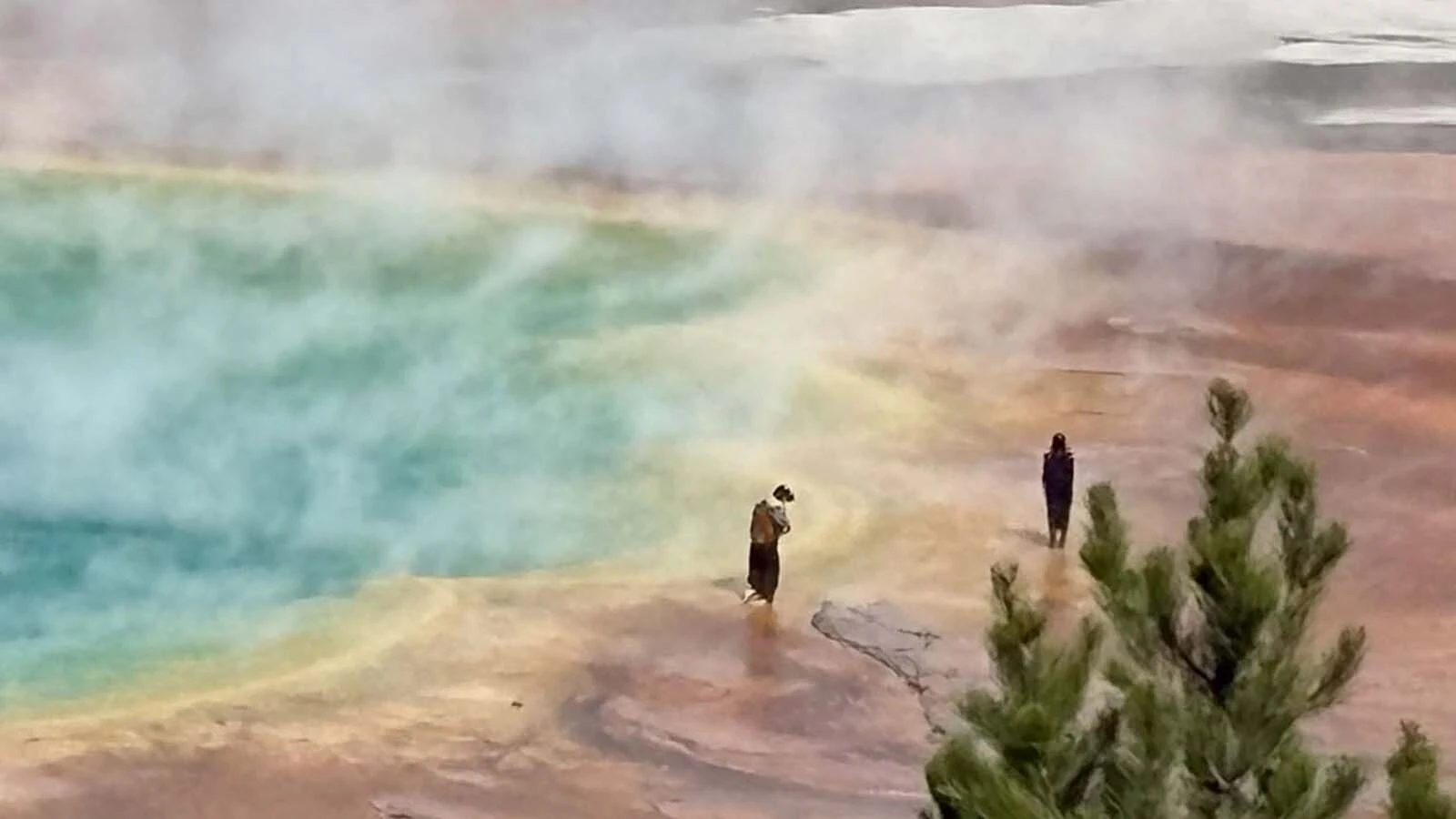
He had just finished the 0.6-mile hike to the Grand Prismatic Overlook when he saw two people standing within a few feet of the pool’s scalding water.
“My reaction was, ‘Oh my God! They shouldn't be there.’ The one person was right at the edge of the yellow, peering over into the spring,” Osborn said.
He said seeing people treading on the delicate thermal mats surrounding Grand Prismatic “upset me more than anything.”
Determined to find some justice, Osborn took a few pictures of the thermal trespassers and drove 45 minutes to the Old Faithful Visitor Center to report them.
That didn’t do much to assuage his feelings.
“I was hoping that this was such an egregious event that there were several reports that I’d be adding to, but I was the first one,” he said.
A ranger told Osborn that “there wasn’t a whole lot they could do,” especially because the incident had occurred nearly an hour earlier.
“I didn’t feel good at all,” he said.
The Disney Syndrome
Are Yellowstone tourists getting worse, or are they just as brazen as they were in 1872?
Author, historian, and former ranger Bob Richard has spent much of his life in Yellowstone. Few people have done or seen more in the last century than Richard and his family.
While Richard can get as frustrated as anyone when people trespass on thermal basins or overcrowd animals, he doesn’t see it as any worse than it’s ever been.
“I don't think that it's changed that much,” he said. “I told people to stay away from the bears for years, and they'd walk right up to a bear to photograph it.
"A lot of times, they weren’t paying attention or just not thinking. That was happening in my grandfather’s time.”
Richard has a theory for what inspires such behavior. He called it “the Disney Syndrome.”
“In the back of their mind, Yellowstone is a park,” he said. “A park means something different to people when they come from the city than it does to us, when we have over a couple million acres of wilderness around us.”
Richard said he believes many people assume they know everything they need to know from the name. If Yellowstone is a park, they think they’re in a safe, controlled environment where they can do whatever they want.
Most people recognize that Yellowstone isn’t a traditional park. Some don’t, and they act as such.
“They get all kinds of warnings to be careful and what have you, but they just lose perspective,” he said. “It's the way they've grown up.”
Bad behavior has been a constant since Yellowstone was established as the nation’s first national park in 1872. The U.S. Cavalry took over management of Yellowstone in 1886 in part to stop poachers, souvenir hunters, and entrepreneurs from exploiting the park’s resources.
What’s different today, in Richard’s opinion, is that more people and more technology catch people in the act. That exposure could help prevent more incidents going forward.
“Every time you show somebody breaking the law or getting injured because they were not paying attention, I think it helps to prevent others from doing the same or make them more aware,” he said. “I think the more we show, the better we are.”
All Too Common
Despite the plethora of signs warning people of Yellowstone’s dangers, and the potential risk of serious injury or death if they don’t heed them, people are regularly seen and photographed going where they shouldn’t.
The incident Osborn witnessed at Grand Prismatic was identical to one earlier this summer.
Two people stepped off the boardwalk and onto the colorful mats surrounding the massive hot spring.
Their clear act of thermal trespass could have potentially caused serious or irreversible damage to the delicate colonies of thermophilic bacteria that make the hot spring so colorful.
The individuals were captured on film but never identified.
Osborn’s frustration with the trespassing tourists was heightened by the response of other onlookers at the overlook. Or, more accurately, their lack of response.
“For the most part, the people around me were unaffected,” he said. “A few people pointed, but most were unfazed by what was going on and just enjoying the view.”
When incidents of thermal trespass attract a lot of attention — and public outcry — it’s usually because they involve a sensational act like obvious damage or serious injury.
Many people were upset when a 60-year-old New Hampshire woman suffered second- and third-degree burns while walking her dog off-trail in a thermal area near the Mallard Lake Trailhead in September 2024.
Similar reactions followed the discovery of a human foot floating in the Abyss Pool in August 2022. It was later identified as the remains of 70-year-old Il Hun Ro.
Some people are caught and penalized, with fines or even jail time, for thermal trespass. Even then, Yellowstone’s defenders get upset that the punishments are too lenient.
For Osborn, seeing people walking on Grand Prismatic Spring was sacrilegious, especially for those who care about preserving what makes Yellowstone unique.
“I was witnessing blatant disregard for everything that our national parks are supposed to mean,” he said. “What I saw on Sunday really upset me.”
The Miscreant Mindset
Greg Jackson, a former deputy chief for the National Park Service’s Division of Law Enforcement, Security and Emergency Services in Washington, D.C., called the tourists who blow past or step over warning signs “the 0.1%.”
“Some people see the world differently than the mainstream,” he told Cowboy State Daily in July. “You build an infrastructure that's dedicated to the 99.9% of people that don’t do this, and then you get people who don’t see that infrastructure or decide it doesn’t apply to them.”
Jackson said he doesn’t think there is any reasonable way of stopping the 0.1%. No matter the peril, where there’s a will, there’s a way.
“I’ve seen people climb over guardrails to keep them from falling off a cliff for a better picture,” he said. “You can create as much of a deterrent as you can, but some people aren’t deterred by what would deter most people. Those outliers walk among us.”
Most Yellowstone visitors enjoy the park without incident. In Jackson’s view, the National Park Service has made “reasonable and good efforts” to curtail the brazen behavior of a small number of tourists.
Signs, boardwalks, and barricades do a lot of good and prevent much bad behavior. But where most see a wall, some see a challenge to go beyond, he said.
“I think they’ve done everything they can, but somebody's always going to think in a way you hadn't thought of before,” Jackson said. “If you build a barricade, people will jump over it. If you build a wall, someone will hang-glide or parachute in.”
The big difference is that people are seeing these instances more often, thanks to smartphones and social media. Is it a problem that’s getting worse as Yellowstone’s visitation increases?
Better Than Ever
Jeff Henry, another former Yellowstone ranger who’s spent most of his life living and working in the park, doesn’t think thermal trespassers have gotten worse.
“I would say there are fewer people going off boardwalks than there were in my early days in the park,” he said. “Things were more casual in my early days, and I assume even more casual before I got here.”
Henry said the park’s attitude toward thermal trespass was “more lackadaisical” when he started working there in 1977.
“It wasn't seen as such a big deal if somebody stepped off the boardwalk, which was really common to see,” he said. “You’d always see somebody step off and walk out 10 or 20 feet to get a different photo angle, and in those days, people didn't get that uptight about it.”
Attitudes and enforcement have changed a lot since then. Henry credits that to several factors, particularly tighter park management and increased visitation.
“There wasn’t that much danger to damage or to the person on an individual level, but you can't have 5 million people doing it,” he said. “That’s the real bottom line.”
The More Things Change
When a photo or video of thermal trespassers starts circulating, Yellowstone fans worldwide share their outrage.
Many people condemn these trespassers' decisions, but Henry said he believes their motivation is something every Yellowstone visitor can relate to on some level.
“I think it's a very natural thing to be curious about the geothermal features,” he said. “It's a very natural thing to want to stick your fingers in the hot water runoff channels. The very earliest explorers did that. It's a very natural thing to want to do.”
What’s different today, in Henry’s opinion, is that more people and more technology catch people in the act.
“I think incidents were more frequent in the past because people were more relaxed about doing it,” he said. “Now there are cellphones that record everything you can see, so even a slight infraction becomes a big deal.”
Richard also said technology is why thermal trespass appears to be happening more often and more brazenly in the 21st century. He also believes that could be what keeps it from happening more.
“Every time you show somebody breaking the law or getting injured because they were not paying attention, I think it helps to prevent others from doing the same or make them more aware,” he said. “I think the more we show, the better we are.”
Andrew Rossi can be reached at arossi@cowboystatedaily.com.


