
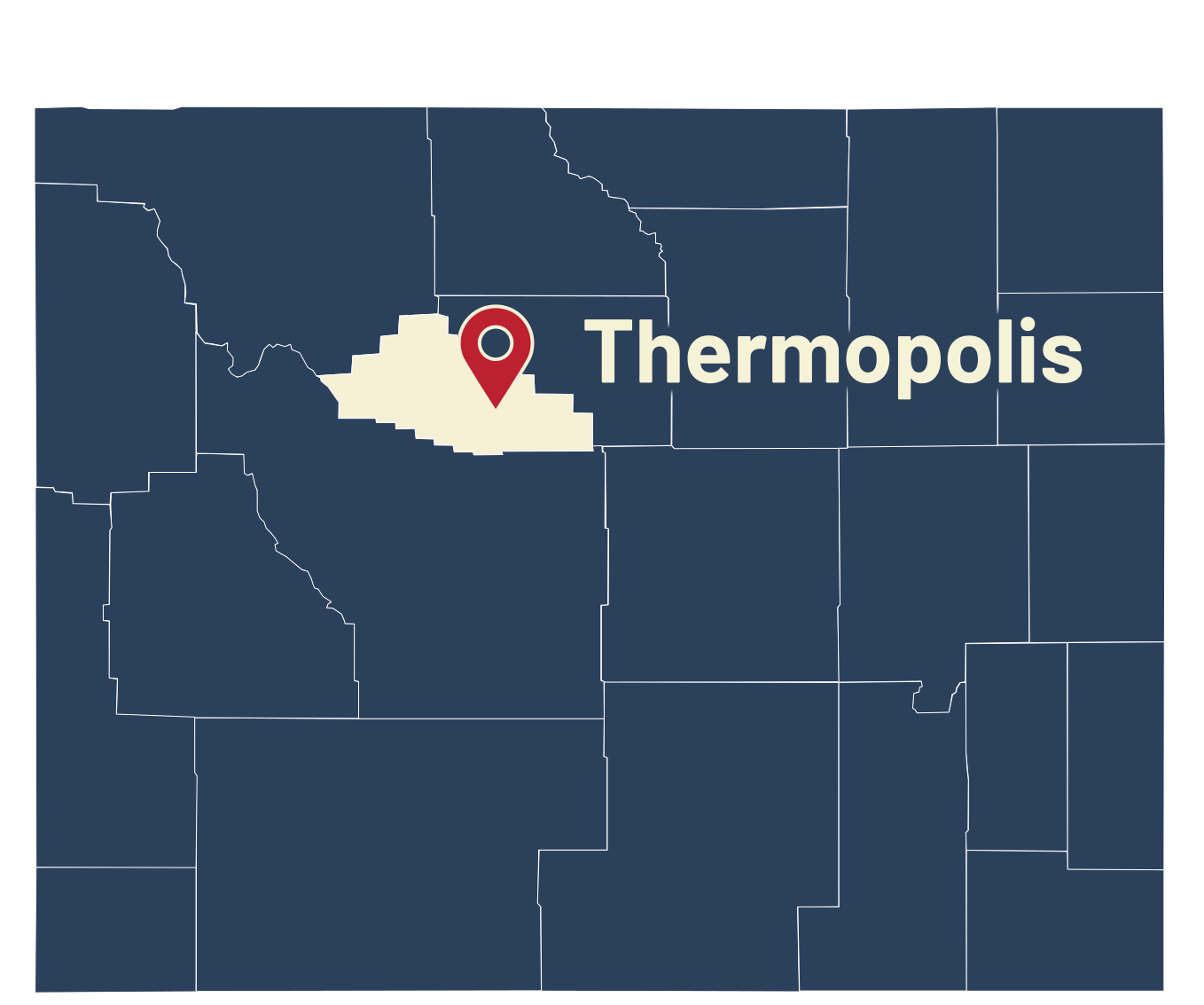

Thermopolis is down to just one regular emergency dispatcher after a string of employee departures, leaving the small town unable to staff its 911 center around the clock.
Now, when someone in Hot Springs County calls for help between 7 p.m. and 9 a.m., the person answering might be sitting in Cody, roughly 90 miles away by road.
The arrangement has kept emergency services running, but it has also raised questions about why dispatchers left and how long the town will need another county to help answer its calls.
Mayor Adam Estenson told Cowboy State Daily the town's dispatch operation has become difficult to sustain as staffing problems put more pressure on the employees who remained.
"We just reached a point where that model was not sustainable," he said.
Hot Springs County Sheriff Jerimie Kraushaar said the dispatch center now has one regular dispatcher working weekdays, with an administrative assistant available to help when needed.
That leaves Park County dispatchers handling much of the remaining workload.
One Dispatcher Left
Thermopolis has handled emergency dispatching for the town and Hot Springs County for decades.
Kraushaar said the arrangement dates to 1982, when the law-enforcement center was built. Under that agreement, the Thermopolis Police Department operates dispatch, while the Hot Springs County Sheriff's Office handles the jail.
The dispatch center serves Thermopolis police, sheriff's deputies, firefighters and ambulance crews.
Now, Kraushaar said, one regular dispatcher remains.
"Monday through Friday, 8-5, they have their lone dispatcher," he said.
Administrative assistant Laura Leseberg also is trained to dispatch, Kraushaar said, but mainly handles administrative duties.
Kraushaar said his deputies are not answering 911 calls or taking over emergency dispatching. Some of the administrative responsibilities previously handled by dispatchers, however, have shifted to the sheriff's office and detention center.
The sheriff said he knows at least one departing dispatcher left for another job in Washakie County. He was aware of another departure but did not know the circumstances.
The precise number of recent departures, when they occurred and whether employees raised workplace concerns before leaving have not been independently established.
Thermopolis Police Chief Pat Cornwell and other department personnel have not returned requests for comment on those questions.
'The Workload Is High'
The Thermopolis Town Council addressed the dispatch staffing problem Oct. 20. The town subsequently called on Park County Communications to help cover shifts under an existing mutual-aid agreement.
Estenson said the town had reached a point where its existing staffing model could no longer keep up with the demands of providing around-the-clock emergency coverage.
"The workload is high," Estenson said.
The mayor said the town concluded that its existing staffing model could not continue.
"It's a hard job," he said. "It's a real difficult job, and mental health plays into that, too."
Estenson also acknowledged that communication within the department needed improvement, both between employees and supervisors and among employees working different shifts.
"Like any organization, it's communication," he said.
The town has since established a standing weekly meeting, giving employees 15 minutes to discuss their work, identify problems and communicate with one another.
Estenson said the town also is recruiting new employees, but wants to avoid rushing people into positions simply to fill vacancies.
"We're going to take the time to do it right, and put together a plan that gives us a sustainable model where we're not overworking our people anymore," he said.
Help From Cody
Park County's assistance gives Thermopolis time to rebuild its dispatch operation while continuing to provide emergency coverage.
The arrangement uses an existing mutual-aid agreement between the agencies.
Estenson said Park County communications personnel can answer transferred 911 calls and communicate with first responders in Hot Springs County from their dispatch center in Cody.
The mayor said the agencies already had strong working relationships, making Park County a practical choice when Thermopolis needed help quickly.
He said Park County had the staffing and technical ability to take on the additional calls.
For residents, he said, the transition should be largely invisible.
"The calls are going through, and they're going to be answered and handled by people who are professionals and know what they're doing," Estenson said.
Someone calling a nonemergency police or sheriff's office number after hours might hear a dispatcher identify themselves as being in Park County or Cody.
Emergency calls, however, are still being routed to dispatchers who can contact the appropriate local responders, Estenson said.
The mayor acknowledged that the transition has involved a few problems, but said he was not aware of any calls that had gone unanswered.
"We've had really good success here in the beginning of that," he said. "There have been a few little hiccups."
The town is working on a formal memorandum of understanding with Park County to establish the arrangement more clearly.
Estenson said he hopes to have that agreement ready for the Thermopolis Town Council's first meeting in December.
In the meantime, the outside assistance gives the town room to develop a longer-term staffing plan.
"It gives us time to breathe, gives us a little space to regroup," he said.
Seconds Matter
Former Thermopolis police officer and Hot Springs County sheriff's deputy Ken Smith II understands why the person answering an emergency call matters so much to the people responding.
During his law enforcement career, Smith said, he made a point of getting to know the dispatchers personally.
"They have to be able to tell by the sound of my voice what kind of situation I'm in out on the street," he said.
That kind of familiarity, he said, is difficult to replace when a dispatch center loses experienced employees.
"There was plenty of times as an officer, I ran down to the pharmacy for my dispatchers because they weren't going to be able to make it," he said, recalling their 12-hour shifts.
Those sacrifices rarely get much attention, he said.
People recognize that police officers and firefighters miss family dinners, holidays and birthdays. Dispatchers make many of the same sacrifices, often without leaving the building.
"The pay is not great," he said. "And it's hard on family life."
He has mixed feelings about the current arrangement with Park County.
On one hand, he said, the dispatchers in Cody are capable professionals. One former Thermopolis police officer now works in dispatch there, providing valuable familiarity with the town and its responders.
As a resident, Smith worries about potential hiccups with technical glitches and dispatchers who may not be as familiar with the area, especially when every second counts in an emergency.
"Sometimes, you know, technical glitches take up those seconds," he said.
Weight Of The Job
Smith said staffing problems cannot be separated entirely from the emotional demands placed on dispatchers.
Unlike officers and firefighters, dispatchers don't physically respond to the emergencies they are hearing. They listen to frightened callers, send help and remain at their desks while the situation unfolds somewhere else.
"You can hear it from across the phone," Smith said. "And you're stuck in a chair."
For dispatchers, he said, that restraint is part of the job.
Crystal Fauver knows that feeling firsthand.
A former Thermopolis dispatcher who spent nearly 18 years working in emergency communications for three Wyoming agencies, Fauver said the emotional toll of the job eventually became impossible to ignore.
On Feb. 15, 2024, she was working when an Apple Watch crash alert came through, followed by a 911 call from her daughter's friend.
Her daughter was involved in a serious head-on collision.
Fauver continued helping coordinate the emergency response until coworkers could relieve her. Her daughter survived, but Fauver said the experience changed how she reacted to emergency calls.
She later experienced panic attacks, nightmares and anxiety that made returning to the dispatch center increasingly difficult.
In a written account shared with Cowboy State Daily, Fauver described struggling to recover while also trying to find a way back to the work she loved.
Her employment ended April 29, 2025, after she exhausted her available leave.
Fauver said her workers' compensation claim for post-traumatic stress disorder was also denied. A written administrative decision issued Jan. 26, 2026, upheld the denial, she said, in part because Wyoming's applicable workers' compensation provision did not include dispatchers among the first responders eligible for certain work-related mental injury benefits.
For Fauver, the distinction highlights a problem she believes Wyoming needs to address.
Dispatchers might not physically enter burning buildings or respond to violent crime scenes, she said, but they hear emergencies unfold in real time and carry those experiences long after their shifts end.
"We do not have to see the blood to carry the trauma," she said.
What Happens Next?
For now, Thermopolis is continuing to recruit dispatchers while relying on Park County to help keep emergency communications operating.
The mayor said the immediate priority is completing the formal agreement with Park County and building a staffing model that does not continually exhaust its employees.
The town has not announced a firm date for returning to full-time local dispatch coverage.
Questions also remain about the recent departures, including how many employees left, whether they resigned around the same time and what prompted their decisions.
Kraushaar said his office continues to work with the town under the existing division of responsibilities, while Park County handles calls that Thermopolis cannot staff locally.
Smith hopes the arrangement works, but said maintaining dependable communication between dispatchers and responders is essential.
Estenson said the goal is to give employees some relief while the town develops a more sustainable approach to dispatching.
"We're not just continually in emergency management mode," he said. "We can put a strategic plan together on how we're going to continue forward."
Kolby Fedore can be reached at kolby@cowboystatedaily.com.


