
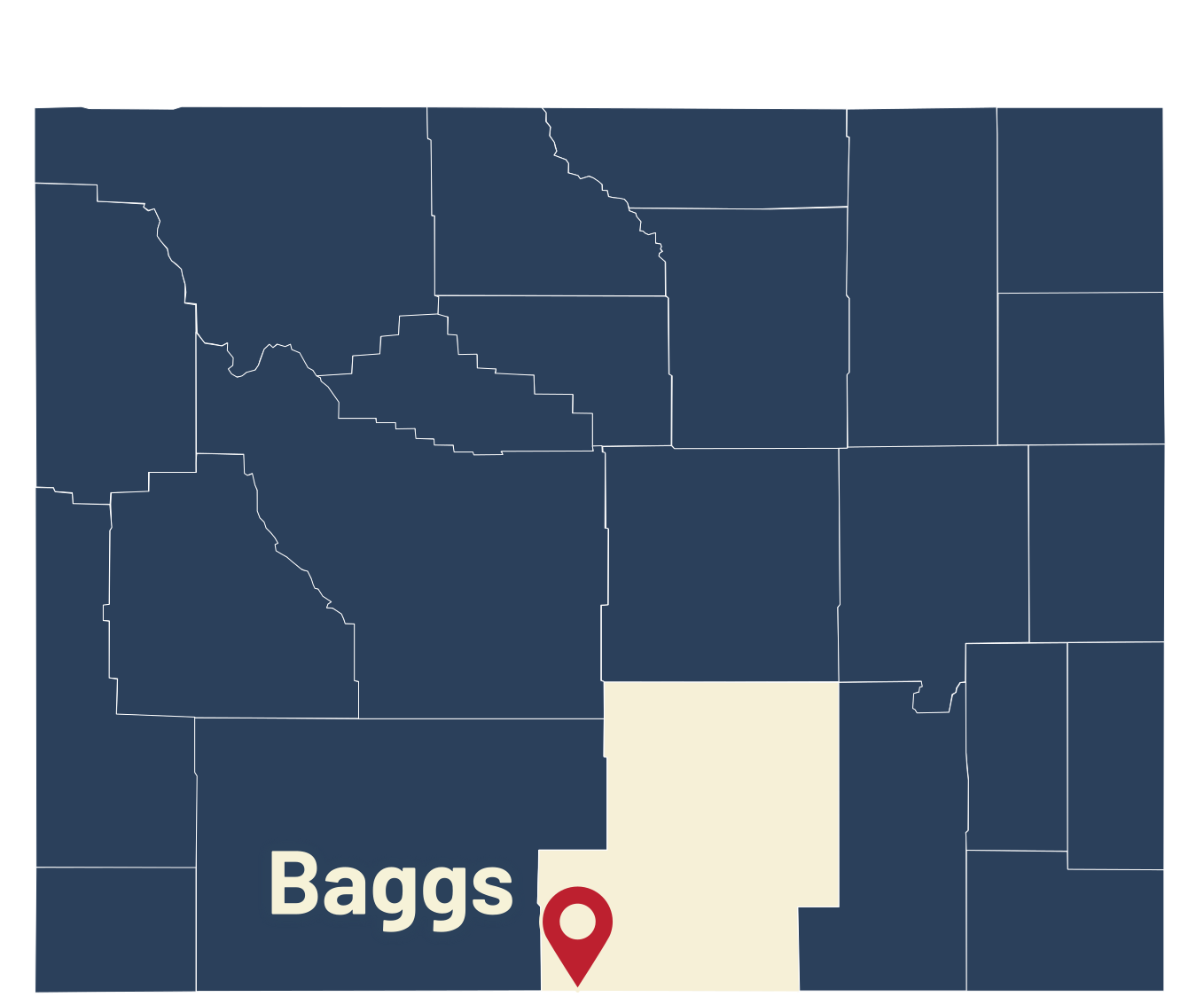

Shooting a record book-sized bull bison after six days of hunting in Utah’s remote Book Cliffs region was one thing.
Getting it packed out was quite another, Larry Hicks of Baggs told Cowboy State Daily.
“We were up to our elbows in buffalo meat,” Hicks said of an hours-long process of skinning and butchering a massive carcass with two hunting partners, after he dropped the bull on the afternoon of Nov. 10.
It took eight horses the better part of the next two days to pack out their camp and about 540 pounds of bison meat, he said, not to mention the bull’s skull and cape (skin from the shoulders forward).
“We covered 53 miles in about 30 hours,” said Hicks, a Republican state senator.
He’s shot bison during hunts in Wyoming in 2020 and South Dakota in 2024.
But the Book Cliffs roadless area bison hunt is unique, and it took Hicks 28 years to draw one of the highly coveted tags.
The Book Cliffs herd is truly free-ranging and includes animals descended from Yellowstone bison.
Hunting there is “grueling,” Hicks said. It involves up to 20 miles of horseback riding and hiking every day, through the deep canyons and high plateaus the bison call home.
Elevations range from 7,200 to 9,000 feet.

“I shot the buffalo at 7,600 feet in elevation,” Hicks said.
Utah’s Gem
The Book Cliffs roadless area encompasses a 50,608-acre parcel in eastern Utah and is considered one of the state’s backcountry gems.
“The total surface area might be about 50,000, but there’s so much steep topography there, you probably have double that in terms of landscape,” Hicks said.
It’s surrounded by arid country, but water improvement projects there, through the state and wildlife conservation groups, have created prime habitat for bison, elk, mule deer, black bears, and other wildlife, Hicks said.
“They manage it as a quasi-wilderness,” and the only way in or out is on foot or horseback, he said.
It’s a 26-mile drive on dirt roads to the trailhead, and their camp was 22 miles in from the trailhead, he said.
One of his hunting partners, Bryan Martin of South Dakota, works as a guide and has been on numerous bison hunts.
“There’s really no other hunt like it (Book Cliffs),” Martin told Cowboy State Daily. “You’re not hunting along a park boundary, waiting for a bison migration,” he said, referencing Yellowstone-area hunts.
Instead, it’s a matter of finding free-roaming bison, which can be difficult, he said.
“The big bulls don’t just stay in one spot after the rut (mating season) the way bull moose do. They wander around,” he said.
The Book Cliffs herd includes DNA from Yellowstone bison. In 2009 and 2010, the Utah Division of Wildlife Resources augmented the herd with bison from the Henry Mountains.
Those bison trace their ancestry to Yellowstone bison and were introduced to the Henry Mountains in 1941.

Hunting High and Low
Their camp was at the head of several canyons, running 500 to 1,500 feet deep and each more than 20 miles long, Hicks said.
They found bison scattered in “bunches” along the creek beds in the bottoms of the canyon. But those were cows, calves, and young bulls.
Hicks was determined to get a huge, older bull.
Mature bulls were off by themselves or in small groups, mostly high on the vast plateaus between the bottoms the canyons.
On more than one occasion, they looked across a canyon and saw big bulls.
“But it would take hours to cross the canyon to get to them. And when we came back the next morning, they would have moved somewhere else,” he said.
“We probably saw 400 buffalo” without getting close enough to a bull he thought was big enough to shoot, Hicks said.

Five Bulls Appear
Luck finally came late on the sixth day.
“There’s always going to be buffalo there; it’s just a matter of finding opportunity,” Martin said.
And all the scouring of the landscape finally paid off when they found a group of five large bulls feeding in a draw, Hicks said.
“They just showed up short. We hadn’t seen that group before,” he said.
He spent the next half-hour or so stalking and closely observing the bulls, trying to pick out the biggest.
It was first a matter of determining body size.
“Bison are sort of like Angus bulls," Hicks said. "They just keep growing in body size as they age and mature.”
Two of the bulls were visibly more massive than the other three.
Then, it was a matter of judging horn size.
The vaunted Boone and Crockett trophy game scoring system judges bison horns by overall length. But mass is what comes into play most for a record book score, and that’s calculated by measuring the girth at several points along the length of the horn.
After eyeballing each bull’s horns for a while, Hicks determined which won out in terms of length and mass, and then he shot with his 300 Winchester Magnum.
He and Martin figure the bull was probably in the prime of maturity, perhaps 9 to 12 years old.
Bull bison can live “into their teens” in the wild and into their 20s on bison ranches, Martin said.

Bone Mass
Martin said he brought several sharp knives, which expedited the task of processing the huge carcass.
Hicks shot the bull at about 4 p.m., and it was well after dark before they had all the meat removed from the bones.
It’s necessary to bone out bison meat before packing it because they have massive bones, leaving a lot of unnecessary weight to burden the horses, Hicks said.
They ate some of the tenderloins in camp, and it was superb, Hicks said. He dropped the rest of the meat at a butcher shop for final processing after he got home.
And he’s looking forward to getting a freezer full of fresh bison.
“It’s the best wild game meat I’ve had, except for Oryx,” he said.
That’s a huge African antelope species that has been transplanted and is free-ranging in some states, such as New Mexico. Hicks has a tag for an Oryx hunt in March.
True Trophy
B&C requires a 60-day drying period for big-game trophies before it can be measured for an official score. Anything taken before that is considered an unofficial “green score.”
Hicks said the green score on his bison indicates it could be one of the top 10 largest ever taken in Utah.
There have been 80 B&C record-sized bison taken in Utah. Wyoming has 122, including many taken during herd culls in Yellowstone National Park during the early 20th century.
The world-record bison was taken during a Yellowstone herd reduction in 1925.
“There has been only one B&C bull bison killed in Wyoming in the last five years,” Hicks said.
South Dakota has logged 174 B&C bison, mostly from the Custer State Park herd, he added.
There have also been 56 B&C bull bison taken in Alaska, 55 in Montana, and 20 in Arizona.
Hicks dropped his bull’s cape off at a local shop for tanning. He does his own taxidermy and plans a full shoulder mount of the bull.
Mark Heinz can be reached at mark@cowboystatedaily.com.


