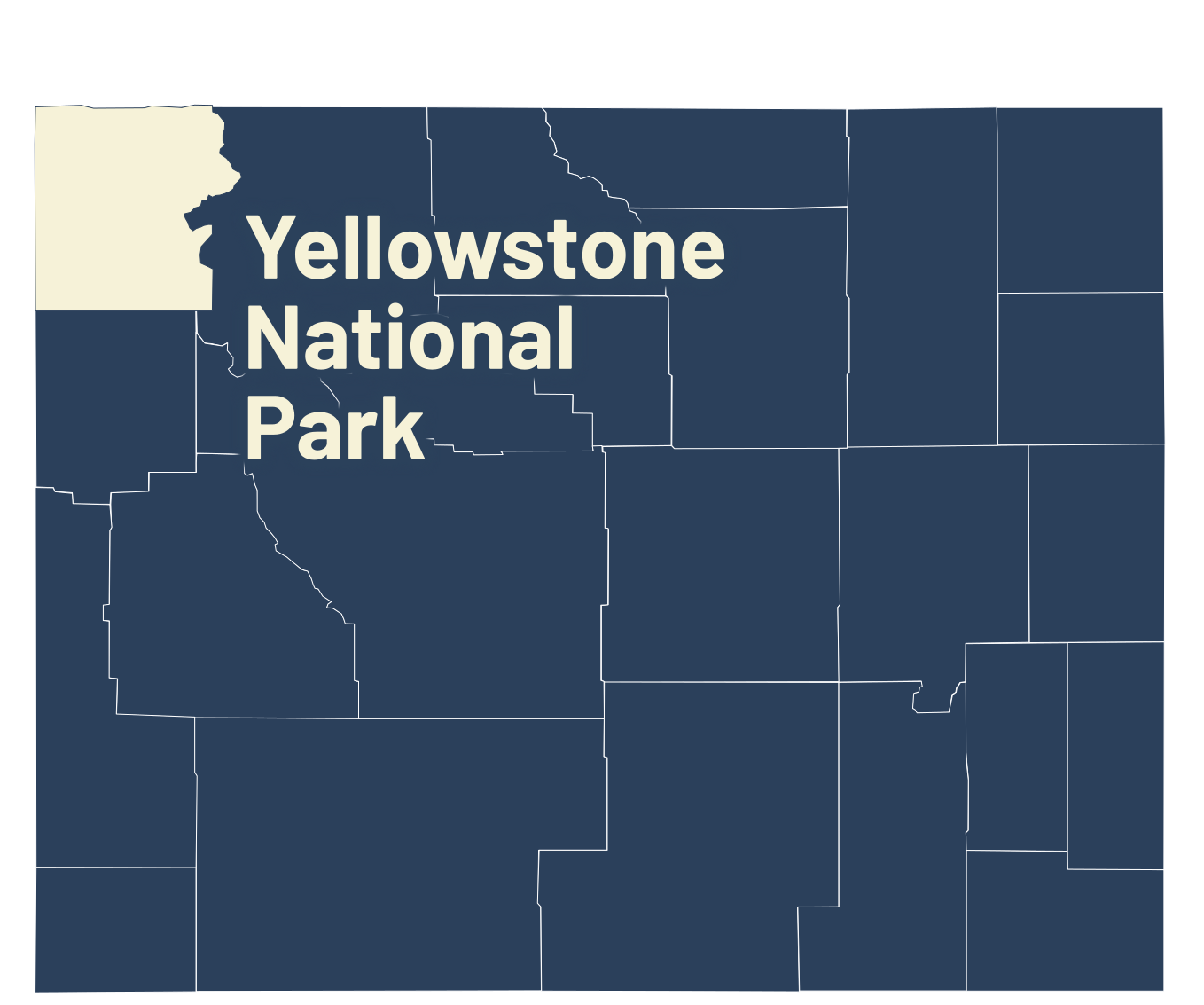
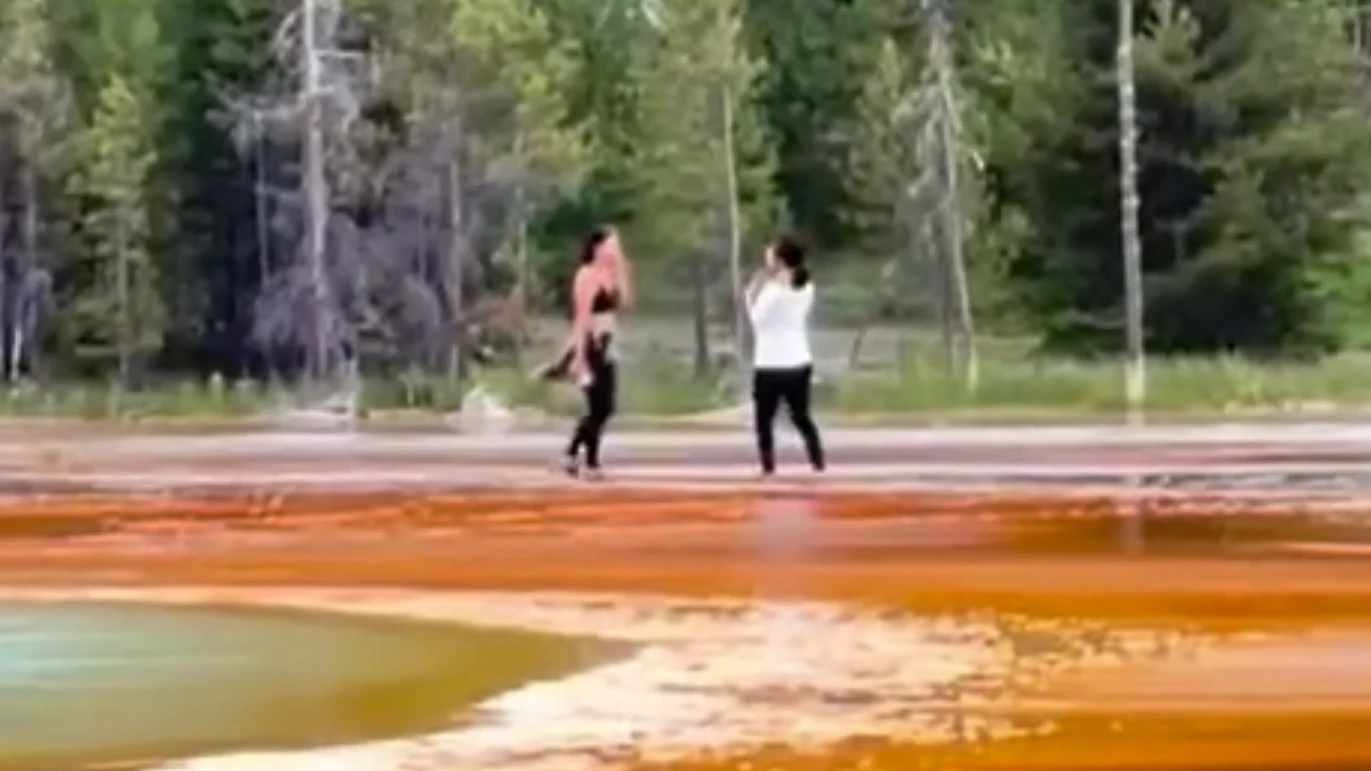
Two tourists were seen getting dangerously and illegally close to Grand Prismatic Spring on Sunday in Yellowstone National Park, enraging hundreds of spectators and millions of internet onlookers.
Tanya Saueressig of Livingston, Montana, was visiting Yellowstone with a friend when she witnessed the incident. She was standing on the Grand Prismatic boardwalk around 7 p.m. during what was otherwise a pleasant evening.
“It was a really nice crowd,” she told Cowboy State Daily. “People on the boardwalk were being lovely, giving each other space, and being quiet. It was a really nice experience.”
Saueressig was getting her final look of the evening when she saw something moving across the expansive microbial mats toward Grand Prismatic.
“I stopped in my tracks and was like, ‘Is that people? That can't be people. Nobody's that dumb,’” she said.
After all, temperatures in the spring run from 145 - 188 degrees. Deadly.
But, it was people. Two women, who appeared to be approaching the massive hot spring from the Fairy Falls Trail, which runs along the western edge of Grand Prismatic.
Saueressig's lovely evening quickly soured, as she was immediately overwhelmed by a wave of different emotions.
“I started getting scared because I thought they were going to fall in and get really, really hurt,” she said. “I worried people at the overlook were going to watch someone die that day. They were out there where nobody could help them.”
Concern quickly turned to anger. As she watched the women nonchalantly walk along the edge of Grand Prismatic, within 50 feet of its scalding-hot water, she got “so furious that I literally had tears in my eyes.”
“You could tell they were just strolling along, taking their selfies, without a care in the world,” she said. “They were totally oblivious to what was right under their feet. You're causing so much damage with every step you take, and you don't care.”
Someone else filmed the dark-haired duo from the Grand Prismatic Spring Overlook. That video has been viewed millions of times in less than 24 hours.
There’s no word on whether the individuals in the videos were identified or reported to Yellowstone's law enforcement rangers.
“I was so angry,” Saueressig said. “It was so mind-boggling to me that they would be out there in the first place.”
The 0.1%
Walking on the fragile microbial mats around Grand Prismatic Spring and Yellowstone's many thermal features is a crime, punishable by fines, incarceration, and a multi-year ban from Yellowstone.
Many people have been tried and sentenced for thermal trespass in the park. That hasn’t stopped others from stepping off the boardwalks and past the signs, putting their own lives and the thermal features in danger.
Greg Jackson, a former deputy chief for the National Park Service’s Division of Law Enforcement, Security and Emergency Services in Washington, D.C., called this type of tourist “the 0.1%.”
“Some people see the world differently than the mainstream,” he said. “You build an infrastructure that's dedicated to the 99.9% of people that don’t do this, and then you get people who don’t see that infrastructure or decide it doesn’t apply to them.”
Many people plead ignorance when charged with thermal trespass, saying they weren’t aware they were violating any rules or that they saw no signs in the immediate area where they were caught.
In Jackson’s opinion, it doesn’t matter how much the National Park Service does to prevent this kind of behavior. Nothing stops the 0.1%.
“I’ve seen people climb over guardrails to keep them from falling off a cliff for a better picture,” he said. “You can create as much of a deterrent as you can, but some people aren’t deterred by what would deter most people. Those outliers walk among us.”
“Helpless”
Saueressig wanted to immediately report the Sunday evening incident to a Yellowstone ranger. Unfortunately, she couldn’t find one.
“There weren't any rangers on the boardwalk, which there rarely are,” she said. “I think they only show up if an incident is called in, because they have so many other places to be and there's so few of them.”
That left Saueressig even more despondent in the moment. She felt “helpless” to do anything about the egregious act she was witnessing.
“You can help them or stop them because it’s already happening,” she said. “I didn’t have cell reception, so I couldn't call anybody. There wasn't anybody I could run up to and notify. I didn’t know what to do.”
With no other options, Saueressig did the best thing she could by filming and sharing the video on social media. While not a guarantee, it could lead to the identification of the perpetrators.
Still, it did little to comfort her in the moment.
“The anger I was feeling was awful, and feeling helpless made it worse,” she said.
How Vs. Why Not?
Can anything be done to stop “the 0.1%”? Jackson doesn’t see a viable solution that hasn’t already been tried.
“If I could find a way of fixing that, I certainly would,” he said. “It creates a problem for everyone.”
In Jackson’s view, the National Park Service has made “reasonable and good efforts” to curtail the brazen behavior of the small number of tourists who choose to do these things. After all, the vast majority of Yellowstone’s visitors enjoy the park without incident.
Would more signage, boardwalks, and barricades help?
Yes, but in Jackson’s experience, only to a point.
“I think they’ve done everything they can, but somebody's always going to think in a way you hadn't thought of before,” he said. “If you build a barricade, people will jump over it. If you build a wall, someone will hang-glide or parachute in.”
Having a ranger in the vicinity, visibly keeping an eye out for miscreants, might help stop this behavior. However, Jackson still didn’t think that would be enough.
“I’ve seen people do things right in front of me that you wouldn't think they would do, and they don’t have a clue,” he said. “A ranger might deter some people, but some people aren't deterred by the things that would deter most people.”
Most people, including Jackson, don’t think like this. That’s why trying to prevent this behavior is often futile.
“We can't see how, and they can't see why not,” he said. “That’s what makes people different. It’s a strange world we live in.”
Damage Done
When Saueressig started filming the two tourists, there was more on her mind than justice.
She recalled the incident at Grand Prismatic in June 2025, when a bison fell into the pool and was scalded to death by the 160-degree thermal water. One wrong step or a small crack in the thin crust could quickly prove fatal.
She was also enraged by the damage being done to the microbial mats surrounding Grand Prismatic. These delicate living masses of thermophilic bacteria are what give the pool its vibrant colors.
“If they didn’t die, they were leaving permanent scars on the microbial mats,” she said. “They were causing so much damage with every step they took, and they literally didn’t care at all.”
People charged with thermal trespass can, and often do, plead ignorance. That usually isn’t enough to get them off the hook for fines, although it can be enough to avoid a few days at the Yellowstone Detention Center at Mammoth Hot Springs.
Ultimately, the damage is already done. No amount of money or jail time can remove the footprints and other scars left behind by people walking on Yellowstone’s thermal features.
“Ignorance may be a reason, but it’s no excuse,” Jackson said. “The resource doesn't care whether it's been damaged by people who are unaware or malicious. It’s still damage.”
Even the worst sentences can be seen as lucky breaks. Several people have been seriously injured or killed after getting too close to Yellowstone’s thermal features.
One would think a high risk of death might be enough to dissuade tourists from tempting their luck. That mentality’s been proven, time and time again, to not be enough to stop “the 0.1%”
“People still die whether they’re aware they’re intentionally violating the law or not,” Jackson said. “Sometimes, life's a little harder if you're clueless or decide the danger doesn’t apply to you.”
Andrew Rossi can be reached at arossi@cowboystatedaily.com.