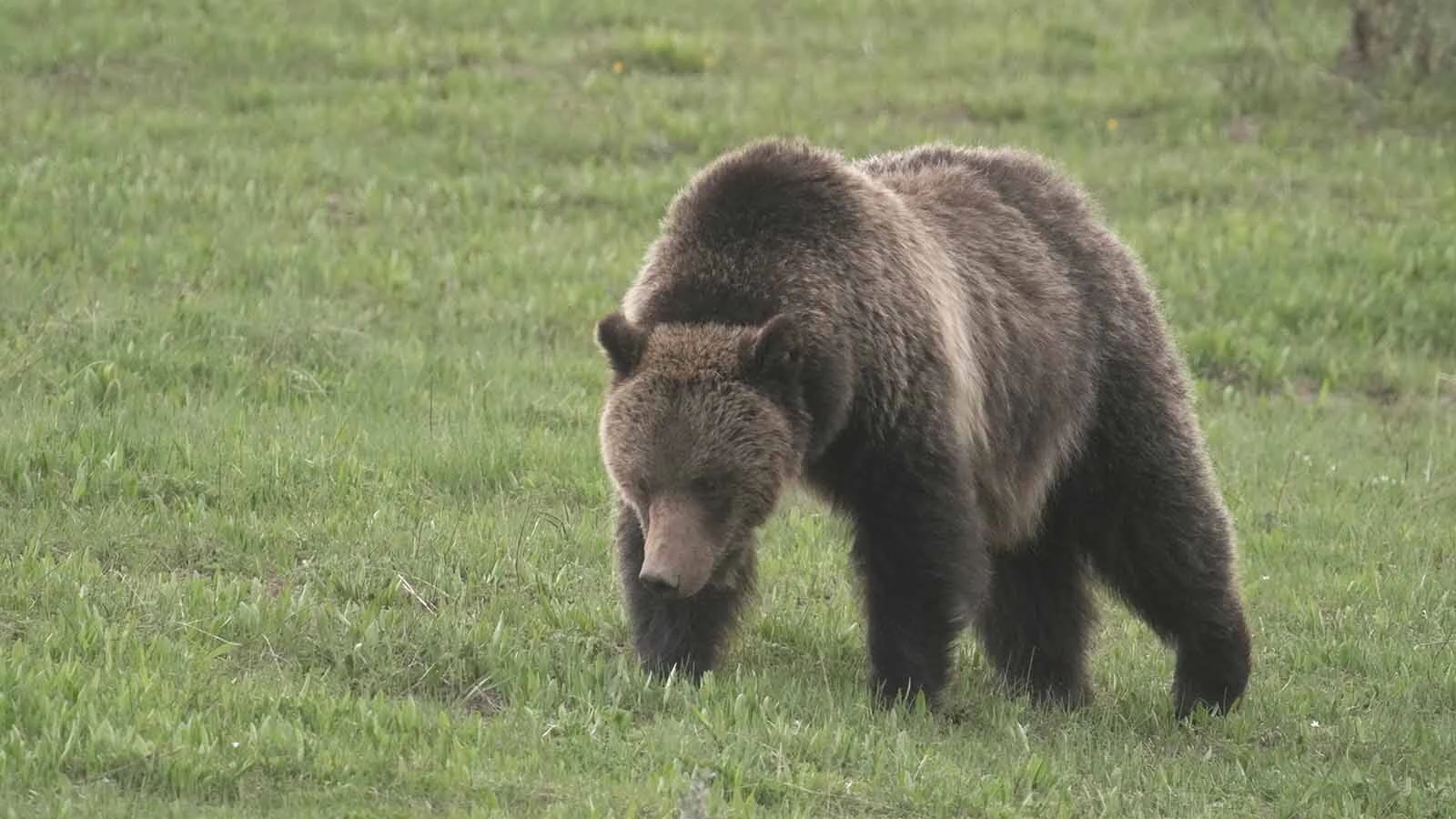
The number of grizzlies needed to consider the species “recovered” in the Greater Yellowstone Ecosystem seemingly remains an open question.
However, grizzly advocate Pete Bengeyfield, who has been watching and photographing the bears for decades, said even he has to admit there are probably enough of them to consider the species “recovered,” even if he still opposes having the bears delisted from Endangered Species Act protection and hunted.
There are an estimated 1,000 or so grizzlies in the Greater Yellowstone region of Wyoming, Montana and Idaho. And roughly the same number of grizzlies in Montana’s Northern Continental Divide Ecosystem.
The Wyoming Game and Fish Department and elected officials in Wyoming, Montana and Idaho think that’s plenty of grizzlies, perhaps even too many.
Gov. Mark Gordon and Wyoming’s congressional delegation praised the Department of the Interior’s announcement this week of a proposal to hand management of grizzlies over to the states.
The proposal must go through a public comment period before it’s finalized — and wouldn’t amount to a full delisting of grizzlies.
Game and Fish still wouldn’t be allowed to open a Wyoming grizzly hunting season, which top department brass has said they intend to do if and when full delisting happens.
Wyoming Republican U.S. Rep. Harriet Hageman indicated that she will continue to push to have grizzlies delisted through legislation.
Numbers Tell The Story
Bengeyfield lives in Dillon, Montana, as a U.S. Forest Service hydrologist. He moved to southwest Montana in 1984 and started photographing grizzlies.
At the time, “there were maybe 200 bears” in the Yellowstone ecosystem, he said.
He retired from the Forest Service about 15 years ago, which gave him more time to dedicate to following and photographing grizzlies, and he's become an outspoken advocate for the bears.
Grizzly watching and photography was a completely different game in the mid-1980s, Bengeyfield said.
Then, he had to search far and wide to find bears.
“When I started, there were no bears in the Tetons at all. Well, maybe up in the mountains, but you didn’t see them down around Jackson at all,” he told Cowboy State Daily.
Now bears are plentiful, he said. They’re increasingly showing up in places where they were seldom, if ever, seen before, Bengeyfield said.
That includes, for example, the Gravelly Range mountains in southwest Montana, he said, adding that there’s no denying the size of the population.
“The numbers, I think, tell the story. If there really are 1,000 bears in the Yellowstone ecosystem now, I think that’s plenty to say they’re recovered,” he said. “I think bear advocates, and I consider myself to be one, are going to have a hard time justifying that we have ‘non-recovered’ numbers.”
It’s also been widely argued that habitat connectivity between the Yellowstone and Northern Continental Divide bear populations matters just as much, if not more, than the sheer number of bears.
“I think the arguments about connectivity to the Glacier (National Park) population and all of that, they’re real arguments,” Bengeyfield said. "I’m not disputing that at all.”
Can The States Be Trusted?
After posting his thoughts on social media, Bengeyfield said he’s received numerous comments.
One person suggested that grizzlies be allowed to repopulate their entire historical range, he said. That would include most of the Great Plains and nearly as far south as the U.S.-Mexico border.
As appealing as that might sound, it’s “silly” in light of how much has changed since grizzlies roamed their entire range, he said.
Bengeyfield said he feels stuck on the horns of a dilemma in terms of what might be the next best step for grizzlies.
Regarding the Department of the Interior’s move to hand grizzly management over to the states, he said he’s not exactly enthusiastic about it.
“I think when you deal with the states, especially in Montana, the local view of the grizzlies — and not the view of the majority of the people, but of the people in power — is that they don’t want grizzlies at all,” he said. "Or, they want to hunt them."
More bears on the landscape, along with more people than he’s ever seen before, has increased the risk of human-bear conflicts, Bengeyfield said.
In that sense, he said that “the recovery effort has almost been too successful. They’ve recovered so many bears, and there are so many more people, the bear-people interactions are just going to increase."
Numbers Are Not Enough
Former Wyoming Game and Fish director and current U.S. Fish and Wildlife Service Director Brian Nesvik has stated that the number of grizzlies indicates full recovery.
His successor at Game and Fish, Director Angi Bruce, has openly argued the same.
Delisting supporters point out that 500 grizzlies was the original target number for the Yellowstone Ecosystem, and that’s now doubled.
Grizzly conservationist Louisa Willcox told Cowboy State Daily that she thinks the “500” number is tied to a 1993 grizzly recovery plan that was flawed to begin with.
Also, population estimates alone can’t be the only measure of whether the species is recovered in the Lower 48, she added.
“The numbers have to be tied to habitat,” she said.
That means not only habitat in its current state, but how it might look in the future.
For instance, grizzlies are now dependent upon berries and cutworm moths for peak summer foods, and those are at high altitudes, Willcox said.
But scientific models indicate those food sources might start to run out, she said.
“What happens when the moths run out?” she said.
That could very well mean bears moving to lower altitudes during the summer. And more people are at lower altitudes, meaning more chances for human-bear conflicts, Willcox said.
“There’s no magic number” of grizzlies that would mark full recovery, she said.
Instead, as she sees it, there needs to be a complete revision of the 1993 grizzly recovery plan. And all interested parties should be involved, she said.
And FWS should lead that effort, Willcox said.
But as she sees it, at least so far, the agency hasn’t shown a willingness to do that.
Mark Heinz can be reached at mark@cowboystatedaily.com.