Wildfires are burning homes and habitat across the western U.S., filling the skies with smoke, but even these fearsome flames can have incredible moments of beauty.
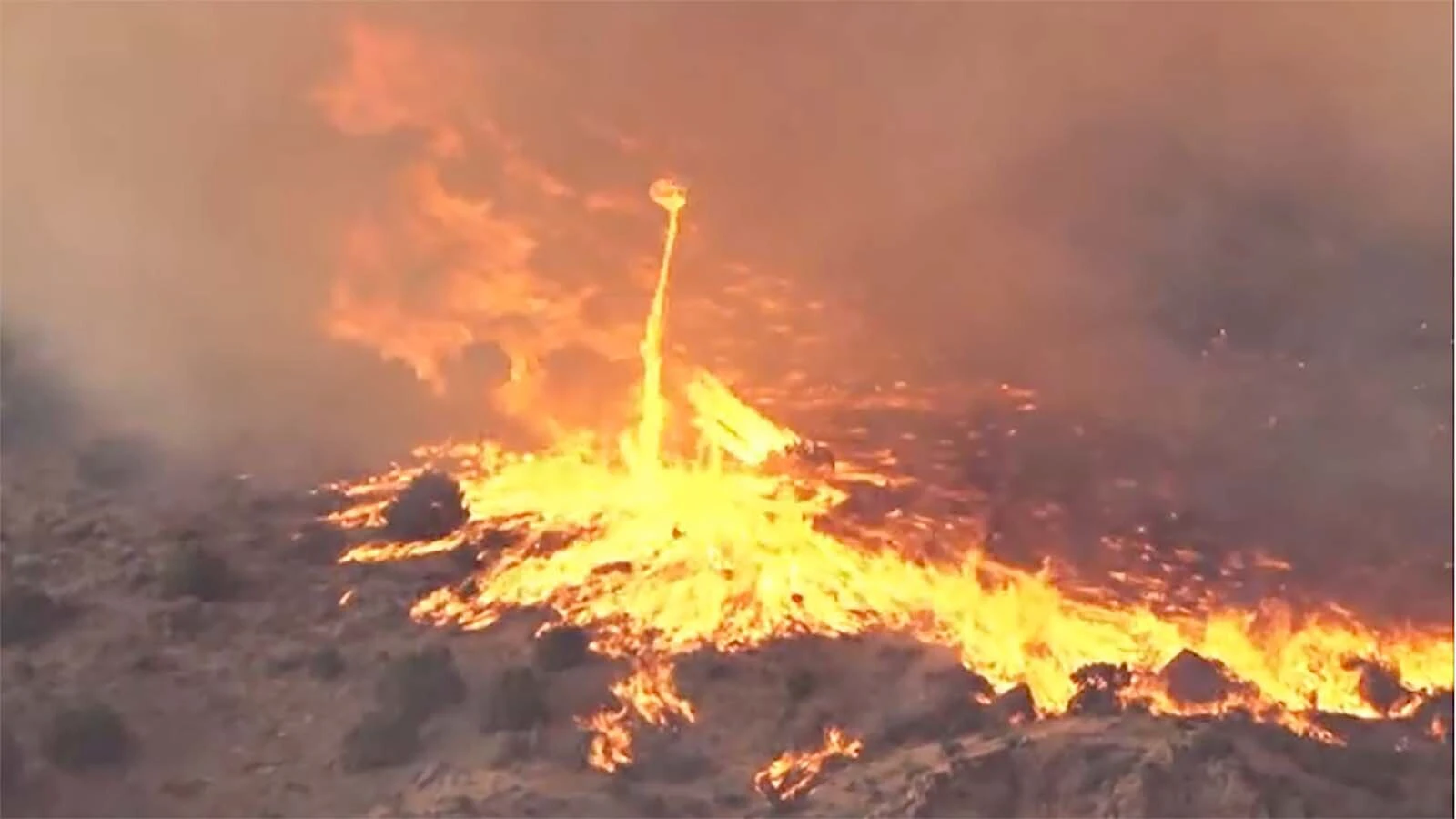
That’s what Justin Duke witnessed along the banks of the Snake River in eastern Idaho on Sunday. As the fire raged near Heise, the conflicting wind currents came together into a twirling spire of destruction.
“It came and went for a couple of minutes, at least,” Duke told Cowboy State Daily. “It would spin up and die down, and then do it again.”
The Big Rock Fire started on the north bank of the Snake River, 30 miles west of the Wyoming state line, on July 31. As of Monday afternoon, the lightning-strike fire had burned nearly 2,500 acres and was 0% contained.
Duke lives around three miles from where the first flames were spotted. Since it was burning away from him, he decided to step outside to get some photos.
“I was working in the yard and could see the fire off in the distance,” he said. “I've got a pretty big wildlife lens on my camera, so I figured I’d try to go get a few action shots of helicopters dumping water buckets.”
From across the river, Duke could see the fire spreading and brush spontaneously bursting into flames from the surrounding heat.
As he watched and documented, the flames suddenly started swirling together. As multiple spokes of flame came together, they were thrust into the air.
“I was about a mile away from the spin,” he said. “It's hard to say how high it went, but I would guess a couple hundred feet.”
The spiral would slow down and collapse, only to surge upward again with renewed intensity.
“It was changing pretty quickly,” he said. “The sun was going down, temperatures and humidity were changing, and it was going uphill. That all affected how fast it was moving.”


Fire Devils
These swirling spirals of fire are seen during many wildfires.
Many people call them “fire tornadoes.” Cowboy State Daily meteorologist Don Day would prefer they didn’t.
“It’s not a tornado moving into a wildfire,” Day said. “It’s not a fire strong enough to create a tornado, in terms of what a tornado actually is. Putting ‘-nado’ at the end of things isn’t the correct thing to do.”
Nevertheless, these “fire devils,” as Day prefers to call them, can be extremely dangerous. They result from a wildfire strong enough to essentially create its own weather as it burns and intensifies.
“The heat from the fire generates a lot of rising motion, because hot air has to lift,” Day said. “There’s a natural spin motion in the atmosphere that these tap into. When you combine that vertical motion of the heat and flame with the natural horizontal motion of the wind, you get a ‘fire devil.’”
That’s a distinctly different phenomenon from a tornado, even if they have some superficial similarities.
According to Day, fire devils are a signal that a wildfire is getting worse. As they form, they feed the flames burning at their base.
“These vertical motions draw air up, and when you draw air up, you're pulling oxygen into the fire, which makes it worse,” Day said. “If fire devils pop up, it’s a very dangerous situation for firefighters, and there's nothing you're going to be able to do to mitigate them.”
Exorcising Devils
A fire devil was documented during the Deer Creek Fire in southern Utah in July 2025. Jerod DeLay, assistant state forester and fire management officer with the Wyoming State Forestry Division, said he’d “never seen one as large as that.”
When firefighters respond to a wildfire, they don’t try to engage with the flames directly. They attempt to anticipate the fire’s next move and establish fire lines that will, hopefully, cut it off or redirect it into another line.
According to DeLay, fire devils tend to break through fire lines, making them even more dangerous and unpredictable.
“You have to make sure to see if your lines held,” he said in July 2025. “If your lines didn't hold, you make another plan to see where you can go. If they hold, you continue to strengthen and improve the lines that you already have.”
The one thing firefighters won’t do is attack the fire devil. It’s not worth the risk.
“You make sure you’re in a good, safe place and let it run its course,” DeLay said. “It adds another element that you probably weren't expecting.”
Fire Season In Full Swing
As of Monday, four confirmed wildfires were burning in northeastern Wyoming. Two, the Left Creek and Newton fires, sparked within a few miles of Devils Tower National Monument.
Day, without wanting to jinx anything, said Wyoming was “lucky” to get through a dry July with only a few wildfires.
“I think that the higher humidity and thunderstorm activity we did see really kept the activity down in July,” he said. “We had a lot of thunderstorms that kept the mountains in northwest and western Wyoming very active. Where it fell, that July rain really helped.”
That said, Wyoming’s fire season extends from July through October. If the first days of August are any indication, many potentially dangerous months are ahead.
Duke wasn’t anticipating an evacuation from his Heise home. The fire’s still 0% contained, but responding agencies seem confident they’ll be able to protect people and structures.
“It’s just burning through trees and stuff on public land,” he said. “I don’t think the situation’s improved much, but I know they've got the structures protected, and that's the main concern.”
Where there’s smoke, there’s fire. And where there’s fire, there’s a chance that a fire devil will spiral up and out of control.
Not every wildfire creates fire devils, but they’re real and potent threats that shouldn’t be underestimated.
“It was remarkable that we got through the month of July with very little activity in terms of wildfires in Wyoming,” Day said. “We dodged the bullet there, but I don't want to shout from the mountaintop that fire season's over. We’re not done, by a long shot.”
Andrew Rossi can be reached at arossi@cowboystatedaily.com.