
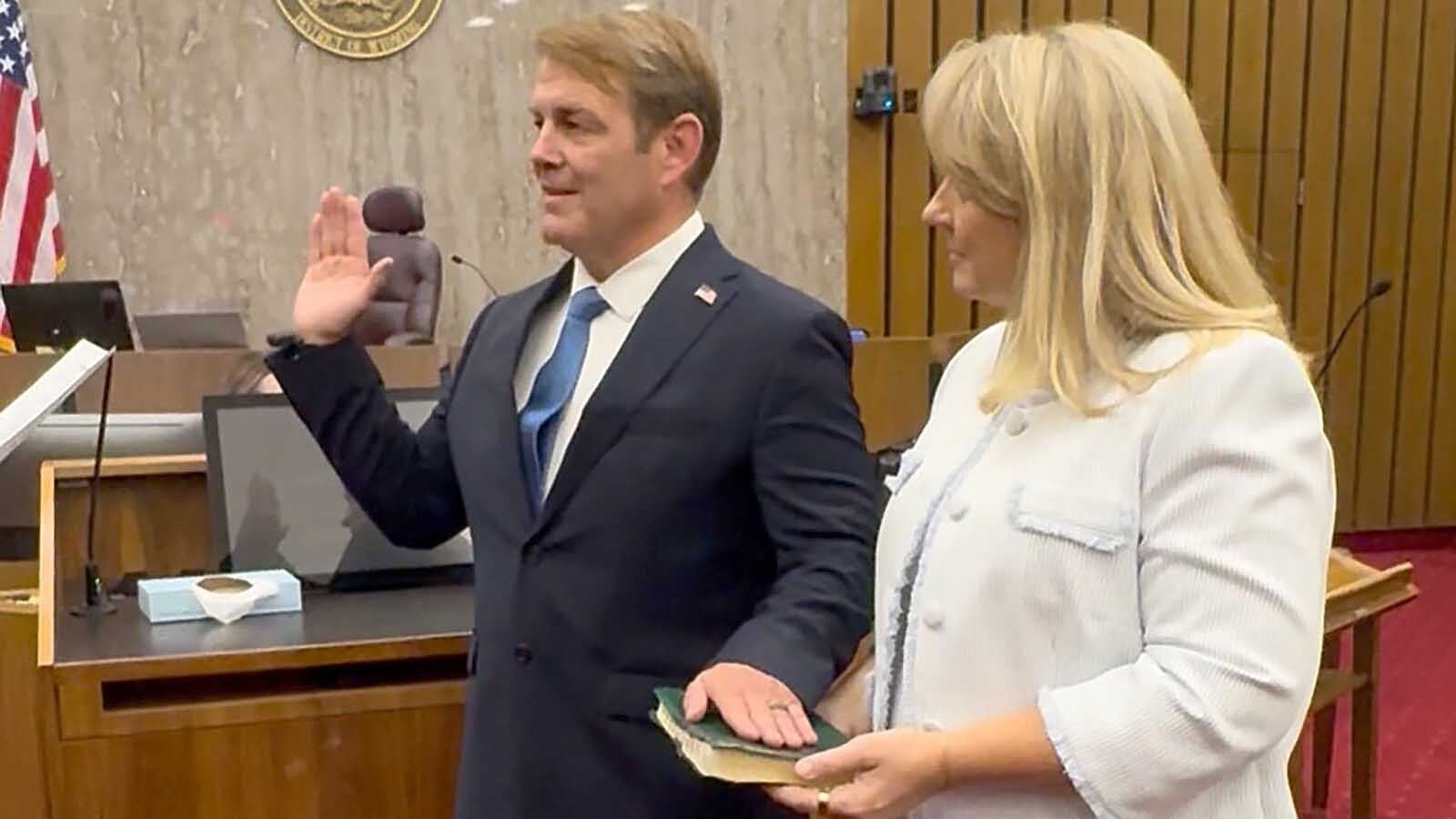
Three federal judges ruled Tuesday that there’s no proof that the U.S. Attorney’s Office of Wyoming engaged in an institutional cover-up when its topmost prosecutor, Darin Smith, committed misconduct during March grand jury proceedings.
In light of that misconduct, Chief U.S. District Court Judge Kelly Rankin, and District Court Judges Alan Johnson and Scott Skavdahl, all filed a Friday order dismissing nine felony-level cases, including one that contained a first-degree murder charge.
But the judges are letting the U.S. Attorney’s Office attempt to indict those nine people again with a fresh grand jury.
Defense attorneys had instead urged the judges to free the defendants from being prosecuted altogether, or "with prejudice."
The judges declined in their Tuesday order to grant the defense attorneys' wish.
'Embellishment'
The defense attorneys argued that, if the judges aren't willing to dismiss the cases permanently, they should instead bar the entire Wyoming-based U.S. Attorney's Office from prosecuting those cases, and they should begin public disciplinary actions against Smith.
The judges declined Tuesday to grant those requests as well.
The defense attorneys had submitted a theory that the U.S. Attorney’s Office engaged in an “institutional cover-up” and other prosecutors responded wrongly to the controversy.
Rankin, Johnson and Skavdahl rebutted that.
“Contrary to Defense counsel’s embellishment, there is no evidence of institutional cover-up or systemic failure,” says the order. The conduct at issues “was isolated and limited” to Smith’s “inappropriate and improper remarks,” the order adds.
The judges wrote that for the defense to assume multiple attorneys “deliberately withheld” information about the misconduct from the court is “unwarranted and ill-advised.”
The order also speaks to the uniqueness of the situation.
“This Court has been presiding over the grand jury selection process in the District of Wyoming for decades,” wrote the judges. “This instance is the first time there has ever been any questionable or problematic conduct by a U.S. Attorney or an Assistant U.S. Attorney.”
The earlier, tainted grand jury has been discharged and a new one was empaneled Monday, the order says.
The judges wrote that they’re confident the misconduct “will not be repeated” and that, if any concerns are raised, the judges are confident those will be brought to the court’s attention.
Why Not Permanently?
The judges pointed to past cases on this topic showing that dismissing cases permanently over misconduct is at the very least drastic and rare.
The 10th Circuit Court of Appeals, which is the umbrella authority to Wyoming’s federal courts among others in the region, has in the past told judges to cure risks of harm to defendants with less drastic remedies, when less drastic remedies were available, the order notes.
In one case the U.S. Supreme Court fielded on this topic, the court cautioned against “granting a windfall to the unprejudiced defendant” and rather to focus sanctions on the person at fault.
Public Discipline
The defense attorneys had called for the court to direct Smith to show why he should not be disciplined, to issue an opinion “publicly chastising” Smith, and to ask the U.S. Department of Justice to start disciplinary proceedings against Smith.
The judges responded to that in a two-sentence paragraph saying they have any potential issues handled.
“This Court is keenly aware of its obligations under the Code of Judicial Conduct and will take appropriate action as it deems necessary to prevent harm to those affected by any misconduct and to prevent reoccurrence,” says the order.
The Federal Public Defender’s Office of Wyoming, which keeps a perpetual disclaimer saying it doesn’t comment on cases, did not respond by publication to an email request for comment.
Smith declined Wednesday to comment.
Background Here
President Donald Trump’s administration nominated Smith, then a state senator, to lead the Wyoming-based federal prosecutor’s office last summer. Smith became interim U.S. Attorney starting Aug. 11 while waiting for the U.S. Senate to confirm him as the state’s top federal prosecutor.
Starting April 24, defense attorneys in 10 felony cases filed motions urging the court to dismiss the 10 indictments, citing Smith’s behavior before the grand jury.
Smith had told the grand jurors the defendants were “murderers” and “bad people,” court documents say. He also handed out his business card to grand jurors and said the cases were “slam dunks,” Smith’s office has since conceded.
Around this time, four attorneys left the office, and one is slated to leave in June, Cowboy State Daily reported prior.
One of the 10 cases settled in a plea agreement, so only nine remained to dismiss.
Then on Monday, the U.S. Senate voted 46-43 along party lines in favor of confirming Smith among a slate of other Trump nominees to various federal offices. Wyoming's Republican U.S. Sens. John Barrasso and Cynthia Lummis were among the aye votes.
The Cases
The indictments dismissed were for:
• Jose Benito Ocon, who was accused of fatally shooting a man in the head “without provocation” in a vehicle before pointing a gun at two women who were also in the vehicle.
• Brian Johnson, who was accused of possessing a pistol despite being a felon, and whom court documents say pointed a pistol at a Riverton Police Department officer in February while police responded to a report of a male assaulting two females.
• Dennison Antelope, who was accused of possessing a gun despite being a felon.
• Wolf Elkins Duran, who was accused of keeping child pornography of prepubescent children and bestiality on his phone.
• Matthew Miller Jr, who was accused of possessing and intending to distribute drugs.
• Cheyenne Swett, who was accused of possessing guns despite being a felon, which police say they discovered after Swett shot himself in the abdomen.
• Michael Hopper, who was accused of possessing pistols despite being a felon.
• Mathew Jacoby, who was accused of possessing and intending to distribute a “burrito” like package of meth.
• Richard Allen, who was accused of possessing a short-barreled rifle that was not registered to him, and despite being a convicted felon.
Clair McFarland can be reached at clair@cowboystatedaily.com.


