
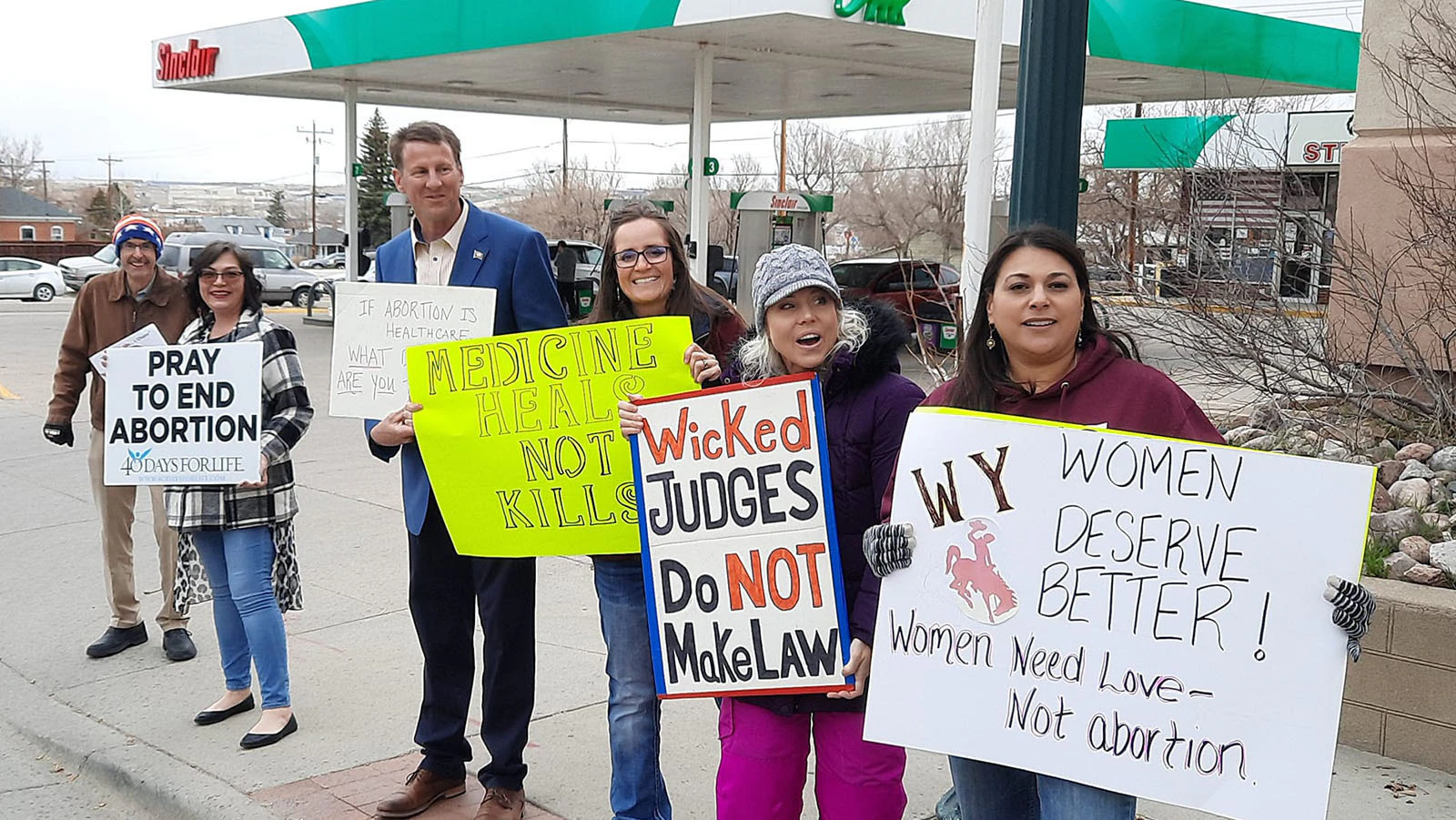
A retired Wyoming judge on Friday struck down three state-level abortion restrictions.
One would have required abortion clinics to be licensed as surgical centers and that abortionists to have admitting privileges at a hospital within 10 miles of the clinic. Another would have required women have an ultrasound 48 hours before taking abortion drugs.
The third law took on the abortion issue from a backward angle: it was a response to the COVID-19 era, when at least one Wyoming doctor reportedly suffered professional consequences for prescribing off-label drugs to treat COVID.
The Legislature in 2025 gave protections to doctors prescribing drugs off-label, but carved out abortion drugs so that medical professionals prescribing off-label abortion drugs wouldn’t enjoy those protections.
None of these laws survive the Wyoming Constitution’s call for health care autonomy, ruled District Court Judge Thomas Campbell, who was called to return to the bench in 2025 and oversee this case in place of any regularly-seated Natrona County District Court Judge.
The difference between retired judges recalled to service and seated district court judges in Wyoming is that seated judges face retention elections every six years.
Campbell’s Friday order gave summary judgment — which is a pre-trial win — to the pro-choice coalition suing the state.
The judge said the pro-choice group provided evidence “that abortion is inherently safe.”
The ‘Johnson’ Ruling
Campbell’s order relies on the Jan. 6 ruling by the Wyoming Supreme Court, called the “Johnson” ruling.
That ruling struck down two laws that together banned nearly all abortions, but had exemptions for medical emergencies, rape, and incest.
The Johnson case, a landmark ruling in Wyoming, declares that abortion access is a fundamental health care right under the Constitution’s health care clause.
To overcome that right, the state would have to survive the most rigorous standard in constitutional law and show it has a compelling interest to restrict the right, and that its restrictions are both capable of achieving that interest and narrowly tailored to do so.
According to Campbell, Wyoming didn’t bring adequate evidence to show it needs these abortion restrictions. The judge blocked all three laws, permanently, from being enforced.
“In these instances, the Court agrees with the (pro-choice group) Plaintiffs’ characterization that these laws ‘are solutions in need of a problem,’” wrote Campbell in the order.
The Wyoming Attorney General’s Office had argued that the ultrasound requirement would help protect women who don’t know they have ectopic pregnancies and take abortion drugs, risking ruptures and other serious conditions.
Campbell said the study the state brought as evidence was inadequate because there were anachronisms in the evidence.
Wait 48 Hours
As for the 48-hour waiting period, wrote Campbell, “the State cites no empirical evidence regarding the propriety of a waiting period.”
The AG’s office had argued, conversely, that the waiting period would help a woman consider the accuracy of her ultrasound and whether she wants a second opinion on it.
The state had defended the law requiring clinics to meet surgical center requirements by noting that it would tether abortion clinics to cleanliness standards in the associated Wyoming Department of Health rules.
But the state failed to show that the abortion clinic isn’t already meeting cleanliness standards, Campbell parried.
“Thus, the Court cannot conclude this concern is justified,” wrote Campbell. “Instead, the harm remains speculative.”
Regarding the law’s requirement for admitting privileges, the state had argued that abortionists should be linked with a nearby hospital because otherwise, they could simply send harmed women to an emergency room and dodge accountability for botched surgeries.
Campbell called that allegation conclusory, and said the state offered no evidence “regarding the prevalence of such an event.”
Campbell also maintained that the carveout under Wyoming’s off-label protection law acted like a harm to those prescribing chemical abortions.
“As the Plaintiffs aptly note, mifepristone and misoprostol are the most common medications prescribed for a chemical abortion,” Campbell wrote, “the combination of which is considered an ‘off-label indication’ for the drugs.”
By excluding them from protections, the carveout would have greenlit consequences for chemical abortion providers, Campbell concluded.
And The Next Rodeo
Wyoming has been defending its many abortion bans and restrictions from roughly the same pro-choice coalition since the U.S. Supreme Court overturned Roe v. Wade and made the issue a state-level policy decision in 2022.
Even after the Johnson case and Friday's ruling, the battle continues.
The Legislature passed the Human Heartbeat Act in its most recent lawmaking session, banning abortions generally after the point in gestation at which a fetal heartbeat can be heard, about six weeks.
Natrona County District Court Judge Dan Forgey temporarily blocked that law in April. The case against it is ongoing. Forgey is a sitting judge.
Wyoming Attorney General Keith Kautz has pronounced an intention, in a court hearing, to bring evidence that the state is justified in banning abortion.
Gov. Mark Gordon has urged the Wyoming Legislature to advance to the voters a constitutional amendment so that the Legislature can restrict or ban abortions. The Legislature did not do that, instead passing more legislation this year.
Clair McFarland can be reached at clair@cowboystatedaily.com.


