
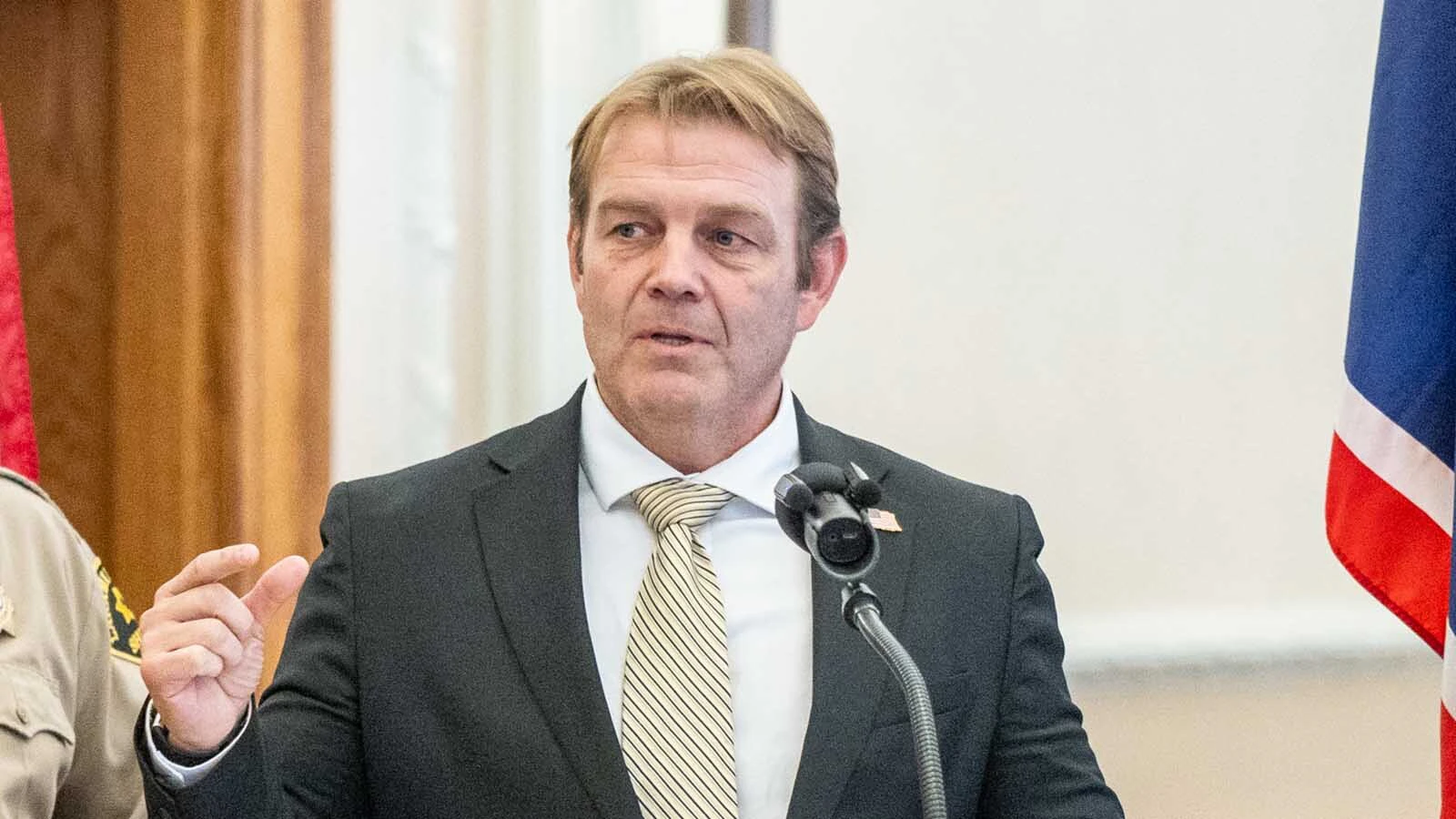
The U.S. Senate majority voted 46-43 Monday to confirm Darin Smith as Wyoming’s top federal prosecutor for the next four years, among a slate of other Trump-backed nominees for federal offices.
The Senate’s approval comes four days after all three sitting judges of the U.S. District Court for Wyoming dismissed nine felony cases, citing “flagrant” misconduct by Smith that prejudiced nine defendants.
One of those cases contained a first-degree murder charge.
Smith had ingratiated himself with grand jurors at an indictment proceeding in March, had called prospective defendants “murderers,” and “bad people,” and called the cases “slam dunks,” court documents say.
The judges dismissed the cases “without prejudice,” meaning the government can bring charges again, and they’ve paused their order until Wednesday to give Smith’s office time to appeal.
But defense attorneys on the cases are urging the judges to reconsider and dismiss the cases altogether, saying, “this Court retains the inherent supervisory power to dismiss an indictment with prejudice when prosecutorial misconduct is flagrant, widespread, or continuous.”
Wyoming’s two Republican U.S. Sens. John Barrasso and Cynthia Lummis both voted in Smith’s favor.
Lummis' senior communications advisor Joe Jackson told Cowboy State Daily on Monday that Lummis "appreciates him stepping up to serve in this important role."
Barrasso's communications director Laura Mengelkamp pointed to Barrasso's past statements on Smith.
Barrasso, Lummis and U.S. Rep. Harriet Hageman all had praised the Trump administration's nomination of Smith last July. Barrasso said at the time, "Darin Smith is ready and well-qualified to serve as Wyoming’s chief federal law enforcement officer" and a “conservative choice."
Smith told Cowboy State Daily he's "deeply honored and grateful" the Senate has confirmed him to serve as Wyoming's U.S. Attorney.
"Wyoming is a state defined by its rugged independence, strong communities, and steadfast respect for the rule of law," he said in a Monday text message. "To be entrusted with representing the people of this great district and the United States of America in the pursuit of justice, is a responsibility I do not take lightly."
Smith thanked Trump, Barrasso and Lummis, and "the dedicated men and women of this office whose tireless work protects the safety and rights of every Wyoming resident."
The Exodus
Five attorneys have left or are leaving the office since Smith began working as interim U.S. Attorney last August, the office spokeswoman Lori Hogan confirmed Monday following a Cowboy State Daily email inquiry.
U.S. attorney Nicole Romine, assistant U.S. attorney Jasmine Peters, criminal assistant U.S. attorney Ariel Calmes, criminal assistant U.S. attorney Paige Hammer have left the office within the past month.
Jeremy Gross, a civil assistant U.S. attorney, is expected to leave in June, Hogan noted.
Of the exodus, Smith said, "There's always going to be some turnover in a large office like ours. We are a top-tier district by every metric, and we're improving every week."
He added: "Our office has a deep bench of capable attorneys ready to handle anything thrown our way."
Tribes’ Prosecutor
Monday’s vote unfolded quietly, though Senate Minority Whip Dick Durbin, D-Illinois, voiced objections last week and in December over Smith’s presence at the Jan. 6, 2021, U.S. Capitol breach.
Durbin had told the Senate Judiciary in a scathing speech last December that Smith had not served before grand juries prior.
One of the two groups currently claiming executive branch authority over the Eastern Shoshone Tribe issued a statement Monday morning opposing Smith’s confirmation.
The Northern Arapaho Business Council, which is the executive branch of the Northern Arapaho Tribe, had also opposed Smith’s confirmation in a statement last week.
“The Tribe finds these actions deeply troubling and inconsistent with the solemn responsibility entrusted to the United States Attorney’s Office,” the statement says. “The stakes on the Wind River Reservation are far too high for carelessness.”
The Northern Arapaho and Eastern Shoshone tribes are both headquartered on the Wind River Indian Reservation in central Wyoming.
While counties throughout Wyoming elect their prosecutors locally, tribal members implicated in felony crimes on the reservation are prosecuted, generally, by the Wyoming-based U.S. Attorney.
That means the president, not the people, chooses the top prosecutor of tribal members implicated in felonies on the reservation generally.
“The people of the Wind River Reservation deserve better,” says the NABC’s statement.
All The Background
Defense attorneys in late April and early May filed at least 10 motions to dismiss various indictments in felony cases ranging from unlawful firearm possession to child pornography charges to murder, saying Smith had spoiled the grand jury proceedings with inappropriate comments.
Wyoming-based U.S. District Court Chief Judge Kelly Rankin, and Judges Alan B. Johnson and Scott Skavdahl agreed with the defense attorneys in a Friday order.
Smith’s statements “cannot be downplayed as ‘perhaps overly informal and friendly’ conversation,” says the judges’ order. “They were inflammatory and inappropriate. … And, until proven guilty, they are incorrect.”
Smith had, according to court documents, referred to the defendants as “murderers” and “bad people,” had called the cases “slam dunks.” He had also spoken with grand jurors and had handed out his business card to jurors before the judge entered the room.
The U.S. Attorney’s Office on May 8 had argued that Smith’s comments were “ill-advised” but didn’t rise to the level of prejudicing the defendants.
The judges disagreed.
“This is not a case where a few off-hand statements were improperly sprinkled throughout the presentation of evidence in one defendant’s case,” says the order. “This misconduct began with some of the first words spoken to the grand jurors by the U.S. Attorney.”
By providing “the business card of a high-ranking government official” and inviting the grand jurors to reach out to him, Smith “appears to curry favor with the grand jurors,” says the order. The prosecutor shouldn’t be seeking to speak with grand jurors outside of court anyway, it adds.
Prosecutors can’t add a “false aura” to the government’s case, such as calling all the defendants murderers, wrote the judges.
Only one of the defendants, Jose Ocon, was facing a murder charge.
Grand juries are gatekeepers tasked with deciding whether the government has probable cause to start prosecuting people. They’re not an arm of the federal government, but an independent entity.
Though the judge overseeing the grand jury proceedings educated the grand jury to this end, it wasn’t enough to cure Smith’s statements, the order says.
Citing rules of conduct like a mandate for “candor” in court, Smith’s office had, while arguing on his behalf, felt it necessary to disclose some of Smith’s interactions with grand jurors that the defense attorneys had not raised.
“The misconduct continued to permeate the proceedings in the off-record conversations, occurring on the breaks between indictments,” the judges wrote. “This is deeply concerning.”
Why Not Permanently?
Shortly after the three judges’ order, defense attorneys filed motions for reconsideration, saying their cases should have been dismissed “with prejudice,” meaning permanently so they couldn’t be brought again — or the whole office should be disqualified from representing the second round of these cases’ prosecution if they’re brought again. They also said Smith should be disciplined.
The motions lament that the defense attorneys did not get the chance to reply to the government’s points before the judges filed their order.
“Consequently, the Court’s Order did not address the government’s institutional suppression of misconduct, nor did it address the necessary secondary sanctions required if the government is permitted to re-present this case,” reads a defense filing.
By letting the government start over with a new grand jury in all the cases, the outcome “inadvertently rewards the United States Attorney’s Office for an institutional cover-up,” says the filing.
Dismissing the cases altogether is a drastic remedy, the filing concedes. But, the defense wrote, it’s “required here because the misconduct was not an isolated lapse in judgment by a single attorney; it metastasized into systemic, institutional failure by the United States Attorney’s Office.”
Multiple attorneys knew about the misconduct as early as March and did not notify the court of its disclosures until May 8, the filing says.
The Cases
The indictments dismissed are for:
• Jose Benito Ocon, who was accused of fatally shooting a man in the head “without provocation” in a vehicle before pointing a gun at two women who were also in the vehicle.
• Brian Johnson, who was accused of possessing a pistol despite being a felon, and whom court documents say pointed a pistol at a Riverton Police Department officer in February while police responded to a report of a male assaulting two females.
• Dennison Antelope, who was accused of possessing a gun despite being a felon.
• Wolf Elkins Duran, who was accused of keeping child pornography of prepubescent children and bestiality on his phone.
• Matthew Miller Jr, who was accused of possessing and intending to distribute drugs.
• Cheyenne Swett, who was accused of possessing guns despite being a felon, which police say they discovered after Swett shot himself in the abdomen.
• Michael Hopper, who was accused of possessing pistols despite being a felon.
• Mathew Jacoby, who was accused of possessing and intending to distribute a “burrito” like package of meth.
• Richard Allen, who was accused of possessing a short-barreled rifle that was not registered to him, and despite being a convicted felon.
This story has been updated to include post-publication comments.
Clair McFarland can be reached at clair@cowboystatedaily.com.


