

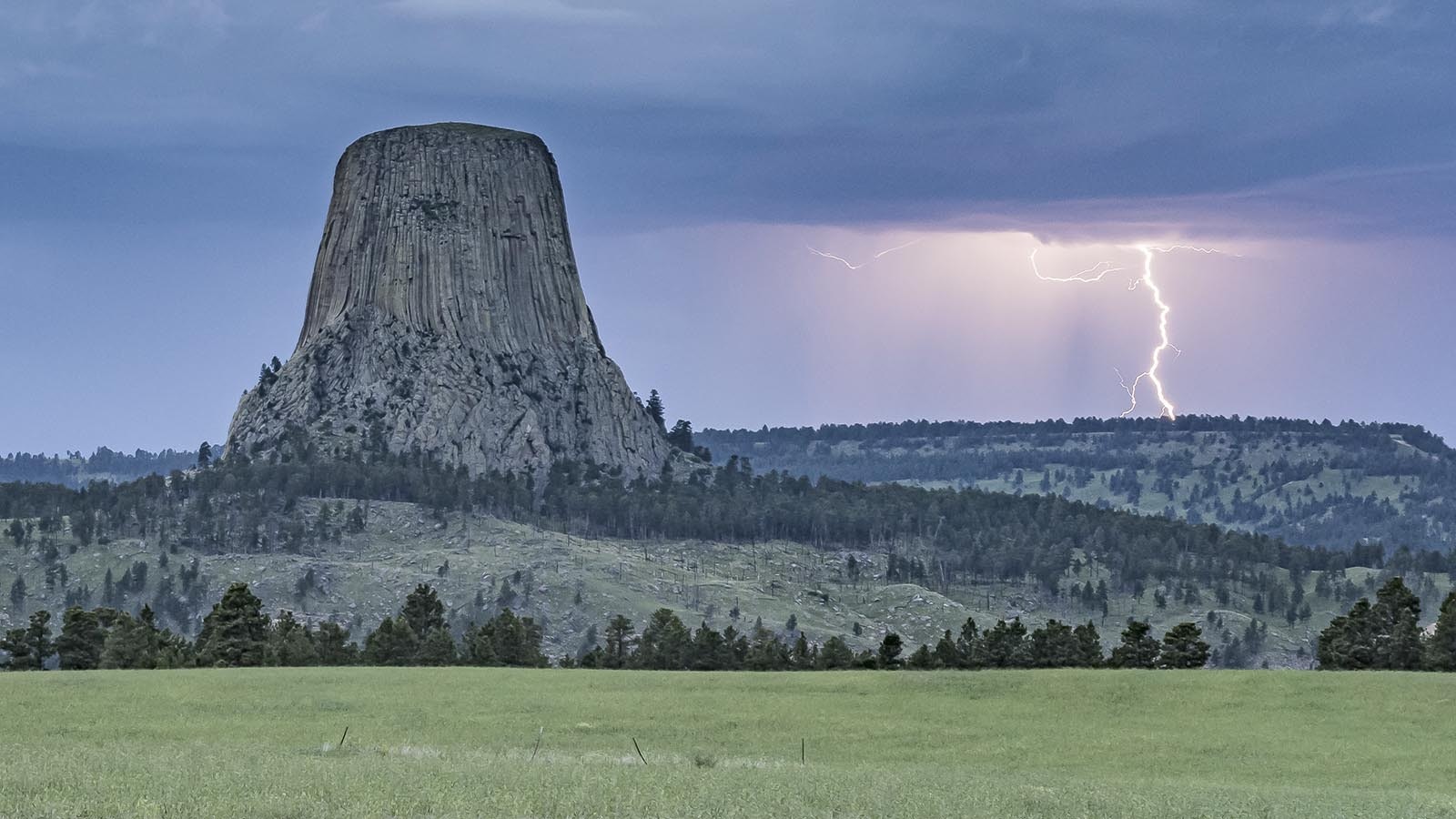
Wyoming’s winds are so strong, they actually move Devils Tower.
The nation’s first national monument has been swaying back and forth for millions of years — and it’s moving right now.
New research published by the Geological Society of America has revealed that Wyoming’s iconic Devils Tower is constantly moving.
An international team of geologists studied the massive monolith and determined that it's perpetually and ever-so-slightly swaying, twisting, and turning in the wind.
“It’s not only a static rock structure, millions of years in the making,” said Jeffrey Moore, a professor of geology and geophysics at the University of Utah and lead author of the new study. “It is moving on human timescales. It's constantly in motion.”
Solid As A Rock
Devils Tower is a giant, eroded plug of volcanic rock. It was an intrusive body of magma that cooled under the surface and was gradually exposed by millions of years of erosion.
When most people see Devils Tower, they assume it’s as solid as a rock. Moore’s research shows that it isn’t entirely true.
“It’s lively with vibrational energy,” Moore said. “You can't see it, feel it, hear it, or anything, but it's nonetheless very real. It’s happened right this very second.”
Moore and his colleagues studied Devils Tower using ambient vibration modal analysis techniques.
It’s a way of analyzing the ambient vibrations moving through solid rock forms, identifying the mode of those vibrations, and determining the extent and nature of movement they cause.
“It’s similar to playing a note on a piano,” Moore said. “If you looked at the sound wave of that, it wouldn't look like much, but if you looked at the frequency, it would tell you quite a lot about the frequencies of what you’re hearing. That’s what we did at Devils Tower.”
To conduct the study, the team placed two sensors at the base of Devils Tower and a seismometer at its 867-foot summit.
Kathryn Vollinger, another author of the study, was tasked with climbing Devils Tower twice in two days to set up and remove the seismometer at the top.
“She hauled it up, set it there, left it overnight, and climbed up the next morning to take it down,” Moore said. “All done with a permit from the National Park Service, of course.”
The data collected by the sensors revealed a lot about the movement of Devils Tower. It’s not just a once-in-a-while phenomenon, but an everyday occurrence.
“It’s constantly in motion,” Moore said.
Twist And Turn, Back And Forth
Different movements have different frequencies. By analyzing the frequencies collected by the sensors, Moore and his colleagues determined how Devils Tower moves.
“We were able to discern the three modes of vibration,” Moore said. “The first two modes are what we might call full-height swinging, as it sways in one direction and then back in the other direction.”
Unnaturally tall, narrow objects do this.
It’s a physical force that constantly acts on skyscrapers, forcing architects to design and use the proper materials so their hundred-story buildings can safely sway with the wind.
The third mode of vibration Moore found was a torsional mode. That means Devils Tower twists on its vertical axis, around and back, and not just back and forth.
“That’s a rather interesting one, but again, something that's relatively common for tall buildings,” Moore said.
So, on an average day, Devils Tower is swaying and twisting back and forth.
And what are the forces causing that movement? Wind and seismic activity.
Moore said Wyoming’s wind was particularly impactful on Devils Tower.
“When it was windier, the amplitudes of movement were higher, but the frequencies were the same,” he said.
Seismic activity was a smaller factor, but one that was easily distinguished and had an impact, according to the data collected. Moore said there is enough seismic activity to keep Devils Tower moving even on the rare windless day.
“There’s enough seismic energy to keep the tower in constant motion,” he said. “On a windy day, it's going to sway stronger, but it's still in motion on a calm day. It's just very, very subtle.”
In this case, the subtlety is definitely in the details.
Never Blink And You’ll Miss It
If Devils Tower is constantly in motion, could it eventually twist or sway enough to partially or fully collapse? Could the nation’s first national monument send itself to hell?
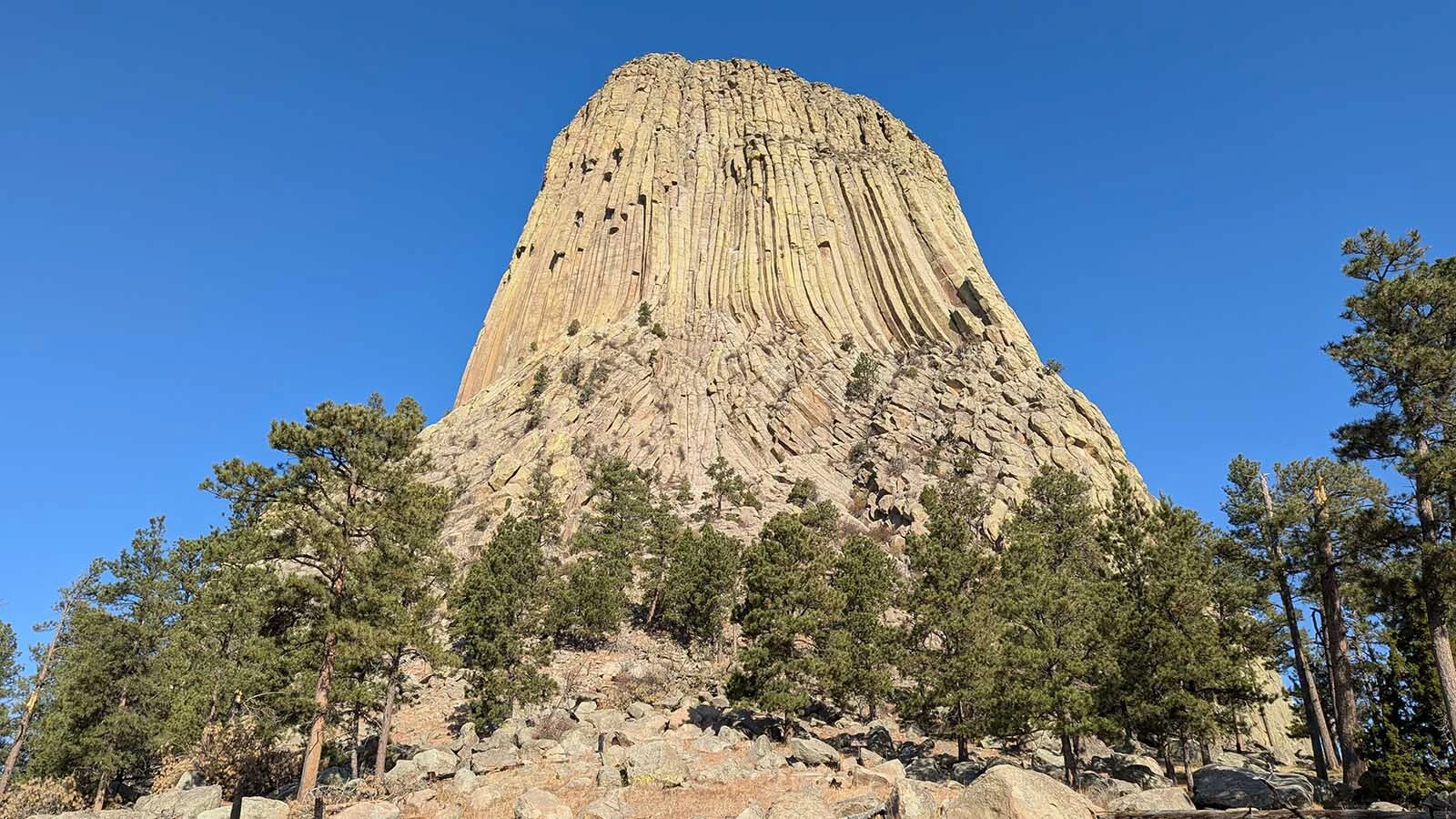
Unlikely, said Moore. While the tower is constantly in motion, that motion is so minuscule that it’s barely noticeable.
“The movements are very, very small,” he said. “They’re on the order of a micrometer. That's a thousandth of a millimeter, and a millionth of a meter. It’s easily measurable on modern seismographs, but not to the human eye.
Someone could stare at the constantly moving Devils Tower all day and not see a thing. If someone pointed a time-lapse at the tower for 100 years, it would appear to remain motionless.
The difference between Devils Tower and Dubai’s Burj Khalifa, now the tallest building in the world at 2,717 feet, is that Devils Tower is solid. That’s why the swaying and twisting of skyscrapers is noticeable and much more intense.
“Tall buildings are mostly hollow steel structures, so they sway enough that people feel ill,” Moore said. “Devils Tower is solid throughout, so its movements are very small.”
It’s also important to note that while Devils Tower constantly moves, technically it isn’t moving.
While the tower itself is swaying, twisting, and turning on a daily basis, it isn’t migrating across the landscape like the Yellowstone or Hawaiian hotspots. The volcanic activity that created Devils Tower ended a long time ago and shows no signs of reawakening.
But what about the worst-case scenario? Moore and his colleagues have that covered.

A Future In Modeling
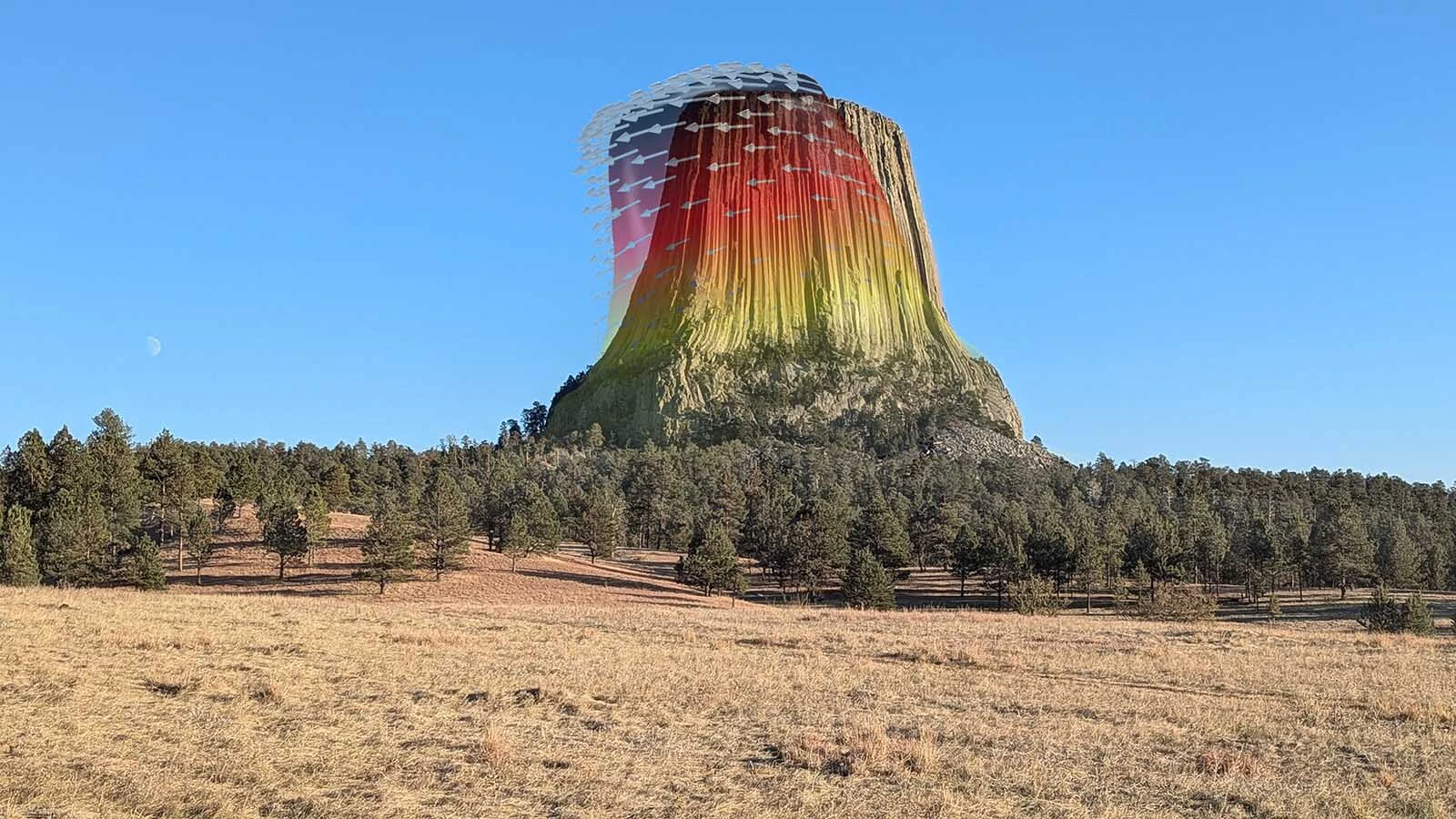
As part of their research, the team created models of Devils Tower’s structural dynamics. They used their data to create predicted resonance models visualizing its constant directional movement to the extreme.
“These are very exaggerated deformation shapes,” Moore said. “They're exaggerated so you can see the motion, and how it's bending, swaying, and twisting.”
The models are a little alarming, showing a much more precarious Devils Tower leaning to-and-fro to an extent that would make anyone scared of an imminent collapse.
However, these are not predictive models. Nobody’s saying Devils Tower can or ever would reach these extremes.
The volcanic activity that created Devils Tower ended millions of years ago.
Today, northeast Wyoming is far from any active seismic faults that could create enough force to twist the tower out of shape or cause a collapse.
Like all geologic wonders, Devils Tower will be worn down by wind, water, and erosion over a prolonged period. Its daily micrometers of swaying, twisting, and turning are not a cause of concern.
“These animations help us understand how it might move if there were a big earthquake,” Moore said. “There isn’t any sort of risk associated with these movements that I know of, and I don’t even know that there could be.”

Twist And Shout
Devils Tower is the latest geologic wonder that Moore has studied using ambient vibration modal analysis. He’s done similar studies on Utah’s famous rock arches and the Matterhorn in the Swiss Alps.
The scientific justification for these projects is using the ambient movement of geologic landforms to determine their composition and study how their properties change over time.
“It’s called structural health monitoring,” Moore said. “What we've shown is that by placing a seismometer on top of a geologic landform for a few hours, you can derive the key structural and mechanical properties of the materials and then compare those to other materials across the world.”
Structural health monitoring can help identify the effects of cracks on famous landforms and how geologic composition may lead to future failures that could affect people.
There’s nothing to worry about at Devils Tower. According to Moore, another fact they confirmed during their research is that the monolith is “pretty monolithic.”
“In some cases, we find important impacts of cracks and other structural additions, but that’s not super prominent at Devils Tower,” he said. “Based on its rock properties, it’s pretty solid.”
Moore hopes his work will reignite interest in Devils Tower and its unique geology.
At the very least, people who visit the iconic Wyoming landmark will know that the seemingly still, immovable object looming above them is actually constantly in motion.
“Hopefully, we’re adding a new layer to the way that people can appreciate Devils Tower,” he said. “It’s an unexpected layer of interest. The motion is very, very tiny, but it’s constantly in motion. It’s alive.”
Andrew Rossi can be reached at arossi@cowboystatedaily.com.


