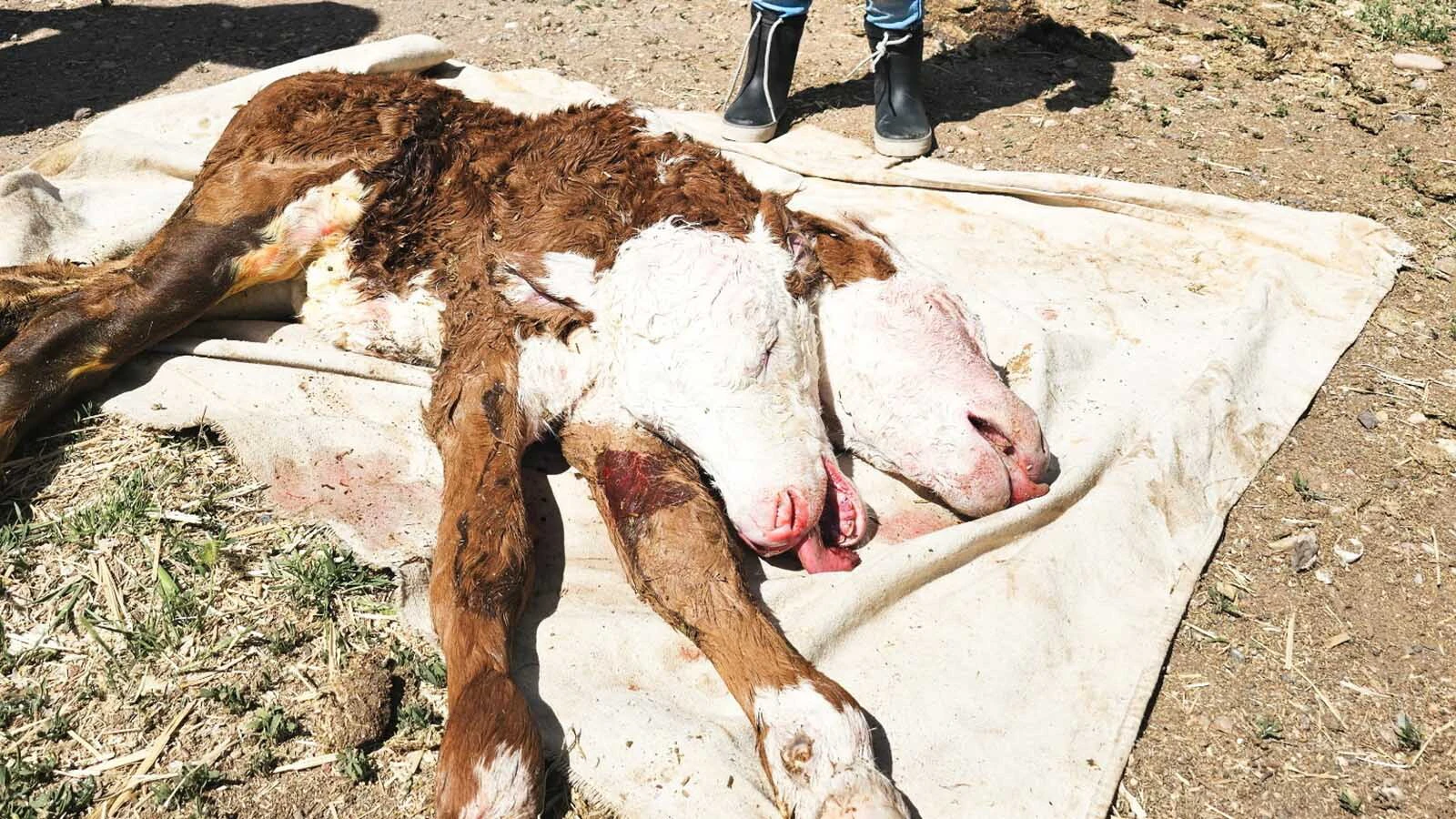
A Utah ranch in the peak of calving season saw something that’s never happened before in the nearly 155 years its been raising cattle — the birth of a two-headed calf.
Dry Lakes Ranch near Parowan, Utah, was busy with calving season Friday when one of its pregnant cows went into labor, but it was anything but textbook.
After hours of stalled labor, rancher Kacie Carballo said her husband stepped in, realizing something wasn’t right.
At first, they thought they were dealing with twins because of the two heads. Instead, it was one calf with two heads and two necks — the kind of abnormal width that makes a natural delivery nearly impossible, she said.
Still, they managed.
Her husband, Carballo said, is “well known in the area for animals and about as good as any vet,” and with careful handling, they pulled the calf.
It was stillborn, but the cow survived.
“She’s doing good,” Carballo said, adding that she’s walking, eating and drinking — “a little trauma,” but alive.
Carballo describes the once-in-millions moment as “a blessing.”
‘A Freak Accident’
She sees the two-headed calf as more than a rare defect, and something that can teach people about individuality and how things don’t always come out the way you expect.
“Have you ever heard that old 1970’s poem about the two-headed calf?” she asked.
She is talking about the one by Laura Gilpen that goes: "Tomorrow when the farm boys find this freak of nature, they will wrap his body in newspaper and carry him to the museum …"
This is the first time the Carballos have seen anything like it during calving season. Carballo believes it was “just a freak accident at the cellular level. It should’ve been twins, but the egg didn’t fully split.
“Some people say these deformities happen when cows eat a bad plant,” she continued. “But we take land stewardship very seriously. We make sure we know what kind of grass and plant community our cattle are grazing, and we don’t think it was that.”
Instead of burying the calf, the family is donating the skeleton and organs to science so researchers can study the rarity, but they’re keeping the hide.
Carballo said she’s going to have the calf taxidermied — though she’s not sure where to put it just yet. The family owns a boutique named after the ranch, Dry Lakes Beef, in the heart of their small town.
“I might put it there,” she said. “But the retailer in me is unsure about whether people would like it or not.”
For now, the feeling is still a mix of shock and gratitude — that something this rare happened on their ranch, a place with roots stretching back to the 1870s.
‘Too Many Legs’
“Birth abnormalities are common, but a two-headed calf is not,” said Heath Hornecker, an agriculture instructor at Casper College.
He said he’s only ever seen similar cases in a museum.
For some Wyoming ranchers, though, hearing about the ultra-rare birth of a two-headed calf hits closer to home.
Multi-generational ranchers Gene and Shona Siems remember the day they ran into something just as strange in the early 2000s outside of Daniel, Wyoming.
“It was our old milk cow,” Shona said. “The calf looked like the old push-me, pull-you creature from 'Doctor Dolittle.' It had a head on each end and a butt coming out the middle.”
Their veterinarian at the time, Vern Aultman, hadn’t seen anything like it either.
“When he got there, he said, ‘There’s too many legs,’” Shona recalled.
That calf couldn’t be delivered naturally, and Aultman had to perform a cesarean section to save the cow.
“This was before anybody carried cellphones around,” Shona said. “I wish I’d taken a picture.”
The calf lived for about 30 minutes, but the cow lived a lot longer.
“We sewed her back up and she kept being the milk cow,” Shona said.
After more than 50 years in ranching, the Siems say it’s the only case like it they’ve ever seen — before or since.
It’s also something the lifetime ranchers will never forget.
A Big Piney veterinarian said he's seen about a half a dozen in his 40-year career.
"Once every five to 10 years or so," said Bob Beiermann.
A couple years ago he saw a "primo one" that was born alive and unassisted. He said it had two fully functional heads, but "it had a balance problem" and could not stand.
That calf belonged to ranchers Bob and Mike Beard.
Back in Utah, the calf delivered at Dry Lakes Ranch had one fully formed body that split at the shoulders into two necks and heads, with no other visible deformities.
Instead of quietly burying what happened, the Carballos are preserving it — turning a one-in-millions moment into something that might actually teach people something.
For ranchers, it’s a reminder that even in the most routine, muscle-memory parts of the job, the unexpected can still show up without warning.
Kolby Fedore can be reached at kolby@cowboystatedaily.com.