
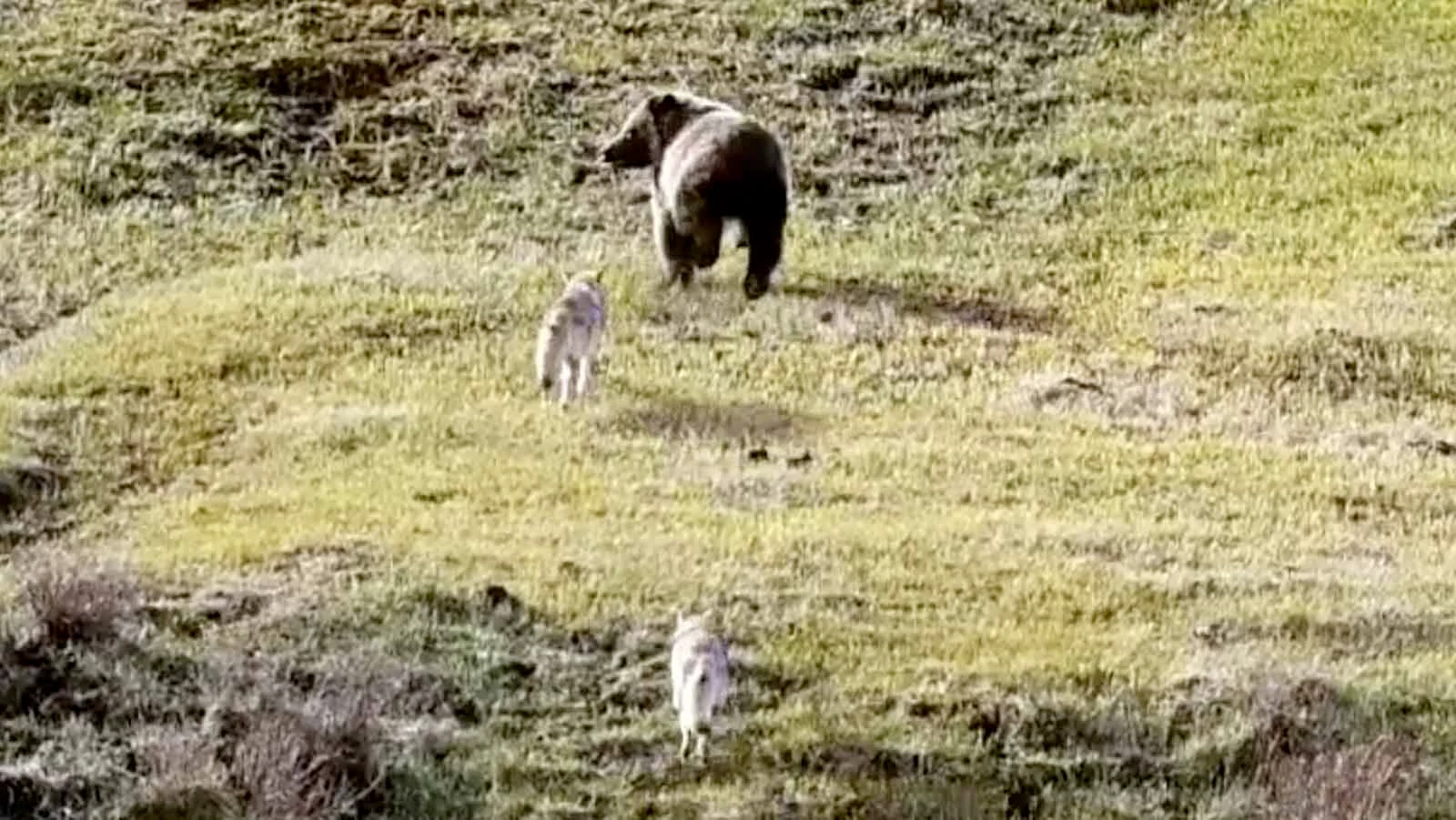
When it comes to protective parental instincts in nature, size doesn’t matter, as demonstrated by a pair of Yellowstone coyotes who chased off a grizzly that apparently got too close to their den of pups.
The grizzly, likely a young and inexperienced bear, initially pivoted and tried to chase one of the coyotes that came after it. But when the second coyote came barreling in, the grizzly turned tail, fled up a hill and didn’t come back.
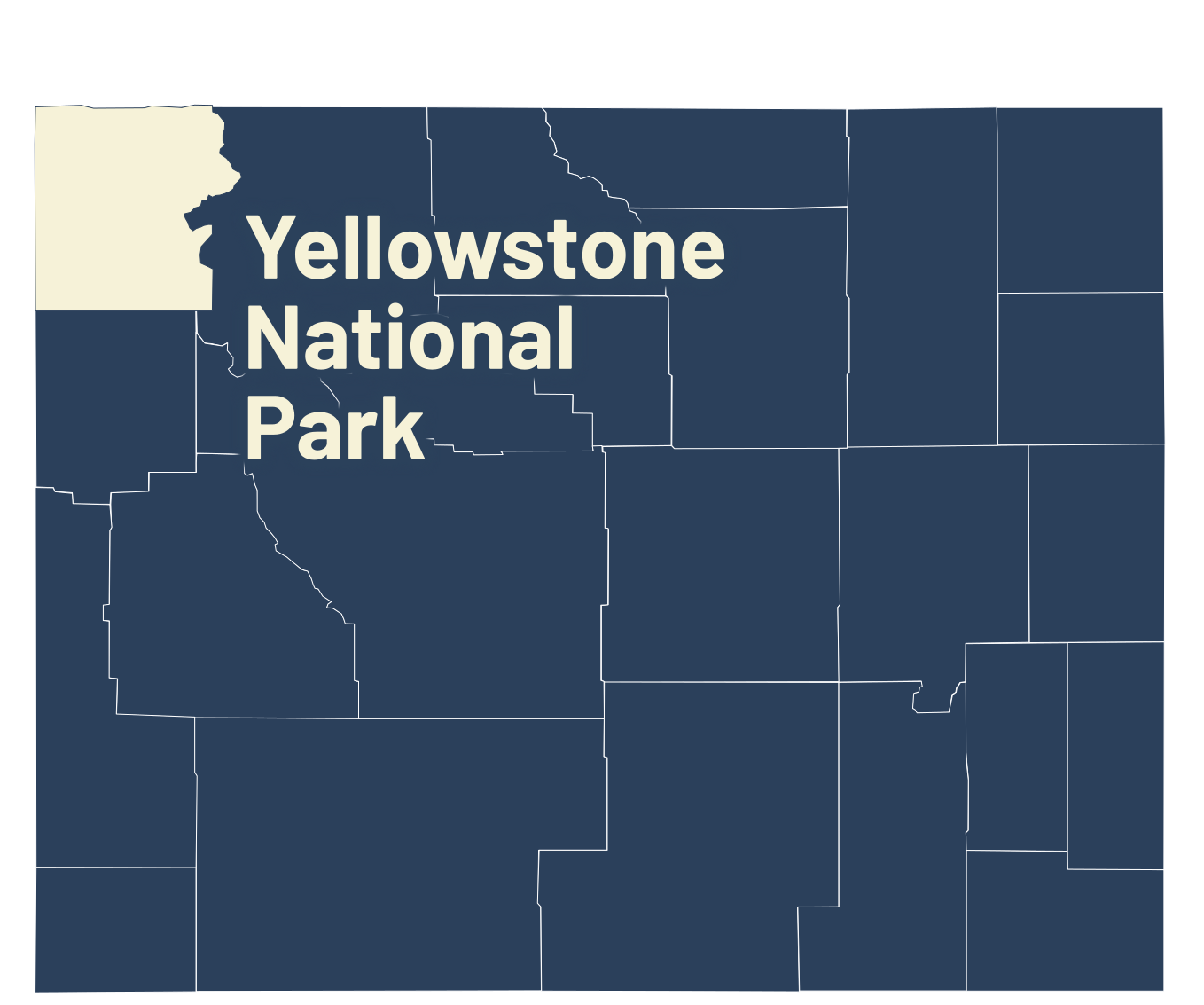
None of the animals made contact with each other during the brief, dramatic encounter at Blacktail Ponds in Yellowstone National Park.
‘Pretty Ballsy’
It was probably a classic example of coyotes protecting their young, retired wildlife biologist Franz Camenzind told Cowboy State Daily.
Normally, even a pack of coyotes wouldn’t be a match for a healthy adult grizzly. But that didn’t seem to matter to these coyotes when their pups were threatened.
“They’d be aggressive” if their pups were at stake, said Camenzind, who studied coyote behavior in and around the National Elk Refuge near Jackson.
“Normally, they wouldn’t do that (go after a grizzly), but there’s the motivation of protecting young,” he said.
“It’s pretty ballsy of them,” he added.
Wildlife photographer Mark Fletcher took video of the encounter on April 25. He told Cowboy State Daily that he didn’t see any coyote pups.
But he surmised that protecting a den of pups would be the one thing that would prompt coyotes to risk getting torn up by a grizzly.
Camenzind said that tracks with coyote biology and behavior.
Coyote pups are usually born in April, and mated pairs — or even groups of adults — will guard dens, he said.
Wildlife Jam
Fletcher has been a professional photographer for 40 years and has photographed wildlife all over the world.
He said he’s never seen anything quite as bold as those little coyotes chasing off a grizzly.
During his latest trip to Yellowstone, he was driving on his way out of the park toward Gardiner, Montana, when he saw several vehicles stopping and pulling over ahead of him, a typical wildlife traffic jam.
He drove past those cars and into a pullout at Blacktail Ponds.
The Blacktail Ponds are a busy place this time of year. Herds of bison pass through as they move between their winter and summer range.
And every year, a few unlucky bison get trapped in thick mud under the ponds and drown. Their carcasses attract scavengers and carnivores, including grizzlies.
Fletcher said he immediately spotted the grizzly, which he figured to be a young bear, just striking out on its own.
“I just jumped in the back of the pickup and used that to brace my camera,” so he could photograph the bear through a 600 mm telephoto lens.
“All of the sudden, the bear started running, and I switched my camera over to video,” he said.
That’s when he saw the coyotes come zipping in, and he caught the chase on video.
It was a matter of being in the right place at just the right time, he said.
“I’ve never seen anything that brave,” he said of the coyotes’ actions.
He didn’t see a carcass nearby. He also figured there was no way the coyotes would have been that bold over just a carcass, so they must have had pups somewhere close.
After running the bear off, “the coyotes just calmly walked back down the hill,” Fletcher said.
Communal Parenting
Coyotes are good parents and caregivers to their young, Camenzind said. A mated pair will take care of their pups together.
“The male will go out and do most of the hunting,” while the female is nursing very young pups, he said.
Across most of Wyoming, coyotes can be legally hunted any time of year, so people might be used to seeing them only alone, or perhaps in pairs.
“Coyotes can make it as just a pair, whereas that’s really difficult for wolves,” Camenzind said.
That’s because wolves rely primarily on large prey animals that take an entire pack to hunt. Coyotes can get by on a huge variety of food, including grasshoppers and the like, he said.
In places like Yellowstone where they’re protected, coyotes will form groups or packs, not unlike wolves.
Sometimes more than one female in the pack will have pups, and the entire group will pitch in to help, he said.
Once the pups get big enough to eat meat, the adults go out to hunt or find carrion to bring back to the den to feed them, he said.
Mark Heinz can be reached at mark@cowboystatedaily.com.


