
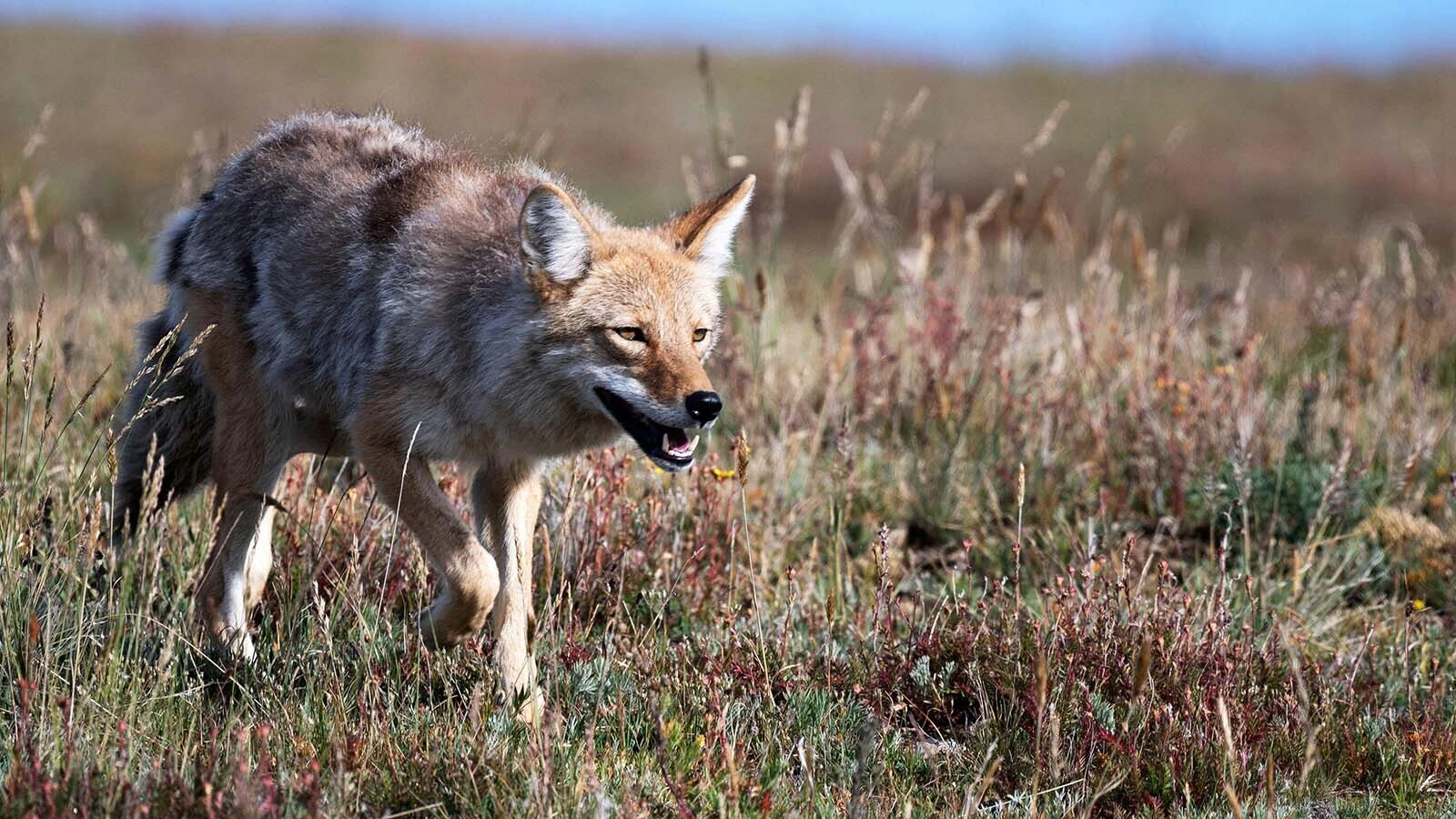
After being banned on public land for roughly three years, spring-loaded M-44 cyanide bombs for killing coyotes might make a comeback in Wyoming and other Western states.
That could be good news for ranchers who want to protect livestock during lambing and calving seasons, but others worry that M-44s could kill dogs and other unsuspecting animals.
An M-44 is a cylindrical device with a ground spike at one end.
It's left nearly buried with bait exposed on the top. When an animal bites the bait, it activates an ejector spring, releasing a burst of sodium cyanide into the animal’s mouth.
The Biden administration banned the use of M-44s on Bureau of Land Management land in 2023.
They were still allowed on private property, although some states were considering banning them altogether, including California, Idaho and Oregon.
In April, the Trump administration issued a memorandum of understanding clearing the way for M-44s to be allowed again on BLM land, including in Wyoming.

A Tool For Protecting Livestock
Wyoming sheep rancher Jim Magagna told Cowboy State Daily that “it’s definitely a good thing” that M-44s might once again be allowed on BLM land.
“That was a significant loss to predator control when they were prevented (in 2023),” he said. “They’re not going to solve all of the problems with predation, but they’re one significant tool.
“We need all of the tools that we can have.”
Controlling predators becomes vital for ranchers in the spring when livestock animals are having lambs and calves, he said. Coyotes are drawn in by the easy pickings.
State and county predator control agents can shoot coyotes from aircraft, but that entails high fuel costs, Magagna said.
“And an airplane is not there every day,” he added.
M-44s are on the landscape around the clock every day, providing another layer of protection for livestock, he said.
However, Magagna noted that the devices shouldn’t be indiscriminately placed all over the landscape and there should be warning signs posted in areas where they’re planted.
“If you have an area where there’s a significant amount of problems with predators,” M-44s might be the answer, he said.
“You have to place them where they can do the most good and present the least amount of danger to the public,” Magagna said.
Worried About Dogs
Casper Humane Society animal shelter manager Johnnie Ramirez told Cowboy State Daily that she’s not pleased about M-44s possibly making a comeback.
“Ultimately, my opinion is they are indiscriminate,” and can pose a threat to dogs and other animals besides the predators M-44s are supposed to target, she said.
“It just takes your pet catching the scent of that bait, going up to it and trying to bite it for it to be triggered,” she said.
“There have been instances in the past where people have lost their pets or been injured,” Rameriz said.
One high-profile case in Idaho drove calls for a ban on M-44s in that state.
On March 16, 2017, Canyon Mansfield, then 14, was near his rural Pocatello home with his yellow Labrador retriever, Kasey, when the dog found and triggered an M-44.
Mansfield was hurt and Kasey was killed.
The boy's mother, Theresa Mansfield, later told The Idaho Statesman that Canyon suffered lingering trauma and physical effects, such as headaches.
All For Coyote Control
Avid hunter and mule deer conservationist Zach Key of La Barge told Cowboy State Daily that he supports predator control.
“I speak specifically to that method (using M-44s). But I feel that predator control is important, even if some people want to pretend that it isn’t,” he said.
It’s vital to hit coyotes during that species’ breeding season, ahead of elk and deer herds having calves and fawns, he said.
Coyotes and black bears take a heavy toll on newborn calves and fawns, he said.
Key is one of the founders of the Wyoming Range Hunting and Fishing Expo conservation group.
That group recently sent $10,000 to the Lincoln County Predator Control Board to help fund coyote control in the area, Key said.
‘A Tool Of War’
Wyoming Wildlife Advocates Executive Director Kristin Combs told Cowboy State Daily that as she sees it, the risks of putting M-44s back on BLM land far outweigh the potential benefits.
“They are indiscriminate. They’ll kill anything that comes across them. There’s no way that anybody needs that to protect their livestock. There are other ways to do that,” she said.
“It’s cyanide. That’s a tool of war, not something that needs to be used to protect livestock,” Combs added.
She said that M-44s could pose a particular risk to bird-hunting dogs.
“They’re just asking for sporting dogs to get killed,” she said.
Mark Heinz can be reached at mark@cowboystatedaily.com.


